Knowledge Graph Re-engineering Along the Ontological Continuum (extended version)
Pith reviewed 2026-05-22 05:59 UTC · model grok-4.3
The pith
The ontological continuum organizes knowledge graph practices using two distinctions: semantics versus pragmatics and properties versus affordances.
A machine-rendered reading of the paper's core claim, the machinery that carries it, and where it could break.
Core claim
The paper introduces the ontological continuum as the missing conceptualisation for knowledge graph modeling, a theoretical construct whose characterisation framework is defined by two orthogonal distinctions—semantics versus pragmatics, and properties versus affordances—together supplying a vocabulary to describe, compare, navigate, and transform KGs across the full range of modelling practices. The methodological stance is empirical rather than prescriptive: the continuum seeks to define a theory of the existent derived from observation of real-world KG engineering practices, whose structure can be made formally explicit through methods such as Formal Concept Analysis. The vision is shown,
What carries the argument
The ontological continuum, a theoretical construct defined by the two orthogonal distinctions of semantics versus pragmatics and properties versus affordances that supplies a vocabulary for describing and transforming knowledge graphs.
If this is right
- Knowledge graph integration and reuse become less expensive and brittle when graphs can be compared and transformed along the continuum.
- Re-engineering of graphs to meet new requirements becomes more systematic in neuro-symbolic AI settings.
- Generative AI tools for knowledge graph adaptation gain a principled conceptual grounding instead of remaining unguided.
- Formal Concept Analysis can be used to make the structure of observed practices explicit and computable.
- Five open research challenges are set out for the community to develop the continuum further.
Where Pith is reading between the lines
- The framework could support empirical classification studies that map large repositories of existing knowledge graphs onto the continuum.
- Similar continua might be constructed for other structured data representations that face comparable integration problems.
- Automated tools could be developed to detect a graph's position on the continuum and suggest minimal transformations to a target position.
Load-bearing premise
The two distinctions between semantics and pragmatics and between properties and affordances are sufficient to capture and organize the full observed diversity of real-world knowledge graph modeling practices.
What would settle it
A systematic survey of deployed knowledge graphs that identifies modeling practices requiring additional distinctions beyond semantics-pragmatics and properties-affordances to be described or transformed would falsify the claim that the two distinctions suffice.
Figures



read the original abstract
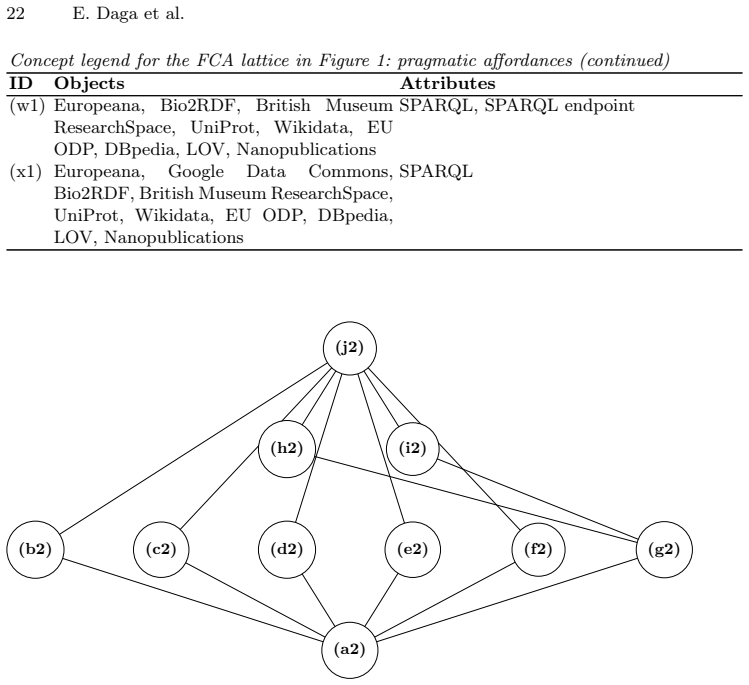
Knowledge graphs have become the primary vehicle for data integration and are critical to the success of modern AI, but the diversity of KG modelling practices, from lightweight vocabularies to richly axiomatised ontologies, makes integration and reuse expensive and brittle. This challenge is particularly acute in neuro-symbolic AI, where bridging neural and symbolic components depends on the ability to reengineer KGs to fit new requirements; GenAI now offers unprecedented automation capability, but without a principled understanding of the KG space, such automation remains conceptually ungrounded. We introduce the ontological continuum as that missing conceptualisation, a theoretical construct a theoretical construct whose characterisation framework is defined by two orthogonal distinctions: semantics vs pragmatics, and properties vs affordances; together these define a vocabulary to describe, compare, navigate, and transform KGs across the full range of modelling practices. The methodological stance is empirical: rather than prescribing how KGs should be modelled, the continuum aims to define a theory of the existent, derived from observation of real-world KG engineering practices and whose structure can be made formally explicit, for example, through Formal Concept Analysis (FCA). We ground the vision through a case study on provenance knowledge, showing how a single concern manifests differently across the continuum. We articulate five open research challenges and invite the community to develop the ontological continuum as a shared research agenda.
Editorial analysis
A structured set of objections, weighed in public.
Referee Report
Summary. The paper introduces the ontological continuum as a theoretical construct to address the diversity of knowledge graph (KG) modeling practices. The framework is characterized by two orthogonal distinctions: semantics versus pragmatics, and properties versus affordances. These distinctions are intended to provide a vocabulary for describing, comparing, navigating, and transforming KGs. The approach is empirical, based on observation of real-world practices, with potential formalization via Formal Concept Analysis (FCA). It is grounded by a case study on provenance knowledge and ends with five open research challenges.
Significance. If the proposed framework proves effective, it could provide a much-needed conceptual tool for KG re-engineering in AI applications, particularly neuro-symbolic systems. The paper's strengths include its empirical methodological stance, which avoids prescriptivism, and its explicit articulation of open challenges to foster community development. This positions the work as a starting point for an empirical theory of KG modeling practices.
major comments (2)
- [Abstract] The claim that the two distinctions are sufficient to capture the observed diversity of real-world KG modeling practices is central to the proposal but is only illustrated at a high level in the provenance case study; additional concrete mappings or examples would help substantiate that the framework can support transformation across the continuum.
- [Case Study] The case study on provenance demonstrates differential manifestation but lacks detail on how the distinctions enable specific re-engineering steps, which is load-bearing for the utility in neuro-symbolic AI contexts mentioned in the introduction.
minor comments (2)
- [Abstract] Typo: the phrase 'a theoretical construct' is repeated consecutively as 'a theoretical construct a theoretical construct'.
- [Throughout] Clarify the definitions of 'affordances' and 'pragmatics' in the context of KGs, possibly with references to related literature in ontology engineering.
Simulated Author's Rebuttal
We thank the referee for their thoughtful review and recommendation for minor revision. Below we provide point-by-point responses to the major comments.
read point-by-point responses
-
Referee: [Abstract] The claim that the two distinctions are sufficient to capture the observed diversity of real-world KG modeling practices is central to the proposal but is only illustrated at a high level in the provenance case study; additional concrete mappings or examples would help substantiate that the framework can support transformation across the continuum.
Authors: We note that the abstract summarizes the contribution, and the sufficiency of the two distinctions is positioned as a hypothesis derived from empirical observation rather than a fully validated claim. The provenance case study serves to illustrate differential manifestation for a single concern. To strengthen substantiation of transformation support, we will add concrete mappings for two further KG scenarios (e.g., entity linking and schema alignment) in the revised case study section. revision: yes
-
Referee: [Case Study] The case study on provenance demonstrates differential manifestation but lacks detail on how the distinctions enable specific re-engineering steps, which is load-bearing for the utility in neuro-symbolic AI contexts mentioned in the introduction.
Authors: The case study is deliberately scoped to demonstrate differential manifestation across the continuum in order to ground the distinctions empirically. Specific re-engineering steps are not detailed because they form part of the five open research challenges explicitly listed in the paper; the distinctions are intended to provide conceptual guidance for such steps rather than prescriptive procedures. We will revise the case study to include a high-level outline of how the distinctions can inform re-engineering choices while clarifying that full operationalization remains future work. revision: partial
Circularity Check
No significant circularity; framework presented as empirical observation
full rationale
The paper introduces the ontological continuum as an independent theoretical construct derived from observation of real-world KG modelling practices, using two orthogonal distinctions (semantics vs pragmatics; properties vs affordances) to supply a descriptive vocabulary. It explicitly adopts an empirical stance, aims to define a theory of the existent rather than prescribe rules, notes that the structure can be made formally explicit (e.g., via FCA), and lists five open research challenges. No equations, fitted parameters, self-referential definitions, or load-bearing self-citations appear in the derivation; the central claim remains a provisional conceptual framework grounded in observed diversity rather than reducing to its own inputs by construction.
Axiom & Free-Parameter Ledger
axioms (1)
- domain assumption The distinctions semantics vs pragmatics and properties vs affordances are orthogonal and jointly sufficient to characterize the space of KG modeling practices.
invented entities (1)
-
Ontological continuum
no independent evidence
discussion (0)
Sign in with ORCID, Apple, or X to comment. Anyone can read and Pith papers without signing in.