High-throughput study of electrical conductivity in ordered metals
Pith reviewed 2026-05-22 05:16 UTC · model grok-4.3
The pith
Intermetallic compounds like LiBePt2 achieve conductivities comparable to aluminum by shifting high-scattering d-states below the Fermi level with valence electrons from light elements.
A machine-rendered reading of the paper's core claim, the machinery that carries it, and where it could break.
Core claim
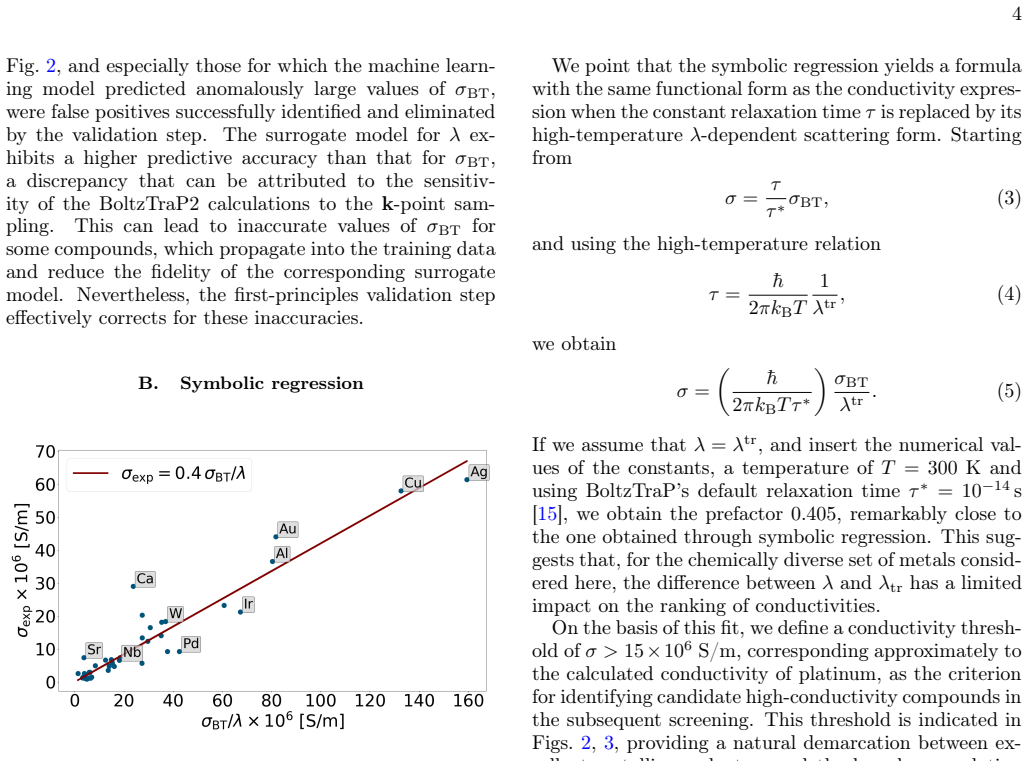
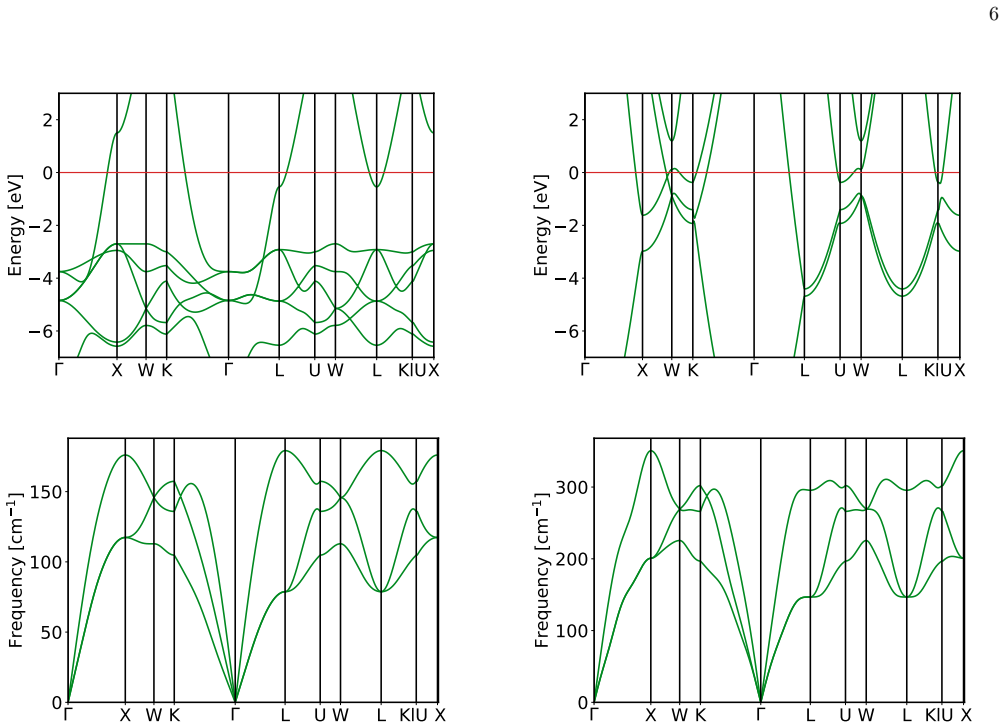
Noble metals set the practical upper bound for conductivity because of their electronic structures and low scattering rates. Certain intermetallics reach similar levels when valence electrons supplied by light elements shift high-scattering d-states below the Fermi level. In LiBePt2 this adjustment reduces electron-phonon scattering enough to yield predicted conductivities near 36.59 million siemens per meter. Full coupling calculations confirm the predictions and align with measured data for known materials.
What carries the argument
The d-state shifting mechanism in which valence electrons from light elements move high-scattering platinum d-states below the Fermi level, thereby lowering scattering and raising conductivity.
If this is right
- Several new intermetallic candidates are identified with predicted conductivities close to aluminum.
- Noble metals remain the benchmark because of their low-scattering electronic structures.
- The combined machine-learning and ab initio workflow reliably ranks and validates transport in metals.
- The same approach can locate additional high-conductivity ordered compounds beyond the noble metals.
Where Pith is reading between the lines
- Design efforts could deliberately engineer Fermi-level positioning through light-element substitution to minimize scattering in other intermetallics.
- The screening pipeline might be applied to disordered solid solutions or non-cubic structures to find still more candidates.
- Practical wiring or electronic components could benefit from replacing or supplementing noble metals with these lighter, cheaper alternatives if synthesis proves feasible.
Load-bearing premise
The machine learning model trained on a subset of compounds generalizes accurately to the full 2.8 million screened set, and the subsequent ab initio electron-phonon calculations capture the dominant scattering mechanisms without significant systematic errors.
What would settle it
A laboratory measurement of electrical conductivity in a synthesized sample of LiBePt2 that falls substantially below the predicted value near aluminum would show the screening or the mechanism does not hold.
Figures



read the original abstract
We present a computational framework that integrates machine learning with high-throughput \textit{ab initio} calculations to screen over 2.8 million compounds for metallic transport. We identify several intermetallic candidates with predicted high conductivities comparable to that of aluminum ($36.59 \times 10^6$~S/m). We perform full electron--phonon coupling calculations for the top-performing materials, yielding results in excellent agreement with available experimental data. Our analysis reveals that while the noble metals (Ag, Au, Cu) define the practical ceiling for conductivity due to their unique electronic structure and low scattering, compounds like $\text{LiBePt}_2$ can achieve comparable performance by utilizing valence electrons from light elements to shift high-scattering $d$-states beneath the Fermi level. This study not only identifies novel high-performance conductors but also demonstrates the predictive power of combining statistical learning with detailed ab initio calculations.
Editorial analysis
A structured set of objections, weighed in public.
Referee Report
Summary. The manuscript presents a high-throughput computational framework integrating machine learning with ab initio calculations to screen over 2.8 million ordered metal compounds for electrical conductivity. It identifies intermetallic candidates such as LiBePt2 predicted to achieve conductivities comparable to aluminum (36.59 × 10^6 S/m) by using valence electrons from light elements to shift high-scattering d-states below the Fermi level. Full electron-phonon coupling calculations on top-performing materials are reported to agree well with available experimental data, and the work highlights design principles beyond the noble metals (Ag, Au, Cu).
Significance. If the central claims hold, the work would be significant for identifying new high-conductivity intermetallics and demonstrating a scalable workflow that combines statistical screening with detailed first-principles validation. The approach could accelerate discovery of conductors for electronics applications, and the explicit comparison to aluminum provides a concrete benchmark. Strengths include the scale of the screen and the focus on mechanistic insight into d-state positioning.
major comments (2)
- [ML screening and high-throughput workflow description] The manuscript does not report the ML training set size, composition, validation metrics, error bars, or results from a chemistry-diverse hold-out test. This is load-bearing for the central claim because the expensive electron-phonon calculations are performed only on the ML-ranked top candidates; without evidence that the model generalizes accurately to light-element intermetallics (e.g., LiBePt2), the selection of headline materials and the reported conductivity ordering cannot be fully assessed.
- [Results and validation section] The abstract states that full electron-phonon calculations agree with experimental data for top materials, but no quantitative details (e.g., mean absolute errors, specific compounds compared, or convergence parameters) are provided in the methods or results. This weakens the quantitative support for the conductivity values and the claim that the framework reliably identifies high-performance candidates.
minor comments (2)
- [Abstract] The abstract mentions screening 'over 2.8 million compounds' but does not specify the exact database or filtering criteria used to arrive at this number; adding a brief statement on the source and any structural or compositional constraints would improve reproducibility.
- [Results] Notation for conductivity units is clear, but the manuscript would benefit from a short table summarizing the top 5–10 predicted compounds with their ML-predicted and ab initio conductivities for direct comparison.
Simulated Author's Rebuttal
We thank the referee for their constructive and detailed review. The comments highlight important aspects of the ML workflow and validation that require clarification. We address each major comment below and have revised the manuscript to incorporate the requested information.
read point-by-point responses
-
Referee: [ML screening and high-throughput workflow description] The manuscript does not report the ML training set size, composition, validation metrics, error bars, or results from a chemistry-diverse hold-out test. This is load-bearing for the central claim because the expensive electron-phonon calculations are performed only on the ML-ranked top candidates; without evidence that the model generalizes accurately to light-element intermetallics (e.g., LiBePt2), the selection of headline materials and the reported conductivity ordering cannot be fully assessed.
Authors: We agree that the ML model details are essential for evaluating the screening reliability. The original manuscript emphasized the overall workflow but did not include sufficient documentation of the training procedure. In the revised version, we have added a dedicated subsection to the Methods that reports the training set size and composition, the validation metrics with associated error bars, and performance on a chemistry-diverse hold-out test set. This includes explicit checks on generalization to light-element intermetallics, supporting the ranking of candidates such as LiBePt2. revision: yes
-
Referee: [Results and validation section] The abstract states that full electron-phonon calculations agree with experimental data for top materials, but no quantitative details (e.g., mean absolute errors, specific compounds compared, or convergence parameters) are provided in the methods or results. This weakens the quantitative support for the conductivity values and the claim that the framework reliably identifies high-performance candidates.
Authors: We acknowledge that the quantitative aspects of the electron-phonon validation were not presented with sufficient detail. The revised manuscript now includes, in both the Results and Methods sections, the mean absolute error between calculated and experimental conductivities for the benchmark materials, the specific compounds used for comparison, and the convergence parameters (k-point and q-point meshes, smearing, etc.) employed in the calculations. These additions provide the requested quantitative support for the reported agreement with experiment. revision: yes
Circularity Check
No significant circularity; results derive from independent ML screening and ab initio calculations validated externally
full rationale
The paper's workflow screens 2.8 million compounds via machine learning, selects top candidates, and performs full electron-phonon coupling calculations whose outputs are compared directly to experimental conductivity values. The identification of LiBePt2 and similar compounds as high performers follows from computed band structures and scattering rates rather than any redefinition of inputs or fitted parameters presented as predictions. No self-citation chains, ansatzes smuggled via prior work, or uniqueness theorems reduce the central claims to tautologies. External benchmarks (experimental agreement) keep the derivation independent of its own fitted values.
Axiom & Free-Parameter Ledger
axioms (1)
- domain assumption Ab initio calculations with electron-phonon coupling accurately reproduce experimental conductivities for the top candidates.
Lean theorems connected to this paper
-
IndisputableMonolith/Foundation/AlphaCoordinateFixation.leanalpha_pin_under_high_calibration unclear?
unclearRelation between the paper passage and the cited Recognition theorem.
machine-learning-accelerated workflow... two physically motivated descriptors... BoltzTraP2... Eliashberg λ
What do these tags mean?
- matches
- The paper's claim is directly supported by a theorem in the formal canon.
- supports
- The theorem supports part of the paper's argument, but the paper may add assumptions or extra steps.
- extends
- The paper goes beyond the formal theorem; the theorem is a base layer rather than the whole result.
- uses
- The paper appears to rely on the theorem as machinery.
- contradicts
- The paper's claim conflicts with a theorem or certificate in the canon.
- unclear
- Pith found a possible connection, but the passage is too broad, indirect, or ambiguous to say the theorem truly supports the claim.
discussion (0)
Sign in with ORCID, Apple, or X to comment. Anyone can read and Pith papers without signing in.