Analytical solutions for timelike orbits around Damour-Solodukhin wormholes
Pith reviewed 2026-05-22 05:42 UTC · model grok-4.3
The pith
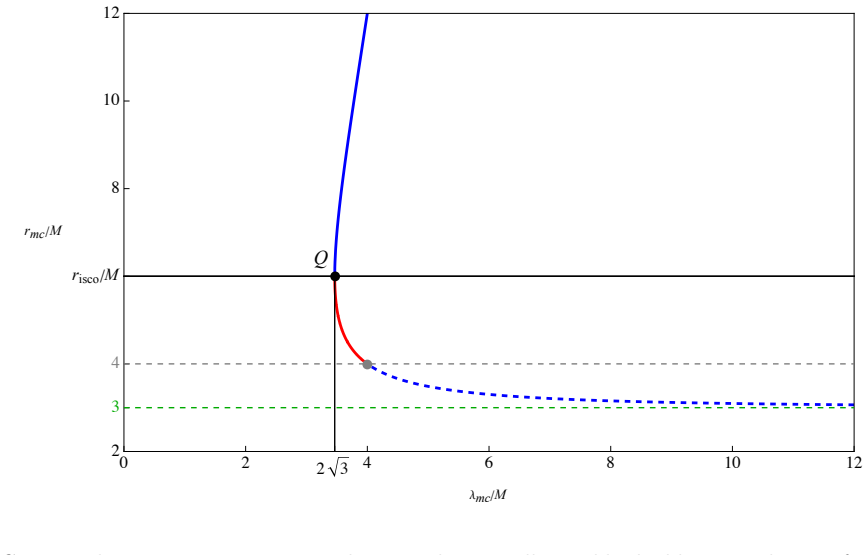
Triple-root configurations at the Damour-Solodukhin wormhole throat fix the innermost stable circular orbit and set it apart from Schwarzschild black holes.
A machine-rendered reading of the paper's core claim, the machinery that carries it, and where it could break.
Core claim
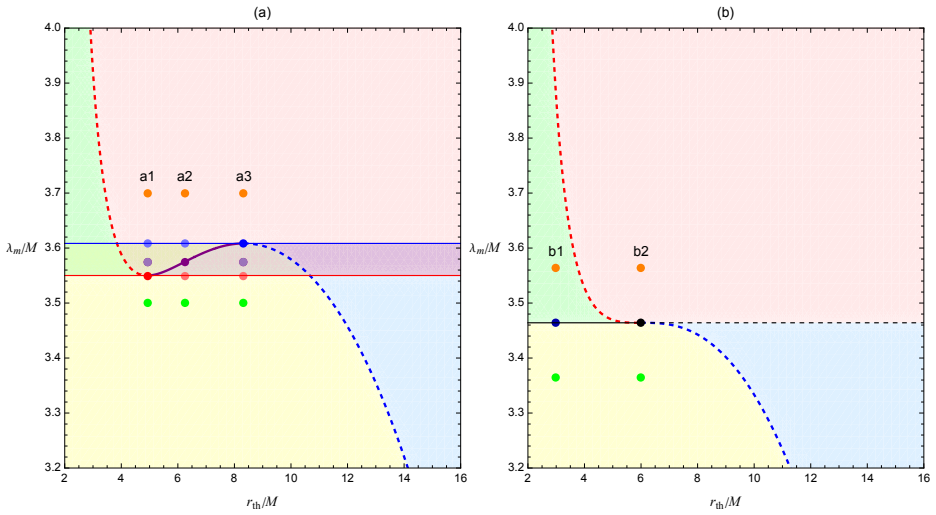
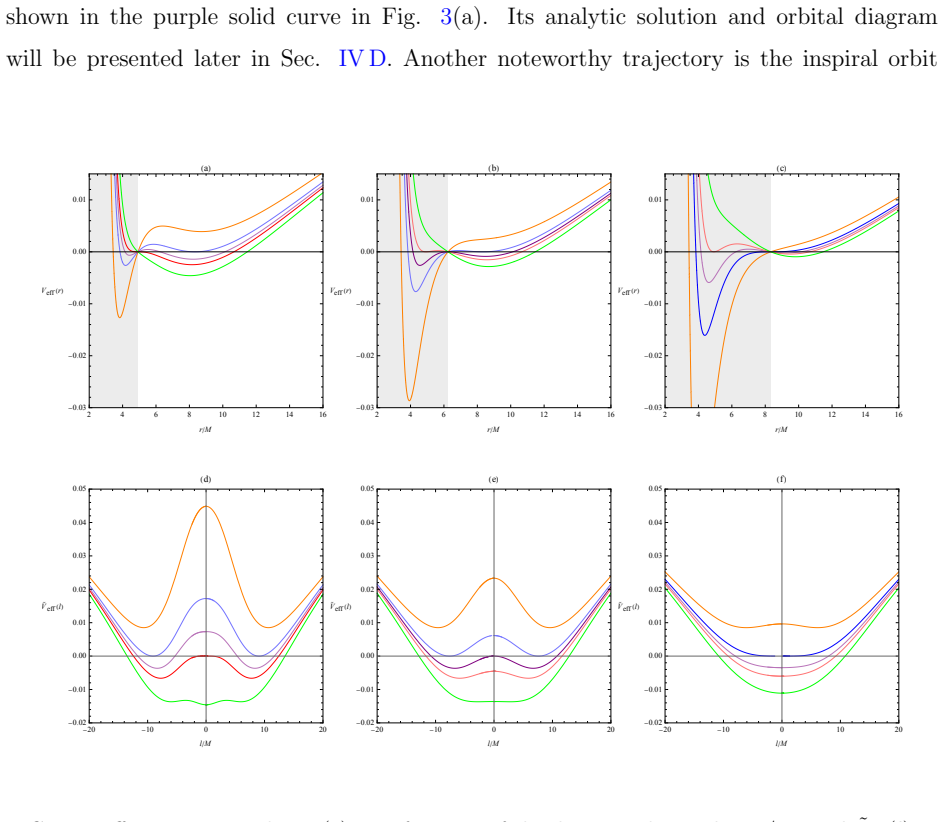
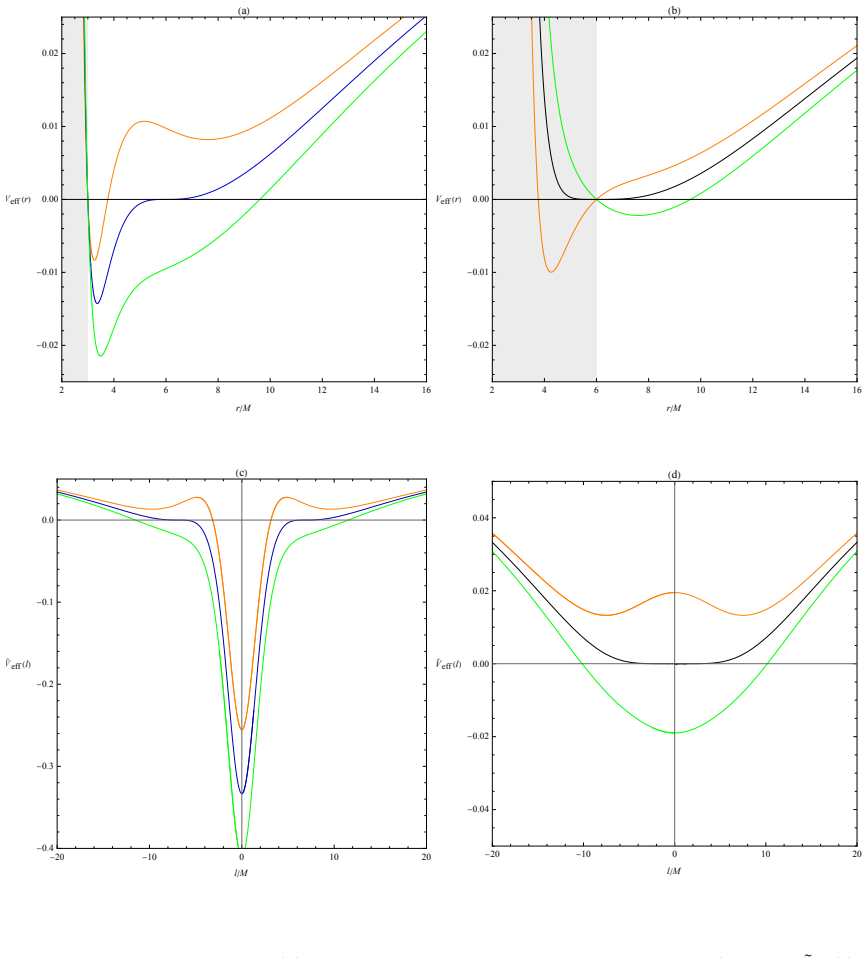
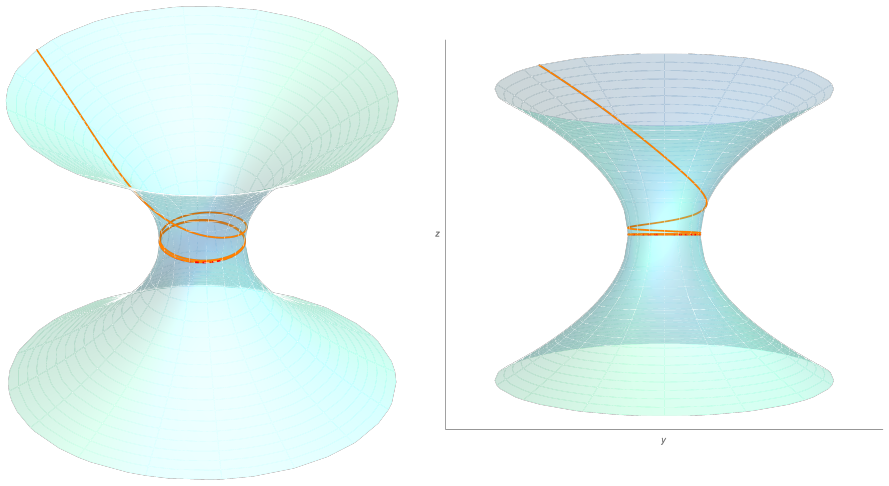
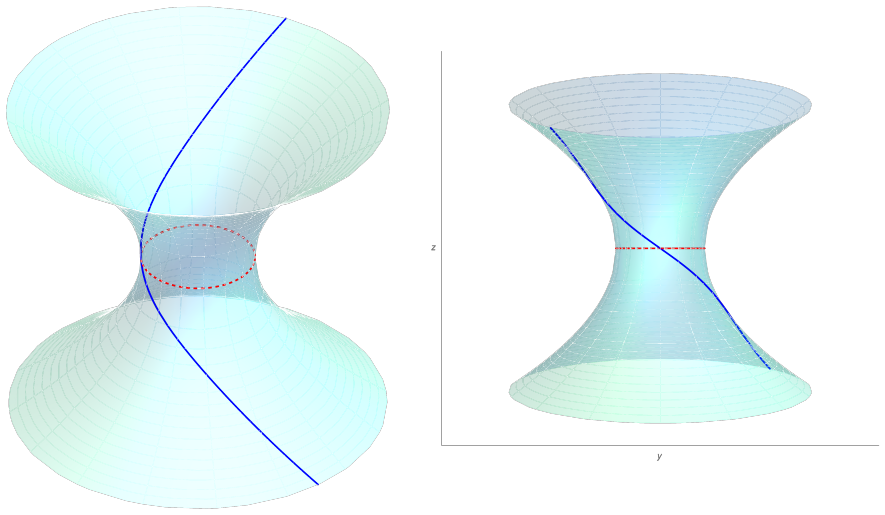
The radial effective potential admits four roots including the throat radius. Triple-root degeneracies involving the throat determine the ISCO. Exact analytic trajectories are constructed via Mino-time parametrization, expressed through incomplete elliptic integrals; when the throat is a double or triple root the azimuthal angle and coordinate time diverge as the particle approaches it, whereas a simple root permits smooth traversal between the two asymptotic regions. Exact homoclinic solutions tied to the throat are also obtained together with their Lyapunov exponents, and analytic inspiral and plunge trajectories through the throat are derived.
What carries the argument
The radial effective potential possessing four roots (one fixed at the throat) whose degeneracies control orbital stability, solved analytically through Mino-time parametrization that yields trajectories in incomplete elliptic integrals.
If this is right
- When the throat is a simple root, particles cross smoothly between the two asymptotically flat regions.
- Double or triple roots at the throat produce logarithmic or power-law divergences in azimuthal angle and coordinate time.
- Homoclinic orbits attached to the throat exist and possess well-defined Lyapunov exponents that can be computed exactly.
- Inspiral and plunge trajectories through the throat admit fully analytic descriptions.
Where Pith is reading between the lines
- If orbital data around a compact object reveal an ISCO radius that cannot be matched by any Schwarzschild geometry yet fits a triple-root throat for some deformation parameter, the observations would favor a wormhole interpretation over a black hole.
- The closed-form elliptic-integral expressions could be used to model the timing of electromagnetic signals or gravitational-wave bursts from matter crossing the throat.
- The same degeneracy analysis might be applied to null geodesics or to spinning generalizations of the wormhole to produce further observational discriminants.
Load-bearing premise
The effective potential is assumed to possess exactly four roots, one of them the throat, for the chosen range of the deformation parameter, so that these roots may merge into multiple degeneracies without further restrictions imposed by the metric.
What would settle it
A direct numerical integration of the geodesic equation for a fixed deformation parameter that places the innermost stable circular orbit at a radius inconsistent with any triple-root configuration would show the claimed relation does not hold.
Figures





read the original abstract
We investigate timelike geodesics around Damour-Solodukhin wormholes, which are Schwarzschild-like geometries characterized by a deformation parameter $\lambda$ that determines the radius of the throat, $r_{\rm th}$. The radial potential admits four roots, including the throat radius itself, allowing the throat to merge with other roots and form double, triple, and quartic degeneracies. In particular, triple-root configurations associated with the throat determine the innermost stable circular orbit (ISCO), providing a potential observational distinction from Schwarzschild black holes. Using the Mino-time parametrization, we derive particle trajectories with closed-form analytical solutions in terms of incomplete elliptic integrals for both bound and unbound motion. In particular, we focus on double or triple roots are located at the throat, the azimuthal angle and coordinate time exhibit logarithmic or power-law divergences as the particle approaches the throat. By contrast, trajectories remain regular when the throat corresponds to a simple root, allowing particles to traverse smoothly between the two asymptotically flat regions. We also derive exact homoclinic solutions associated with the throat and compute the corresponding Lyapunov exponent. In addition, inspiral and plunge trajectories through the throat are analyzed. These results provide analytic insights into particle dynamics and possible observational signatures of the wormholes.
Editorial analysis
A structured set of objections, weighed in public.
Referee Report
Summary. The manuscript derives closed-form analytical solutions for timelike geodesics in Damour-Solodukhin wormholes using Mino-time parametrization, expressing particle trajectories in terms of incomplete elliptic integrals for bound and unbound motion. It analyzes the radial effective potential, which is stated to admit four roots including the throat radius r_th for the deformation parameter λ, examines degeneracies (double, triple, quartic) at the throat, identifies the ISCO with triple-root configurations at r_th, derives exact homoclinic solutions with associated Lyapunov exponents, and discusses divergences in azimuthal angle and coordinate time when roots merge at the throat, as well as inspiral and plunge trajectories.
Significance. If the derivations hold and the root structure is correctly established, the work supplies exact analytic expressions for geodesic motion in these wormhole spacetimes, including regular traversals and divergent behaviors near the throat. This could furnish concrete observational signatures distinguishing Damour-Solodukhin wormholes from Schwarzschild black holes via ISCO location and homoclinic orbit properties, strengthening the analytic toolkit for exotic compact objects.
major comments (2)
- [Abstract] Abstract and the radial-equation setup: the claim that 'the radial potential admits four roots, including the throat radius itself' for the chosen range of λ is not automatic. The radial function R(r) = E² - V_eff(r) vanishes at r_th only when E² exactly equals V_eff(r_th), which imposes a constraint on the conserved quantities E and L that is not shown to follow directly from the metric definition or the range of λ without additional tuning; this assumption underpins the entire discussion of root mergers, triple-root ISCO, and throat-associated divergences.
- [Geodesic analysis section] The identification of triple-root configurations at the throat as determining the ISCO (abstract and relevant geodesic section): the standard ISCO condition requires both V_eff'(r) = 0 and V_eff''(r) = 0 at a circular orbit; when the throat is forced to be a root by parameter choice, it is unclear whether the resulting degeneracy automatically satisfies the stability criterion or merely reflects the imposed root condition rather than a generic extremum of the effective potential.
minor comments (2)
- Clarify the explicit form of the radial polynomial R(r) and the metric functions g_tt, g_rr used to construct V_eff, ensuring the throat radius appears as a root only under stated conditions on E and L.
- Add a brief comparison table or plot contrasting the ISCO radius and Lyapunov exponent with the Schwarzschild case for representative λ values to strengthen the observational-distinction claim.
Simulated Author's Rebuttal
We thank the referee for their thorough review and valuable feedback on our manuscript concerning analytical solutions for timelike geodesics in Damour-Solodukhin wormholes. We address each major comment below and indicate the revisions we plan to make.
read point-by-point responses
-
Referee: [Abstract] Abstract and the radial-equation setup: the claim that 'the radial potential admits four roots, including the throat radius itself' for the chosen range of λ is not automatic. The radial function R(r) = E² - V_eff(r) vanishes at r_th only when E² exactly equals V_eff(r_th), which imposes a constraint on the conserved quantities E and L that is not shown to follow directly from the metric definition or the range of λ without additional tuning; this assumption underpins the entire discussion of root mergers, triple-root ISCO, and throat-associated divergences.
Authors: We agree that the throat radius r_th is a root of the radial equation only when the conserved energy satisfies E² = V_eff(r_th). In the manuscript, our analysis focuses on the physically relevant cases where this condition holds, allowing us to study orbits that reach or traverse the throat, including the degeneracies and divergences mentioned. This choice of E and L is not arbitrary but selected to explore the distinctive features of the wormhole geometry. We will revise the abstract and the relevant sections to explicitly state the constraint on E and L and clarify that we consider the parameter regime where r_th is indeed a root for the chosen λ range. revision: yes
-
Referee: [Geodesic analysis section] The identification of triple-root configurations at the throat as determining the ISCO (abstract and relevant geodesic section): the standard ISCO condition requires both V_eff'(r) = 0 and V_eff''(r) = 0 at a circular orbit; when the throat is forced to be a root by parameter choice, it is unclear whether the resulting degeneracy automatically satisfies the stability criterion or merely reflects the imposed root condition rather than a generic extremum of the effective potential.
Authors: A root of multiplicity three in the radial function R(r) = E² - V_eff(r) at r = r_th necessarily implies that R(r_th) = R'(r_th) = R''(r_th) = 0. Since R'(r) = -V_eff'(r) and R''(r) = -V_eff''(r), this directly enforces V_eff'(r_th) = 0 and V_eff''(r_th) = 0, satisfying the standard conditions for an inflection point and thus the ISCO. The triple degeneracy is not merely imposed but arises from tuning the parameters λ, E, and L such that the throat coincides with the location where the effective potential has an inflection point. We will include an explicit verification of these derivative conditions in the revised geodesic analysis section to address this concern. revision: yes
Circularity Check
No significant circularity; derivation is self-contained
full rationale
The paper applies the geodesic equation to the fixed Damour-Solodukhin metric, constructs the radial effective potential from the metric functions, and derives closed-form solutions in elliptic integrals for chosen root configurations. The statement that the potential admits four roots including the throat is an explicit modeling choice of parameter ranges and conserved quantities E, L rather than a reduction of any output to the input by construction. No fitted parameters are renamed as predictions, no self-citation chain supports a uniqueness claim, and the analytical expressions follow directly from standard integration techniques without circular dependence on the claimed ISCO distinction.
Axiom & Free-Parameter Ledger
free parameters (1)
- λ
axioms (1)
- standard math Timelike geodesics obey the geodesic equation derived from the metric
Lean theorems connected to this paper
-
IndisputableMonolith/Foundation/AlexanderDuality.leanalexander_duality_circle_linking unclear?
unclearRelation between the paper passage and the cited Recognition theorem.
The radial potential admits four roots, including the throat radius itself, allowing the throat to merge with other roots and form double, triple, and quartic degeneracies. In particular, triple-root configurations associated with the throat determine the innermost stable circular orbit (ISCO)
-
IndisputableMonolith/Cost/FunctionalEquation.leanwashburn_uniqueness_aczel unclear?
unclearRelation between the paper passage and the cited Recognition theorem.
V_eff(r) = -g(r) (γ_m² / f(r) - λ_m² / r² - 1)
What do these tags mean?
- matches
- The paper's claim is directly supported by a theorem in the formal canon.
- supports
- The theorem supports part of the paper's argument, but the paper may add assumptions or extra steps.
- extends
- The paper goes beyond the formal theorem; the theorem is a base layer rather than the whole result.
- uses
- The paper appears to rely on the theorem as machinery.
- contradicts
- The paper's claim conflicts with a theorem or certificate in the canon.
- unclear
- Pith found a possible connection, but the passage is too broad, indirect, or ambiguous to say the theorem truly supports the claim.
Reference graph
Works this paper leans on
-
[1]
A. Einstein and N. Rosen, The particle problem in the general theory of relativity, Phys. Rev. 48, 73 (1935)
work page 1935
-
[2]
M. S. Morris, K. S. Thorne, and U. Yurtsever, Wormholes, time machines, and the weak energy condition, Phys. Rev. Lett.61, 1446 (1988)
work page 1988
-
[3]
Visser, Lorentzian Wormholes (American Institute of Physics, New York, 1995)
M. Visser, Lorentzian Wormholes (American Institute of Physics, New York, 1995)
work page 1995
-
[4]
T. Damour and S. N. Solodukhin, Wormholes as black hole foils, Phys. Rev. D76, 024016 (2007)
work page 2007
-
[5]
The Event Horizon Telescope Collaboration, First M87 Event Horizon Telescope results. I. The shadow of the supermassive black hole, Astrophys. J. Lett.875, L1 (2019)
work page 2019
-
[6]
The Event Horizon Telescope Collaboration, First Sagittarius A* Event Horizon Telescope re- sults. I. The shadow of the supermassive black hole in the center of the Milky Way, Astrophys. J. Lett.930, L12 (2022)
work page 2022
- [7]
-
[8]
V. Cardoso, E. Franzin, and P. Pani, Is the Gravitational-Wave Ringdown a Probe of the Event Horizon?, Phys. Rev. Lett.116, 171101 (2016)
work page 2016
-
[9]
Konoplya, How to tell the shape of a wormhole by its quasinormal modes, Phys
R. Konoplya, How to tell the shape of a wormhole by its quasinormal modes, Phys. Lett. B 784, 43 (2018)
work page 2018
-
[10]
S. Kasuya and M. Kobayashi, Throat effects on shadows of Kerr-like wormholes, Phys. Rev. D103, 104050 (2021)
work page 2021
-
[11]
M. Amir, K. Jusufi, A. Banerjee, and S. Hansraj, Shadow images of Kerr-like wormholes, Classical Quantum Gravity36, 215007 (2019)
work page 2019
-
[12]
N. Tsukamoto, Nonlogarithmic divergence of a deflection angle by a marginally unstable pho- ton sphere of the Damour-Solodukhin wormhole in a strong deflection limit, Phys. Rev. D 101, 104021 (2020). 31
work page 2020
-
[13]
¨Ovg¨ un, Light deflection by Damour-Solodukhin wormholes and Gauss-Bonnet theorem, Phys
A. ¨Ovg¨ un, Light deflection by Damour-Solodukhin wormholes and Gauss-Bonnet theorem, Phys. Rev. D98, 044033 (2018)
work page 2018
-
[14]
Shaikh, Shadows of rotating wormholes, Phys
R. Shaikh, Shadows of rotating wormholes, Phys. Rev. D98, 024044 (2018)
work page 2018
-
[15]
P. G. Nedkova, V. K. Tinchev, and S. S. Yazadjiev, Shadow of a rotating traversable wormhole, Phys. Rev. D88, 124019 (2013)
work page 2013
-
[16]
T. Hsieh, D.-S. Lee, and C.-Y. Lin, Throat effects on strong gravitational lensing in Kerr-like wormholes, Phys. Rev. D111, 044051 (2025)
work page 2025
- [17]
-
[18]
C. Liu, H. Siew, H.-X. Jiang, Y. Mizuno, and T. Zhu, Signature of iron line profile from a Kerr-like wormhole, A&A 10.1051/0004-6361/202557027 (2026)
-
[19]
B. P. Abbottet al.(LIGO Scientific and Virgo Collaboration), Observation of Gravitational Waves from a Binary Black Hole Merger, Phys. Rev. Lett.116, 061102 (2016)
work page 2016
-
[20]
B. P. Abbottet al.(LIGO Scientific and Virgo Collaboration), GWTC-1: A Gravitational- Wave Transient Catalog of Compact Binary Mergers Observed by LIGO and Virgo during the First and Second Observing Runs, Phys. Rev. X9, 031040 (2019)
work page 2019
-
[21]
R. Abbottet al.(LIGO Scientific and Virgo Collaboration), GWTC-2: Compact Binary Co- alescences Observed by LIGO and Virgo during the First Half of the Third Observing Run, Phys. Rev. X11, 021053 (2021)
work page 2021
-
[22]
E. Consortiumet al., The gravitational universe, arXiv: 1305.5720 10.48550/arxiv.1305.5720 (2013)
work page internal anchor Pith review Pith/arXiv arXiv doi:10.48550/arxiv.1305.5720 2013
-
[23]
Barausseet al., Prospects for fundamental physics with LISA, Gen
E. Barausseet al., Prospects for fundamental physics with LISA, Gen. Relativ. Gravit.52 (2020)
work page 2020
-
[24]
LISA Consortium Waveform Working Group, Waveform modelling for the Laser Interferom- eter Space Antenna, Living Reviews in Relativity28, 9 (2025)
work page 2025
- [25]
- [26]
-
[27]
C. A. Benavides-Gallego, W.-B. Han, D. Malafarina, B. Ahmedov, and A. Abdujabbarov, Spinning test particle motion around a traversable wormhole, Phys. Rev. D104, 084024 32 (2021)
work page 2021
-
[28]
B. Narzilloev, D. Malafarina, A. Abdujabbarov, B. Ahmedov, and C. Bambi, Particle motion around a static axially symmetric wormhole, Phys. Rev. D104, 064016 (2021)
work page 2021
-
[29]
F. Abdulxamidov, C. A. Benavides-Gallego, W.-B. Han, J. Rayimbaev, and A. Abdujabbarov, Spinning test particle motion around a rotating wormhole, Phys. Rev. D106, 024012 (2022)
work page 2022
- [30]
-
[31]
C.-Y. Wang, D.-S. Lee, and C.-Y. Lin, Null and timelike geodesics in the Kerr-Newman black hole exterior, Phys. Rev. D106, 084048 (2022)
work page 2022
- [32]
- [33]
-
[34]
S.-Y. Ciou, T. Hsieh, and D.-S. Lee, Dynamics of spinning particles in Reissner-Nordstr¨ om black hole exterior, JCAP05(2025), 086
work page 2025
-
[35]
Y.-P. Chen, T. Hsieh, and D.-S. Lee, Motion of spinning particles in the Kerr-Newman black hole exterior. I. Periodic orbits, arXiv: 2510.05603 10.48550/arxiv.2510.05603 (2025)
-
[36]
J. B. Hartle, Gravity: An Introduction to Einstein’s General Relativity (Benjamin Cum- mings, New York, 2003)
work page 2003
-
[37]
J. Levin and G. Perez-Giz, Homoclinic orbits around spinning black holes. I. Exact solution for the Kerr separatrix, Phys. Rev. D79, 124013 (2009)
work page 2009
-
[38]
J. Maldacena, S. H. Shenker, and D. Stanford, A bound on chaos, J. High Energy Phys.08 (2016), 106
work page 2016
-
[39]
J. B. Dent, W. E. Gabella, K. Holley-Bockelmann, and T. W. Kephart, Gravitational waves from a black hole orbiting in a wormhole geometry, Phys. Rev. D104, 044030 (2021)
work page 2021
-
[40]
M. N. Malik, J. B. Dent, W. E. Gabella, and T. W. Kephart, Gravitational Waves from a Black Hole Falling Radially into a Thin-Shell Traversable Wormhole, arXiv: 2605.01216 10.48550/arxiv.2605.01216 (2026)
work page internal anchor Pith review Pith/arXiv arXiv doi:10.48550/arxiv.2605.01216 2026
-
[41]
P. F. Byrd and M. D. Friedman, Handbook of Elliptic Integrals for Engineers and Scientists (Springer Berlin, Heidelberg, 1971)
work page 1971
-
[42]
Mino, Perturbative approach to an orbital evolution around a supermassive black hole, 33 Phys
Y. Mino, Perturbative approach to an orbital evolution around a supermassive black hole, 33 Phys. Rev. D67, 084027 (2003)
work page 2003
-
[43]
V. Cardoso, A. S. Miranda, E. Berti, H. Witek, and V. T. Zanchin, Geodesic stability, Lya- punov exponents, and quasinormal modes, Phys. Rev. D79, 064016 (2009)
work page 2009
- [44]
discussion (0)
Sign in with ORCID, Apple, or X to comment. Anyone can read and Pith papers without signing in.