Recognition: unknown
Gravitational Waves from a Black Hole Falling Radially into a Thin-Shell Traversable Wormhole
Pith reviewed 2026-05-09 19:07 UTC · model grok-4.3
The pith
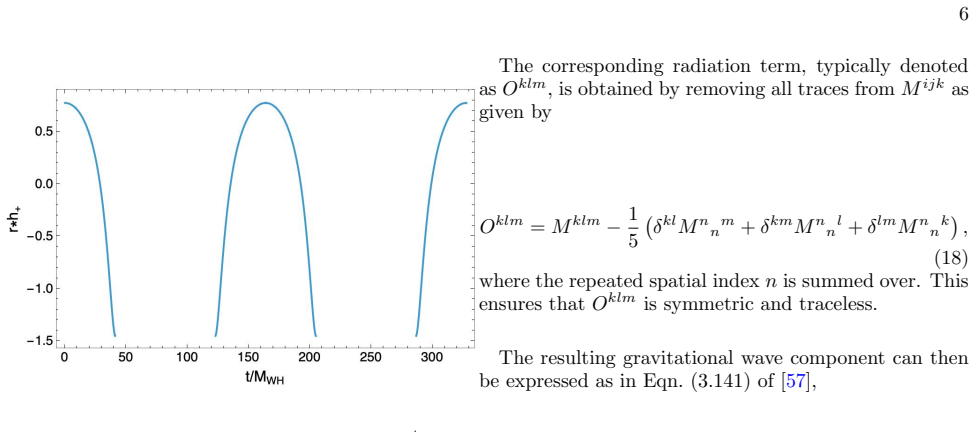
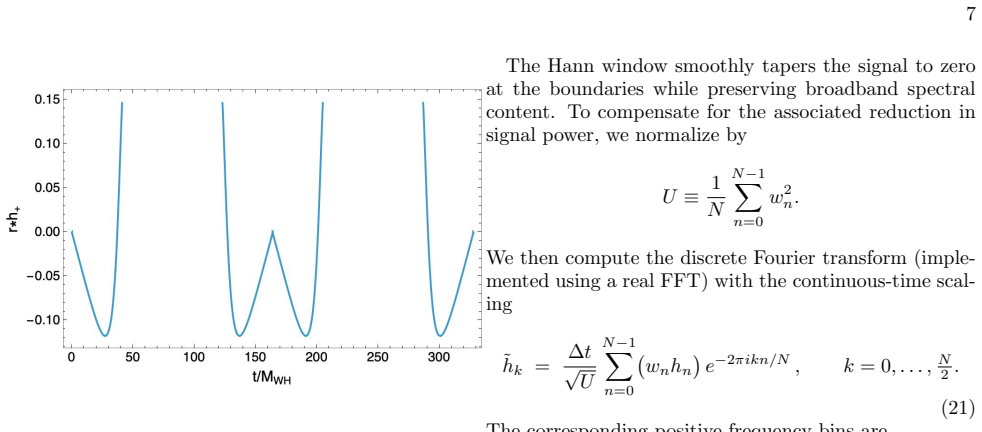
A black hole falling radially into a thin-shell traversable wormhole produces gravitational waves with a repeated pulse-gap structure that could reach ground-based detector sensitivities at distances of order 500 Mpc.
A machine-rendered reading of the paper's core claim, the machinery that carries it, and where it could break.
Core claim
We compute the gravitational-wave signal generated by the radial infall of a stellar-mass black hole into a thin-shell Schwarzschild traversable wormhole. Modeling the black hole as a test particle, we derive analytic expressions for the emitted waveform, including contributions from the mass quadrupole and higher-order multipoles. The resulting signal exhibits a characteristic pulse-gap structure associated with repeated throat crossings. We further compute the amplitude spectral density and compare it with representative ground-based detector sensitivities, finding that such signals could lie within the sensitivity range for optimally oriented sources at distances of order ~500 Mpc.
What carries the argument
The test-particle geodesic trajectory through the thin-shell wormhole spacetime that produces repeated throat crossings and the associated multipolar gravitational radiation.
If this is right
- Analytic waveform expressions are obtained from the quadrupole and higher multipoles along the radial trajectory.
- Repeated throat crossings produce a time-domain pulse-gap structure in the emitted waves.
- The amplitude spectral density places the signals inside the sensitivity band of ground-based detectors for sources at distances of order 500 Mpc when optimally oriented.
- Detection of the pulse-gap pattern would constitute an observational signature of traversable wormholes.
Where Pith is reading between the lines
- The measured interval between successive pulses could constrain the throat radius or other geometric parameters of the wormhole.
- Including the back-reaction of the black hole on the wormhole geometry would yield more accurate amplitude predictions for realistic events.
- Similar pulse-gap features might appear in signals from other horizonless compact objects, offering a way to classify exotic mergers in gravitational-wave catalogs.
Load-bearing premise
The black hole is treated as a test particle whose mass and energy do not disturb the fixed wormhole background or its stability.
What would settle it
A gravitational wave detection from an infalling compact object that lacks the predicted pulse-gap intervals or whose spectrum deviates from the calculated amplitude spectral density would falsify the signal for stable thin-shell wormholes.
Figures



read the original abstract
We compute the gravitational-wave signal generated by the radial infall of a stellar-mass black hole into a thin-shell Schwarzschild traversable wormhole. Modeling the black hole as a test particle, we derive analytic expressions for the emitted waveform, including contributions from the mass quadrupole and higher-order multipoles. The resulting signal exhibits a characteristic pulse-gap structure associated with repeated throat crossings. We further compute the amplitude spectral density and compare it with representative ground-based detector sensitivities, finding that such signals could lie within the sensitivity range for optimally oriented sources at distances of order ~500 Mpc. These results provide a potential observational signature of traversable wormholes in gravitational-wave data.
Editorial analysis
A structured set of objections, weighed in public.
Referee Report
Summary. The paper computes the gravitational-wave signal generated by the radial infall of a stellar-mass black hole into a thin-shell Schwarzschild traversable wormhole. Modeling the black hole as a test particle in a fixed background, it derives analytic expressions for the emitted waveform including contributions from the mass quadrupole and higher-order multipoles. The resulting signal exhibits a characteristic pulse-gap structure associated with repeated throat crossings. The amplitude spectral density is compared with ground-based detector sensitivities, suggesting such signals could be detectable for optimally oriented sources at distances of order ~500 Mpc.
Significance. If the central approximations hold, the work identifies a distinctive pulse-gap feature in the waveform as a potential observational signature of traversable wormholes. The analytic derivation of the multipole contributions and the direct comparison to detector noise curves provide concrete, falsifiable predictions that could be tested with existing or near-future gravitational-wave data.
major comments (1)
- [Abstract] Abstract and modeling section: the central derivation of the analytic waveform and pulse-gap structure relies on geodesic radial motion with repeated throat crossings in an unperturbed thin-shell Schwarzschild wormhole. The test-particle approximation in a fixed background is load-bearing for this claim, yet for a stellar-mass black hole the mass ratio is not parametrically small relative to the wormhole's effective mass (set by throat radius and surface stress-energy); back-reaction on the shell and metric is not quantified, raising the possibility that multiple crossings are suppressed and the closed-form waveform invalid.
minor comments (1)
- [Abstract] The abstract states that higher-order multipoles are included but does not specify the truncation order or convergence criteria used in the expansion.
Simulated Author's Rebuttal
We thank the referee for their careful reading of the manuscript and for raising an important point about the test-particle approximation. We address the comment in detail below and have revised the manuscript to clarify the regime of validity.
read point-by-point responses
-
Referee: [Abstract] Abstract and modeling section: the central derivation of the analytic waveform and pulse-gap structure relies on geodesic radial motion with repeated throat crossings in an unperturbed thin-shell Schwarzschild wormhole. The test-particle approximation in a fixed background is load-bearing for this claim, yet for a stellar-mass black hole the mass ratio is not parametrically small relative to the wormhole's effective mass (set by throat radius and surface stress-energy); back-reaction on the shell and metric is not quantified, raising the possibility that multiple crossings are suppressed and the closed-form waveform invalid.
Authors: We agree that the test-particle approximation is central to the analytic derivation and that back-reaction is not quantified in the present work. The manuscript models the stellar-mass black hole explicitly as a test particle on geodesics in the fixed thin-shell wormhole background. This approximation is valid when the black-hole mass is much smaller than the effective mass set by the throat radius and surface stress-energy, which can be arranged by choosing a sufficiently large throat for a given black-hole mass. We have added a new paragraph to the modeling section that states the required mass-ratio condition, notes that back-reaction could in principle alter the trajectory and suppress repeated crossings, and explains that a self-consistent treatment lies beyond the analytic scope of the paper. Within the stated test-particle limit the pulse-gap waveform remains a well-defined prediction. revision: partial
Circularity Check
No circularity: standard test-particle waveform derivation in fixed background
full rationale
The paper's derivation chain consists of geodesic radial motion for a test particle in a pre-specified thin-shell Schwarzschild wormhole metric, followed by standard GR multipole expansions to obtain the waveform and its spectral density. No equation reduces to a fitted parameter renamed as a prediction, no self-definition of quantities, and no load-bearing self-citation chain. The pulse-gap structure is a direct geometric consequence of the assumed repeated throat crossings in the unperturbed metric, and the ~500 Mpc detectability estimate is a post-computation comparison against detector curves rather than an input. The calculation is self-contained against external benchmarks and exhibits no reduction of outputs to inputs by construction.
Axiom & Free-Parameter Ledger
free parameters (1)
- wormhole throat radius
axioms (2)
- domain assumption The wormhole is a thin-shell connection between two Schwarzschild geometries
- domain assumption Black hole treated as test particle with negligible back-reaction
Reference graph
Works this paper leans on
-
[1]
B. P. Abbottet al.(LIGO Scientific, Virgo), Phys. Rev. Lett.116, 061102 (2016), arXiv:1602.03837 [gr-qc]
work page internal anchor Pith review arXiv 2016
-
[2]
B. P. Abbottet al.(LIGO Scientific, Virgo), Phys. Rev. X9, 031040 (2019), arXiv:1811.12907 [astro-ph.HE]
work page internal anchor Pith review arXiv 2019
-
[3]
R. Abbottet al.(LIGO Scientific, Virgo), Phys. Rev. X 11, 021053 (2021), arXiv:2010.14527 [gr-qc]
work page internal anchor Pith review arXiv 2021
-
[4]
R. Abbottet al.(LIGO Scientific, Virgo, KAGRA), Phys. Rev. X13, 041039 (2023), arXiv:2111.03606 [gr-qc]
work page internal anchor Pith review arXiv 2023
-
[5]
The NANOGrav 15-year Data Set: Evidence for a Gravitational-Wave Background
G. Agazieet al.(NANOGrav), Astrophys. J. Lett.951, L8 (2023), arXiv:2306.16213 [astro-ph.HE]
work page internal anchor Pith review arXiv 2023
-
[6]
K. S. Thorne, in1994 DPF Summer Study on High- energy Physics: Particle and Nuclear Astrophysics and Cosmology in the Next Millenium (Snowmass 94)(1995) pp. 0160–184, arXiv:gr-qc/9506086
work page internal anchor Pith review arXiv 1995
-
[7]
Cool horizons for entangled black holes
J. Maldacena and L. Susskind, Fortsch. Phys.61, 781 (2013), arXiv:1306.0533 [hep-th]
work page Pith review arXiv 2013
-
[8]
H. Deng, J. Garriga, and A. Vilenkin, JCAP04, 050 (2017), arXiv:1612.03753 [gr-qc]
work page Pith review arXiv 2017
-
[9]
Primordial black hole formation by vacuum bubbles
H. Deng and A. Vilenkin, JCAP12, 044 (2017), arXiv:1710.02865 [gr-qc]
work page Pith review arXiv 2017
- [10]
- [11]
-
[12]
Numerical simulations of primordial black hole formation via delayed first-order phase transitions,
Z. Ning, X.-X. Zeng, R.-G. Cai, and S.-J. Wang, (2026), arXiv:2601.21878 [gr-qc]
- [13]
-
[14]
Y. Chen, P.-P. Wang, B. Wang, R. Luo, and C.-G. Shao, Universe12, 48 (2026), arXiv:2603.07158 [astro-ph.CO]
-
[15]
G. Bertone, Nucl. Phys. B1003, 116487 (2024), arXiv:2404.11513 [astro-ph.CO]
- [16]
-
[17]
Review of cosmic phase transitions: their significance and experimental signatures,
A. Mazumdar and G. White, Rept. Prog. Phys.82, 076901 (2019), arXiv:1811.01948 [hep-ph]
- [18]
-
[19]
Cosmological phase transitions: From perturbative particle physics to gravitational waves,
P. Athron, C. Bal´ azs, A. Fowlie, L. Morris, and L. Wu, Prog. Part. Nucl. Phys.135, 104094 (2024), arXiv:2305.02357 [hep-ph]
-
[20]
Caprini, HiHEP1, 22 (2025), arXiv:2602.02861 [astro- ph.CO]
C. Caprini, HiHEP1, 22 (2025), arXiv:2602.02861 [astro- ph.CO]
-
[21]
B. J. Carr and S. W. Hawking, Mon. Not. Roy. Astron. Soc.168, 399 (1974)
1974
-
[22]
S. Bird, I. Cholis, J. B. Mu˜ noz, Y. Ali-Ha¨ ımoud, M. Kamionkowski, E. D. Kovetz, A. Raccanelli, and A. G. Riess, Phys. Rev. Lett.116, 201301 (2016), arXiv:1603.00464 [astro-ph.CO]
work page Pith review arXiv 2016
- [23]
-
[24]
Primordial Black Holes - Perspectives in Gravitational Wave Astronomy -
M. Sasaki, T. Suyama, T. Tanaka, and S. Yokoyama, Class. Quant. Grav.35, 063001 (2018), arXiv:1801.05235 [astro-ph.CO]
work page Pith review arXiv 2018
-
[25]
A. M. Green and B. J. Kavanagh, J. Phys. G48, 043001 (2021), arXiv:2007.10722 [astro-ph.CO]
work page internal anchor Pith review arXiv 2021
-
[26]
T. Papanikolaou, V. Vennin, and D. Langlois, JCAP03, 053 (2021), arXiv:2010.11573 [astro-ph.CO]
-
[27]
B. Carr and F. Kuhnel, SciPost Phys. Lect. Notes48, 1 (2022), arXiv:2110.02821 [astro-ph.CO]
- [28]
- [29]
-
[30]
V. Cardoso, S. Hopper, C. F. B. Macedo, C. Palen- zuela, and P. Pani, Phys. Rev. D94, 084031 (2016), arXiv:1608.08637 [gr-qc]
work page Pith review arXiv 2016
-
[31]
Testing the nature of dark compact objects: a status report
V. Cardoso and P. Pani, Living Rev. Rel.22, 4 (2019), arXiv:1904.05363 [gr-qc]
work page internal anchor Pith review arXiv 2019
-
[32]
M. S. Morris and K. S. Thorne, Am. J. Phys.56, 395 (1988)
1988
-
[33]
H. G. Ellis, J. Math. Phys.14, 104 (1973)
1973
-
[34]
K. A. Bronnikov, Acta Phys. Polon. B4, 251 (1973)
1973
-
[35]
K. Sato, M. Sasaki, H. Kodama, and K.-i. Maeda, Prog. Theor. Phys.65, 1443 (1981)
1981
-
[36]
Maeda, K
K.-i. Maeda, K. Sato, M. Sasaki, and H. Kodama, Phys. Lett. B108, 98 (1982)
1982
-
[37]
C. Bambi and D. Stojkovic, Universe7, 136 (2021), arXiv:2105.00881 [gr-qc]
- [38]
-
[39]
V. Diemer and E. Smolarek, Class. Quant. Grav.30, 175014 (2013), arXiv:1302.1705 [gr-qc]
- [40]
-
[41]
M. S. Morris, K. S. Thorne, and U. Yurtsever, Phys. Rev. Lett.61, 1446 (1988)
1988
-
[42]
Visser, Phys
M. Visser, Phys. Lett. B242, 24 (1990)
1990
- [43]
- [44]
-
[45]
E. Poisson and M. Visser, Phys. Rev. D52, 7318 (1995), arXiv:gr-qc/9506083
- [46]
-
[47]
J. B. Hartle,Gravity(Cambridge University Press, 2021)
2021
-
[48]
Israel, Nuovo Cim
W. Israel, Nuovo Cim. B44S10, 1 (1966), [Erratum: Nuovo Cim.B 48, 463 (1967)]
1966
-
[49]
S. K. Blau, E. I. Guendelman, and A. H. Guth, Phys. Rev. D35, 1747 (1987)
1987
-
[50]
S. W. Hawking and G. F. R. Ellis,The Large Scale Struc- ture of Space-Time, Cambridge Monographs on Mathe- matical Physics (Cambridge University Press, 2023)
2023
-
[51]
R. V. Buniy and S. D. H. Hsu, Phys. Lett. B632, 543 (2006), arXiv:hep-th/0502203
work page Pith review arXiv 2006
- [52]
-
[53]
Chandrasekhar,The mathematical theory of black holes(1985)
S. Chandrasekhar,The mathematical theory of black holes(1985)
1985
-
[54]
Weinberg,Gravitation and Cosmology: Principles and Applications of the General Theory of Relativity(John Wiley and Sons, New York, 1972)
S. Weinberg,Gravitation and Cosmology: Principles and Applications of the General Theory of Relativity(John Wiley and Sons, New York, 1972)
1972
- [55]
-
[56]
Chakrabarty, (1999), arXiv:physics/9908041
I. Chakrabarty, (1999), arXiv:physics/9908041
-
[57]
Maggiore,Gravitational Waves
M. Maggiore,Gravitational Waves. Vol. 1: Theory and Experiments(Oxford University Press, 2007)
2007
-
[58]
The Next Generation Global Gravitational Wave Observatory: The Science Book
V. Kalogeraet al., (2021), arXiv:2111.06990 [gr-qc]
-
[59]
Kozai, Astron
Y. Kozai, Astron. J.67, 591 (1962)
1962
-
[60]
M. L. Lidov, Planet. Space Sci.9, 719 (1962)
1962
- [61]
-
[62]
D. Farrahet al., Astrophys. J. Lett.944, L31 (2023), arXiv:2302.07878 [astro-ph.CO]
-
[63]
I. R. Klebanov, L. Susskind, and T. Banks, Nucl. Phys. B317, 665 (1989)
1989
-
[64]
F. Duplessis and D. A. Easson, Phys. Rev. D92, 043516 (2015), arXiv:1506.00988 [gr-qc]
- [65]
discussion (0)
Sign in with ORCID, Apple, or X to comment. Anyone can read and Pith papers without signing in.