Nature of 4FGL J2249.4+6229: Evidence for a redback system with a cool companion and low X-ray and γ-ray luminosities
Pith reviewed 2026-05-22 05:50 UTC · model grok-4.3
The pith
The unassociated Fermi source 4FGL J2249.4+6229 is a redback binary with a cool 0.5-solar-mass M-dwarf companion at 500-550 parsecs.
A machine-rendered reading of the paper's core claim, the machinery that carries it, and where it could break.
Core claim
The source exhibits a 5.6-hour periodicity confirmed over 6.6 years of optical monitoring, with folded light curves displaying two peaks per orbit. X-ray spectra from Swift and eROSITA are described by an absorbed power law of photon index approximately 2.0. Application of the direct heating model to the optical data yields a companion mass of approximately 0.5 solar masses and effective temperature of approximately 3600 K. These parameters place the object among the coldest and most massive companions known in redback systems, and at 500-550 pc the source possesses the lowest X-ray and gamma-ray luminosities of any redback.
What carries the argument
Direct heating model fitted to the double-peaked sinusoidal optical light curve to extract companion mass and temperature from the orbital heating pattern.
If this is right
- Redback systems can accommodate cooler and more massive companions than most previously known examples.
- The X-ray to optical flux ratio near 0.2 supports classification as a redback rather than other classes of gamma-ray binaries.
- Low luminosities at the derived distance imply this may represent an extreme or evolved member of the redback population.
- Optical spectra confirming an M-type star with asymmetric H-alpha emission are consistent with the companion in a redback system.
Where Pith is reading between the lines
- Similar low-luminosity redbacks may be hidden among other unassociated Fermi sources if they also have cool companions.
- Radial-velocity monitoring could directly measure the mass function and test whether the companion is truly the most massive in the class.
- If the low luminosities prove intrinsic rather than distance-related, models of pulsar wind heating in redbacks may need adjustment for lower spin-down power or different geometries.
Load-bearing premise
The 5.6-hour periodicity and double-peaked sinusoidal optical light curve are produced by direct heating of the companion star in a binary without substantial contributions from ellipsoidal variations or star spots.
What would settle it
A trigonometric parallax placing the source beyond 1 kpc would raise its X-ray and gamma-ray luminosities above the claimed lowest values for redbacks.
Figures


read the original abstract
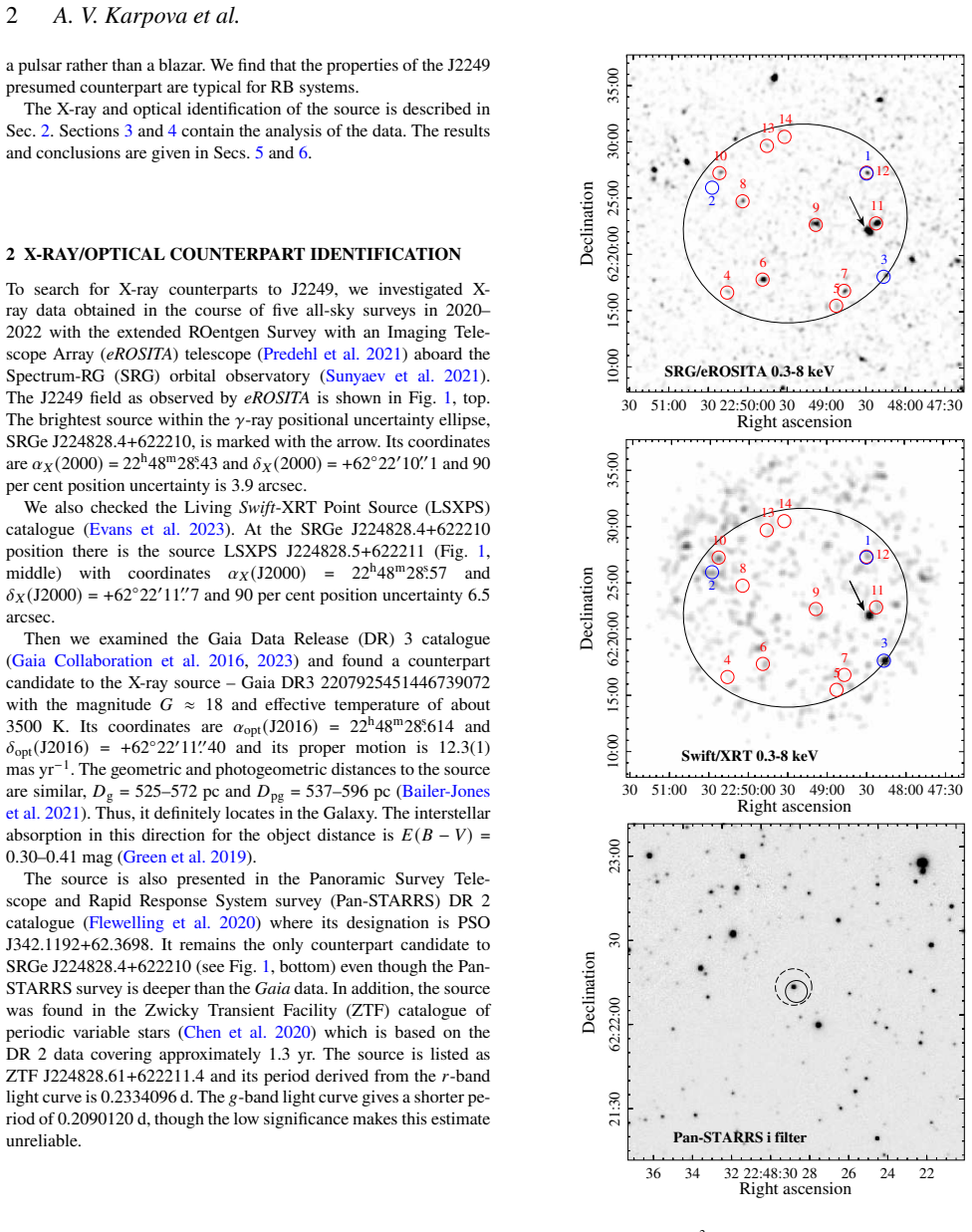
We report the identification of the likely X-ray and optical counterpart to the unassociated Fermi source 4FGL J2249.4+6229. To clarify its nature, we investigate the X-ray data from Swift/XRT and SRG/eROSITA as well as photometric data from optical catalogues and archival spectroscopic data from the Gemini-North telescope. Using Zwicky Transient Facility data spanning over 6.6 yr, we confirmed a period of $\approx$5.6 h likely associated with the orbital motion in a binary system. The folded light curves have a smooth sinusoidal shape with two peaks per period and the amplitude of $\approx$0.2 mag. The X-ray spectra of the source are well fitted by an absorbed power law with the photon index of $\approx$2.0 and unabsorbed flux of $\approx$1.4$\times10^{-13}$ erg s$^{-1}$ cm$^{-2}$. All these together with the X-ray to optical flux ratio of $\sim$0.2 implies that 4FGL J2249.4+6229 is a promising redback candidate. Fitting the optical light curves with the direct heating model, we obtained the companion mass of $\approx$0.5 M$_\odot$ and temperature of $\approx$3600 K implying an M-type star. This places it among the coldest and most massive companions known in redback systems.Optical spectra confirms the M-type star and shows the broad asymmetric H$\alpha$ emission line. For the distance of 500--550 pc derived from the optical data, the source can be the redback with the lowest X-ray and $\gamma$-ray luminosities.
Editorial analysis
A structured set of objections, weighed in public.
Referee Report
Summary. The paper reports the identification of 4FGL J2249.4+6229 as a candidate redback millisecond pulsar binary. X-ray spectra from Swift/XRT and eROSITA are fitted by an absorbed power law (photon index ≈2.0, unabsorbed flux ≈1.4×10^{-13} erg s^{-1} cm^{-2}). ZTF photometry over 6.6 years shows a ≈5.6 h periodicity with a sinusoidal light curve of amplitude ≈0.2 mag and two peaks per orbit. Gemini spectra confirm an M-type companion with broad asymmetric Hα emission. A direct-heating model fit to the optical light curve yields companion mass ≈0.5 M_⊙ and temperature ≈3600 K; combined with an optical-derived distance of 500–550 pc, the source is claimed to have the lowest X-ray and γ-ray luminosities among redbacks and one of the coldest/most massive companions.
Significance. If the distance and companion parameters are robust, the result would usefully extend the observed range of redback systems to lower luminosities and cooler companions. The long-baseline ZTF period detection, consistent X-ray power-law spectrum, and X-ray-to-optical flux ratio ≈0.2 provide independent supporting evidence from public archives. The multi-facility approach is a clear strength.
major comments (1)
- [Optical light-curve modeling] Optical light-curve modeling section: the direct-heating model is used to derive companion mass ≈0.5 M_⊙ and T≈3600 K, which are then used to infer the 500–550 pc distance and hence L_X and L_γ (both ∝ d²). However, the observed light curve shows two peaks per orbit, the expected signature of ellipsoidal variation from a tidally distorted star; a pure irradiation model produces one maximum per orbit. If ellipsoidal terms, gravity darkening, or spots are omitted or under-weighted, the fitted heating luminosity, inclination, radius, and temperature are systematically offset, directly biasing the distance and the central low-luminosity claim.
minor comments (2)
- [Abstract] The sentence in the abstract beginning 'All these together with the X-ray to optical flux ratio of ∼0.2 implies...' contains a subject-verb agreement issue; consider rephrasing for clarity.
- [Distance estimation] The distance range 500–550 pc is stated as 'derived from the optical data' but the precise method (e.g., absolute magnitude from the fitted radius and temperature plus apparent magnitude) is not quantified with uncertainties; adding this would improve reproducibility.
Simulated Author's Rebuttal
We thank the referee for their thorough review and constructive comments on our manuscript. We address the major comment on the optical light-curve modeling below.
read point-by-point responses
-
Referee: Optical light-curve modeling section: the direct-heating model is used to derive companion mass ≈0.5 M_⊙ and T≈3600 K, which are then used to infer the 500–550 pc distance and hence L_X and L_γ (both ∝ d²). However, the observed light curve shows two peaks per orbit, the expected signature of ellipsoidal variation from a tidally distorted star; a pure irradiation model produces one maximum per orbit. If ellipsoidal terms, gravity darkening, or spots are omitted or under-weighted, the fitted heating luminosity, inclination, radius, and temperature are systematically offset, directly biasing the distance and the central low-luminosity claim.
Authors: We agree that the ZTF light curve exhibits two peaks per orbit, consistent with ellipsoidal variations arising from the tidally distorted companion. The direct-heating model applied in the manuscript was used as an initial approximation to constrain the companion temperature and mass, producing values indicative of an M-type star. We recognize, however, that a pure irradiation model would typically yield a single maximum and that the omission of explicit ellipsoidal terms, gravity darkening, and possible surface spots can bias the fitted inclination, radius, and temperature, thereby affecting the derived distance and luminosities. In the revised manuscript we will replace the current modeling with a more complete binary light-curve code that simultaneously includes both irradiation and ellipsoidal effects (plus gravity darkening). This will permit a re-evaluation of the companion parameters and the resulting X-ray and γ-ray luminosities. The redback classification itself rests on several independent observables—the 5.6 h periodicity, the X-ray power-law spectrum, the X-ray-to-optical flux ratio, and the broad asymmetric Hα line—that are not directly dependent on the precise light-curve decomposition. revision: yes
Circularity Check
No circularity: sequential fitting and distance inference remain independent of inputs
full rationale
The paper fits the observed ZTF light curve (P≈5.6 h, two peaks, Δm≈0.2 mag) with an explicit direct-heating model to obtain companion mass ≈0.5 M⊙ and T≈3600 K, then derives distance 500–550 pc from the implied absolute magnitude and apparent flux, and finally computes L_X and L_γ from measured fluxes and this distance. This is a standard forward-modeling chain with no quantity defined in terms of itself, no fitted parameter renamed as a prediction, and no load-bearing self-citation or uniqueness theorem. The two-peak morphology is noted in the data but does not create a self-referential loop; any model inadequacy would be a systematic bias, not circularity by construction.
Axiom & Free-Parameter Ledger
free parameters (2)
- companion mass =
0.5 solar masses
- companion temperature =
3600 K
axioms (2)
- domain assumption The detected 5.6 h periodicity corresponds to the orbital period of a binary system
- domain assumption The optical light curve is dominated by heating of the companion by an unseen pulsar
Lean theorems connected to this paper
-
IndisputableMonolith/Cost/FunctionalEquation.leanwashburn_uniqueness_aczel unclear?
unclearRelation between the paper passage and the cited Recognition theorem.
Fitting the optical light curves with the direct heating model, we obtained the companion mass of ≈0.5 M⊙ and temperature of ≈3600 K
-
IndisputableMonolith/Foundation/ArithmeticFromLogic.leanreality_from_one_distinction unclear?
unclearRelation between the paper passage and the cited Recognition theorem.
The folded light curves have a smooth sinusoidal shape with two peaks per period
What do these tags mean?
- matches
- The paper's claim is directly supported by a theorem in the formal canon.
- supports
- The theorem supports part of the paper's argument, but the paper may add assumptions or extra steps.
- extends
- The paper goes beyond the formal theorem; the theorem is a base layer rather than the whole result.
- uses
- The paper appears to rely on the theorem as machinery.
- contradicts
- The paper's claim conflicts with a theorem or certificate in the canon.
- unclear
- Pith found a possible connection, but the passage is too broad, indirect, or ambiguous to say the theorem truly supports the claim.
Reference graph
Works this paper leans on
-
[1]
LSXPS J224829.5+622718 / 12) SRGe J224829.6+622723 7.8 22 h48m28.s69, +62◦27′25.′′2 0.03 1.95 F-type star
-
[2]
LSXPS J225028.2+622559 – variable in X-rays 6.4 A) 22 h50m27.s99, +62◦26′00.′′7 0.2 3.30 late-type star, likely counterpart to the X-ray source B) 22h50m28.s19, +62◦26′02.′′5 0.8 2.15 late-type star
-
[3]
LSXPS J224816.5+6218 – variable in X-rays 5.8 22 h48m16.s20, +62◦18′09.′′2 0.08 2.57 RS CVn,𝑃 𝑏 ≈2.3d (Chen et al. 2020)
work page 2020
-
[4]
SRGe J225016.1+621641 7.8 22 h50m15.s72, +62◦16′47.′′0 0.1 3.34 late-type star
-
[5]
SRGe J224852.8+621533 9.7 22 h48m53.s24, +62◦15′28.′′2 0.02 3.35 YSO (Gaia Collaboration et al. 2023)
work page 2023
-
[6]
SRGe J224949.1+621751 7.3 22 h49m48.s55, +62◦17′49.′′6 0.006 2.34 active F-type star
-
[7]
SRGe J224846.8+621653 6.9 22 h48m46.s01, +62◦16′54.′′8 0.08 3.23 late-type star, likely YSO
-
[8]
SRGe J225004.8+622448 7.1 22 h50m04.s76, +62◦24′54.′′5 0.002 1.71 active G-type star, likely binary
-
[9]
SRGe J224908.5+622244 7.4 22 h49m08.s56, +62◦22′45.′′8 0.01 2.42 RS CVn,𝑃 𝑏 ≈1.8d (Chen et al. 2020)
work page 2020
-
[10]
SRGe J225022.7+622718 9.7 22 h50m22.s54, +62◦27′20.′′9 0.006 2.38 YSO (Gaia Collaboration et al. 2023)
work page 2023
-
[11]
SRGe J224822.3+622253 5.2 22 h48m21.s82, +62◦22′54.′′3 0.006 1.90 active late-type star
-
[12]
SRGe J224946.3+622945 8.9 22 h49m46.s82, +62◦29′48.′′9 0.03 3.54 YSO (Gaia Collaboration et al. 2023)
work page 2023
-
[13]
SRGe J224932.8+623033 8.7 22 h49m32.s11, +62◦30′30.′′5 0.03 3.22 YSO (Gaia Collaboration et al. 2023) Notes.Err 90 is the 90 per cent position uncertainty of the X-ray source measured in arcsec; if the source is presented in bothSwift andeROSITAdata, the more precise position was used.𝛼opt and𝛿 opt are coordinates of the possibleGaiacounterparts.𝑓𝑋 is the...
work page 2023
discussion (0)
Sign in with ORCID, Apple, or X to comment. Anyone can read and Pith papers without signing in.