Configuration of the xi Tau system constrained by multi-technique observations
Pith reviewed 2026-05-22 03:40 UTC · model grok-4.3
The pith
The ξ Tau system is best explained by a five-component hierarchical model that includes tidal dissipation in the inner binary with a time lag of about 100 seconds.
A machine-rendered reading of the paper's core claim, the machinery that carries it, and where it could break.
Core claim
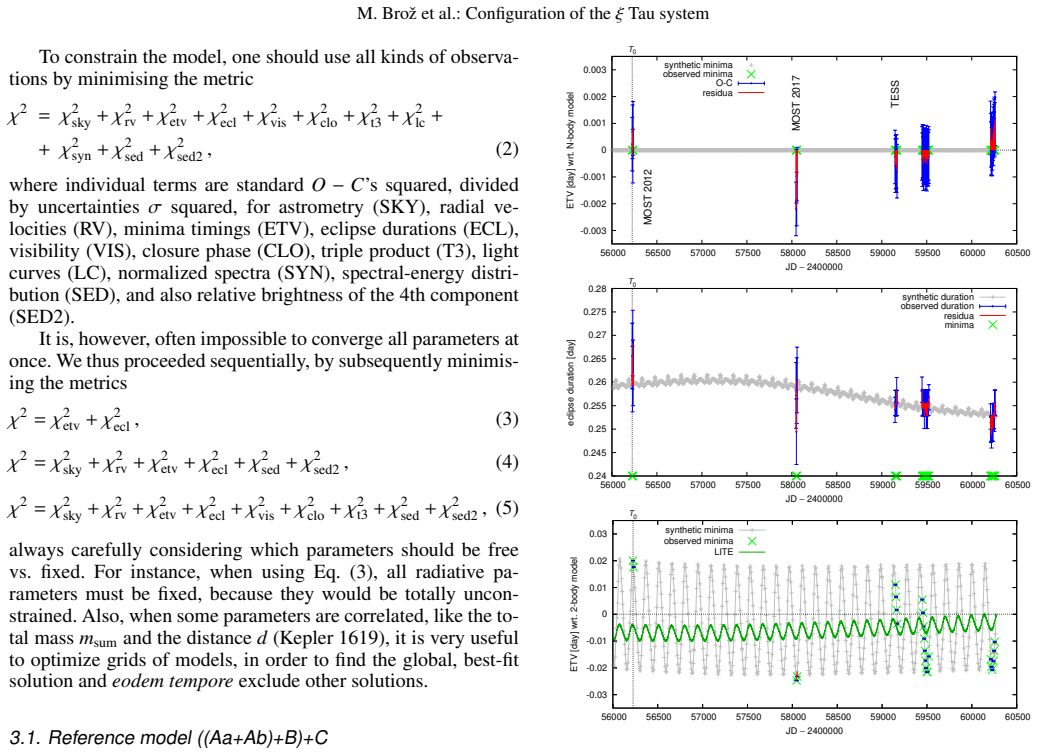
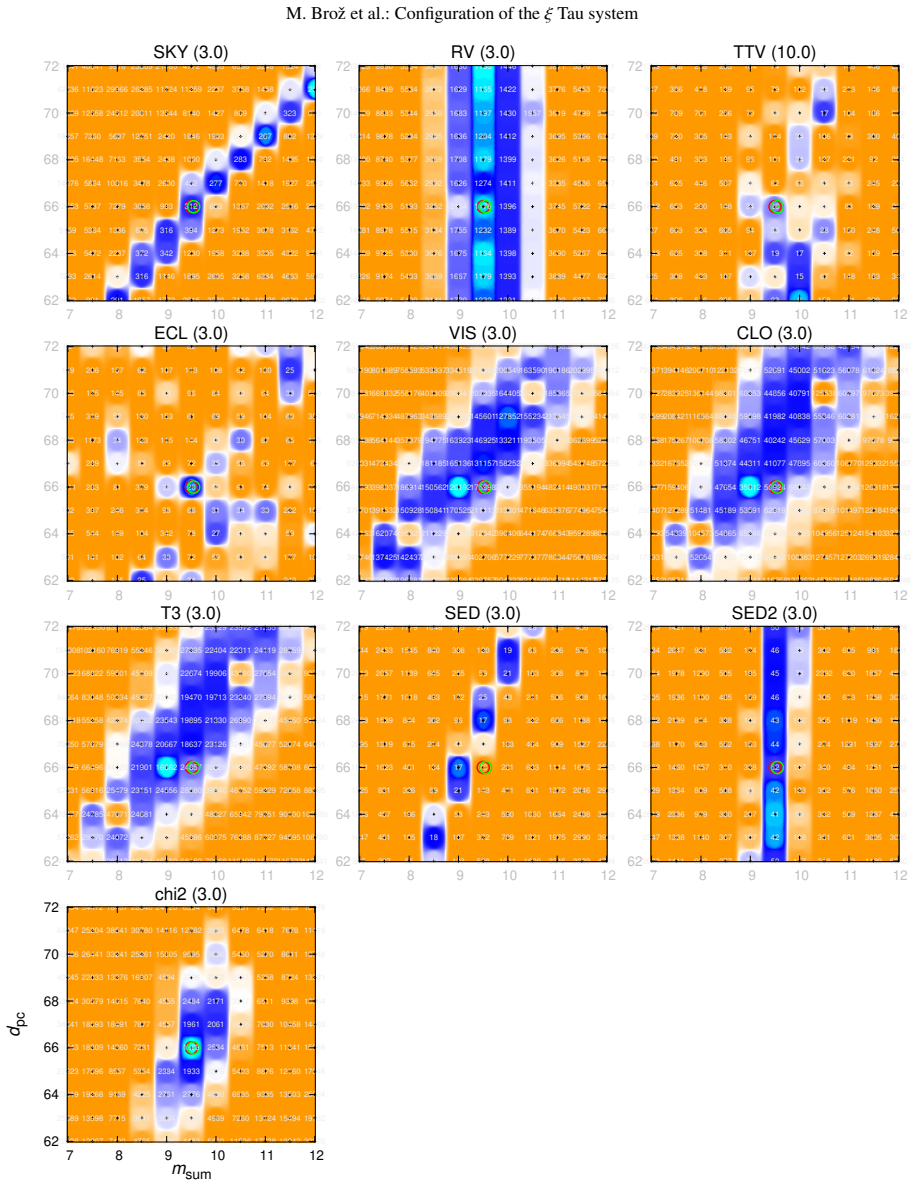
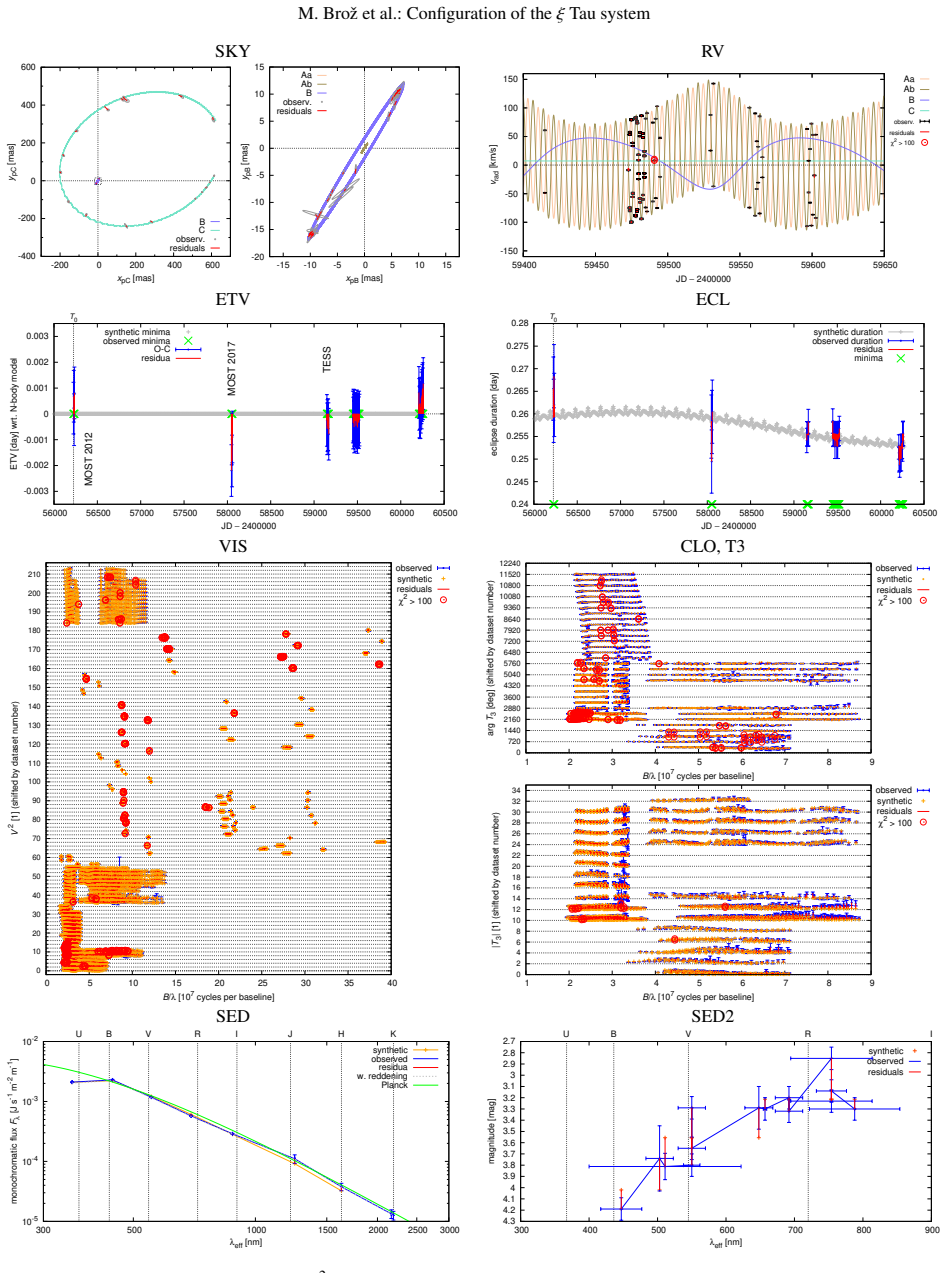
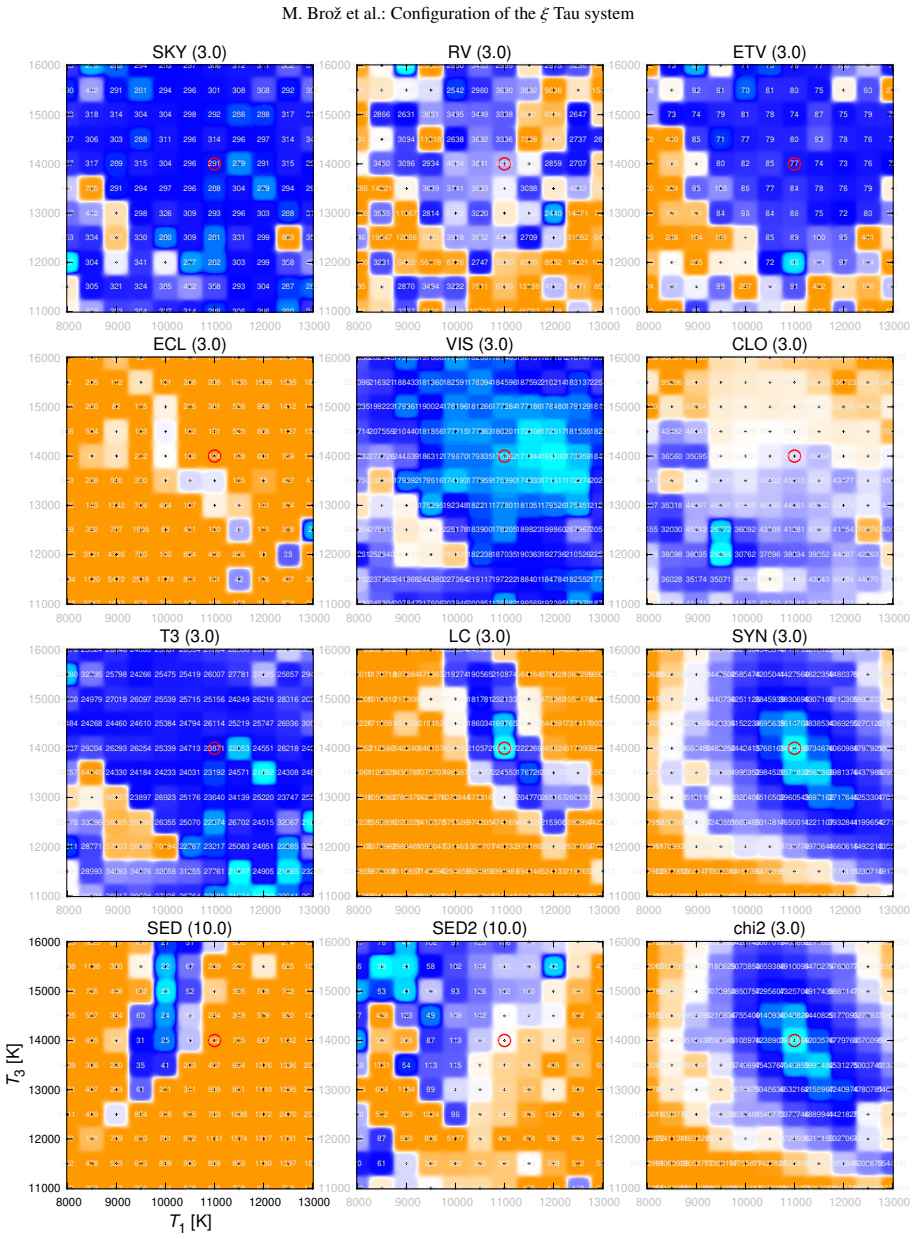
Given the hierarchical architecture of ξ Tau, ((Aa+Ab)+B)+C, the orbital evolution is detected on all time scales with short-period oscillations in eccentricity and inclination changes over about 7000 days affecting eclipse depths. There is also a long-term trend from the outer orbit with period about 18900 days. The mutual inclinations are about 0.5 and 71 degrees, and stability is ensured by fast precession suppressing Kozai oscillations. The best model requires tidal dissipation in the inner binary with time lag of about 100 seconds and five components where component C is a binary Ca+Cb, constraining the masses of the three main components to 2.27, 2.15, and 3.78 solar masses within 1%.
What carries the argument
Hierarchical three-orbit model of the ((Aa+Ab)+B)+C system with tidal dissipation applied to the inner binary.
If this is right
- The inclination of the inner eclipsing pair varies between 86.1 and 87.1 degrees, changing the observed eclipse depths over time.
- Eccentricities oscillate with small amplitudes on orbital timescales.
- The outer component C shows a perihelion passage bump in radial velocities.
- Long-term stability is maintained despite the large mutual inclination of 71 degrees due to rapid apsidal precession.
- The suspected binary nature of C at 600 mas offset requires further characterization.
Where Pith is reading between the lines
- If the tidal time lag is indeed around 100 seconds, it could indicate the viscous dissipation properties inside the stars of the inner binary.
- Better characterization of the Ca+Cb pair might reveal whether the system has even more components as hinted.
- The constrained masses could be used to test theoretical models of stellar structure and evolution for stars of these masses.
- Ongoing observations could detect any additional dwarf or exoplanetary companions through continued monitoring.
Load-bearing premise
The hierarchical architecture ((Aa+Ab)+B)+C is taken as given and the outer component C is modeled as an unresolved binary to fit the long-term radial-velocity trend and astrometric offset.
What would settle it
A direct resolution of component C into two separate stars via high-resolution astrometry or interferometry at the predicted 600 mas separation, or the absence of the expected long-term radial velocity trend if C is not binary, would confirm or refute the five-component model.
Figures

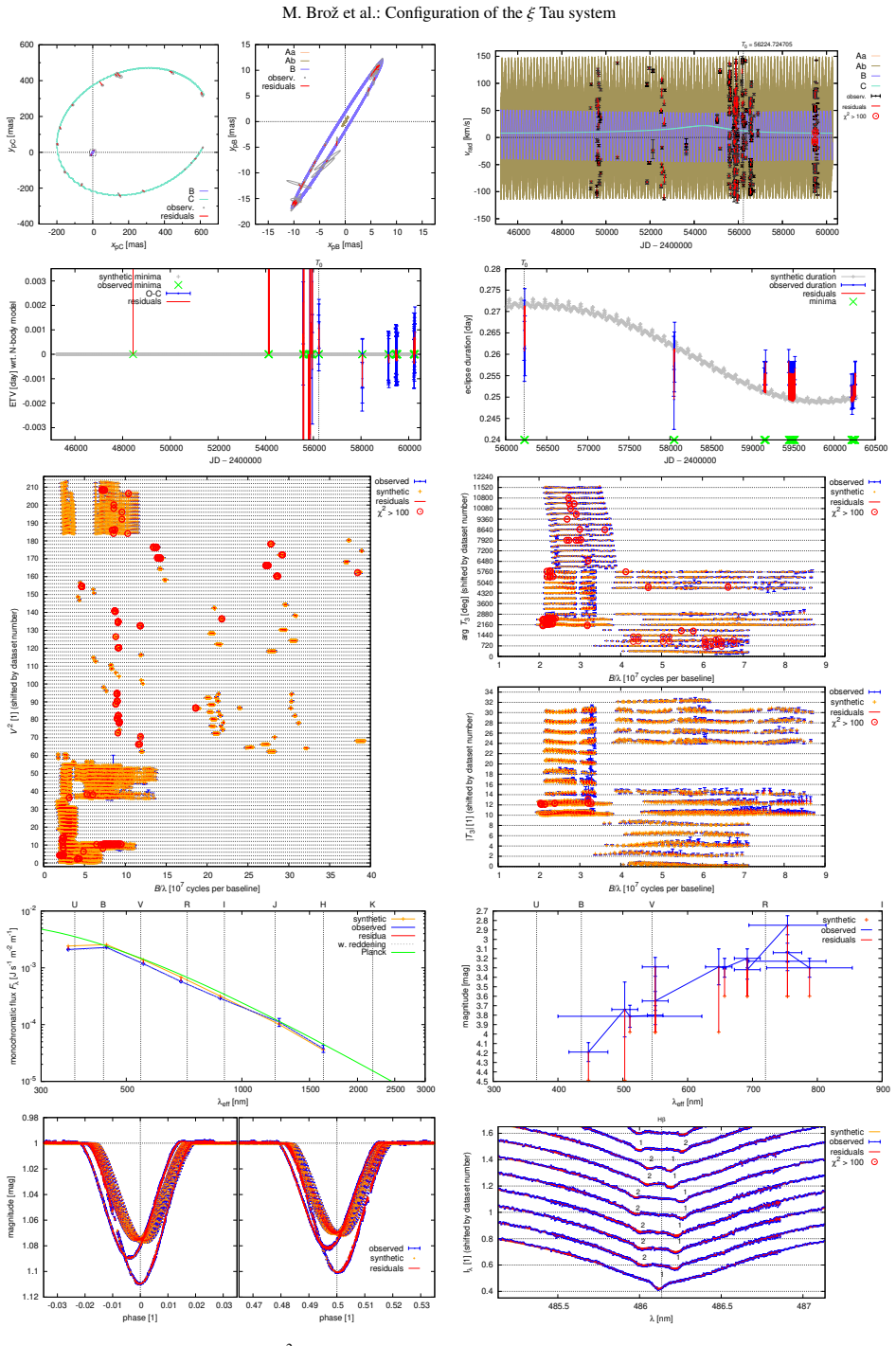


read the original abstract
$\xi$ Tau is one of the most compact multiple stellar systems, which is sufficiently close (67 pc) to be constrained by all kinds of observations. To better constrain its current configuration, we utilized new observational data: (i) photometry from TESS and astrometry from WDS, and (ii) our own photometry from the MOST spacecraft and spectroscopy from the CTIO observatory. [...] Given the hierarchical architecture of $\xi$ Tau, ((Aa+Ab)+B)+C, we detected the orbital evolution on all time scales. Oscillations of periods $P$ occur on the shortest, orbital time scales ($P_1$, $P_2$); the variation of eccentricity $e_1$ is from 0 to 0.008, and of $e_2$ from 0.202 to 0.207, respectively. Oscillations of projected $i$, $\Omega$ are coupled, and occur on the secular time scale of about 7000 d. The inclination $i_1$ of the inner, eclipsing pair (Aa+Ab) changes from $86.1^\circ$ to $87.1^\circ$, which is clearly manifested in eclipse depths. There is also a long-term trend due to the outer orbit ($P_3 \doteq 18900\,{\rm d}$), with a perihelion passage (a `bump') of component C, which is manifested in radial velocities. The mutual inclinations between the three orbital planes, ${\simeq}\,0.5^\circ$ and $71^\circ$, are very different. Long-term stability is ensured by suppressing Kozai oscillations due to the fast precession rate $\dot\omega_2$. The best model requires tidal dissipation in the inner binary (with the time lag of ${\sim}100\,{\rm s}$) and five components, where component C is a binary (Ca+Cb). Although the masses of the three components ($2.27$, $2.15$, $3.78\,M_\odot$) are now constrained to within 1%, the suspected binary (Ca+Cb), offset by $600\,{\rm mas}$, should be better characterized. A key question remains whether this bright stellar system contains additional dwarf or exoplanetary components with low masses. Continuing monitoring of $\xi$ Tau is highly desirable.
Editorial analysis
A structured set of objections, weighed in public.
Referee Report
Summary. The manuscript analyzes the ξ Tau stellar system using combined photometric data from TESS and MOST, spectroscopic observations from CTIO, and astrometric data from WDS. Assuming a hierarchical architecture ((Aa+Ab)+B)+C with C as an unresolved binary (Ca+Cb), it models orbital evolution across different timescales, including short-term oscillations in eccentricity and inclination, secular changes, and a long-term trend from the outer orbit with period ~18900 days. The analysis concludes that tidal dissipation in the inner binary with a time lag of ~100 s is required, and constrains the masses of the three main components to within 1%.
Significance. The combination of multiple independent observational techniques (photometry, spectroscopy, and astrometry) is a strength that enables constraints on both short-term orbital variations and longer-term dynamical effects such as inclination changes affecting eclipse depths. If validated, the work contributes to understanding tidal dissipation and stability in compact hierarchical multiples by reporting specific parameter values and noting the suppression of Kozai cycles via fast precession.
major comments (2)
- [Abstract] Abstract: The central claim that 'the best model requires tidal dissipation in the inner binary (with the time lag of ∼100 s) and five components, where component C is a binary (Ca+Cb)' and that masses are constrained to within 1% rests on attributing the long-term RV trend and 600 mas astrometric offset to an outer orbit (P3 ≃ 18900 d) without reported statistical model comparison. No Δχ², BIC, AIC, or nested-model F-test results are provided to demonstrate that a single-C 4-body model fails to reproduce the CTIO RV data and WDS astrometry at the stated precision; this makes the necessity of the Ca+Cb split and the resulting mass precisions dependent on an untested architectural choice rather than an independent test.
- [Model fitting section] Model fitting section: Orbital elements (including e1, e2, i1, Ω) and the tidal time lag are fitted directly to the same photometric and spectroscopic time series used to detect the long-term trend. This introduces potential circularity, as the conclusion that the model 'requires' five components and a specific dissipation timescale depends on the chosen parameterization; explicit tests of alternative architectures (e.g., single C vs. binary C) or parameterizations should be shown to establish that the 1% mass constraints are robust rather than prior-dependent.
minor comments (2)
- [Abstract] Abstract: The periods are denoted P1, P2, P3 and eccentricities e1, e2 without an explicit introductory definition or reference to the corresponding orbital planes, which may reduce clarity for readers.
- The manuscript would benefit from a dedicated table summarizing the best-fit parameters with uncertainties, covariance information, and reduced χ² values for the adopted model.
Simulated Author's Rebuttal
We thank the referee for the constructive comments on our manuscript analyzing the ξ Tau system. We address each major comment below and will make revisions to strengthen the statistical support for our model choices.
read point-by-point responses
-
Referee: [Abstract] The central claim that 'the best model requires tidal dissipation in the inner binary (with the time lag of ∼100 s) and five components, where component C is a binary (Ca+Cb)' and that masses are constrained to within 1% rests on attributing the long-term RV trend and 600 mas astrometric offset to an outer orbit (P3 ≃ 18900 d) without reported statistical model comparison. No Δχ², BIC, AIC, or nested-model F-test results are provided to demonstrate that a single-C 4-body model fails to reproduce the CTIO RV data and WDS astrometry at the stated precision.
Authors: We agree that explicit statistical comparisons were not reported in the original manuscript. The choice of a five-component model with C as a binary (Ca+Cb) is based on the 600 mas astrometric offset observed in WDS data and the long-term radial velocity trend in CTIO observations, which align with an outer period of ~18900 days. To address this, we will add BIC and AIC comparisons between the 4-body and 5-body models in the revised version, demonstrating the improved fit and justifying the mass constraints to within 1%. revision: yes
-
Referee: [Model fitting section] Orbital elements (including e1, e2, i1, Ω) and the tidal time lag are fitted directly to the same photometric and spectroscopic time series used to detect the long-term trend. This introduces potential circularity, as the conclusion that the model 'requires' five components and a specific dissipation timescale depends on the chosen parameterization; explicit tests of alternative architectures (e.g., single C vs. binary C) or parameterizations should be shown to establish that the 1% mass constraints are robust rather than prior-dependent.
Authors: We acknowledge the potential for circularity in fitting parameters to data that also exhibits the long-term trend. The short-term orbital oscillations are primarily constrained by the photometric data from TESS and MOST, while the long-term aspects come from spectroscopy and astrometry. In the revision, we will present explicit tests of alternative architectures, including single C versus binary C, and report the fit statistics to show that the 1% mass precision and the tidal time lag of ~100 s are robust. revision: yes
Circularity Check
No significant circularity; results are direct observational fits
full rationale
The paper constrains the ξ Tau configuration by fitting orbital elements, tidal time lag, and component masses directly to photometric, spectroscopic, and astrometric time series under an assumed hierarchical architecture ((Aa+Ab)+B)+C. No derivation chain claims an independent prediction or first-principles result that reduces by construction to the fitted inputs; the 'best model requires' statement is the outcome of the fit itself rather than a separate prediction. No self-citation load-bearing steps, uniqueness theorems, or ansatzes smuggled via prior work are present in the abstract or described methods. The analysis is self-contained against the external data sets.
Axiom & Free-Parameter Ledger
free parameters (2)
- tidal time lag =
~100 s
- component masses =
2.27, 2.15, 3.78 solar masses
axioms (1)
- domain assumption Hierarchical architecture ((Aa+Ab)+B)+C
invented entities (1)
-
Ca+Cb binary
no independent evidence
Lean theorems connected to this paper
-
IndisputableMonolith/Cost/FunctionalEquation.leanwashburn_uniqueness_aczel unclear?
unclearRelation between the paper passage and the cited Recognition theorem.
The best model requires tidal dissipation in the inner binary (with the time lag of ∼100 s) and five components, where component C is a binary (Ca+Cb).
-
IndisputableMonolith/Foundation/DimensionForcing.leanalexander_duality_circle_linking unclear?
unclearRelation between the paper passage and the cited Recognition theorem.
Given the hierarchical architecture of ξ Tau, ((Aa+Ab)+B)+C, we detected the orbital evolution on all time scales.
What do these tags mean?
- matches
- The paper's claim is directly supported by a theorem in the formal canon.
- supports
- The theorem supports part of the paper's argument, but the paper may add assumptions or extra steps.
- extends
- The paper goes beyond the formal theorem; the theorem is a base layer rather than the whole result.
- uses
- The paper appears to rely on the theorem as machinery.
- contradicts
- The paper's claim conflicts with a theorem or certificate in the canon.
- unclear
- Pith found a possible connection, but the passage is too broad, indirect, or ambiguous to say the theorem truly supports the claim.
Reference graph
Works this paper leans on
-
[1]
Applications of satellites to geodesy
Theory of satellite geodesy. Applications of satellites to geodesy
-
[2]
Improved equations for eccentricity generation in hierarchical triple systems. , keywords =. doi:10.1111/j.1365-2966.2008.14143.x , archivePrefix =. 0811.1146 , primaryClass =
-
[3]
M., Protopapas, P., Sandvik, H
Eccentricity generation in hierarchical triple systems: the planetary regime. , keywords =. doi:10.1111/j.1365-2966.2005.09888.x , archivePrefix =. 1408.6263 , primaryClass =
-
[4]
2003, , 341, 501, 10.1046/j.1365-8711.2003.06431.x
Eccentricity evolution in hierarchical triple systems with eccentric outer binaries. , keywords =. doi:10.1046/j.1365-8711.2003.06942.x , archivePrefix =. 1408.5890 , primaryClass =
-
[5]
Secular motion in a hierarchic triple stellar system. , keywords =. doi:10.1093/mnras/stv361 , adsurl =
-
[6]
Bidirectional reflectance spectroscopy. I - Theory. , keywords =. doi:10.1029/JB086iB04p03039 , adsurl =
-
[7]
New determination of the size and bulk density of the binary Asteroid 22 Kalliope from observations of mutual eclipses. , keywords =. doi:10.1016/j.icarus.2008.03.014 , archivePrefix =. 0710.1471 , primaryClass =
work page internal anchor Pith review Pith/arXiv arXiv doi:10.1016/j.icarus.2008.03.014 2008
-
[8]
Disk-resolved photometry of small bodies
-
[9]
M-type (22) Kalliope: A tiny Mercury. , keywords =. doi:10.1051/0004-6361/202243200 , adsurl =
-
[10]
Discovery of an asteroid family linked to (22) Kalliope and its moon Linus. , keywords =. doi:10.1051/0004-6361/202243628 , archivePrefix =. 2205.15736 , primaryClass =
-
[11]
Comm.\ ACM , year = 1992, volume =
A generic solution to polygon clipping. Comm.\ ACM , year = 1992, volume =
work page 1992
-
[12]
Physics Of Eclipsing Binaries. II. Toward the Increased Model Fidelity. , keywords =. doi:10.3847/1538-4365/227/2/29 , archivePrefix =. 1609.08135 , primaryClass =
work page internal anchor Pith review Pith/arXiv arXiv doi:10.3847/1538-4365/227/2/29
-
[14]
Gaia DR2 documentation
-
[15]
Astronomicheskii Vestnik , keywords =
UBV photometry of the M-type asteroids 16 Psyche and 22 Kalliope. Astronomicheskii Vestnik , keywords =
-
[16]
Gaia Data Release 2. Summary of the contents and survey properties
Gaia Data Release 2. Summary of the contents and survey properties. , keywords =. doi:10.1051/0004-6361/201833051 , archivePrefix =. 1804.09365 , primaryClass =
work page internal anchor Pith review Pith/arXiv arXiv doi:10.1051/0004-6361/201833051
-
[17]
Astrometric measurements of visual binaries in 2015-2016
Speckle observations with PISCO in Calern (France): I. Astrometric measurements of visual binaries in 2015-2016. Astronomische Nachrichten , keywords =. doi:10.1002/asna.201913642 , adsurl =
-
[18]
DAMIT: a database of asteroid models. , keywords =. doi:10.1051/0004-6361/200912693 , adsurl =
-
[19]
Precise astrometry and diameters of asteroids from occultations - a data set of observations and their interpretation. , keywords =. doi:10.1093/mnras/staa3077 , archivePrefix =. 2010.06086 , primaryClass =
-
[20]
SOFA: Standards of Fundamental Astronomy
-
[21]
Photometric Studies of Asteroids.IX. Additional Light-Curves. , year = 1962, month = may, volume =. doi:10.1086/147334 , adsurl =
-
[22]
Lightcurves, Phase Function and Pole of the Asteroid 22 Kalliope. , keywords =. doi:10.1016/0019-1035(78)90129-X , adsurl =
-
[23]
Expressions for the Precession Quantities Based upon the IAU (1976) System of Astronomical Constants. , keywords =
work page 1976
-
[24]
Geophysical Journal , keywords =
The forced nutations of an elliptical, rotating, elastic and oceanless earth. Geophysical Journal , keywords =. doi:10.1111/j.1365-246X.1981.tb02691.x , adsurl =
-
[25]
Astronomická příručka
-
[26]
Photoelectric photometry of 22 Kalliope during the 1985 opposition and determination of its pole orientation - The 'magnitude-aspect' relations revisited. , keywords =
work page 1985
-
[27]
SPECULOOS: a network of robotic telescopes to hunt for terrestrial planets around the nearest ultracool dwarfs. Ground-based and Airborne Telescopes VII , year = 2018, editor =. doi:10.1117/12.2312475 , archivePrefix =. 1806.11205 , primaryClass =
work page internal anchor Pith review Pith/arXiv arXiv doi:10.1117/12.2312475 2018
-
[28]
An advanced multipole model for (216) Kleopatra triple system. , keywords =. doi:10.1051/0004-6361/202140901 , archivePrefix =. 2105.09134 , primaryClass =
-
[29]
Observed tidal evolution of Kleopatra's outer satellite. , keywords =. doi:10.1051/0004-6361/202142055 , archivePrefix =. 2110.12702 , primaryClass =
-
[30]
, year = 2006, month = may, volume = 182, pages =
Yarkovsky footprints in the Eos family. , year = 2006, month = may, volume = 182, pages =. doi:10.1016/j.icarus.2005.12.011 , adsurl =
-
[31]
, archivePrefix = "arXiv", eprint =
The size distributions of asteroid families in the SDSS Moving Object Catalog 4. , archivePrefix = "arXiv", eprint =. doi:10.1016/j.icarus.2008.07.002 , adsurl =
-
[32]
Main Belt Asteroids with WISE/NEOWISE. I. Preliminary Albedos and Diameters. , archivePrefix = "arXiv", eprint =. doi:10.1088/0004-637X/741/2/68 , adsurl =
-
[33]
An extension of the Bus asteroid taxonomy into the near-infrared. , year = 2009, month = jul, volume = 202, pages =. doi:10.1016/j.icarus.2009.02.005 , adsurl =
-
[34]
, year = 2005, month = may, volume = 435, pages =
Chaotic capture of Jupiter's Trojan asteroids in the early Solar System. , year = 2005, month = may, volume = 435, pages =. doi:10.1038/nature03540 , adsurl =
-
[35]
, year = 1995, month = aug, volume = 116, pages =
Asteroid families: Search of a 12,487-asteroid sample using two different clustering techniques. , year = 1995, month = aug, volume = 116, pages =. doi:10.1006/icar.1995.1127 , adsurl =
-
[36]
The long-term dynamical behavior of short-period comets. , keywords =. doi:10.1006/icar.1994.1039 , adsurl =
-
[37]
Celestial Mechanics and Dynamical Astronomy , eprint =
High order symplectic integrators for perturbed Hamiltonian systems. Celestial Mechanics and Dynamical Astronomy , eprint =
-
[38]
, year = 2004, month = dec, volume = 172, pages =
The YORP effect with finite thermal conductivity. , year = 2004, month = dec, volume = 172, pages =. doi:10.1016/j.icarus.2004.07.003 , adsurl =
-
[39]
Did the Hilda collisional family form during the late heavy bombardment?. , archivePrefix = "arXiv", eprint =. doi:10.1111/j.1365-2966.2011.18587.x , adsurl =
-
[40]
, archivePrefix = "arXiv", eprint =
A study of asteroid pole-latitude distribution based on an extended set of shape models derived by the lightcurve inversion method. , archivePrefix = "arXiv", eprint =. doi:10.1051/0004-6361/201116738 , adsurl =
-
[41]
, year = 1998, month = apr, volume = 132, pages =
Meteorite Delivery via Yarkovsky Orbital Drift. , year = 1998, month = apr, volume = 132, pages =. doi:10.1006/icar.1997.5872 , adsurl =
-
[42]
Yarkovsky Effect and the Dynamics of the Solar System. PhD Thesis, Charles Univ. , year = 2006, pages =
work page 2006
-
[43]
Celestial Mechanics and Dynamical Astronomy , keywords =
Frequency modified Fourier transform and its applications to asteroids. Celestial Mechanics and Dynamical Astronomy , keywords =. doi:10.1007/BF00048443 , adsurl =
-
[44]
, year = 2000, month = may, volume = 145, pages =
Fugitives from the Eos Family: First Spectroscopic Confirmation. , year = 2000, month = may, volume = 145, pages =. doi:10.1006/icar.2000.6349 , adsurl =
-
[45]
, year = 1999, month = sep, volume = 141, pages =
The Velocity-Size Relationship for Members of Asteroid Families and Implications for the Physics of Catastrophic Collisions. , year = 1999, month = sep, volume = 141, pages =. doi:10.1006/icar.1999.6149 , adsurl =
-
[46]
Asteroid proper elements and secular resonances. , keywords =. doi:10.1016/0019-1035(92)90091-K , adsurl =
-
[47]
A frequency approach to identifying asteroid families. , keywords =. doi:10.1051/0004-6361:20077689 , adsurl =
-
[48]
A frequency approach to identifying asteroid families. II. Families interacting with nonlinear secular resonances and low-order mean-motion resonances. , keywords =. doi:10.1051/0004-6361:200809852 , adsurl =
-
[49]
The (not so) peculiar case of the Padua family. , keywords =. doi:10.1111/j.1365-2966.2009.14523.x , adsurl =
-
[50]
Asteroids, Comets, Meteors 2014 , year = 2014, editor =
Recent disruption of an asteroid from the Eos family. Asteroids, Comets, Meteors 2014 , year = 2014, editor =
work page 2014
-
[51]
, archivePrefix = "arXiv", eprint =
The Eos family halo. , archivePrefix = "arXiv", eprint =. doi:10.1016/j.icarus.2013.02.002 , adsurl =
-
[52]
Asteroids IV , year = 2015, editor =
Identification and Dynamical Properties of Asteroid Families. Asteroids IV , year = 2015, editor =. doi:10.2458/azu_uapress_9780816532131-ch016 , publisher =
-
[53]
, year = 2008, month = may, volume = 195, pages =
Mineralogical analysis of the Eos family from near-infrared spectra. , year = 2008, month = may, volume = 195, pages =. doi:10.1016/j.icarus.2007.12.005 , adsurl =
-
[54]
, year = 1918, month = oct, volume = 31, pages =
Groups of asteroids probably of common origin. , year = 1918, month = oct, volume = 31, pages =. doi:10.1086/104299 , adsurl =
-
[55]
Diurnal Yarkovsky effect as a source of mobility of meter-sized asteroidal fragments. I. Linear theory. , keywords =
-
[56]
The Yarkovsky Seasonal Effect on Asteroidal Fragments: A Nonlinearized Theory for Spherical Bodies. , keywords =. doi:10.1086/301138 , adsurl =
-
[57]
, year = 2000, month = nov, volume = 148, pages =
Fast and Slow Rotation of Asteroids. , year = 2000, month = nov, volume = 148, pages =. doi:10.1006/icar.2000.6482 , adsurl =
-
[58]
A three million year integration of the earth's orbit. , keywords =. doi:10.1086/115850 , adsurl =
-
[59]
, archivePrefix = "arXiv", eprint =
Asteroids were born big. , archivePrefix = "arXiv", eprint =. doi:10.1016/j.icarus.2009.07.011 , adsurl =
-
[60]
Size-frequency distributions of fragments from SPH/ N-body simulations of asteroid impacts: Comparison with observed asteroid families. , keywords =. doi:10.1016/j.icarus.2006.09.013 , adsurl =
-
[61]
, archivePrefix = "arXiv", eprint =
Distribution of spin-axes longitudes and shape elongations of main-belt asteroids. , archivePrefix = "arXiv", eprint =. doi:10.1051/0004-6361/201629192 , adsurl =
-
[62]
, archivePrefix = "arXiv", eprint =
Spin states of asteroids in the Eos collisional family. , archivePrefix = "arXiv", eprint =. doi:10.1016/j.icarus.2017.07.007 , adsurl =
-
[63]
SPH/N-Body simulations of small ( D = 10 \,km) asteroidal breakups and improved parametric relations for Monte-Carlo collisional models. , keywords =. doi:10.1016/j.icarus.2017.06.021 , adsurl =
-
[64]
Catastrophic Disruptions Revisited. , eprint =. doi:10.1006/icar.1999.6204 , adsurl =
-
[65]
Linking the collisional history of the main asteroid belt to its dynamical excitation and depletion. , year = 2005, month = dec, volume = 179, pages =. doi:10.1016/j.icarus.2005.05.017 , adsurl =
-
[66]
, year = 2018, month = apr, volume = 304, pages =
Reconstructing the size distribution of the primordial Main Belt. , year = 2018, month = apr, volume = 304, pages =
work page 2018
-
[67]
Proper element catalogs and asteroid families. , keywords =. doi:10.1051/0004-6361:20030475 , adsurl =
-
[68]
, archivePrefix = "arXiv", eprint =
Evolution of eccentricity and inclination of hot protoplanets embedded in radiative discs. , archivePrefix = "arXiv", eprint =. doi:10.1093/mnras/stx856 , adsurl =
-
[69]
, archivePrefix = "arXiv", eprint =
Eccentricity excitation and merging of planetary embryos heated by pebble accretion. , archivePrefix = "arXiv", eprint =. doi:10.1051/0004-6361/201731033 , adsurl =
-
[70]
, archivePrefix = "arXiv", eprint =
On the formation of compact planetary systems via concurrent core accretion and migration. , archivePrefix = "arXiv", eprint =. doi:10.1093/mnras/stw149 , adsurl =
-
[71]
Three-dimensional Interaction between a Planet and an Isothermal Gaseous Disk. II. Eccentricity Waves and Bending Waves. , keywords =. doi:10.1086/380992 , adsurl =
-
[72]
Using FU Orionis outbursts to constrain self-regulated protostellar disk models. , eprint =. doi:10.1086/174206 , adsurl =
-
[73]
, archivePrefix = "arXiv", eprint =
Reduced gas accretion on super-Earths and ice giants. , archivePrefix = "arXiv", eprint =. doi:10.1051/0004-6361/201731014 , adsurl =
-
[74]
, archivePrefix = "arXiv", eprint =
Rapid growth of gas-giant cores by pebble accretion. , archivePrefix = "arXiv", eprint =. doi:10.1051/0004-6361/201219127 , adsurl =
-
[75]
, archivePrefix = "arXiv", eprint =
Runaway gas accretion and gap opening versus type I migration. , archivePrefix = "arXiv", eprint =. doi:10.1016/j.icarus.2016.10.017 , adsurl =
-
[76]
II - Self-consistent nonlinear interaction
On the tidal interaction between protoplanets and the primordial solar nebula. II - Self-consistent nonlinear interaction. , keywords =. doi:10.1086/164426 , adsurl =
-
[77]
, archivePrefix = "arXiv", eprint =
Linear and non-linear evolution of the vertical shear instability in accretion discs. , archivePrefix = "arXiv", eprint =. doi:10.1093/mnras/stt1475 , adsurl =
-
[78]
Turbulence in Accretion Disks: Vorticity Generation and Angular Momentum Transport via the Global Baroclinic Instability. , eprint =. doi:10.1086/344743 , adsurl =
-
[79]
A powerful local shear instability in weakly magnetized disks. I - Linear analysis. II - Nonlinear evolution. , keywords =. doi:10.1086/170270 , adsurl =
-
[80]
Protostars and Planets VI , archivePrefix = "arXiv", eprint =
Transport and Accretion in Planet-Forming Disks. Protostars and Planets VI , archivePrefix = "arXiv", eprint =. doi:10.2458/azu_uapress_9780816531240-ch018 , adsurl =
-
[81]
The Spiral Wave Instability Induced by a Giant Planet. I. Particle Stirring in the Inner Regions of Protoplanetary Disks. , archivePrefix = "arXiv", eprint =. doi:10.3847/1538-4357/833/2/126 , adsurl =
discussion (0)
Sign in with ORCID, Apple, or X to comment. Anyone can read and Pith papers without signing in.