The impact of evolving dark energy on the Weyl potential measured from the Dark Energy Survey Year 3 data
Pith reviewed 2026-05-22 03:44 UTC · model grok-4.3
The pith
Evolving dark energy models reduce the tension between DES Year 3 Weyl potential data and General Relativity predictions to 1.6-2.2 sigma.
A machine-rendered reading of the paper's core claim, the machinery that carries it, and where it could break.
Core claim
The paper claims that w0waCDM models, which allow dark energy to evolve and cross the phantom divide, reduce the tension between the measured Weyl potential from DES Year 3 and General Relativity predictions from a higher value down to 1.6-2.2 sigma, depending on the CMB lensing treatment. This reduction occurs because the evolving background changes the theoretical evolution of the potentials in GR, rather than because the uncertainties on the Weyl potential measurement increase. The authors conclude that additional data are needed to decide whether this background evolution fully accounts for the low value of the Weyl potential at intermediate redshifts or whether new physics is required.
What carries the argument
The w0waCDM parametrization of dark energy evolution with a phantom crossing, inserted into General Relativity to compute the redshift dependence of the Weyl potential.
If this is right
- The low value of the Weyl potential at intermediate redshifts can be explained by the stronger acceleration produced by phantom-crossing dark energy inside standard General Relativity.
- The reduction in tension is driven by a change in the predicted signal rather than by any inflation of the error bars on the measurement.
- Treatment of CMB lensing affects the precise tension level, showing that consistent modeling of lensing is required for future comparisons.
- If evolving dark energy is confirmed, it may simultaneously address the stabilization of the phantom crossing indicated by DESI.
Where Pith is reading between the lines
- Confirmation of this background evolution could alter predictions for other large-scale structure observables and help test consistency across different probes.
- Similar calculations could be repeated with next-generation surveys to isolate whether the Weyl potential discrepancy persists beyond current error bars.
- A mismatch between the Weyl potential and w0waCDM expectations at higher redshifts would point toward the need for dark-sector interactions.
Load-bearing premise
The phantom-crossing behavior preferred by DESI data provides an accurate description of dark energy that can be directly inserted into General Relativity predictions for the Weyl potential without additional dark-sector interactions or gravity modifications.
What would settle it
A high-precision measurement of the Weyl potential at intermediate redshifts from a future survey that deviates significantly from the w0waCDM prediction in General Relativity, while remaining consistent with DES Year 3, would falsify the claim.
Figures




read the original abstract
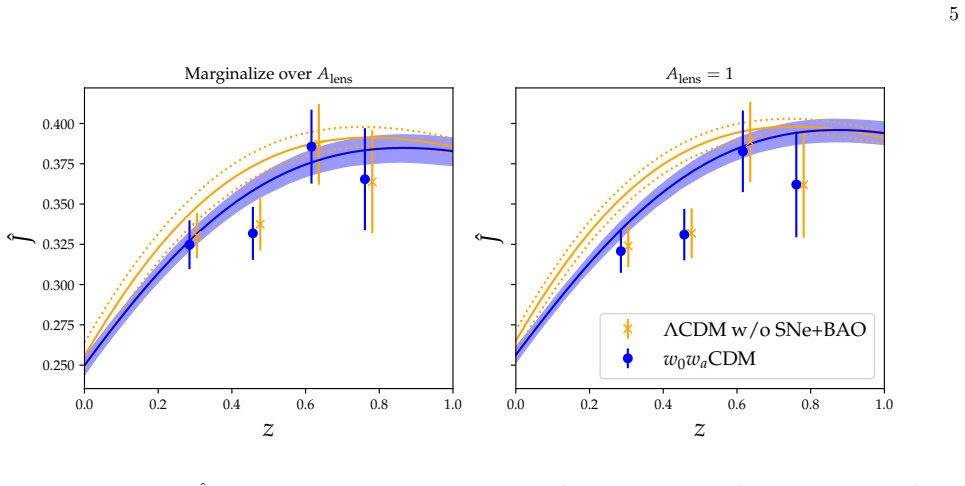
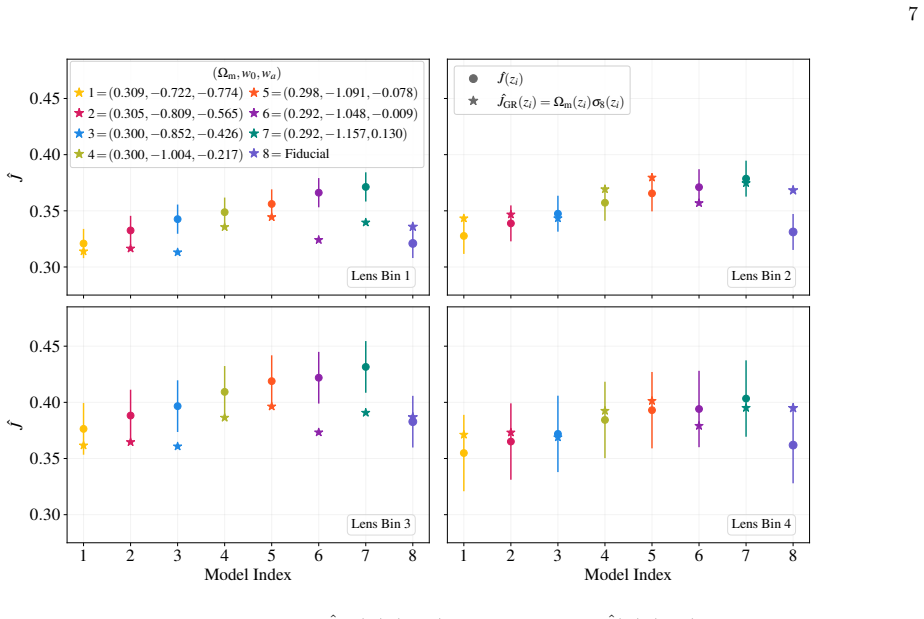
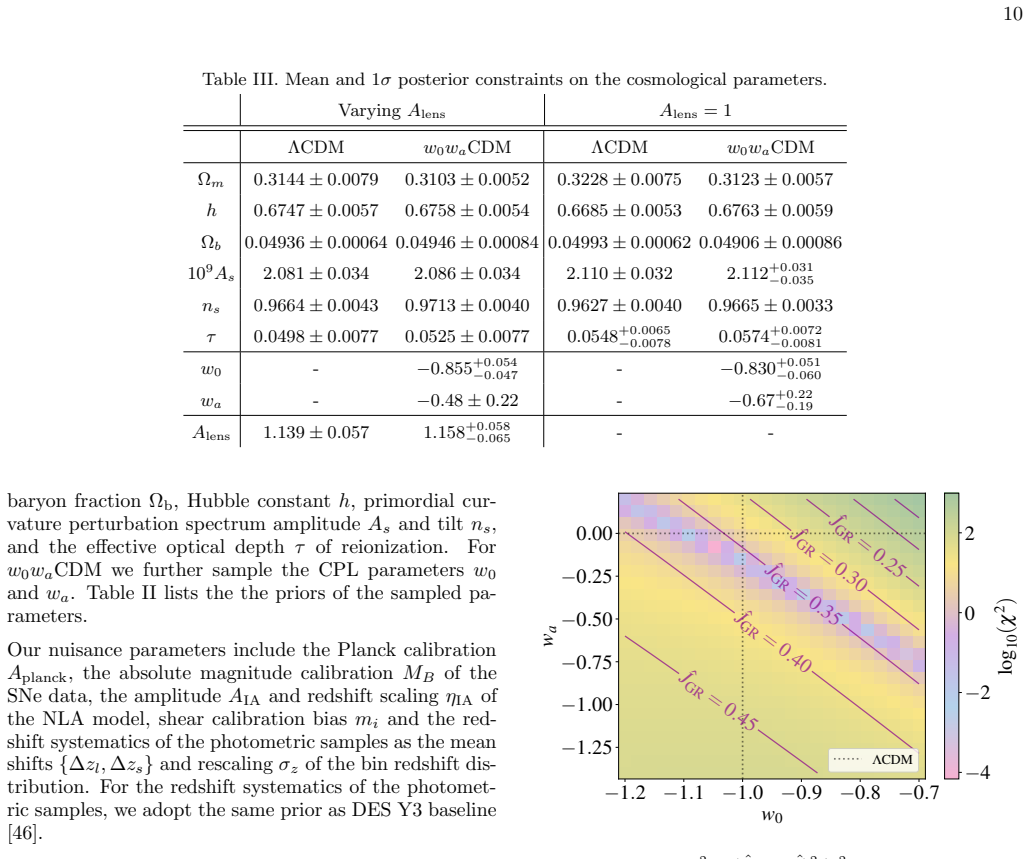
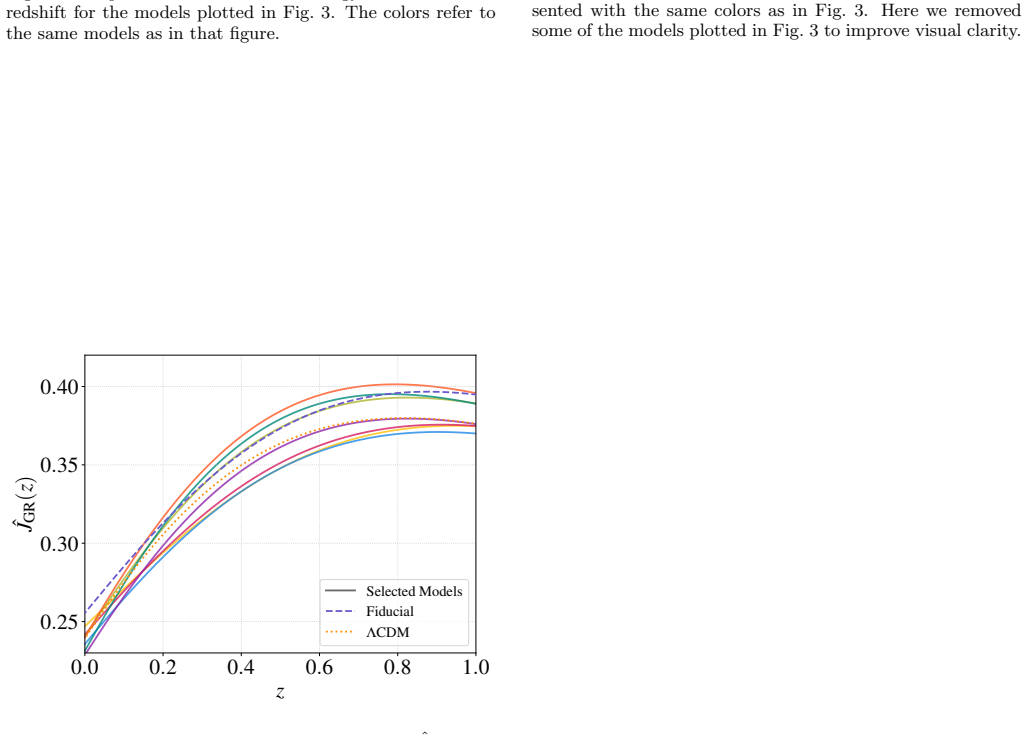
Measurements from the Dark Energy Survey (DES) Year 3 data have shown that the Weyl potential -- the sum of the spatial and temporal distortions of the geometry -- evolves more slowly than predicted by General Relativity, assuming a $\Lambda$CDM background evolution. An evolving dark energy with a phantom crossing, as preferred by the Dark Energy Spectroscopic Instrument (DESI), is expected to decrease the depth of the gravitational potentials through a stronger acceleration than in $\Lambda$CDM, potentially solving the tension with General Relativity. In this paper, we show that $w_0w_a$CDM models indeed reduce the tension with respect to $\Lambda$CDM, down to a level of $1.6-2.2\sigma$, depending on the treatment of CMB lensing. This reduction is not due to an increase in the Weyl potential's uncertainties, but truly to the impact of the evolving background on the theoretical predictions in General Relativity. More data are needed to robustly determine if evolving dark energy fully explains the low value of the Weyl potential at intermediate redshifts, or if modifications of gravity or interactions in the dark sector are needed, which could simultaneously stabilize the phantom crossing indicated by DESI.
Editorial analysis
A structured set of objections, weighed in public.
Referee Report
Summary. The paper claims that w0waCDM models with parameters preferred by DESI data reduce the tension between the Weyl potential measured from DES Year 3 and General Relativity predictions (under a ΛCDM background) to 1.6-2.2σ, depending on CMB lensing treatment. This reduction is attributed to the effect of the evolving background on the theoretical GR prediction for the Weyl potential evolution, rather than to changes in the measurement uncertainties.
Significance. If the result holds, it would show that an evolving dark energy background consistent with DESI can bring the GR-predicted Weyl potential evolution into better agreement with DES Y3 observations, thereby offering a resolution to the apparent slow evolution without requiring modifications to gravity. This underscores the importance of using a consistent background cosmology when interpreting perturbation-level observables and motivates further tests with upcoming data to distinguish evolving dark energy from dark-sector interactions or gravity modifications.
major comments (1)
- [Modeling / Theoretical Predictions] The central claim that the tension reduction arises purely from the impact of the evolving background on GR predictions requires that the w0waCDM model with phantom crossing can be inserted into the standard perturbation equations without additional dark-energy clustering terms or instabilities. The manuscript does not appear to demonstrate the stability of the sound speed or absence of gauge artifacts around w = −1; this assumption is load-bearing for the quoted 1.6-2.2σ levels and should be explicitly verified or referenced in the modeling section.
minor comments (2)
- [Abstract] The abstract states that the reduction is 'not due to an increase in the Weyl potential's uncertainties'; a quantitative comparison (e.g., error bars or covariance matrices for ΛCDM vs. w0waCDM) should be shown in a table or figure to make this explicit.
- [Introduction] Clarify the exact baseline tension value under ΛCDM for direct comparison with the reported 1.6-2.2σ range.
Simulated Author's Rebuttal
We thank the referee for their careful reading and constructive feedback on our manuscript. We appreciate the emphasis on the theoretical robustness of our w0waCDM implementation and address the major comment below. We have prepared revisions to strengthen the modeling section accordingly.
read point-by-point responses
-
Referee: [Modeling / Theoretical Predictions] The central claim that the tension reduction arises purely from the impact of the evolving background on GR predictions requires that the w0waCDM model with phantom crossing can be inserted into the standard perturbation equations without additional dark-energy clustering terms or instabilities. The manuscript does not appear to demonstrate the stability of the sound speed or absence of gauge artifacts around w = −1; this assumption is load-bearing for the quoted 1.6-2.2σ levels and should be explicitly verified or referenced in the modeling section.
Authors: We agree that explicit verification of perturbation stability is important for the reliability of our results. Our calculations employ the standard fluid implementation of w0waCDM within the CLASS Boltzmann solver, which adopts c_s² = 1 to suppress instabilities and ghost modes during phantom crossing while introducing no extra clustering beyond the background evolution. This setup is the conventional choice in the literature for such models and has been shown to remain free of gauge artifacts in the Weyl potential computation. To address the referee's concern directly, the revised manuscript will include a brief paragraph in the modeling section that references key works on the stability of dark-energy fluid perturbations (e.g., those validating the c_s² = 1 choice for w0wa) and confirms that our DESI-preferred parameter ranges produce no unphysical behavior. This addition will make the theoretical foundation of the reported 1.6–2.2σ tension reduction fully transparent without altering the core analysis. revision: yes
Circularity Check
No significant circularity: external DESI parameters drive GR prediction for independent DES observable
full rationale
The paper takes w0waCDM parameters preferred by DESI data as input and substitutes them into the standard GR perturbation equations to obtain a theoretical prediction for the Weyl potential evolution. This prediction is compared against the Weyl potential measurement extracted from DES Year 3 data. Because the background parameters originate from a separate experiment and the calculation follows directly from the background evolution equation without refitting or re-deriving the target observable, the central claim that evolving dark energy reduces tension does not reduce to a self-fit or self-citation by construction. The derivation chain is self-contained against external benchmarks.
Axiom & Free-Parameter Ledger
free parameters (2)
- w0
- wa
axioms (2)
- domain assumption General Relativity accurately describes the evolution of the Weyl potential once the background expansion history is specified.
- domain assumption The DESI-inferred dark energy parameters can be used without modification for the DES lensing analysis.
Lean theorems connected to this paper
-
IndisputableMonolith/Foundation/RealityFromDistinction.leanreality_from_one_distinction unclear?
unclearRelation between the paper passage and the cited Recognition theorem.
We parameterize the latter through its equation of state using the Chevallier-Polarski-Linder (CPL) parametrization... constrain the dark energy time evolution parameters w0 and wa, together with the Weyl potential
What do these tags mean?
- matches
- The paper's claim is directly supported by a theorem in the formal canon.
- supports
- The theorem supports part of the paper's argument, but the paper may add assumptions or extra steps.
- extends
- The paper goes beyond the formal theorem; the theorem is a base layer rather than the whole result.
- uses
- The paper appears to rely on the theorem as machinery.
- contradicts
- The paper's claim conflicts with a theorem or certificate in the canon.
- unclear
- Pith found a possible connection, but the passage is too broad, indirect, or ambiguous to say the theorem truly supports the claim.
Reference graph
Works this paper leans on
-
[1]
This inferred ˆJprovides a good approximation of the measured ˆJthat we would infer directly from the data through an MCMC, but under the constraints that the other parameters are fixed, which is sufficient for our 7 Ideally, we should use the measuredC ∆κ ℓ in our fit. However, we do not have access to it, first, since DES’s public release provides the c...
-
[2]
Planck 2018 results. VI. Cosmological parameters
N. Aghanimet al.(Planck), Astron. Astrophys.641, A6 (2020), [Erratum: Astron.Astrophys. 652, C4 (2021)], arXiv:1807.06209 [astro-ph.CO]
work page internal anchor Pith review Pith/arXiv arXiv 2020
-
[3]
Modified Gravity and Cosmology
T. Clifton, P. G. Ferreira, A. Padilla, and C. Sko- rdis, Phys. Rept.513, 1 (2012), arXiv:1106.2476 [astro- ph.CO]
work page internal anchor Pith review Pith/arXiv arXiv 2012
-
[4]
Cosmological Tests of Modified Gravity
K. Koyama, Rept. Prog. Phys.79, 046902 (2016), arXiv:1504.04623 [astro-ph.CO]
work page internal anchor Pith review Pith/arXiv arXiv 2016
-
[5]
Dark Energy vs. Modified Gravity
A. Joyce, L. Lombriser, and F. Schmidt, Ann. Rev. Nucl. Part. Sci.66, 95 (2016), arXiv:1601.06133 [astro-ph.CO]
work page internal anchor Pith review Pith/arXiv arXiv 2016
- [6]
-
[7]
I. Tutusaus, C. Bonvin, and N. Grimm, Nature Com- mun.15, 9295 (2024), arXiv:2312.06434 [astro-ph.CO]
-
[8]
Measurement of the Weyl Potential Evolution and $E_G$ Statistic from KiDS-1000, BOSS and 2dFLenS
X. Zhang, M. Zhang, Y. Ren, and X. Yang, (2026), arXiv:2604.24631 [astro-ph.CO]
work page internal anchor Pith review Pith/arXiv arXiv 2026
-
[9]
E. Abdallaet al., JHEAp34, 49 (2022), arXiv:2203.06142 [astro-ph.CO]
work page internal anchor Pith review Pith/arXiv arXiv 2022
-
[10]
A. G. Adameet al.(DESI), JCAP02, 021 (2025), arXiv:2404.03002 [astro-ph.CO]
work page internal anchor Pith review Pith/arXiv arXiv 2025
-
[11]
DESI DR2 Results II: Measurements of Baryon Acoustic Oscillations and Cosmological Constraints
M. Abdul Karimet al.(DESI), Phys. Rev. D112, 083515 (2025), arXiv:2503.14738 [astro-ph.CO]
work page internal anchor Pith review Pith/arXiv arXiv 2025
-
[12]
R. Calderonet al.(DESI), JCAP10, 048 (2024), arXiv:2405.04216 [astro-ph.CO]
- [13]
- [14]
-
[15]
E. Fazzari, W. Giar` e, and E. Di Valentino, Astrophys. J. Lett.996, L5 (2026), arXiv:2509.16196 [astro-ph.CO]
-
[16]
A. Gonz´ alez-Fuentes and A. G´ omez-Valent, JCAP12, 049 (2025), arXiv:2506.11758 [astro-ph.CO]
-
[17]
I. Tutusaus, D. Sobral-Blanco, and C. Bonvin, Phys. Rev. D107(2023), 10.1103/physrevd.107.083526, arXiv:2209.08987 [astro-ph.CO]
-
[18]
Accelerating Universes with Scaling Dark Matter
M. Chevallier and D. Polarski, Int. J. Mod. Phys. D10, 213 (2001), arXiv:gr-qc/0009008
work page internal anchor Pith review Pith/arXiv arXiv 2001
-
[19]
E. V. Linder, Phys. Rev. Lett.90, 091301 (2003), arXiv:astro-ph/0208512
work page internal anchor Pith review Pith/arXiv arXiv 2003
-
[20]
A. Chudaykin and M. Kunz, Phys. Rev. D110, 123524 (2024), arXiv:2407.02558 [astro-ph.CO]
-
[21]
Non-minimally coupled gravity constraints from DESI DR2 data
J. Pan and G. Ye, Phys. Rev. D113, L041304 (2026), arXiv:2503.19898 [astro-ph.CO]
work page internal anchor Pith review Pith/arXiv arXiv 2026
- [22]
- [23]
- [24]
- [25]
-
[26]
Effective Theory of Dark Energy at Redshift Survey Scales
J. Gleyzes, D. Langlois, M. Mancarella, and F. Vernizzi, JCAP02, 056 (2016), arXiv:1509.02191 [astro-ph.CO]
work page internal anchor Pith review Pith/arXiv arXiv 2016
-
[27]
L. Pogosian, M. Raveri, K. Koyama, M. Martinelli, A. Silvestri, G.-B. Zhao, J. Li, S. Peirone, and A. Zucca, Nature Astron.6, 1484 (2022), arXiv:2107.12992 [astro- ph.CO]
-
[28]
S. Srinivasan, S. Prabhu, K. Lehman, A. K. V., and J. Weller, (2026), arXiv:2603.11895 [astro-ph.CO]
work page internal anchor Pith review Pith/arXiv arXiv 2026
- [29]
-
[30]
S. Srinivasan, D. B. Thomas, F. Pace, and R. Battye, JCAP06, 016 (2021), arXiv:2103.05051 [astro-ph.CO]
-
[31]
S. Srinivasan, D. B. Thomas, and R. Battye, JCAP03, 039 (2024), arXiv:2306.17240 [astro-ph.CO]
-
[32]
S. Srinivasan, D. B. Thomas, and P. L. Taylor, JCAP 02, 071 (2025), arXiv:2409.06569 [astro-ph.CO]
-
[33]
Tackling non-linearities with the effective field theory of dark energy and modified gravity
N. Frusciante and G. Papadomanolakis, JCAP12, 014 (2017), arXiv:1706.02719 [gr-qc]
work page internal anchor Pith review Pith/arXiv arXiv 2017
- [34]
-
[35]
Constraining modified theory of gravity with galaxy bispectrum
D. Yamauchi, S. Yokoyama, and H. Tashiro, Phys. Rev. D96, 123516 (2017), arXiv:1709.03243 [astro-ph.CO]
work page internal anchor Pith review Pith/arXiv arXiv 2017
-
[36]
A. Porredonet al.(DES), Phys. Rev. D106, 103530 (2022), arXiv:2105.13546 [astro-ph.CO]
-
[37]
X.-H. Fan, M. A. Strauss, R. H. Becker, R. L. White, J. E. Gunn, G. R. Knapp, G. T. Richards, D. P. Schneider, J. Brinkmann, and M. Fukugita, Astron. J.132, 117 (2006), arXiv:astro-ph/0512082
work page internal anchor Pith review Pith/arXiv arXiv 2006
-
[38]
The Pantheon+ Analysis: The Full Dataset and Light-Curve Release
D. Scolnicet al., Astrophys. J.938, 113 (2022), arXiv:2112.03863 [astro-ph.CO]
work page internal anchor Pith review Pith/arXiv arXiv 2022
-
[39]
CosmoSIS: modular cosmological parameter estimation
J. Zuntz, M. Paterno, E. Jennings, D. Rudd, A. Man- zotti, S. Dodelson, S. Bridle, S. Sehrish, and J. Kowalkowski, Astron. Comput.12, 45 (2015), arXiv:1409.3409 [astro-ph.CO]
work page internal anchor Pith review Pith/arXiv arXiv 2015
-
[40]
W. J. Handley, M. P. Hobson, and A. N. Lasenby, Mon. Not. Roy. Astron. Soc.450, L61 (2015), arXiv:1502.01856 [astro-ph.CO]
work page internal anchor Pith review Pith/arXiv arXiv 2015
-
[41]
Efficient Computation of CMB anisotropies in closed FRW models
A. Lewis, A. Challinor, and A. Lasenby, Astrophys. J. 538, 473 (2000), arXiv:astro-ph/9911177 [astro-ph]
work page internal anchor Pith review Pith/arXiv arXiv 2000
-
[42]
S. Heydenreich, A. Leauthaud, and J. DeRose, (2025), arXiv:2508.05746 [astro-ph.CO]
-
[43]
Ishak et al., (2024), arXiv:2411.12026
M. Ishaket al., JCAP09, 053 (2025), arXiv:2411.12026 [astro-ph.CO]
- [44]
-
[45]
S. M. Carroll, M. Hoffman, and M. Trodden, Phys. Rev. D68, 023509 (2003), arXiv:astro-ph/0301273
work page internal anchor Pith review Pith/arXiv arXiv 2003
-
[46]
G. Ye, A. Chudaykin, C. Bonvin, and M. Kunz, (2026), arXiv:2605.12415 [astro-ph.CO]
work page internal anchor Pith review Pith/arXiv arXiv 2026
-
[47]
T. M. C. Abbottet al.(DES), Phys. Rev. D105, 023520 (2022), arXiv:2105.13549 [astro-ph.CO]
work page internal anchor Pith review Pith/arXiv arXiv 2022
discussion (0)
Sign in with ORCID, Apple, or X to comment. Anyone can read and Pith papers without signing in.