Recognition: no theorem link
Late-time reconstruction of non-minimally coupled gravity with a smoothness prior
Pith reviewed 2026-05-13 03:57 UTC · model grok-4.3
The pith
Cosmological data indicate a 2.8 sigma hint for non-minimal coupling in gravity theories, which stabilizes dark energy perturbations and permits phantom divide crossing.
A machine-rendered reading of the paper's core claim, the machinery that carries it, and where it could break.
Core claim
Within the Effective Field Theory of dark energy, the functions Lambda(t) and Omega(t) are reconstructed non-parametrically from the listed datasets, yielding a 2.8 sigma deviation from minimal coupling that stabilizes dark energy perturbations and supports a crossing of w_DE = -1 at z < 0.8.
What carries the argument
Non-parametric reconstruction of Lambda(t) and Omega(t) with a correlated smoothness prior inside the EFT of dark energy framework.
If this is right
- Modified gravity models with non-minimal coupling gain support as a stable alternative to Lambda-CDM for late-time acceleration.
- Phantom-crossing dark energy models become viable once the coupling is included, because perturbations remain stable.
- The same reconstruction pipeline can be applied to next-generation surveys to tighten the constraint on Omega(t).
Where Pith is reading between the lines
- The method could be extended to include early-universe data to test whether the late-time coupling is consistent across all epochs.
- Different choices of smoothness hyperparameters or independent datasets such as gravitational-wave standard sirens could serve as cross-checks on the 2.8 sigma signal.
- The coupling may correspond to specific scalar-tensor theories whose parameters could be mapped onto the reconstructed Omega(t).
Load-bearing premise
The correlated smoothness prior restricts the allowed functions to a space that is both sufficiently smooth and free of instabilities without introducing bias.
What would settle it
A future data combination that constrains the non-minimal coupling parameter to be consistent with zero at less than 2 sigma while still showing phantom crossing would falsify the interpretation.
Figures




read the original abstract
We present a non-parametric, model-independent reconstruction of the cosmological background and perturbation dynamics in non-minimally coupled theories of gravity. Within the Effective Field Theory of dark energy framework, we reconstruct the time-dependent cosmological constant, $\Lambda(t)$, and the non-minimal coupling function, $\Omega(t)$, from cosmological data. To ensure stability, we apply a correlated smoothness prior that restricts the reconstruction to the space of sufficiently smooth functions. Using CMB, DESI BAO, Type Ia supernovae, CMB-ISW lensing cross-correlations, and large-scale 3x2pt DES Year 3 data, we find a $2.8\sigma$ hint for a non-minimal coupling. For the dark energy equation of state, our results indicate a preference for the existence of crossing of the phantom divide, $w_{DE}=-1$, at $z<0.8$. The non-minimal coupling effect stabilizes dark energy perturbations, providing a viable physical interpretation of the phantom crossing scenario. Our work paves the way for model-agnostic searches for signatures of modified gravity in cosmological data.
Editorial analysis
A structured set of objections, weighed in public.
Referee Report
Summary. The paper presents a non-parametric reconstruction within the Effective Field Theory of dark energy of the time-dependent cosmological constant Λ(t) and non-minimal coupling function Ω(t) from CMB, DESI BAO, Type Ia supernovae, CMB-ISW lensing, and DES Year 3 3x2pt data. A correlated smoothness prior is imposed to enforce stability of dark energy perturbations. The central result is a reported 2.8σ hint for non-zero Ω(t), together with a preference for phantom-divide crossing in w_DE at z<0.8, which the non-minimal coupling is said to stabilize.
Significance. If the 2.8σ deviation survives scrutiny of the prior, the work would supply a model-independent, late-time test of modified gravity and a concrete physical mechanism (non-minimal coupling) that renders phantom crossing perturbatively stable. The non-parametric character and the breadth of datasets employed are genuine strengths that could be leveraged for future analyses once the prior dependence is quantified.
major comments (3)
- [Smoothness prior specification] Section describing the correlated smoothness prior: the hyperparameters (correlation length and variance) that define the prior are fixed rather than marginalized; no robustness scans or hyperparameter posterior are shown. Because the prior explicitly truncates the function space for Ω(t), the reported 2.8σ deviation from zero cannot be separated from this modeling choice without additional tests.
- [Results] Results section (quantitative significance): the 2.8σ figure is stated without accompanying details on error propagation, the form of the covariance matrix used for the reconstructed functions, or the exact statistic from which the significance is derived. This information is required to evaluate whether the hint is statistically robust.
- [Validation / mock tests] Validation subsection: no mock-data recovery tests or prior-variation experiments are presented that demonstrate the deviation of Ω(t) from zero is driven by the data rather than by the smoothness constraint. Such checks are load-bearing for interpreting the central claim as a data-driven hint.
minor comments (1)
- [Notation] The notation for the EFT functions Ω(t) and Λ(t) would benefit from an explicit equation block early in the methods to avoid ambiguity when reading the reconstruction equations.
Simulated Author's Rebuttal
We thank the referee for the constructive and detailed report. The comments highlight important aspects of prior specification, statistical reporting, and validation that strengthen the interpretation of our results. We address each major comment below and have revised the manuscript to incorporate additional tests, clarifications, and details as requested.
read point-by-point responses
-
Referee: Section describing the correlated smoothness prior: the hyperparameters (correlation length and variance) that define the prior are fixed rather than marginalized; no robustness scans or hyperparameter posterior are shown. Because the prior explicitly truncates the function space for Ω(t), the reported 2.8σ deviation from zero cannot be separated from this modeling choice without additional tests.
Authors: We agree that the hyperparameters were fixed in the original analysis, selected to enforce perturbative stability while permitting the reconstruction sufficient flexibility to capture data-driven features, consistent with the EFT framework and the requirement that dark energy perturbations remain well-behaved. The prior is physically motivated rather than arbitrary. To directly address the concern that the 2.8σ hint cannot be disentangled from this choice, the revised manuscript includes a new robustness subsection. We vary the correlation length and variance over a broad range (spanning values that still guarantee stability) and recompute the posterior for Ω(t). We also present the impact on the significance of the deviation from zero. These scans demonstrate that the hint persists across the tested hyperparameter range, indicating that the result is not an artifact of the specific fixed values. We have clarified the selection rationale in the text and added the corresponding figures. revision: yes
-
Referee: Results section (quantitative significance): the 2.8σ figure is stated without accompanying details on error propagation, the form of the covariance matrix used for the reconstructed functions, or the exact statistic from which the significance is derived. This information is required to evaluate whether the hint is statistically robust.
Authors: We apologize for the insufficient detail in the original submission. The 2.8σ value is obtained from the reconstructed posterior of Ω(t) by computing the probability that the function deviates from zero, marginalized over the relevant redshift range and accounting for the full covariance matrix of the reconstructed functions (derived from the MCMC samples of the joint posterior on the basis coefficients). Error propagation follows from the standard Gaussian approximation to the posterior, with the covariance matrix constructed directly from the chain. In the revised manuscript we have expanded the Results section to include an explicit description of this procedure, the precise form of the covariance matrix, the integration limits used for the significance calculation, and the exact statistic (a one-sided integral over the posterior probability). This addition allows readers to reproduce and assess the robustness of the quoted significance. revision: yes
-
Referee: Validation subsection: no mock-data recovery tests or prior-variation experiments are presented that demonstrate the deviation of Ω(t) from zero is driven by the data rather than by the smoothness constraint. Such checks are load-bearing for interpreting the central claim as a data-driven hint.
Authors: We concur that mock recovery and prior-variation tests are essential to establish that the deviation is data-driven. Although the original manuscript did not contain these explicit checks, the revised version now includes a dedicated validation subsection. We generate mock datasets both with and without a non-zero Ω(t) input (using the same covariance structure as the real data) and demonstrate that the reconstruction recovers the injected signal when present and remains consistent with zero when absent. We further perform prior-variation experiments by repeating the full analysis under altered smoothness hyperparameters and show that the 2.8σ hint is stable and does not appear in the absence of supporting data. These tests confirm that the reported deviation originates from the combination of CMB, DESI BAO, supernovae, ISW lensing, and DES 3x2pt measurements rather than from the prior alone. revision: yes
Circularity Check
No significant circularity in the reconstruction chain
full rationale
The paper conducts a non-parametric reconstruction of Λ(t) and Ω(t) in the EFT framework directly from external cosmological datasets (CMB, DESI BAO, supernovae, ISW lensing, DES 3x2pt). The correlated smoothness prior is introduced explicitly as a modeling assumption to restrict function space and guarantee perturbation stability, rather than being derived from or equivalent to the target result by construction. No self-citations, fitted inputs renamed as predictions, or self-definitional steps are present in the provided derivation; the 2.8σ hint is framed as data-driven under the chosen prior, leaving the central claim with independent observational content.
Axiom & Free-Parameter Ledger
free parameters (1)
- hyperparameters of the correlated smoothness prior
axioms (1)
- domain assumption Validity of the Effective Field Theory of dark energy for parametrizing late-time background and perturbations
Reference graph
Works this paper leans on
-
[1]
Late-time reconstruction of non-minimally coupled gravity with a smoothness prior
INTRODUCTION Dark energy, which drives the observed accelerated ex- pansion of the Universe, remains one of the central open problems in fundamental physics. An important ques- tion is whether this phenomenon is due to a constant vac- uum energy or is induced by a dynamical component that evolves over cosmic time. Recent measurements from the Dark Energy ...
work page internal anchor Pith review Pith/arXiv arXiv 2026
-
[2]
DA T A AND METHODOLOGY In order to parameterize evolving dark energy and its modified gravity effect in a theoretically consistent way, we base the reconstruction on the EFT of dark energy 3 action, up to linear perturbation order [26, 42] S= Z d4x √−g ( M2 p 2 h 1 + Ω(t) i R+ Λ(t)−c(t)a 2 δg00 + M2 p H2 0 2 γ1(t) a2 δg00 2 − M2 p H0 2 γ2(t)a 2 δg00 δK µ ...
work page 2018
-
[3]
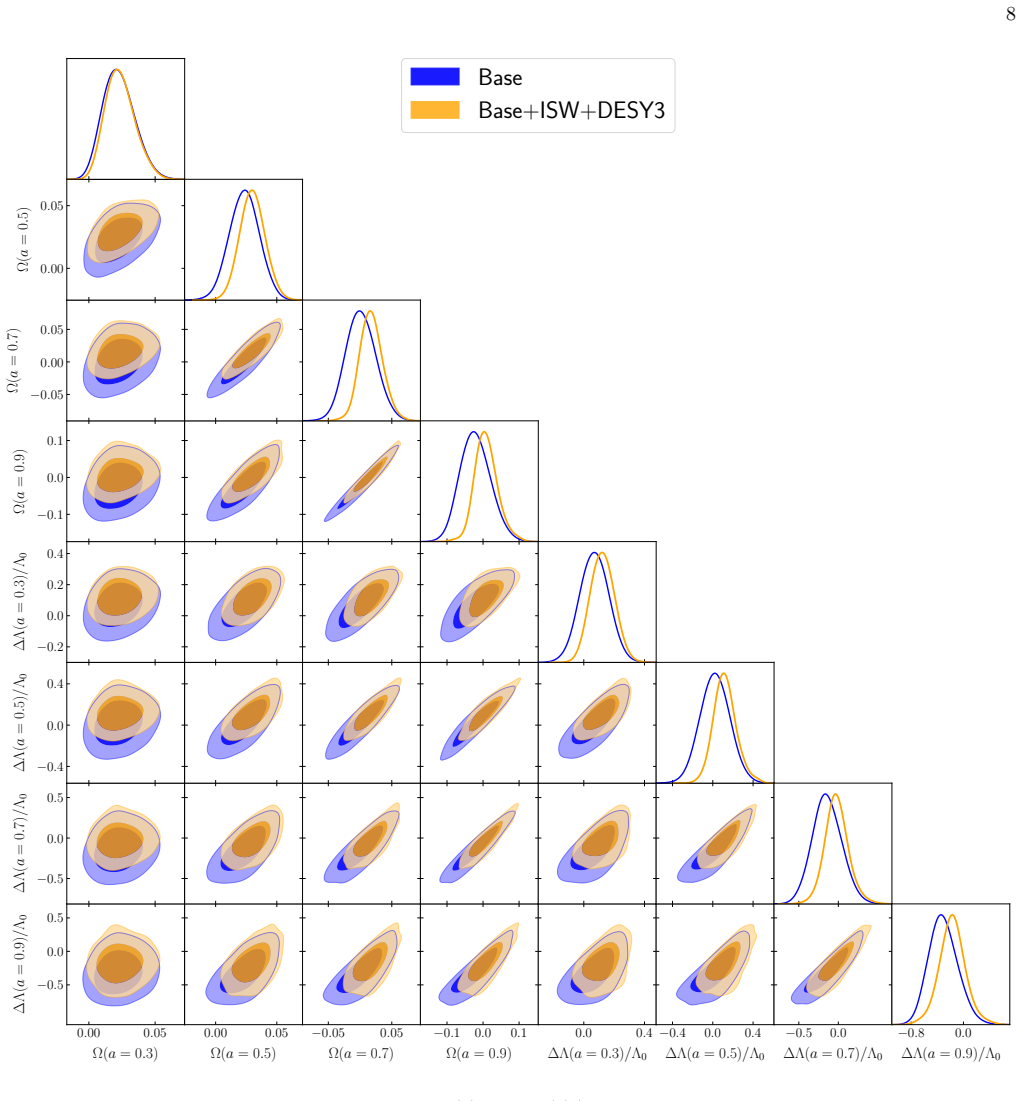
RESUL T Fig. 1 shows the reconstructed EFT functions Ω(a) and ∆Λ(a)/Λ 0. 7 We may immediately conclude that the use of the correlated prior ensures stable reconstruc- tion results by filtering out nonphysical sharp features (cf. Fig. 4 in Appendix A). 6 The original likelihood is available only inCosmoSis[58]. It is ported toCobayaby wrappingCosmoSisas li...
-
[4]
CONCLUSION It is known that non-minimal coupling in gravity can stabilize the phantom-crossing of the dark energy that is hinted at by recent BAO and SNIa observa- tions, which has motivated a number of studies to re- construct gravity within the EFT of dark energy frame- work. Due to the limited constraining power of cos- mological data, EFT-based analys...
-
[5]
A. G. Adameet al.(DESI), JCAP02, 021 (2025), arXiv:2404.03002 [astro-ph.CO]
work page internal anchor Pith review Pith/arXiv arXiv 2025
-
[6]
DESI DR2 Results II: Measurements of Baryon Acoustic Oscillations and Cosmological Constraints
M. Abdul Karimet al.(DESI), Phys. Rev. D112, 083515 (2025), arXiv:2503.14738 [astro-ph.CO]
work page internal anchor Pith review Pith/arXiv arXiv 2025
-
[7]
Can dark energy evolve to the phan- tom?
A. Vikman, Phys. Rev. D71, 023515 (2005), arXiv:astro- ph/0407107
-
[8]
S. M. Carroll, M. Hoffman, and M. Trodden, Phys. Rev. D68, 023509 (2003), arXiv:astro-ph/0301273
work page Pith review arXiv 2003
- [9]
-
[10]
P. Creminelli, G. D’Amico, J. Norena, and F. Vernizzi, JCAP02, 018 (2009), arXiv:0811.0827 [astro-ph]
-
[11]
Dark Energy Constraints from the Cosmic Age and Supernova
B. Feng, X.-L. Wang, and X.-M. Zhang, Phys. Lett. B 607, 35 (2005), arXiv:astro-ph/0404224
work page Pith review arXiv 2005
-
[12]
Hessence: A New View of Quintom Dark Energy
H. Wei, R.-G. Cai, and D.-F. Zeng, Class. Quant. Grav. 22, 3189 (2005), arXiv:hep-th/0501160
work page Pith review arXiv 2005
-
[13]
R. R. Caldwell and M. Doran, Phys. Rev. D72, 043527 (2005), arXiv:astro-ph/0501104
work page Pith review arXiv 2005
-
[14]
M. Kunz and D. Sapone, Phys. Rev. D74, 123503 (2006), arXiv:astro-ph/0609040
-
[15]
Y.-F. Cai, T. Qiu, R. Brandenberger, Y.-S. Piao, and X. Zhang, JCAP03, 013 (2008), arXiv:0711.2187 [hep- th]
work page Pith review arXiv 2008
- [16]
-
[17]
A. Chudaykin and M. Kunz, Phys. Rev. D110, 123524 (2024), arXiv:2407.02558 [astro-ph.CO]
- [18]
- [19]
-
[20]
Non-minimally coupled gravity constraints from DESI DR2 data
J. Pan and G. Ye, Phys. Rev. D113, L041304 (2026), arXiv:2503.19898 [astro-ph.CO]
work page internal anchor Pith review Pith/arXiv arXiv 2026
-
[21]
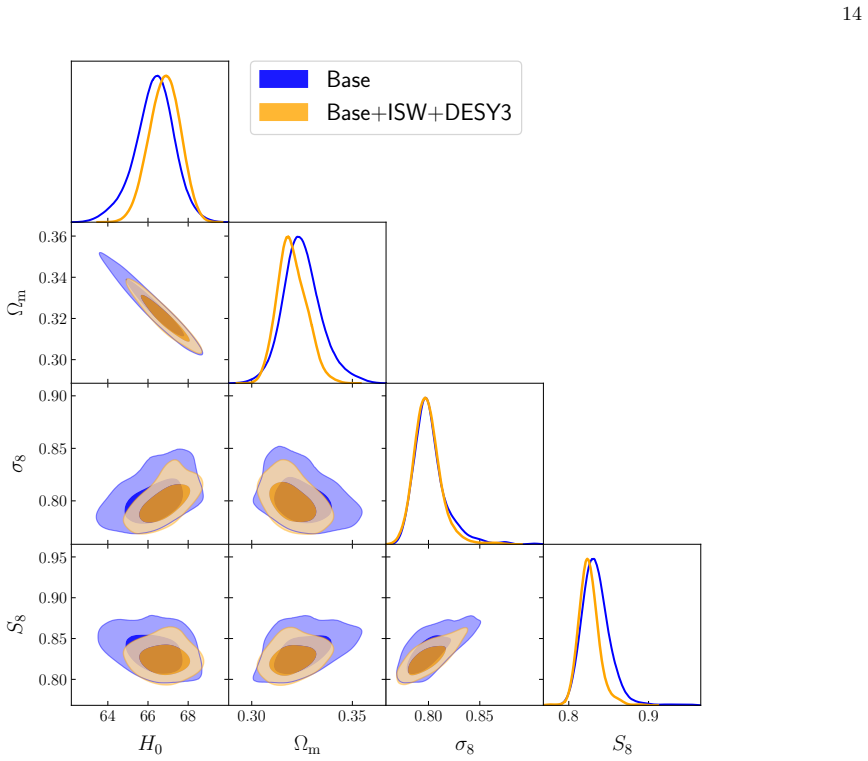
A. Chudaykin, M. Kunz, and J. Carron, Phys. Rev. D 14 64 66 68 H0 0.80 0.85 0.90 0.95 S8 0.80 0.85 0.90 σ8 0.30 0.32 0.34 0.36 Ωm 0.30 0.35 Ωm 0.80 0.85 σ8 0.8 0.9 S8 Base Base+ISW+DESY3 FIG. 8. ΛCDM parameters:1σand 2σposterior distributions for the ΛCDM parametersH 0, Ω m,σ 8 andS 8 obtained in the late-time reconstruction analyses using the Base (blue)...
- [22]
- [23]
- [24]
-
[25]
Resolving the Planck-DESI tension by nonminimally coupled quintessence
J.-Q. Wang, R.-G. Cai, Z.-K. Guo, and S.-J. Wang, Phys. Rev. D113, 083534 (2026), arXiv:2508.01759 [astro- ph.CO]
work page internal anchor Pith review Pith/arXiv arXiv 2026
-
[26]
Non-minimally coupled quintessence with sign-switching interaction
J.-Q. Wang, R.-G. Cai, Z.-K. Guo, Y.-H. Li, S.-J. Wang, and X. Zhang, (2026), arXiv:2604.02204 [astro-ph.CO]
work page internal anchor Pith review Pith/arXiv arXiv 2026
- [27]
- [28]
-
[29]
Bridge the Cosmological Tensions with Thaw- ing Gravity,
G. Ye, (2024), arXiv:2411.11743 [astro-ph.CO]
-
[30]
The Effective Field Theory of Dark Energy,
G. Gubitosi, F. Piazza, and F. Vernizzi, JCAP02, 032 (2013), arXiv:1210.0201 [hep-th]. 15
- [31]
-
[32]
L. Pogosian, M. Raveri, K. Koyama, M. Martinelli, A. Silvestri, G.-B. Zhao, J. Li, S. Peirone, and A. Zucca, Nature Astron.6, 1484 (2022), arXiv:2107.12992 [astro- ph.CO]
- [33]
- [34]
-
[35]
M. Raveri, Phys. Rev. D101, 083524 (2020), arXiv:1902.01366 [astro-ph.CO]
-
[36]
Nonparametric Reconstruction of the Dark Energy Equation of State
T. Holsclaw, U. Alam, B. Sanso, H. Lee, K. Heitmann, S. Habib, and D. Higdon, Phys. Rev. D82, 103502 (2010), arXiv:1009.5443 [astro-ph.CO]
work page Pith review arXiv 2010
-
[37]
Nonparametric Dark Energy Reconstruction from Supernova Data
T. Holsclaw, U. Alam, B. Sanso, H. Lee, K. Heitmann, S. Habib, and D. Higdon, Phys. Rev. Lett.105, 241302 (2010), arXiv:1011.3079 [astro-ph.CO]
work page Pith review arXiv 2010
- [38]
-
[39]
Models of f(R) Cosmic Acceleration that Evade Solar-System Tests
W. Hu and I. Sawicki, Phys. Rev. D76, 064004 (2007), arXiv:0705.1158 [astro-ph]
work page Pith review arXiv 2007
-
[40]
J. Khoury and A. Weltman, Phys. Rev. D69, 044026 (2004), arXiv:astro-ph/0309411
work page Pith review arXiv 2004
-
[41]
K. Hinterbichler and J. Khoury, Phys. Rev. Lett.104, 231301 (2010), arXiv:1001.4525 [hep-th]
-
[42]
E. Rosenberg, S. Gratton, and G. Efstathiou, Mon. Not. Roy. Astron. Soc.517, 4620 (2022), arXiv:2205.10869 [astro-ph.CO]
- [43]
-
[44]
The Pantheon+ Analysis: The Full Dataset and Light-Curve Release
D. Scolnicet al., Astrophys. J.938, 113 (2022), arXiv:2112.03863 [astro-ph.CO]
work page internal anchor Pith review arXiv 2022
- [45]
- [46]
-
[47]
Dark Energy after GW170817 and GRB170817A
P. Creminelli and F. Vernizzi, Phys. Rev. Lett.119, 251302 (2017), arXiv:1710.05877 [astro-ph.CO]
work page Pith review arXiv 2017
-
[48]
J. M. Ezquiaga and M. Zumalac´ arregui, Phys. Rev. Lett. 119, 251304 (2017), arXiv:1710.05901 [astro-ph.CO]
work page Pith review arXiv 2017
-
[49]
R. G. Crittenden, L. Pogosian, and G.-B. Zhao, JCAP 12, 025 (2009), arXiv:astro-ph/0510293
work page Pith review arXiv 2009
-
[50]
Planck 2018 results. VI. Cosmological parameters
N. Aghanimet al.(Planck), Astron. Astrophys.641, A6 (2020), [Erratum: Astron.Astrophys. 652, C4 (2021)], arXiv:1807.06209 [astro-ph.CO]
work page internal anchor Pith review Pith/arXiv arXiv 2020
- [51]
-
[52]
Extended Dark Energy analysis using DESI DR2 BAO measurements
K. Lodhaet al.(DESI), Phys. Rev. D112, 083511 (2025), arXiv:2503.14743 [astro-ph.CO]
work page internal anchor Pith review arXiv 2025
- [53]
- [54]
- [55]
- [56]
-
[57]
Efficient Computation of CMB anisotropies in closed FRW models
A. Lewis, A. Challinor, and A. Lasenby, Astrophys. J. 538, 473 (2000), arXiv:astro-ph/9911177
work page Pith review arXiv 2000
-
[58]
Cobaya: Code for Bayesian Analysis of hierarchical physical models
J. Torrado and A. Lewis, JCAP05, 057 (2021), arXiv:2005.05290 [astro-ph.IM]
work page internal anchor Pith review arXiv 2021
-
[59]
Cobaya: Bayesian analysis in cosmology,
J. Torrado and A. Lewis, “Cobaya: Bayesian analysis in cosmology,” Astrophysics Source Code Library, record ascl:1910.019 (2019)
work page 1910
-
[60]
N. Aghanimet al.(Planck), Astron. Astrophys.641, A5 (2020), arXiv:1907.12875 [astro-ph.CO]
-
[61]
DESI DR2 Results I: Baryon Acoustic Oscillations from the Lyman Alpha Forest
M. Abdul Karimet al.(DESI), Phys. Rev. D112, 083514 (2025), arXiv:2503.14739 [astro-ph.CO]
-
[62]
CosmoSIS: modular cosmological parameter estimation
J. Zuntz, M. Paterno, E. Jennings, D. Rudd, A. Man- zotti, S. Dodelson, S. Bridle, S. Sehrish, and J. Kowalkowski, Astron. Comput.12, 45 (2015), arXiv:1409.3409 [astro-ph.CO]
work page Pith review arXiv 2015
- [63]
-
[64]
J. Gleyzes, D. Langlois, M. Mancarella, and F. Vernizzi, J. Cosmology Astropart. Phys.02, 056 (2016), arXiv:1509.02191 [astro-ph.CO]
-
[65]
L. Pogosian and A. Silvestri, Phys. Rev. D94, 104014 (2016), arXiv:1606.05339 [astro-ph.CO]
- [66]
-
[67]
S. Brieden, H. Gil-Mar´ ın, and L. Verde, JCAP12, 054 (2021), arXiv:2106.07641 [astro-ph.CO]
- [68]
discussion (0)
Sign in with ORCID, Apple, or X to comment. Anyone can read and Pith papers without signing in.