Whole-Blood Boundary Analysis of BioFET-Based ctDNA Detection for Intravascular Sensing in Intrabody Nanonetworks
Pith reviewed 2026-05-22 03:59 UTC · model grok-4.3
The pith
Simulations indicate BioFET ctDNA sensors do not reliably exceed blank thresholds at low concentrations in whole blood.
A machine-rendered reading of the paper's core claim, the machinery that carries it, and where it could break.
Core claim
Under the tested quasi-static charge-gating regime, the simulated current shifts do not reliably exceed the blank-derived threshold at low ctDNA concentrations. The model therefore supplies a whole-blood boundary analysis that identifies which interface configurations and operating conditions most strongly limit reliable BioFET-based intravascular ctDNA detection.
What carries the argument
Reduced-order stochastic simulation model linking Debye-screened charge transduction, stochastic finite-capacity binding, nonspecific adsorption, background fluctuations, and intrinsic electronic noise to blank-threshold detection.
If this is right
- Short Debye length and several-nanometer charge-to-channel separation strongly attenuate the observable current shift.
- Low-frequency noise and background fluctuations shrink the separation between target-present and blank response distributions.
- Reliable detection therefore depends on choosing interface configurations and operating conditions that maximize signal margin over the blank threshold.
Where Pith is reading between the lines
- If the model holds, intravascular nanonetwork designs may need to incorporate surface modifications that extend effective Debye length or reduce separation distance.
- The boundary analysis points to possible value in testing non-quasi-static or frequency-selective gating schemes to improve margin against noise.
- This work suggests hybrid sensing approaches that combine BioFETs with other modalities when whole-blood conditions dominate.
Load-bearing premise
The reduced-order stochastic simulation model with physiologically grounded parameters accurately captures the combined effects of Debye-screened charge transduction, stochastic finite-capacity binding, nonspecific adsorption, background fluctuations, and intrinsic electronic noise in whole blood.
What would settle it
A direct measurement of current-shift distributions in whole blood at low ctDNA concentrations compared against blank thresholds; reliable exceedance in experiment would falsify the simulation-based claim.
Figures

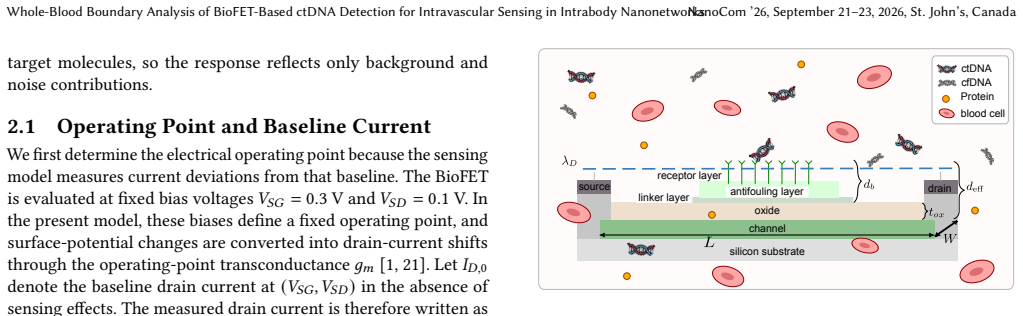


read the original abstract
Liquid biopsy can detect tumor-derived biomarkers such as circulating tumor DNA (ctDNA), but ultra-low-fraction assays remain costly, slow, and difficult to scale. This motivates interest in intravascular in vivo sensing in the context of intrabody nanonetworks, where nanosensors could support local biomarker monitoring. BioFET-based nanosensors are relevant here because they are label-free, highly miniaturizable, and have shown strong ctDNA sensitivity in controlled media. We examine whether this sensitivity still yields reliable ctDNA detection in whole blood using a reduced-order stochastic simulation model that links operating-point selection, Debye-screened charge transduction, stochastic finite-capacity binding, nonspecific adsorption, background fluctuations, and intrinsic electronic noise to blank-threshold detection. Monte Carlo evaluation with physiologically grounded parameters shows that short Debye length and several-nanometer charge-to-channel separation attenuate the current shift, while low-frequency noise and background fluctuations reduce the margin between target-present and blank responses. Under the tested quasi-static charge-gating regime, the simulated current shifts do not reliably exceed the blank-derived threshold at low ctDNA concentrations. The model therefore provides a whole-blood boundary analysis that identifies which interface configurations and operating conditions most strongly limit reliable BioFET-based intravascular ctDNA detection.
Editorial analysis
A structured set of objections, weighed in public.
Referee Report
Summary. The manuscript develops a reduced-order stochastic simulation model for BioFET-based ctDNA detection in whole blood for intravascular sensing in intrabody nanonetworks. The model integrates operating-point selection, Debye-screened charge transduction, stochastic finite-capacity binding, nonspecific adsorption, background fluctuations, and intrinsic electronic noise. Monte Carlo evaluation with physiologically grounded parameters under a quasi-static charge-gating regime shows that short Debye length and several-nanometer charge-to-channel separation attenuate the current shift, while low-frequency noise and background fluctuations reduce the margin between target and blank responses, such that simulated current shifts do not reliably exceed the blank-derived threshold at low ctDNA concentrations. The work positions this as a whole-blood boundary analysis to identify limiting interface configurations and operating conditions.
Significance. If the model accurately represents the combined physical effects, the result would be significant for guiding nanosensor design in intrabody nanonetworks by quantifying how Debye screening, charge separation, and noise limit reliable low-concentration ctDNA detection in whole blood. The Monte Carlo approach with grounded parameters allows exploration of the relevant physics and highlights specific barriers (e.g., attenuation and fluctuation margins) that could inform future experimental efforts in label-free intravascular sensing.
major comments (1)
- [Abstract and Model Description] Abstract and Model Description: The central claim that current shifts do not reliably exceed the blank-derived threshold at low ctDNA concentrations rests on the fidelity of the reduced-order stochastic model in combining Debye-screened charge transduction, finite-capacity binding, nonspecific adsorption, background fluctuations, and electronic noise. The manuscript states that parameters are 'physiologically grounded' but provides no direct comparison of simulated versus measured whole-blood transfer curves, noise spectra, or sensitivity analysis; if the model underestimates signal attenuation (e.g., via charge-to-channel distance) or overestimates low-frequency noise, the margin between target and blank distributions would increase and the headline boundary conclusion could reverse. This validation gap is load-bearing for the reported result.
minor comments (2)
- [Abstract] The abstract would benefit from explicitly stating the range of ctDNA concentrations and number of Monte Carlo runs used in the evaluation.
- Consider adding a table or appendix listing all physiologically grounded parameters with their literature sources and any assumed distributions for the stochastic components.
Simulated Author's Rebuttal
We thank the referee for their thorough review and for recognizing the potential significance of our work in guiding nanosensor design. We provide a point-by-point response to the major comment below.
read point-by-point responses
-
Referee: [Abstract and Model Description] Abstract and Model Description: The central claim that current shifts do not reliably exceed the blank-derived threshold at low ctDNA concentrations rests on the fidelity of the reduced-order stochastic model in combining Debye-screened charge transduction, finite-capacity binding, nonspecific adsorption, background fluctuations, and electronic noise. The manuscript states that parameters are 'physiologically grounded' but provides no direct comparison of simulated versus measured whole-blood transfer curves, noise spectra, or sensitivity analysis; if the model underestimates signal attenuation (e.g., via charge-to-channel distance) or overestimates low-frequency noise, the margin between target and blank distributions would increase and the headline boundary conclusion could reverse. This validation gap is load-bearing for the reported result.
Authors: We agree that the absence of direct experimental validation in whole blood represents a limitation for interpreting the quantitative margins. Our manuscript presents a reduced-order stochastic model as a boundary analysis tool, using parameters sourced from the literature on BioFET operation in physiological environments (e.g., Debye screening lengths in blood plasma, typical biomolecule-to-channel distances in FET biosensors, and noise models from nanoscale electronics). We do not claim the model is calibrated to new whole-blood measurements, as the goal is to highlight fundamental physical constraints that would apply across devices. To address the concern, we will revise the manuscript to include: (1) an expanded table or section detailing the literature sources for each key parameter with specific references, and (2) a sensitivity analysis in which we vary the charge-to-channel separation and the low-frequency noise amplitude over ranges consistent with experimental reports. This will show that the conclusion regarding unreliable detection at low concentrations remains robust unless parameters are set to unrealistically favorable values. We believe this strengthens the presentation without requiring new experimental data. revision: partial
- Providing direct comparisons between simulated and measured whole-blood transfer curves or noise spectra, since the study is a computational modeling effort without accompanying experimental measurements.
Circularity Check
No significant circularity: derivation rests on external physical principles and parameter estimates
full rationale
The paper constructs a reduced-order stochastic simulation that combines Debye screening, finite-capacity binding kinetics, nonspecific adsorption, background fluctuations, and electronic noise under a quasi-static charge-gating regime. Monte Carlo runs then produce the reported current-shift distributions and threshold comparisons. No equations or parameter choices are shown to be defined in terms of the target detection outcome, no fitted subset is relabeled as a prediction, and no self-citation chain is invoked to justify uniqueness or an ansatz. The model therefore remains an independent forward computation whose outputs are not equivalent to its inputs by construction.
Axiom & Free-Parameter Ledger
free parameters (1)
- physiologically grounded parameters
axioms (1)
- domain assumption quasi-static charge-gating regime is representative of operating conditions
Reference graph
Works this paper leans on
-
[1]
Jae-Hyuk Ahn et al. 2017. Charge and dielectric effects of biomolecules on electrical characteristics of nanowire FET biosensors.Applied Physics Letters, 111, 113701. doi:10.1063/1.5003106
-
[2]
I. F. Akyildiz et al. 2015. The internet of Bio-Nano things.IEEE Communications Magazine, 53, 3, 32–40. doi:10.1109/MCOM.2015.7060516. Whole-Blood Boundary Analysis of BioFET-Based ctDNA Detection for Intravascular Sensing in Intrabody Nanonetworks NanoCom ’26, September 21–23, 2026, St. John’s, Canada
-
[3]
Shubham Babbar et al. 2026. Reassessing the challenge of Debye length in field-effect biosensors.Chemical Engineering Journal, 527, 172070. doi:10.1016/j .cej.2025.172070
work page doi:10.1016/j 2026
-
[4]
Chetan Bettegowda et al. 2014. Detection of circulating tumor DNA in early- and late-stage human malignancies.Science Translational Medicine, 6, 224, 224ra24–224ra24. eprint: https://www.science.org/doi/pdf/10.1126/scitranslme d.3007094. doi:10.1126/scitranslmed.3007094
-
[5]
P. Bittla et al. 2023. Exploring circulating tumor DNA (ctDNA) and its role in early detection of cancer: a systematic review.Cureus, 15, 9, (Sept. 2023), e45784. doi:10.7759/cureus.45784
-
[6]
Duo Chen et al. 2024. Nanostructured interface-engineered field-effect tran- sistor biosensors for sensitive detection of serum miRNAs.The Innovation Materials, 2, 4, 100091. doi:10.59717/j.xinn-mater.2024.100091
-
[7]
H. Chen et al. 2019. A new biosensor detection system to overcome the Debye screening effect: dialysis-silicon nanowire field effect transistor.International Journal of Nanomedicine, 14, (Apr. 2019), 2985–2993. doi:10.2147/IJN.S198734
-
[8]
Tim Cholko, Shivansh Kaushik, and Chia-En A. Chang. 2019. Dynamics and molecular interactions of single-stranded DNA in nucleic acid biosensors with varied surface properties.Physical Chemistry Chemical Physics, 21. doi:10.1039 /C9CP02441G
work page 2019
-
[9]
Chia-Ho Chu et al. 2017. Beyond the Debye length in high ionic strength solution: direct protein detection with field-effect transistors (FETs) in human serum.Scientific Reports, 7, 1, 5256. doi:10.1038/s41598-017-05426-6
-
[10]
D. Crosby et al. 2022. Early detection of cancer.Science, 375, eaay9040. doi:10.1 126/science.aay9040
work page 2022
-
[11]
Luca De Vico et al. 2011. Predicting and rationalizing the effect of surface charge distribution and orientation on nano-wire based FET bio-sensors.Nanoscale, 3, 9, 3635–3640. doi:10.1039/C1NR10316D
-
[12]
M. Jamal Deen et al. 2006. Noise considerations in field-effect biosensors.Jour- nal of Applied Physics, 100, 7, 074703. doi:10.1063/1.2355542
-
[13]
Alex M. Downs and Kevin W. Plaxco. 2022. Real-time, in-vivo molecular moni- toring using electrochemical aptamer-based sensors: opportunities and chal- lenges.ACS Sensors, 7, 10, 2823–2832. doi:10.1021/acssensors.2c01428
-
[14]
Andreas Frutiger et al. 2021. Nonspecific binding—fundamental concepts and consequences for biosensing applications.Chemical Reviews, 121, 13, 8095–8160. doi:10.1021/acs.chemrev.1c00044
-
[15]
Ning Gao et al. 2015. General strategy for biodetection in high ionic strength solutions using transistor-based nanoelectronic sensors.Nano Letters, 15, 3, 2143–2148. doi:10.1021/acs.nanolett.5b00133
-
[16]
Lusine Gasparyan, Ferdinand Gasparyan, and Vahan Simonyan. 2021. Internal electrical noises of BioFET sensors based on various architectures.Open Journal of Biophysics, 11, (Jan. 2021), 177–204. doi:10.4236/ojbiphy.2021.112006
-
[17]
Eric A. Josephs and Tao Ye. 2012. Electric-field dependent conformations of single DNA molecules on a model biosensor surface.Nano Letters, 12, 10, 5255–
work page 2012
-
[18]
doi:10.1021/nl3024356
-
[19]
Vladimir Kesler, Boris Murmann, and H. Tom Soh. 2020. Going beyond the Debye length: overcoming charge screening limitations in next-generation bioelectronic sensors.ACS Nano, 14, 12, 16194–16201. doi:10.1021/acsnano.0c0 8622
-
[20]
Dujuan Li et al. 2021. A supersensitive silicon nanowire array biosensor for quantitating tumor marker ctDNA.Biosensors and Bioelectronics, 181, 113147. doi:10.1016/j.bios.2021.113147
-
[21]
X. Liang et al. 2025. Liquid biopsy: a breakthrough technology in early cancer screening.Cancer Screening and Prevention, 4, 1, 40–52. doi:10.14218/CSP.2024 .00031
-
[22]
Benjamin Lowe et al. 2017. Field-effect sensors – from pH sensing to biosensing: sensitivity enhancement using streptavidin-biotin as a model system.The Analyst, 142. doi:10.1039/C7AN00455A
-
[23]
Liwei Ma et al. 2024. Liquid biopsy in cancer: current status, challenges and future prospects.Signal Transduction and Targeted Therapy, 9, 1, (Dec. 2024),
work page 2024
-
[24]
doi:10.1038/s41392-024-02021-w
-
[25]
Carlos Augusto Bergfeld Mori et al. 2022. Signal to noise ratio in nanoscale BioFETs.Solid-State Electronics, 194, 108358. doi:10.1016/j.sse.2022.108358
-
[26]
Jacopo Movilli et al. 2018. Control of probe density at DNA biosensor surfaces using poly(l-lysine) with appended reactive groups.Bioconjugate Chemistry, 29, 12, 4110–4118. doi:10.1021/acs.bioconjchem.8b00733
-
[27]
Xia Peng et al. 2025. Signal-to-noise enhanced detection of circulating tumor DNA via rolling circle amplification and amphiphilic polymer-integrated field- effect transistor sensors.Microchemical Journal, 217, 114981. doi:10.1016/j.micr oc.2025.114981
-
[28]
Toshiya Sakata. 2024. Signal transduction interfaces for field-effect transistor- based biosensors.Communications Chemistry, 7, 1, 35. doi:10.1038/s42004-024- 01121-6
-
[29]
Soumadri Samanta et al. 2026. Biological transistors for direct biosensing of L-Dopa in ultrasmall samples of unprocessed and unwashed whole blood.ACS Sensors, 11, 1, 107–118. doi:10.1021/acssensors.5c02466
-
[30]
Jiping Shi et al. 2020. Size profile of cell-free DNA: a beacon guiding the practice and innovation of clinical testing.Theranostics, 10, 11, 4737–4748. doi:10.7150/t hno.42565
work page doi:10.7150/t 2020
-
[31]
Ethungshan Shitiri et al. 2024. Work-in-progress: intra-body nanonetworks for in vivo biomarker detection in capillaries. InProceedings of the 11th Annual ACM International Conference on Nanoscale Computing and Communication (NANOCOM ’24). Association for Computing Machinery, Milan, Italy, 134–135. isbn: 9798400711718. doi:10.1145/3686015.3689424
-
[32]
Giulia Siravegna et al. 2017. Integrating liquid biopsies into the management of cancer.Nature Reviews Clinical Oncology, 14, 9, 531–548
work page 2017
-
[33]
Eric Stern et al. 2010. Label-free biomarker detection from whole blood.Nature Nanotechnology, 5, 2, 138–142. doi:10.1038/nnano.2009.353
-
[34]
Mohamad T. 2018. Limit of Blank (LOB), Limit of Detection (LOD), and Limit of Quantification (LOQ).Organic & Medicinal Chemistry International Journal, 7, 5, 555722. doi:10.19080/OMCIJ.2018.07.555722
- [35]
-
[36]
World Health Organization. 2025. Cancer. [Accessed: 13-Feb-2026]. https://ww w.who.int/health-topics/cancer#tab=tab_1
work page 2025
-
[37]
Jie Wu et al. 2023. Device integration of electrochemical biosensors.Nature Reviews Bioengineering, 1, 5, 346–360. doi:10.1038/s44222-023-00032-w
-
[38]
Jian Xu and Hyowon Lee. 2020. Anti-biofouling strategies for long-term con- tinuous use of implantable biosensors.Chemosensors, 8, 3, 66. doi:10.3390/che mosensors8030066
work page doi:10.3390/che 2020
-
[39]
Shicai Xu et al. 2017. Real-time reliable determination of binding kinetics of DNA hybridization using a multi-channel graphene biosensor.Nature Commu- nications, 8, 14902. doi:10.1038/ncomms14902
-
[40]
Kexin Yi et al. 2023. Emerging ctDNA detection strategies in clinical cancer theranostics.Smart Medicine, 2, 4, e20230031. doi:10.1002/SMMD.20230031
-
[41]
Jingcheng Zhou et al. 2022. A fiber optic photoacoustic sensor for real-time heparin monitoring.Biosensors and Bioelectronics, 196, 113692. doi:10.1016/j.bi os.2021.113692
discussion (0)
Sign in with ORCID, Apple, or X to comment. Anyone can read and Pith papers without signing in.