Follow the wobble: Statistical methods to detect astrometric binary asteroids in Gaia FPR
Pith reviewed 2026-05-25 02:26 UTC · model grok-4.3
The pith
Statistical method on Gaia FPR residuals flags 343 binary asteroid candidates.
A machine-rendered reading of the paper's core claim, the machinery that carries it, and where it could break.
Core claim
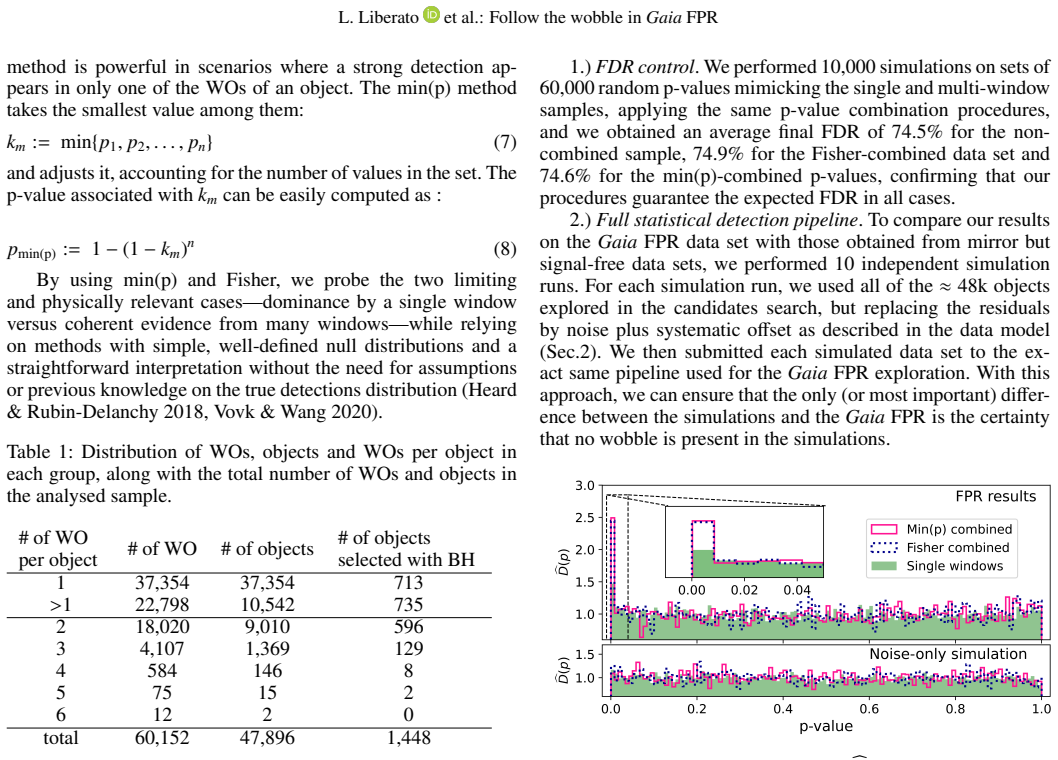
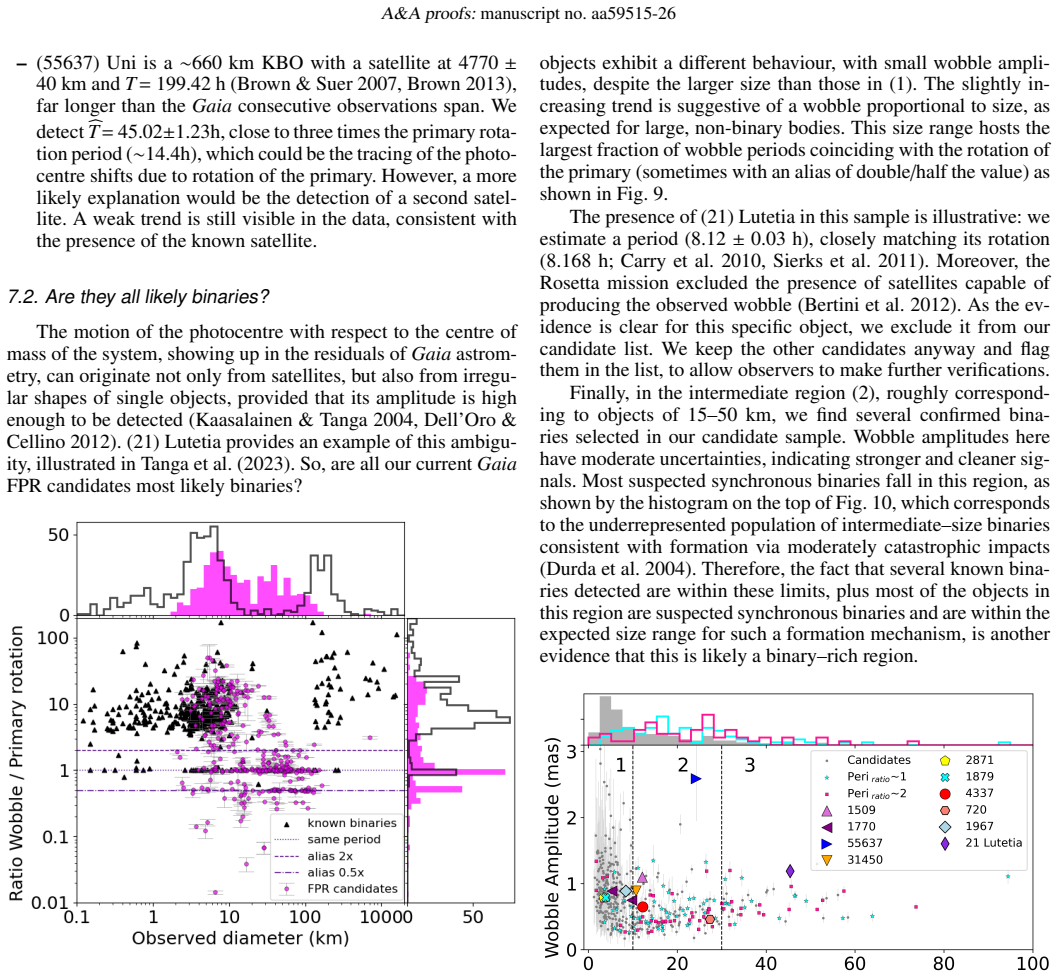
Application of trend detection, period search, and Monte Carlo significance testing to Gaia FPR astrometric residuals identifies 343 binary asteroid candidates in 410 windows, with the real data producing 88 percent more detections than noise-only control runs.
What carries the argument
Trend detection in residuals plus dedicated period search, scored against Monte Carlo realizations drawn from a refined model of FPR astrometric uncertainties.
If this is right
- The catalog recovers 9 known binaries, 25 Pan-STARRS overlaps, and 99 overlaps with the prior DR3 search.
- 45 additional objects show residual trends consistent with wide binaries.
- The same pipeline can be applied to later Gaia releases without new hardware.
- Physical parameters of the candidates are now more tightly constrained by the updated selection.
Where Pith is reading between the lines
- Repeated application to future data releases would grow the sample of known binaries at small separations.
- Cross-matching the 343 candidates against independent photometric or radar surveys would provide an external confirmation rate.
- The method could be tested on synthetic populations with known binary fractions to calibrate its completeness.
Load-bearing premise
The refined statistical model accurately captures the properties of Gaia FPR astrometric uncertainties and residuals so that Monte Carlo simulations supply a valid null distribution.
What would settle it
Re-running the full pipeline on fresh simulated datasets whose residuals match the observed FPR uncertainty distribution but contain no binaries, and obtaining roughly 343 detections instead of the reported ~40, would falsify the claim that the excess is due to real binary signals.
Figures





read the original abstract
In a previous article, we obtained the first-ever list of astrometric binary asteroid candidates. Some of these candidates have now been confirmed. In that previous work, however, the details of the statistical methods were not provided. Our first aim is to provide methodological details and performance evaluation of the approach used for detecting binaries. Our second aim is to establish an updated list of binary asteroid candidates from Gaia FPR astrometric residuals exploration, where we account for the statistical properties of FPR data. We account for the astrometric uncertainties from FPR and we refine the statistical model of the data, which we use in MC simulation to evaluate the strength of the individual detections; we set up a trend detection method in the residuals and apply a dedicated period search algorithm; we update the statistical selection process to build the list of candidates; we set up a method for detecting objects in multiple windows of consecutive observation; we refine the method for confidence interval estimation of these parameters and we better constrain the physical parameter selection. We detect 343 binary asteroid candidates corresponding to 410 windows of consecutive observations in the astrometric data. We show that in noise-only control simulations, the typical number of detections is 88% lower than in the FPR data. We also detect 9 known binaries, 25 candidates overlapping with the Pan-STARSS survey and 99 overlapping with our previous binary search in DR3. Finally, we report the detection of 45 objects with trends in residuals suggestive of wide binary systems. Our results and analyses demonstrate that although detecting binary asteroids is a difficult problem due to their low signal level, the proposed method is likely to provide a reliable list of detections, including systems poorly accessible to conventional techniques.
Editorial analysis
A structured set of objections, weighed in public.
Referee Report
Summary. The manuscript details the statistical methods used to detect astrometric binary asteroids from Gaia FPR residuals, including accounting for uncertainties, refining the statistical model for Monte Carlo simulations, trend detection in residuals, a dedicated period search, updated selection criteria, multi-window detection, and refined confidence intervals. It reports 343 binary candidates (410 observation windows), an 88% reduction in detections under noise-only MC simulations, recovery of 9 known binaries, overlaps with Pan-STARRS (25) and prior DR3 search (99), and 45 additional objects showing trends suggestive of wide binaries.
Significance. If the refined model produces a valid null distribution, the updated candidate list and methodological transparency would provide a useful resource for follow-up observations of binary asteroids, extending prior DR3 work and offering a complementary approach to conventional detection techniques for low-signal systems.
major comments (2)
- [Abstract and MC simulation section] Abstract and the section describing the MC simulations: the headline claim of 343 candidates (with 88% fewer detections in noise-only controls) rests on the refined statistical model producing a reliable null distribution, yet no explicit validation is shown (e.g., quantile-quantile plots of real vs. simulated residuals or reproduction of scan-angle correlations and non-Gaussian tails) to confirm the model captures the joint distribution of FPR residuals.
- [Section on statistical selection process] Section on statistical selection and post-hoc criteria: the quantitative comparison to noise simulations and the strength assessment of individual detections cannot be fully verified without additional detail on how post-hoc selections and error propagation are handled in the refined model and period search.
minor comments (2)
- [Abstract] The abstract lists several methodological refinements but does not provide a concise summary of the exact changes to the statistical model relative to the prior DR3 work.
- [Throughout manuscript] Ensure consistent definition of acronyms (e.g., FPR) on first use and clarify any table or figure references to the 410 windows vs. 343 objects.
Simulated Author's Rebuttal
We thank the referee for their detailed and constructive report. We address each major comment below with clarifications on our statistical approach and indicate where revisions can strengthen the manuscript without altering its core claims.
read point-by-point responses
-
Referee: [Abstract and MC simulation section] Abstract and the section describing the MC simulations: the headline claim of 343 candidates (with 88% fewer detections in noise-only controls) rests on the refined statistical model producing a reliable null distribution, yet no explicit validation is shown (e.g., quantile-quantile plots of real vs. simulated residuals or reproduction of scan-angle correlations and non-Gaussian tails) to confirm the model captures the joint distribution of FPR residuals.
Authors: We agree that direct visual validation of the null distribution would improve transparency. The refined model was constructed to match the reported uncertainties, scan-angle dependencies, and non-Gaussian features observed in the FPR residuals; the 88% reduction in noise-only detections and recovery of nine known binaries serve as empirical checks. In revision we will add QQ plots of real versus simulated residuals together with explicit checks for scan-angle correlations and tail behavior to make this validation explicit. revision: partial
-
Referee: [Section on statistical selection process] Section on statistical selection and post-hoc criteria: the quantitative comparison to noise simulations and the strength assessment of individual detections cannot be fully verified without additional detail on how post-hoc selections and error propagation are handled in the refined model and period search.
Authors: The manuscript already describes the updated selection criteria, the dedicated period-search algorithm, multi-window detection, and the refined confidence-interval procedure. To address the request for fuller verifiability we will expand the relevant section with explicit formulas for error propagation through the period search and a step-by-step example of how post-hoc thresholds are applied to the Monte-Carlo results. revision: yes
Circularity Check
No significant circularity; detections validated via independent Monte Carlo nulls and external cross-checks.
full rationale
The derivation chain consists of applying a trend-detection method and period-search algorithm to Gaia FPR residuals, followed by statistical selection and MC evaluation under a refined noise model. The headline count (343 candidates) is compared against an independent noise-only simulation that uses the model's uncertainty properties as input rather than fitting to the observed detection rate; the 88% reduction is therefore a genuine excess test. Overlaps with known binaries, Pan-STARRS, and the authors' prior DR3 search are external corroborations, not self-referential definitions. No equation, selection threshold, or parameter is shown to be defined in terms of the final candidate list, and the self-citation to prior work supplies only historical context rather than a load-bearing uniqueness theorem or ansatz. The central assumption that the refined model reproduces the joint residual distribution is a correctness/verification issue, not a circularity reduction.
Axiom & Free-Parameter Ledger
free parameters (1)
- detection thresholds and period search parameters
axioms (1)
- domain assumption Gaia FPR astrometric residuals follow the modeled statistical properties after uncertainty accounting
Reference graph
Works this paper leans on
-
[1]
The generalised Lomb-Scargle periodogram. A new formalism for the floating-mean and Keplerian periodograms. , keywords =. doi:10.1051/0004-6361:200811296 , archivePrefix =. 0901.2573 , primaryClass =
work page internal anchor Pith review Pith/arXiv arXiv doi:10.1051/0004-6361:200811296
-
[2]
Astrophysics and space science , volume=
Least-squares frequency analysis of unequally spaced data , author=. Astrophysics and space science , volume=. 1976 , publisher=
1976
-
[3]
Icarus , volume=
Size--frequency distributions of fragments from SPH/N-body simulations of asteroid impacts: Comparison with observed asteroid families , author=. Icarus , volume=. 2007 , publisher=
2007
-
[4]
AJ , volume=
Forming the Flora family: implications for the near-Earth asteroid population and large terrestrial planet impactors , author=. AJ , volume=. 2017 , publisher=
2017
-
[5]
The Yarkovsky and YORP effects: Implications for asteroid dynamics , author=. Annu. Rev. Earth Planet. Sci. , volume=. 2006 , publisher=
2006
-
[6]
Reconstruction of Asteroid Spin States from. 2023 , month = jul, journal =. doi:10.1051/0004-6361/202345889 , urldate =
-
[7]
Astronomy and Astrophysics Supplement Series , volume=
Variable stars: which Nyquist frequency? , author=. Astronomy and Astrophysics Supplement Series , volume=. 1999 , publisher=
1999
-
[8]
Asteroids III
Spectroscopic properties of asteroid families , author=. Asteroids III. Univ. of Arizona Press, Tucson , pages=
-
[9]
Asteroids IV , volume=
Identification and dynamical properties of asteroid families , author=. Asteroids IV , volume=. 2015 , publisher=
2015
-
[10]
AJ , volume =
Kiyotsugu Hirayama , title =. AJ , volume =
-
[11]
Zappalà and A
V. Zappalà and A. Cellino and P. Farinella and Z. Knezevic , title =. AJ , volume =
-
[12]
A&A , volume=
Orbits of very distant asteroid satellites , author=. A&A , volume=. 2025 , publisher=
2025
-
[13]
MNRAS , volume=
Ages of asteroid families estimated using the YORP-eye method , author=. MNRAS , volume=. 2019 , publisher=
2019
-
[14]
Science , volume=
Collisions and gravitational reaccumulation: Forming asteroid families and satellites , author=. Science , volume=. 2001 , publisher=
2001
-
[15]
Planetary and space science , volume=
The formation of binary asteroids as outcomes of catastrophic collisions , author=. Planetary and space science , volume=. 1997 , publisher=
1997
-
[16]
ApJ , volume=
Formation of the wide asynchronous binary asteroid population , author=. ApJ , volume=. 2013 , publisher=
2013
-
[17]
Planetary and space science , volume=
The shape and structure of small asteroids as a result of sub-catastrophic collisions , author=. Planetary and space science , volume=. 2019 , publisher=
2019
-
[18]
II-Statistical aspects of spectral analysis of unevenly spaced data , author=
Studies in astronomical time series analysis. II-Statistical aspects of spectral analysis of unevenly spaced data , author=. ApJ , volume=
-
[19]
Efron , journal =
B. Efron , journal =. Bootstrap Methods: Another Look at the Jackknife , urldate =
-
[20]
Significance Testing Algorithms , DOI=
Efron, Bradley , year=. Significance Testing Algorithms , DOI=. Large-Scale Inference: Empirical Bayes Methods for Estimation, Testing, and Prediction , publisher=
-
[21]
The European Physical Journal B , volume=
Exponential smoothing weighted correlations , author=. The European Physical Journal B , volume=. 2012 , publisher=
2012
-
[22]
Planetary and Space Science , volume=
Search for satellites near (21) Lutetia using OSIRIS/Rosetta images , author=. Planetary and Space Science , volume=. 2012 , publisher=
2012
-
[23]
Planetary and Space Science , volume=
Observations of asteroids on the Gaia astrometric focal plane , author=. Planetary and Space Science , volume=. 2012 , publisher=
2012
-
[24]
A&A , volume=
Photocentre offset in ultraprecise astrometry: Implications for barycentre determination and asteroid modelling , author=. A&A , volume=. 2004 , publisher=
2004
-
[25]
2004 , publisher=
Order statistics , author=. 2004 , publisher=
2004
-
[26]
Journal of Statistical Planning and Inference , volume=
Estimation of parameters of two-dimensional sinusoidal signal in heavy-tailed errors , author=. Journal of Statistical Planning and Inference , volume=. 2012 , publisher=
2012
-
[27]
1997 , publisher=
Bootstrap methods and their application , author=. 1997 , publisher=
1997
-
[28]
1993 , publisher=
An introduction to the bootstrap , author=. 1993 , publisher=
1993
-
[29]
A&A , volume=
The generalised Lomb-Scargle periodogram-a new formalism for the floating-mean and Keplerian periodograms , author=. A&A , volume=. 2009 , publisher=
2009
-
[30]
Planetary and Space Science , pages=
Testing the binarity of asteroid (720) Bohlinia using lightcurve analysis , author=. Planetary and Space Science , pages=. 2025 , publisher=
2025
-
[31]
Rubin Observatory’s First Asteroid Discoveries , author=
Lightcurves, Rotation Periods, and Colors for Vera C. Rubin Observatory’s First Asteroid Discoveries , author=. ApJ Letters , volume=. 2026 , publisher=
2026
-
[32]
2010 , publisher=
Theory of orbit determination , author=. 2010 , publisher=
2010
-
[33]
Orbit Determination with Topocentric Correction: Algorithms for the Next Generation Surveys
Orbit Determination with Topocentric Correction: Algorithms for the Next Generation Surveys , author=. arXiv preprint arXiv:0707.4260 , year=
work page internal anchor Pith review Pith/arXiv arXiv
-
[34]
ApJ , volume=
Periodograms for multiband astronomical time series , author=. ApJ , volume=. 2015 , publisher=
2015
-
[35]
Earth, Moon, and Planets , volume=
The Gaia mission: Expected applications to asteroid science , author=. Earth, Moon, and Planets , volume=. 2007 , publisher=
2007
-
[36]
, year =
Benishek, Vladimir and Pravec, Petr and Vachier, Frédéric and Durkee, Russell and Marchini, Alessandro and Papini, Riccardo and Klotz, Alain and Thierry, Puissant and Berthier, J. , year =. (18301) Konyukhov is a binary asteroid , volume =
-
[37]
A&A , volume=
Scaling slowly rotating asteroids with stellar occultations , author=. A&A , volume=. 2023 , publisher=
2023
-
[38]
A study of asteroid pole-latitude distribution based on an extended set of shape models derived by the lightcurve inversion method. , keywords =. doi:10.1051/0004-6361/201116738 , archivePrefix =. 1104.4114 , primaryClass =
work page internal anchor Pith review Pith/arXiv arXiv doi:10.1051/0004-6361/201116738
-
[39]
A&A , volume=
Inversion of asteroid photometry from Gaia DR2 and the Lowell Observatory photometric database , author=. A&A , volume=. 2019 , publisher=
2019
-
[40]
Asteroid models reconstructed from ATLAS photometry. , keywords =. doi:10.1051/0004-6361/202037729 , archivePrefix =. 2010.01820 , primaryClass =
-
[41]
Asteroid models from combined sparse and dense photometric data. , keywords =. doi:10.1051/0004-6361:200810393 , adsurl =
-
[42]
Photometry and models of selected main belt asteroids. IX. Introducing interactive service for asteroid models (ISAM). , keywords =. doi:10.1051/0004-6361/201219542 , adsurl =
-
[43]
Photometry and models of selected main belt asteroids. IV. 184 Dejopeja, 276 Adelheid, 556 Phyllis. , keywords =. doi:10.1051/0004-6361:20077694 , adsurl =
-
[44]
Finding asteroids with slow spin
V-band photometry of asteroids from ASAS-SN. Finding asteroids with slow spin. , keywords =. doi:10.1051/0004-6361/202140759 , archivePrefix =. 2107.10027 , primaryClass =
-
[45]
Volumes and bulk densities of forty asteroids from ADAM shape modeling
Volumes and bulk densities of forty asteroids from ADAM shape modeling. , keywords =. doi:10.1051/0004-6361/201629956 , archivePrefix =. 1702.01996 , primaryClass =
work page internal anchor Pith review Pith/arXiv arXiv doi:10.1051/0004-6361/201629956
-
[46]
, year = 2002, month = oct, volume =
Models of Twenty Asteroids from Photometric Data. , year = 2002, month = oct, volume =. doi:10.1006/icar.2002.6907 , adsurl =
-
[47]
Photometric survey, modelling, and scaling of long-period and low-amplitude asteroids
Photometric survey, modelling, and scaling of long-period and low-amplitude asteroids. , keywords =. doi:10.1051/0004-6361/201731479 , archivePrefix =. 1711.01893 , primaryClass =
work page internal anchor Pith review Pith/arXiv arXiv doi:10.1051/0004-6361/201731479
-
[48]
DAMIT: a database of asteroid models. , keywords =. doi:10.1051/0004-6361/200912693 , adsurl =
-
[49]
Asteroids IV , volume=
Formation and evolution of binary asteroids , author=. Asteroids IV , volume=. 2015 , publisher=
2015
-
[50]
F. Marchis and P. Descamps and J. Berthier and D. Hestroffer and F. Vachier and M. Baek and A.W. Harris and D. Nesvorný , keywords =. Main belt binary asteroidal systems with eccentric mutual orbits , journal =. 2008 , issn =. doi:https://doi.org/10.1016/j.icarus.2007.12.010 , url =
-
[51]
Kevin J. Walsh and Derek C. Richardson , keywords =. A steady-state model of NEA binaries formed by tidal disruption of gravitational aggregates , journal =. 2008 , note =. doi:https://doi.org/10.1016/j.icarus.2007.08.020 , url =
-
[52]
Jacob T. VanderPlas , title =. ApJ Supplement Series , abstract =. 2018 , month =. doi:10.3847/1538-4365/aab766 , url =
work page internal anchor Pith review doi:10.3847/1538-4365/aab766 2018
-
[53]
Shape and flyby geometry , author=
Physical properties of the ESA Rosetta target asteroid (21) Lutetia-II. Shape and flyby geometry , author=. A&A , volume=. 2010 , publisher=
2010
-
[54]
science , volume=
Images of asteroid 21 Lutetia: a remnant planetesimal from the early solar system , author=. science , volume=. 2011 , publisher=
2011
-
[55]
Planetary and Space Science , volume=
Density of asteroids , author=. Planetary and Space Science , volume=. 2012 , publisher=
2012
-
[56]
Nature , volume=
A dense ring of the trans-Neptunian object Quaoar outside its Roche limit , author=. Nature , volume=. 2023 , publisher=
2023
-
[57]
Hunter, J. D. , Title =. Computing in Science & Engineering , Volume =
-
[58]
Building a Framework for Predictive Science
Building a framework for predictive science , author=. arXiv preprint arXiv:1202.1056 , year=
work page internal anchor Pith review Pith/arXiv arXiv
-
[59]
URL http://trac
pathos: a framework for heterogeneous computing, 2010 , author=. URL http://trac. mystic. cacr. caltech. edu/project/pathos , year=
2010
-
[60]
Angular momentum content , author=
Binary asteroid population: 1. Angular momentum content , author=. Icarus , volume=. 2007 , publisher=
2007
-
[61]
Astropy: A Community Python Package for Astronomy
doi:10.1051/0004-6361/201322068 , Eid =. arXiv , Author =:1307.6212 , Journal =
work page internal anchor Pith review Pith/arXiv arXiv doi:10.1051/0004-6361/201322068
-
[62]
The Astropy Project: Building an inclusive, open-science project and status of the v2.0 core package
The Astropy Project: Building an Open-science Project and Status of the v2.0 Core Package. , keywords =. doi:10.3847/1538-3881/aabc4f , archivePrefix =. 1801.02634 , primaryClass =
work page internal anchor Pith review Pith/arXiv arXiv doi:10.3847/1538-3881/aabc4f
-
[63]
The Astropy Project: Sustaining and Growing a Community-oriented Open-source Project and the Latest Major Release (v5.0) of the Core Package. apj , keywords =. doi:10.3847/1538-4357/ac7c74 , archivePrefix =. 2206.14220 , primaryClass =
work page internal anchor Pith review Pith/arXiv arXiv doi:10.3847/1538-4357/ac7c74
-
[64]
, year = 2003, month = feb, volume =
S/2003 (1509) 1. , year = 2003, month = feb, volume =
2003
-
[65]
M. E. Brown and T.-A. Suer , title = ". , year = 2007, month = feb, volume =
2007
-
[66]
ApJ Letters , volume=
The density of mid-sized Kuiper belt object 2002 UX25 and the formation of the dwarf planets , author=. ApJ Letters , volume=. 2013 , publisher=
2002
-
[67]
Minor Planet Bulletin , keywords =
Main-belt Asteroids Observed from CS3: 2020 January to March. Minor Planet Bulletin , keywords =
2020
-
[68]
Journal of the Royal statistical society: series B (Methodological) , volume=
Controlling the false discovery rate: a practical and powerful approach to multiple testing , author=. Journal of the Royal statistical society: series B (Methodological) , volume=. 1995 , publisher=
1995
-
[69]
Central Bureau Electronic Telegrams (CBET) No
(2871) Schober. Central Bureau Electronic Telegrams (CBET) No. 5215 , year = 2023, month = feb, volume =
2023
-
[70]
Benishek and P
V. Benishek and P. Pravec and P. Kusnirak and P. Fatka and R. Durkee and F. Pilcher and K. Ergashev and O. Burkhonov and D. Augustin and R. Behrend and R. Goncalves , title =. Central Bureau Electronic Telegrams (CBET) No. 5507 , year =
-
[71]
W. J. Merline, P. M. Tamblyn, B. D. Warner, P. Pravec, J. P. Tamblyn, C. Neyman, A. R. Conrad, W. M. Owen, B. Carry, J. D. Drummond, C. R. Chapman, B. L. Enke, W. M. Grundy, C. Veillet, S. B. Porter, C. Arcidiacono, J. C. Christou, D. D. Durda, A. W. Harris, H. A. Weaver, C. Dumas, D. Terrell, and P. Maley , title = ". Central Bureau Electronic Telegrams ...
2003
-
[72]
European Planetary Science Congress , pages=
Detection and physical characterization of binary asteroids from the IMPACTON project , author=. European Planetary Science Congress , pages=
-
[73]
SF2A-2025: Proceedings of the Annual meeting of the French Society of Astronomy and Astrophysics
First GAIAMOONS occultation results with features suggestive of binarity , author=. SF2A-2025: Proceedings of the Annual meeting of the French Society of Astronomy and Astrophysics. Eds.: A. Siebert , pages=
2025
-
[74]
Benishek and P
V. Benishek and P. Pravec and A. Marchini and R. Papini and F. Pilcher and N. Ruocco and R. Durkee. (1879) Broederstroom. Central Bureau Electronic Telegrams (CBET) No. 5373. 2024
2024
-
[75]
Pray and P
D. Pray and P. Pravec and K. Hornoch and J. Vrastil and H. Kucakova and V. Benishek and R. Roy and R. Behrend and D. Romeuf and B. Warner and A. Scholz and G. Hodosan and J. Pollock and R. Montaigut and A. Leroy and D. Reichart and J. Haislip , year =
-
[76]
Spaceguard Research , volume =
Isao Sato , title =. Spaceguard Research , volume =. 2013 , note =
2013
-
[77]
Multiple asteroid systems: Dimensions and thermal properties from Spitzer Space Telescope and ground-based observations. , keywords =. doi:10.1016/j.icarus.2012.09.013 , archivePrefix =. 1604.05384 , primaryClass =
work page internal anchor Pith review Pith/arXiv arXiv doi:10.1016/j.icarus.2012.09.013 2012
-
[78]
Minor Planet Bulletin , keywords =
A New Satellite of 4337 Arecibo Detected and Confirmed by stellar Occultation. Minor Planet Bulletin , keywords =
-
[79]
Central Bureau Electronic Telegrams , year = 2009, month = nov, volume =
S/2009 (317) 1. Central Bureau Electronic Telegrams , year = 2009, month = nov, volume =
2009
-
[80]
Garrison and Dan Foreman-Mackey and Yu-hsuan Shih and Alex Barnett , title =
Lehman H. Garrison and Dan Foreman-Mackey and Yu-hsuan Shih and Alex Barnett , title =. Research Notes of the AAS , abstract =. 2024 , month =. doi:10.3847/2515-5172/ad82cd , url =
discussion (0)
Sign in with ORCID, Apple, or X to comment. Anyone can read and Pith papers without signing in.