Cross-attention-based bipartite graph neural network for coupled nodal and elemental field prediction in large-deformation sheet material forming
Pith reviewed 2026-05-25 00:34 UTC · model grok-4.3
The pith
A bipartite graph network with cross-attention predicts nodal displacements and elemental thinning directly on their native mesh domains.
A machine-rendered reading of the paper's core claim, the machinery that carries it, and where it could break.
Core claim
The central claim is that a cross-attention-based bipartite graph neural network (CAtt-BiGNN) models nodes and elements as separate vertex sets linked by directed node-element edges; an edge-aware cross-attention processor then computes adaptive coupling weights from geometric features, enabling simultaneous prediction of displacement increments on nodes and thinning on elements. The hierarchical extension CAtt-BiUGNN adds graph coarsening and refinement to improve long-range information flow on bigger meshes. Experiments on two forming cases show improved balance between the two field types relative to node-centred baselines and bipartite ablations, with the hierarchical model strongest on
What carries the argument
CAtt-BiGNN, a bipartite graph with nodes and elements as distinct vertex partitions connected by directed edges whose features drive an edge-aware cross-attention processor for bidirectional state exchange between kinematic and deformation quantities.
If this is right
- Displacement and thinning predictions remain more balanced than those from node-centred graph models because each field is updated on its native discretisation.
- The hierarchical CAtt-BiUGNN variant reduces error accumulation on larger meshes by propagating information through successive coarsening and refinement stages.
- Adaptive Gaussian noise injection during rollout improves stability of long prediction sequences without altering the core message-passing architecture.
- The same bipartite cross-attention structure can serve as a drop-in surrogate component for any finite-element workflow that alternates between nodal and elemental updates.
Where Pith is reading between the lines
- The same node-element bipartite construction could be applied to other coupled problems such as fluid-structure interaction where kinematic and stress fields live on different mesh entities.
- Because the attention weights are learned from geometry alone, the model may transfer across material models provided the training data cover the relevant deformation range.
- Extending the hierarchy to multiple coarsening levels might further improve scaling on industrial-size meshes without increasing the number of message-passing layers.
Load-bearing premise
The node-element coupling inside the finite-element update can be captured by directed edges between separate node and element entities plus cross-attention, without needing the simulator's full constitutive or contact rules.
What would settle it
Train the model on one forming geometry and material, then evaluate rollout error on a second geometry with different boundary conditions or thickness; if the displacement and thinning errors both stay within the range reported for the original test cases, the claim holds.
Figures





read the original abstract
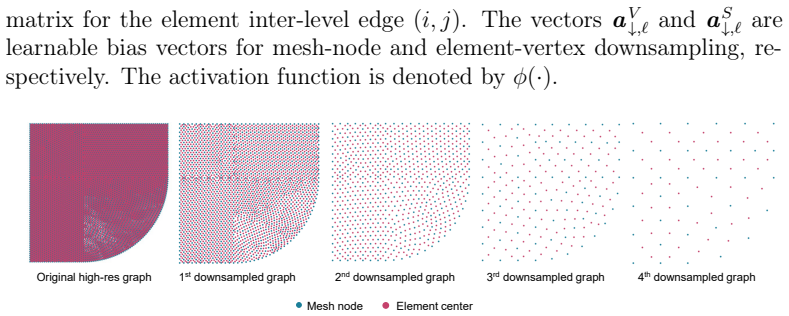
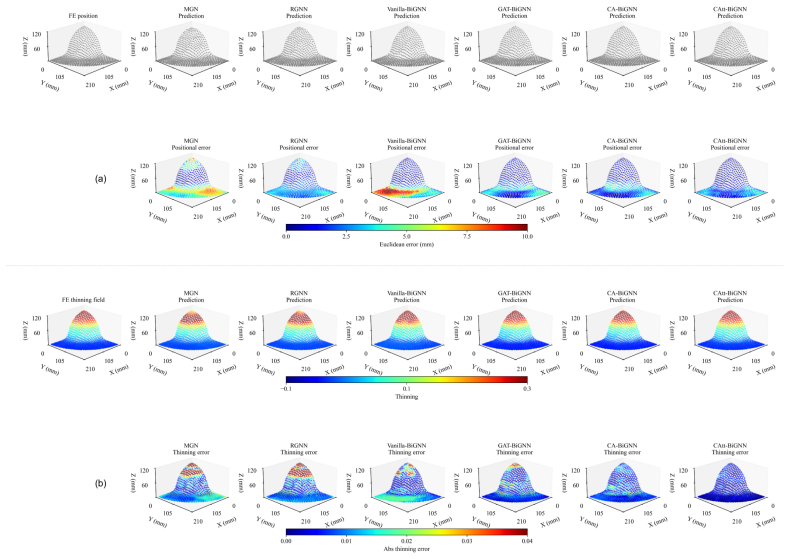
Finite element simulations of large-deformation sheet material forming involve node-element coupling between nodal kinematics and element-level deformation measures. Machine-learning surrogates can accelerate such simulations, but most graph-based models use node-centred representations. This representation is indirect for element-level quantities, which are often recovered from nodal predictions by interpolation or post-processing. It may also obscure the node-element coupling structure that underlies the finite element update. This work proposes a cross-attention-based bipartite graph neural network (CAtt-BiGNN) for coupled prediction of nodal displacement increments and elemental thinning. The graph represents mesh nodes and elements as distinct but connected entities, linked by directed node-element edges, so that nodal and elemental fields are predicted on their native discretisation domains. An edge-aware cross-attention processor conditions adaptive node-element coupling weights on geometric edge features, enabling bidirectional message passing between nodal kinematic states and elemental deformation states. A hierarchical extension, CAtt-BiUGNN, combines the CAtt-BiGNN with graph downsampling-upsampling to improve information propagation on larger meshes. Adaptive Gaussian noise is further evaluated as an optional rollout-stabilisation strategy. The models are tested on two representative forming cases with different graph sizes. CAtt-BiGNN improves the balance between displacement and thinning prediction relative to node-centred baselines and bipartite ablation variants, while CAtt-BiUGNN gives the strongest overall performance in the larger-graph setting. The results indicate that the proposed model provides an effective surrogate framework for large-deformation sheet material forming.
Editorial analysis
A structured set of objections, weighed in public.
Referee Report
Summary. The paper proposes a cross-attention-based bipartite graph neural network (CAtt-BiGNN) that represents mesh nodes and elements as distinct entities connected by directed edges, using edge-aware cross-attention to predict coupled nodal displacement increments and elemental thinning in large-deformation sheet forming FE simulations. A hierarchical extension (CAtt-BiUGNN) with graph downsampling-upsampling is introduced for larger meshes, along with optional adaptive Gaussian noise for rollout stabilization. On two forming cases, CAtt-BiGNN is claimed to improve the balance between displacement and thinning predictions relative to node-centred baselines and bipartite ablations, with CAtt-BiUGNN strongest on larger graphs.
Significance. If the performance claims hold under detailed scrutiny, the bipartite formulation offers a direct way to model node-element coupling on native discretizations, which could yield more consistent surrogates for forming processes than post-processed node-only models. The hierarchical variant and stabilization strategy address practical scalability issues in graph-based surrogates.
major comments (2)
- [Abstract] Abstract: the central empirical claim (improved balance between displacement and thinning) is presented without any quantitative metrics, loss definitions, training details, or ablation tables. This prevents verification of whether the reported gains are supported by the data or are statistically meaningful.
- [Method] Method (cross-attention processor description): the model relies on directed node-element edges and edge-aware cross-attention to capture coupling, yet the finite-element update depends on explicit constitutive integration, contact detection, and tangent operators that are not injected into the graph. It is unclear whether implicit learning from trajectories suffices for the claimed surrogate fidelity, especially under changes in material parameters or friction (directly relevant to the skeptic concern on constitutive rules).
minor comments (1)
- [Abstract] Notation for the bipartite entities and edge features could be introduced with a small diagram or table to clarify the directed node-to-element and element-to-node connections.
Simulated Author's Rebuttal
We thank the referee for the constructive feedback. We address each major comment below, providing clarifications and indicating planned revisions where appropriate.
read point-by-point responses
-
Referee: [Abstract] Abstract: the central empirical claim (improved balance between displacement and thinning) is presented without any quantitative metrics, loss definitions, training details, or ablation tables. This prevents verification of whether the reported gains are supported by the data or are statistically meaningful.
Authors: We agree that the abstract would be strengthened by including key quantitative metrics. The full loss definitions (Section 3.3), training details (Section 4.2), ablation tables (Table 2), and performance metrics comparing displacement and thinning errors (Tables 1 and 3) are already present in the manuscript. In the revised version we will add specific numerical improvements (e.g., relative error reductions) to the abstract to support the central claim. revision: yes
-
Referee: [Method] Method (cross-attention processor description): the model relies on directed node-element edges and edge-aware cross-attention to capture coupling, yet the finite-element update depends on explicit constitutive integration, contact detection, and tangent operators that are not injected into the graph. It is unclear whether implicit learning from trajectories suffices for the claimed surrogate fidelity, especially under changes in material parameters or friction (directly relevant to the skeptic concern on constitutive rules).
Authors: The proposed model is a data-driven surrogate trained end-to-end on FE simulation trajectories; the bipartite graph and edge-aware cross-attention learn the observed node-element coupling implicitly from the data rather than through explicit injection of constitutive integration, contact, or tangent operators. This design choice enables direct prediction on native mesh domains and yields the reported improvements for the fixed material and friction parameters used in the two test cases. We acknowledge that generalization to unseen material parameters or friction coefficients is not evaluated and would require retraining or domain adaptation. We will add an explicit limitations paragraph in the revised discussion section addressing this point. revision: partial
Circularity Check
Empirical model comparison with no derivation chain reducing to inputs
full rationale
The paper proposes a bipartite GNN architecture (CAtt-BiGNN) and its hierarchical extension, then reports empirical performance on two forming cases. No equations, uniqueness theorems, or first-principles derivations are presented that could reduce to self-definitions, fitted parameters renamed as predictions, or self-citation chains. All claims rest on direct comparison of rollout errors against node-centred baselines and ablations; the central result (improved balance between displacement and thinning) is an observed metric difference, not a quantity forced by construction inside the model. This is the standard non-circular case for an architecture paper.
Axiom & Free-Parameter Ledger
invented entities (1)
-
CAtt-BiGNN cross-attention processor
no independent evidence
Reference graph
Works this paper leans on
-
[1]
D. Politis, A. Foster, N. Li, L. Wang, J. Lin, A. Foster, D. Szegda, Pre- diction of thinning behavior for complex-shaped, lightweight alloy pan- els formed through a hot stamping process, in: Advanced High Strength Steel and Press Hardening: Proceedings of the 2nd International Con- ference (ICHSU2015), World Scientific, 2016, pp. 395–401
work page 2016
-
[2]
T. J. R. Hughes, The Finite Element Method: Linear Static and Dy- namic Finite Element Analysis, Prentice-Hall, Englewood Cliffs, NJ, 1987
work page 1987
-
[3]
Bathe, Finite Element Procedures, Prentice Hall, 2006
K. Bathe, Finite Element Procedures, Prentice Hall, 2006. URLhttps://books.google.co.uk/books?id=rWvefGICfO8C
work page 2006
-
[4]
H. R. Attar, A. Foster, N. Li, Development of a deep learning platform for sheet stamping geometry optimisation under manufacturing con- 53 straints, Engineering Applications of Artificial Intelligence 123 (2023) 106295
work page 2023
-
[5]
H. Zhou, H. Li, Y. Zhao, P. R. Childs, N. Li, Image-based artificial intelligence-driven modelling for blank shape optimisation in sheet metal forming, Materials & Design (2025) 114302
work page 2025
-
[6]
G. E. Karniadakis, I. G. Kevrekidis, L. Lu, P. Perdikaris, S. Wang, L. Yang, Physics-informed machine learning, Nature Reviews Physics 3 (2021) 422–440. doi:10.1038/s42254-021-00314-5
-
[7]
Y. Zhao, H. Li, H. Zhou, H. R. Attar, T. Pfaff, N. Li, A review of graph neural network applications in mechanics-related domains, Artificial In- telligence Review 57 (11) (2024) 315
work page 2024
-
[8]
arXiv preprint arXiv:2003.049191(1), 1–34 (2020)
J. Willard, X. Jia, S. Xu, M. Steinbach, V. Kumar, Integrating physics-based modeling with machine learning: A survey (03 2020). doi:10.48550/arXiv.2003.04919
-
[9]
V. K. Dubey, C. E. Haese, O. Gültekin, D. Dalton, M. K. Rausch, J. Fuhg, Graph neural network surrogates for contacting deformable bodies with necessary and sufficient contact detection, Computer Methods in Applied Mechanics and Engineering 448 (2026) 118413. doi:https://doi.org/10.1016/j.cma.2025.118413
-
[10]
L. Xing, P. Gardoni, G. Song, Y. Zhou, Deep learning-based surrogate capacity models and multi-objective fragility es- timates for reinforced concrete frames, Computer Methods in Applied Mechanics and Engineering 440 (2025) 117928. doi:https://doi.org/10.1016/j.cma.2025.117928
-
[11]
A. Sanchez-Gonzalez, J. Godwin, T. Pfaff, R. Ying, J. Leskovec, P. Battaglia, Learning to simulate complex physics with graph net- works, in: International conference on machine learning, PMLR, 2020, pp. 8459–8468
work page 2020
- [12]
-
[13]
Z. Wu, S. Pan, F. Chen, G. Long, C. Zhang, P. S. Yu, A comprehensive survey on graph neural networks, IEEE transactions on neural networks and learning systems 32 (1) (2020) 4–24
work page 2020
-
[14]
M. M. Bronstein, J. Bruna, T. Cohen, P. Veličković, Geometric deep learning: Grids, groups, graphs, geodesics, and gauges, arXiv preprint arXiv:2104.13478 (2021)
work page internal anchor Pith review Pith/arXiv arXiv 2021
-
[15]
P. Veličković, Everything is connected: Graph neural networks, Current Opinion in Structural Biology 79 (2023) 102538
work page 2023
-
[16]
J. Zhou, G. Cui, S. Hu, Z. Zhang, C. Yang, Z. Liu, L. Wang, C. Li, M. Sun, Graph neural networks: A review of methods and applications, AI open 1 (2020) 57–81
work page 2020
- [17]
- [18]
-
[19]
Y. Fei, S. Qin, W. Liao, H. Guan, X. Lu, Graph neural network-assisted evolutionary algorithm for rapid optimization design of shear-wall struc- tures, Advanced Engineering Informatics 65 (2025) 103129
work page 2025
-
[20]
L. Patrignani, S. T. Pinho, Graph neural networks with hybrid local- global attention for effective prediction of mechanical response in struc- tures, Computer Methods in Applied Mechanics and Engineering 452 (2026) 118753. doi:https://doi.org/10.1016/j.cma.2026.118753
-
[21]
Y. Zhao, Q. Chen, H. Li, H. Zhou, H. R. Attar, T. Pfaff, T. Wu, N. Li, Recurrent u-net-based graph neural network (rugnn) for accurate de- formation predictions in sheet material forming, Advanced Engineering Informatics 69 (2026) 104021
work page 2026
-
[22]
Y. Zhao, H. Li, H. Zhou, H. R. Attar, T. Pfaff, N. Li, Rapid prediction of material deformation in hot stamping of battery box geometries using graph neural network, in: Journal of Physics: Conference Series, Vol. 3104, IOP Publishing, 2025, p. 012057. 55
work page 2025
-
[23]
Q. Chen, J. Cao, W. Lin, S. Zhu, S. Wang, Predicting dynamic re- sponses of continuous deformable bodies: A graph-based learning ap- proach, Computer Methods in Applied Mechanics and Engineering 420 (2024) 116669
work page 2024
- [24]
-
[25]
P. Battaglia, R. Pascanu, M. Lai, D. Jimenez Rezende, et al., Interaction networks for learning about objects, relations and physics, Advances in neural information processing systems 29 (2016)
work page 2016
-
[26]
A. Sanchez-Gonzalez, N. Heess, J. T. Springenberg, J. Merel, M. Ried- miller, R. Hadsell, P. Battaglia, Graph networks as learnable physics engines for inference and control, in: International conference on ma- chine learning, PMLR, 2018, pp. 4470–4479
work page 2018
-
[27]
X. Fu, F. Zhou, D. Peddireddy, Z. Kang, M. B.-G. Jun, V. Aggarwal, An finite element analysis surrogate model with boundary oriented graph embedding approach for rapid design, Journal of Computational Design and Engineering 10 (3) (2023) 1026–1046
work page 2023
-
[28]
H. Zhou, Y. Zhao, H. Li, T. Pfaff, N. Li, A multi-level graph-based surrogate model for real-time high-fidelity sheet forming simulations, Advanced Engineering Informatics 66 (2025) 103458
work page 2025
-
[29]
S. Deshpande, S. Bordas, J. Lengiewicz, Magnet: A graph u-net ar- chitecture for mesh-based simulations, arXiv preprint arXiv:2211.00713 (2022)
- [30]
-
[31]
R. Gao, I. K. Deo, R. K. Jaiman, A finite element-inspired hypergraph neural network: Application to fluid dynamics sim- ulations, Journal of Computational Physics 504 (2024) 112866. doi:https://doi.org/10.1016/j.jcp.2024.112866. 56
-
[32]
T. Belytschko, W. K. Liu, B. Moran, K. Elkhodary, Nonlinear finite elements for continua and structures, John wiley & sons, 2014
work page 2014
-
[33]
A. Vaswani, N. Shazeer, N. Parmar, J. Uszkoreit, L. Jones, A. N. Gomez, Ł. Kaiser, I. Polosukhin, Attention is all you need, Advances in neural information processing systems 30 (2017)
work page 2017
-
[34]
P. Veličković, G. Cucurull, A. Casanova, A. Romero, P. Lio, Y. Bengio, Graph attention networks, arXiv preprint arXiv:1710.10903 (2017)
work page internal anchor Pith review Pith/arXiv arXiv 2017
- [35]
- [36]
-
[37]
N. Li, C. Sun, N. Guo, M. Momhamed, J. Lin, M. Takeki, Damage inves- tigation of boron steel at hot stamping conditions, Procedia Engineering 81 (2014) 1744–1749
work page 2014
-
[38]
Dassault Systèmes, United States of America, Getting Started with Abaqus Interactive Edition (2008)
work page 2008
-
[39]
J. L. D. Z. Marciniak, S. J. Hu, Mechanics of Sheet Metal Forming, Butterworth-Heinemann, Great Britain, 2002
work page 2002
- [40]
-
[41]
doi:10.1017/CBO9780511811111
- [42]
-
[43]
H. R. Attar, H. Zhou, A. Foster, N. Li, Rapid feasibility assessment of components to be formed through hot stamping: A deep learning approach, Journal of Manufacturing Processes 68 (2021) 1650–1671. doi:https://doi.org/10.1016/j.jmapro.2021.06.011. 57
-
[44]
M. Mohamed, N. Li, L. Wang, O. E. Fakir, J. Lin, T. Dean, J. Dear, An investigation of a new 2d cdm model in predicting failure in hfqing of an automotive panel, in: 4th International Conference on New Forming Technology (ICNFT 2015), EDP Sciences, 2015, p. 05011. 58
work page 2015
discussion (0)
Sign in with ORCID, Apple, or X to comment. Anyone can read and Pith papers without signing in.