Gravitational waves from cosmic strings with friction: analytical approximations and parameter space
Pith reviewed 2026-05-25 05:35 UTC · model grok-4.3
The pith
Analytical approximations describe the ultra-high-frequency gravitational wave peak from cosmic string loops formed in the friction era.
A machine-rendered reading of the paper's core claim, the machinery that carries it, and where it could break.
Core claim
We derive analytical approximations to describe the ultra-high-frequency secondary peak of the stochastic gravitational wave background generated by cosmic strings that is sourced by loops created in the friction-dominated era. We show that these approximations provide a very good description of the contribution of the friction-era loops over the relevant frequency range and for a broad range of cosmic string parameters, thus enabling a fast and accurate characterization of this signature. We also use these approximations to uncover the full parameter range in which this ultra-high-frequency peak should be distinguishable on the stochastic gravitational wave background spectrum and show that
What carries the argument
Analytical approximations for the gravitational-wave spectrum contribution from loops created during the friction-dominated era of cosmic string evolution.
If this is right
- The approximations enable fast and accurate characterization of the ultra-high-frequency signature without repeated full simulations.
- The peak remains distinguishable from other era contributions over the full uncovered parameter range.
- The signature appears in a broader set of high-energy physics scenarios than first reported.
- The forms hold for a wide range of cosmic string parameters.
Where Pith is reading between the lines
- Detectors aimed at ultra-high frequencies could apply these closed forms to place tighter bounds on string parameters with less computation.
- The same separation technique for isolated era contributions could extend to other transient phases in string network evolution.
- Models of early-universe friction on topological defects beyond the original scenarios now become testable with the same peak signature.
Load-bearing premise
The friction-dominated era produces a distinct population of loops whose gravitational-wave contribution forms an isolated ultra-high-frequency peak that can be separated from radiation-era and matter-era contributions.
What would settle it
Direct numerical evaluation of the full stochastic gravitational wave spectrum for several values of string tension and friction strength, verifying whether the analytical peak height, width, and frequency location match the computed contribution from friction-era loops to within a few percent across the relevant band.
Figures




read the original abstract
We derive analytical approximations to describe the ultra-high-frequency secondary peak of the stochastic gravitational wave background generated by cosmic strings that is sourced by loops created in the friction-dominated era. We show that these approximations provide a very good description of the contribution of the friction-era loops over the relevant frequency range and for a broad range of cosmic string parameters, thus enabling a fast and accurate characterization of this signature. We also use these approximations to uncover the full parameter range in which this ultra-high-frequency peak should be distinguishable on the stochastic gravitational wave background spectrum and show that it should be present in a broader range of high-energy physics scenarios than originally reported in~\cite{Mukovnikov:2024zed}.
Editorial analysis
A structured set of objections, weighed in public.
Referee Report
Summary. The paper derives analytical approximations for the ultra-high-frequency secondary peak in the stochastic gravitational wave background sourced by cosmic string loops formed in the friction-dominated era. It claims these forms accurately capture the friction-era contribution over relevant frequencies for a broad range of string parameters (tension and friction coefficient), enabling rapid characterization, and maps an expanded region of parameter space where the peak is distinguishable from radiation- and matter-era contributions, exceeding the range reported in Mukovnikov:2024zed.
Significance. If the approximations hold, the work supplies a practical, fast analytical tool for isolating and characterizing a distinct GW signature from friction-era loops, which could extend the set of high-energy physics models testable via stochastic GW backgrounds. The explicit mapping of the distinguishable parameter region and the claim of broader applicability constitute the main advance.
minor comments (3)
- The abstract states that the approximations 'provide a very good description' but the manuscript should include explicit quantitative metrics (e.g., maximum relative error or R² values) for the comparison against numerical spectra in the relevant frequency window; this would strengthen the validation claim.
- Notation for the friction coefficient and the transition times between eras should be defined once in §2 and used consistently; occasional redefinition in later sections risks confusion when readers compare the analytical forms to the underlying loop-production model.
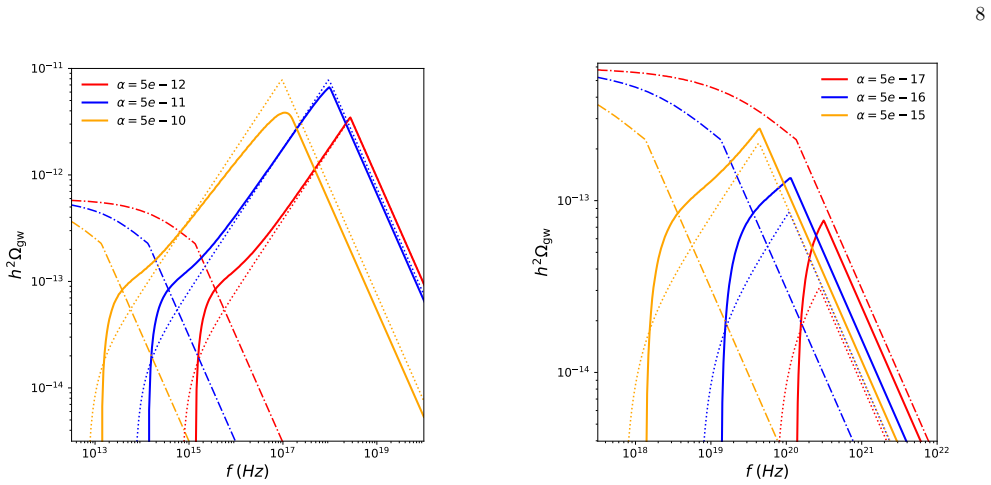
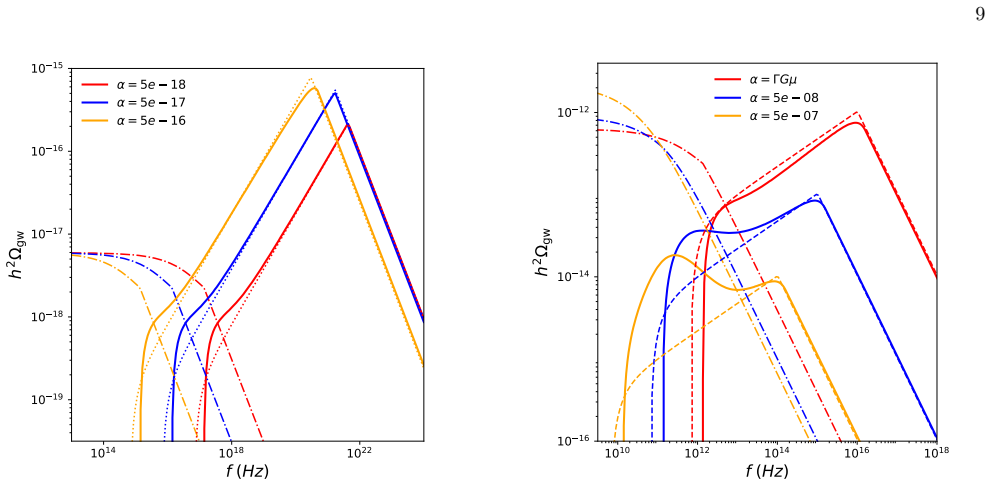
- Figure captions for the spectra plots should explicitly state the frequency range over which the friction-era peak is isolated and the parameter values used, to allow direct visual assessment of the claimed separation from other eras.
Simulated Author's Rebuttal
We thank the referee for the positive assessment of our manuscript, the accurate summary of its contributions, and the recommendation for minor revision. We are pleased that the work is viewed as providing a practical analytical tool and an expanded parameter space mapping.
Circularity Check
No significant circularity in derivation chain
full rationale
The paper states that it derives analytical approximations for the ultra-high-frequency secondary peak sourced by friction-era loops, then validates that these forms describe the contribution well over the relevant frequency range and broad parameter space. The extension to a broader range of scenarios than in the self-cited prior work follows from applying the new approximations rather than from any reduction of the central result to a fit, self-definition, or load-bearing self-citation. No quoted equation or step equates a claimed prediction to its own input by construction, and the derivation is presented as independent of the cited reference.
Axiom & Free-Parameter Ledger
free parameters (2)
- cosmic string tension
- friction coefficient
axioms (1)
- domain assumption Cosmic string loops formed in the friction-dominated era produce a separable ultra-high-frequency gravitational-wave peak
Lean theorems connected to this paper
-
IndisputableMonolith/Cost/FunctionalEquation.leanwashburn_uniqueness_aczel unclear?
unclearRelation between the paper passage and the cited Recognition theorem.
We derive analytical approximations to describe the ultra-high-frequency secondary peak … for a broad range of cosmic string parameters … α∈[5·10−24,0.1], Gμ∈[10−7,10−20], β∈[0.1,100], Lc/tc∈[0.01,1]
-
IndisputableMonolith/Foundation/RealityFromDistinction.leanreality_from_one_distinction unclear?
unclearRelation between the paper passage and the cited Recognition theorem.
Ωgw(f) = 16π/3f (Gμ/H0)² Γ ∫ n(ℓ(t),t) (a(t)/a0)⁵ dt
What do these tags mean?
- matches
- The paper's claim is directly supported by a theorem in the formal canon.
- supports
- The theorem supports part of the paper's argument, but the paper may add assumptions or extra steps.
- extends
- The paper goes beyond the formal theorem; the theorem is a base layer rather than the whole result.
- uses
- The paper appears to rely on the theorem as machinery.
- contradicts
- The paper's claim conflicts with a theorem or certificate in the canon.
- unclear
- Pith found a possible connection, but the passage is too broad, indirect, or ambiguous to say the theorem truly supports the claim.
Reference graph
Works this paper leans on
-
[1]
Small loops When validating the approximation for small loops, for each set of parameters, the largest value ofαcon- sidered wasα= 0.1ΓGµ(represented by the orange line in Fig. 3). We then gradually decreased loop size un- til the signature disappeared completely. This behavior is inevitable since, when we decreaseα, we necessarily encounter the cut-offαL...
-
[2]
(43) — represented by the dashed lines in Figs
Backreaction and larger loops To validate the approximation for loops created with sizes comparable to the gravitational backreaction scale in Eq. (43) — represented by the dashed lines in Figs. 6 - 8 — we started by considering loops withα= ΓGµ(the red lines in Figs. 6 - 8). We then moved to larger loops until the signature becomes smaller than the frict...
-
[3]
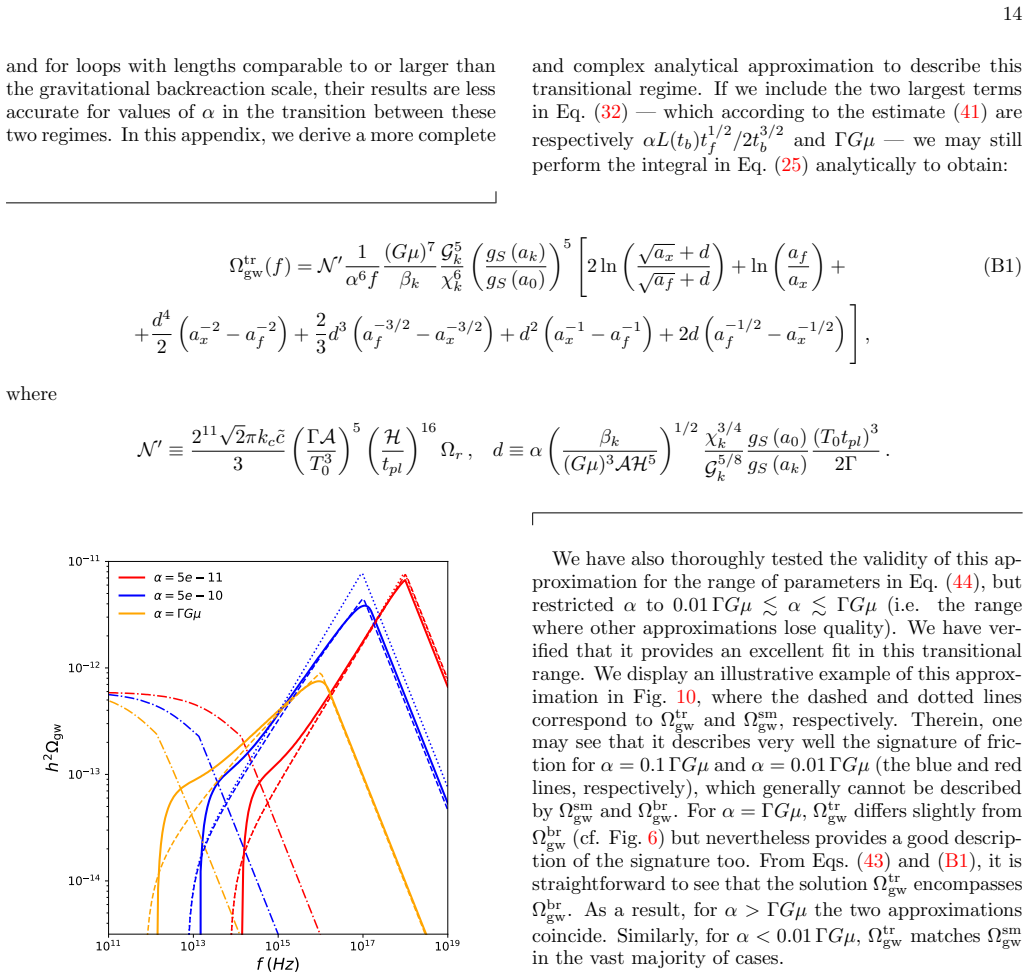
Transitional regime Although, the two approximations derived here pro- vide a good approximation to the SGWB generated by loops during the friction era for a wide range of param- eters, we found a range of values ofαin which they are not so accurate. For this reason, in App. B, we derive a third analytical approximation. The starting point is the approxim...
-
[4]
S. Mukovnikov and L. Sousa, Ultrahigh frequency gravi- tational waves from cosmic strings with friction, Phys. Rev. D110, 063516 (2024), arXiv:2404.13213 [astro- ph.CO]
-
[5]
N. Aggarwalet al., Challenges and opportunities of gravitational-wave searches at MHz to GHz frequencies, Living Rev. Rel.24, 4 (2021), arXiv:2011.12414 [gr-qc]
-
[6]
N. Aggarwalet al., Challenges and opportunities of 15 gravitational-wave searches above 10 kHz, Living Rev. Rel.28, 10 (2025), arXiv:2501.11723 [gr-qc]
-
[7]
M. B. Hindmarsh and T. W. B. Kibble, Cosmic strings, Reports on Progress in Physics58, 477 (1995)
work page 1995
-
[8]
A. Vilenkin and E. P. S. Shellard,Cosmic Strings and Other Topological Defects(Cambridge University Press, 2000)
work page 2000
-
[9]
Witten, Superconducting Strings, Nucl
E. Witten, Superconducting Strings, Nucl. Phys. B249, 557 (1985)
work page 1985
-
[10]
How generic is cosmic string formation in SUSY GUTs
R. Jeannerot, J. Rocher, and M. Sakellariadou, How generic is cosmic string formation in SUSY GUTs, Phys. Rev. D68, 103514 (2003), arXiv:hep-ph/0308134
work page internal anchor Pith review Pith/arXiv arXiv 2003
-
[11]
Cosmic String Production Towards the End of Brane Inflation
S. Sarangi and S. H. H. Tye, Cosmic string production towards the end of brane inflation, Phys. Lett. B536, 185 (2002), arXiv:hep-th/0204074
work page internal anchor Pith review Pith/arXiv arXiv 2002
-
[12]
Vilenkin, Gravitational radiation from cosmic strings, Phys
A. Vilenkin, Gravitational radiation from cosmic strings, Phys. Lett. B107, 47 (1981)
work page 1981
-
[13]
C. J. Hogan and M. J. Rees, Gravitational interactions of cosmic strings, Nature311, 109 (1984)
work page 1984
-
[14]
F. S. Accetta and L. M. Krauss, The stochastic gravita- tional wave spectrum resulting from cosmic string evolu- tion, Nucl. Phys. B319, 747 (1989)
work page 1989
-
[15]
J. J. Blanco-Pillado, K. D. Olum, and B. Shlaer, The number of cosmic string loops, Phys. Rev. D89, 023512 (2014), arXiv:1309.6637 [astro-ph.CO]
work page internal anchor Pith review Pith/arXiv arXiv 2014
-
[16]
L. Sousa and P. P. Avelino, Stochastic Gravitational Wave Background generated by Cosmic String Net- works: Velocity-Dependent One-Scale model versus Scale-Invariant Evolution, Phys. Rev. D88, 023516 (2013), arXiv:1304.2445 [astro-ph.CO]
work page internal anchor Pith review Pith/arXiv arXiv 2013
-
[17]
Probing Cosmic Superstrings with Gravitational Waves
L. Sousa and P. P. Avelino, Probing Cosmic Superstrings with Gravitational Waves, Phys. Rev. D94, 063529 (2016), arXiv:1606.05585 [astro-ph.CO]
work page internal anchor Pith review Pith/arXiv arXiv 2016
- [18]
-
[19]
M. Hindmarsh, J. Lizarraga, A. Urio, and J. Urrestilla, Loop decay in Abelian-Higgs string networks, Phys. Rev. D104, 043519 (2021), arXiv:2103.16248 [astro-ph.CO]
-
[20]
W. Buchmuller, V. Domcke, and K. Schmitz, Metastable cosmic strings, JCAP11, 020, arXiv:2307.04691 [hep- ph]
- [21]
-
[22]
Y. Cui, M. Lewicki, D. E. Morrissey, and J. D. Wells, Probing the pre-BBN universe with gravitational waves from cosmic strings, JHEP01, 081, arXiv:1808.08968 [hep-ph]
work page internal anchor Pith review Pith/arXiv arXiv
-
[23]
Y. Gouttenoire, G. Servant, and P. Simakachorn, Beyond the Standard Models with Cosmic Strings, JCAP07, 032, arXiv:1912.02569 [hep-ph]
-
[24]
P. Auclairet al., Probing the gravitational wave back- ground from cosmic strings with LISA, JCAP04, 034, arXiv:1909.00819 [astro-ph.CO]
-
[25]
J. J. Blanco-Pillado, Y. Cui, S. Kuroyanagi, M. Lewicki, G. Nardini, M. Pieroni, I. Y. Rybak, L. Sousa, and J. M. Wachter (LISA Cosmology Working Group), Gravita- tional waves from cosmic strings in LISA: reconstruc- tion pipeline and physics interpretation, JCAP05, 006, arXiv:2405.03740 [astro-ph.CO]
-
[26]
J. Garriga and M. Sakellariadou, Effects of friction on cosmic strings, Phys. Rev. D48, 2502 (1993), arXiv:hep- th/9303024
- [27]
-
[28]
Planck 2018 results. VI. Cosmological parameters
N. Aghanimet al.(Planck), Planck 2018 results. VI. Cosmological parameters, Astron. Astrophys.641, A6 (2020), [Erratum: Astron.Astrophys. 652, C4 (2021)], arXiv:1807.06209 [astro-ph.CO]
work page internal anchor Pith review Pith/arXiv arXiv 2018
-
[29]
C. J. A. P. Martins and E. P. S. Shellard, Quantita- tive string evolution, Phys. Rev. D54, 2535 (1996), arXiv:hep-ph/9602271
work page internal anchor Pith review Pith/arXiv arXiv 1996
-
[30]
T. W. B. Kibble, Topology of Cosmic Domains and Strings, J. Phys. A9, 1387 (1976)
work page 1976
-
[31]
E. W. Kolb and M. S. Turner,The Early Universe, Vol. 69 (1990)
work page 1990
-
[32]
Vilenkin, Cosmic string dynamics with friction, Phys
A. Vilenkin, Cosmic string dynamics with friction, Phys. Rev. D43, 1060 (1991)
work page 1991
-
[33]
M. G. Alford and F. Wilczek, Aharonov-Bohm Interac- tion of Cosmic Strings with Matter, Phys. Rev. Lett.62, 1071 (1989)
work page 1989
-
[34]
C. J. A. P. Martins and E. P. S. Shellard, Extending the velocity dependent one scale string evolution model, Phys. Rev. D65, 043514 (2002), arXiv:hep-ph/0003298
work page internal anchor Pith review Pith/arXiv arXiv 2002
- [35]
- [36]
-
[37]
Scaling from gauge and scalar radiation in Abelian Higgs string networks
M. Hindmarsh, J. Lizarraga, J. Urrestilla, D. Daverio, and M. Kunz, Scaling from gauge and scalar radiation in Abelian Higgs string networks, Phys. Rev. D96, 023525 (2017), arXiv:1703.06696 [astro-ph.CO]
work page internal anchor Pith review Pith/arXiv arXiv 2017
- [38]
- [39]
-
[40]
C. J. Burden, Gravitational Radiation From a Particular Class of Cosmic Strings, Phys. Lett. B164, 277 (1985)
work page 1985
-
[41]
B. Allen and E. P. S. Shellard, Gravitational radiation from cosmic strings, Phys. Rev. D45, 1898 (1992)
work page 1992
-
[42]
D. Garfinkle and T. Vachaspati, Fields due to kinky, cus- pless, cosmic loops, Phys. Rev. D37, 257 (1988)
work page 1988
- [43]
-
[44]
Gravitational wave bursts from cosmic strings
T. Damour and A. Vilenkin, Gravitational wave bursts from cosmic strings, Phys. Rev. Lett.85, 3761 (2000), arXiv:gr-qc/0004075
work page internal anchor Pith review Pith/arXiv arXiv 2000
-
[45]
J. J. Blanco-Pillado, K. D. Olum, and B. Shlaer, Cos- mic string loop shapes, Phys. Rev. D92, 063528 (2015), arXiv:1508.02693 [astro-ph.CO]
work page internal anchor Pith review Pith/arXiv arXiv 2015
-
[46]
T. Vachaspati and A. Vilenkin, Gravitational Radiation from Cosmic Strings, Phys. Rev. D31, 3052 (1985)
work page 1985
-
[47]
R. J. Scherrer, J. M. Quashnock, D. N. Spergel, and 16 W. H. Press, Properties of Realistic Cosmic String Loops, Phys. Rev. D42, 1908 (1990)
work page 1908
-
[48]
J. M. Quashnock and D. N. Spergel, Gravitational Self- interactions of Cosmic Strings, Phys. Rev. D42, 2505 (1990)
work page 1990
-
[49]
T. W. B. Kibble, Evolution of a system of cosmic strings, Nucl. Phys. B252, 227 (1985), [Erratum: Nucl.Phys.B 261, 750 (1985)]
work page 1985
-
[50]
S. A. Sanidas, R. A. Battye, and B. W. Stappers, Con- straints on cosmic string tension imposed by the limit on the stochastic gravitational wave background from the European Pulsar Timing Array, Phys. Rev. D85, 122003 (2012), arXiv:1201.2419 [astro-ph.CO]
work page internal anchor Pith review Pith/arXiv arXiv 2012
-
[51]
Planck Collaboration XXV, Planck 2013 results. XXV. Searches for cosmic strings and other topological defects, Astron. Astrophys. 571, A25 (2014)
work page 2013
-
[52]
L. Sousa and P. P. Avelino, Stochastic gravitational wave background generated by cosmic string networks: The small-loop regime, Phys. Rev. D89, 083503 (2014), arXiv:1403.2621 [astro-ph.CO]
work page internal anchor Pith review Pith/arXiv arXiv 2014
- [53]
- [54]
- [55]
- [56]
- [57]
-
[58]
G. Vacalis, G. Marocco, J. Bamber, R. Bingham, and G. Gregori, Detection of high-frequency gravitational waves using high-energy pulsed lasers, Class. Quant. Grav.40, 155006 (2023), arXiv:2301.08163
-
[59]
J. Antoniadiset al.(EPTA, InPTA), The second data release from the European Pulsar Timing Array - IV. Implications for massive black holes, dark matter, and the early Universe, Astron. Astrophys.685, A94 (2024), arXiv:2306.16227 [astro-ph.CO]
-
[60]
The NANOGrav 15-year Data Set: Search for Signals from New Physics
A. Afzalet al.(NANOGrav), The NANOGrav 15 yr Data Set: Search for Signals from New Physics, Astrophys. J. Lett.951, L11 (2023), [Erratum: Astrophys.J.Lett. 971, L27 (2024), Erratum: Astrophys.J. 971, L27 (2024)], arXiv:2306.16219 [astro-ph.HE]
work page internal anchor Pith review Pith/arXiv arXiv 2023
discussion (0)
Sign in with ORCID, Apple, or X to comment. Anyone can read and Pith papers without signing in.