Multinuclear fingerprinting
Pith reviewed 2026-05-25 05:07 UTC · model grok-4.3
The pith
Multinuclear fingerprinting produces seven exactly co-registered quantitative brain maps from simultaneous proton and sodium data acquired in 13 minutes.
A machine-rendered reading of the paper's core claim, the machinery that carries it, and where it could break.
Core claim
Multinuclear fingerprinting consists of simultaneous 1H/23Na magnetic resonance fingerprinting followed by a super-resolution algorithm that raises 23Na resolution to match the 1H resolution; the resulting seven maps (PD, T1, T2 from 1H; TSC, T1, T2short, T2long from 23Na) are obtained at 1.5x1.5x5 mm³ resolution in 13 minutes on seven healthy subjects at 7 T, with all images exactly co-registered.
What carries the argument
Multinuclear fingerprinting, the combination of simultaneous dual-nucleus MRF acquisition with a super-resolution reconstruction step that aligns sodium maps to proton resolution while preserving quantitative values.
If this is right
- All seven maps share identical spatial and temporal sampling because the underlying 1H and 23Na data are acquired simultaneously.
- The exact co-registration enables direct voxel-wise comparison between tissue structure from proton maps and ion homeostasis from sodium maps.
- The 13-minute acquisition time supports longitudinal studies that track joint 1H/23Na changes during tasks or interventions.
- The same acquisition and reconstruction pipeline can be adapted to body regions other than the brain.
Where Pith is reading between the lines
- The method could be extended to include additional nuclei or functional tasks to map dynamic ion changes alongside structure.
- If the super-resolution step proves robust across patient populations, the approach might shorten total exam times for combined proton-sodium protocols in clinical research.
- Exact co-registration at this resolution opens the possibility of using the maps as joint inputs for biophysical models of brain tissue.
Load-bearing premise
The super-resolution algorithm recovers sodium image detail without introducing bias or artifacts that would distort the derived sodium parameter maps.
What would settle it
A side-by-side comparison on the same subjects showing statistically significant differences between sodium T2 or TSC values obtained from MNF versus values obtained from separate high-resolution 23Na acquisitions or calibrated phantoms.
Figures




read the original abstract
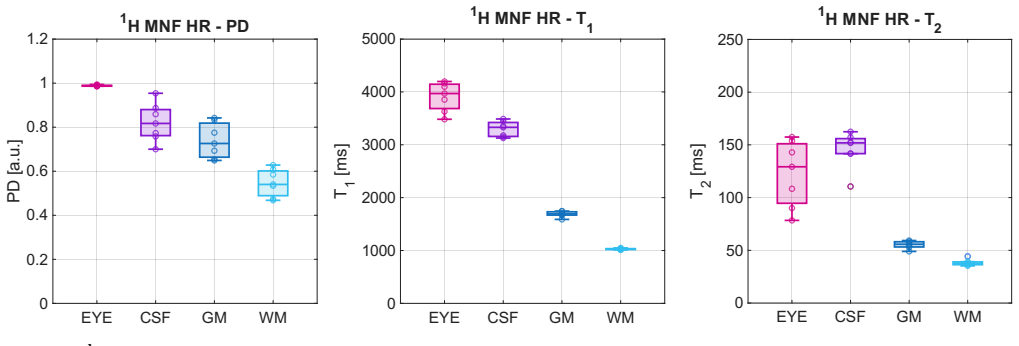
We developed a new magnetic resonance imaging method called multinuclear fingerprinting (MNF) which leverages simultaneously-acquired proton (1H) and sodium (23Na) data to generate seven quantitative maps of the whole brain: proton density (PD), T1 and T2 relaxation times from water, and tissue sodium concentration (TSC), T1, T2short and T2long from Na+ ions. MNF consists of two parts: (1) simultaneous 1H/23Na magnetic resonance fingerprinting (MRF), and (2) a super-resolution (SR) algorithm to increase the 23Na resolution to match the 1H resolution. It was tested on the brain of seven healthy subjects at 7 T, with a final resolution of 1.5x1.5x5 mm3 for all maps acquired in 13 min. MNF could provide new fundamental insights into the inter-relationship between morphology (i.e. tissue structure from the 1H maps) and physiology (i.e. ion homeostasis from the 23Na maps) in vivo to help improve our understanding of the human brain in general, and to study neuropathologies and their treatments. Since all 1H/23Na MRF data is acquired simultaneously, all images are exactly co-registered with identical spatial and temporal resolutions. MNF could be useful in future longitudinal studies for assessing local time-dependent and conjoint 1H/23Na MR changes during tasks or interventions. MNF was initially developed for neuroimaging, but it can be adapted to any other parts of the body.
Editorial analysis
A structured set of objections, weighed in public.
Referee Report
Summary. The manuscript introduces multinuclear fingerprinting (MNF), a method combining simultaneous 1H/23Na MR fingerprinting with a super-resolution (SR) step to produce seven co-registered quantitative maps (PD, T1, T2 from 1H; TSC, T1, T2short, T2long from 23Na) of the whole brain at 1.5×1.5×5 mm³ resolution acquired in 13 min on seven healthy volunteers at 7 T. The central claim is that simultaneous acquisition ensures exact co-registration while the SR algorithm recovers 23Na detail at the 1H resolution without compromising the quantitative sodium parameter maps.
Significance. If the SR step is shown to be unbiased, MNF would enable joint morphological and ion-homeostasis mapping in a single short scan, with potential value for longitudinal studies of brain physiology and neuropathology. The simultaneous acquisition and multi-nuclear parameter set are novel strengths; however, the absence of direct validation for the SR outputs against independent high-resolution 23Na measurements weakens the quantitative claims for the sodium maps.
major comments (1)
- [Abstract and Methods (SR algorithm description)] The SR step is load-bearing for the four sodium maps (TSC, T1, T2short, T2long). The abstract states that SR increases 23Na resolution to match the 1H resolution, yet the method description provides no comparison of SR-reconstructed sodium parameter maps against separately acquired high-resolution 23Na data or against phantoms with known sodium concentrations. Without such a check, any systematic bias or artifact introduced by the SR network would propagate directly into the reported TSC, T1, T2short, and T2long values.
minor comments (1)
- [Abstract] The abstract reports results on seven healthy subjects but does not state whether the quantitative maps were compared to literature values or to conventional separate 1H and 23Na acquisitions in the same cohort.
Simulated Author's Rebuttal
We thank the referee for their constructive review and for recognizing the novelty of simultaneous 1H/23Na acquisition and the multi-nuclear parameter set. We address the single major comment below and will revise the manuscript to strengthen the validation of the super-resolution component.
read point-by-point responses
-
Referee: [Abstract and Methods (SR algorithm description)] The SR step is load-bearing for the four sodium maps (TSC, T1, T2short, T2long). The abstract states that SR increases 23Na resolution to match the 1H resolution, yet the method description provides no comparison of SR-reconstructed sodium parameter maps against separately acquired high-resolution 23Na data or against phantoms with known sodium concentrations. Without such a check, any systematic bias or artifact introduced by the SR network would propagate directly into the reported TSC, T1, T2short, and T2long values.
Authors: We agree that explicit validation of the SR step against independent references is important to rule out systematic bias in the sodium maps. Direct high-resolution 23Na acquisitions are SNR-limited and were not performed in the original study, which is why the SR approach was developed. In the revised manuscript we will add a new subsection to Methods describing (i) numerical simulations with known ground-truth sodium parameter maps and (ii) phantom experiments using solutions of calibrated sodium concentration. These will quantify any residual bias or variance introduced by the SR network on TSC, T1, T2short and T2long, and the results will be reported in Results. This addition directly addresses the referee’s concern while preserving the core claim that simultaneous acquisition guarantees co-registration. revision: yes
Circularity Check
No significant circularity; method development relies on established MRF and SR components without self-referential reduction
full rationale
The abstract and provided context describe MNF as a combination of simultaneous 1H/23Na MRF (a standard dictionary-matching technique) plus a separate SR algorithm to match resolutions. No equations, fitted parameters presented as predictions, or self-citation chains are visible that would make any output equivalent to its inputs by construction. The co-registration advantage follows directly from simultaneous acquisition, not from any derived claim. The reader's assessment of score 2.0 aligns with absence of load-bearing circular steps. This is a typical technical methods paper whose central claims (seven co-registered maps in 13 min) rest on implementation details rather than tautological definitions or renamed fits.
Axiom & Free-Parameter Ledger
Reference graph
Works this paper leans on
-
[1]
Erecinska, M. & Silver, I. A. Ions and energy in mammalian brain.Progress in Neurobiology43, 37–71 (1994)
work page 1994
-
[2]
Molecular Cell Biology(WH Freeman, 2000)
Lodish, H.et al. Molecular Cell Biology(WH Freeman, 2000)
work page 2000
-
[3]
CNS energy metabolism as related to function
Ames III, A. CNS energy metabolism as related to function. Brain Research Reviews34, 42–68 (2000)
work page 2000
-
[4]
Madelin, G.X-Nuclei Magnetic Resonance Imaging(Jenny Stanford Publishing; 1st edition (March 15, 2022) & CRC Press, Singapore, 2022)
work page 2022
-
[5]
Madelin, G., Lee, J.-S., Regatte, R. R. & Jerschow, A. Sodium MRI: Methods and applications.Progress in Nuclear Magnetic Resonance Spectroscopy79, 14–47 (2014)
work page 2014
-
[6]
Gast, L. V., Platt, T., Nagel, A. M. & Gerhalter, T. Recent technical developments and clinical research-applications of sodium (23Na) MRI.Progress in Nuclear Magnetic Resonance Spectroscopy138–139, 51 (2023)
work page 2023
-
[7]
Song, Y ., Yin, Y ., Chen, Q., Marchetti, A. & Kong, X.23Na re- laxometry: An overview of theory and applications.Magnetic Resonance Letters3, 150–174 (2023)
work page 2023
-
[8]
Madelin, G. & Regatte, R. R. Biomedical applications of sodium MRI in vivo.Journal of Magnetic Resonance Imaging 38, 511–529 (2013)
work page 2013
-
[9]
Rodriguez, G. G.et al.Super-resolution of sodium images from simultaneous 1H MRF/23Na MRI acquisition.NMR in Biomedicinee4959 (2023)
work page 2023
-
[10]
Ma, D.et al.Magnetic resonance fingerprinting.Nature495, 187–192 (2013)
work page 2013
-
[11]
Cloos, M. A.et al.Multiparametric imaging with hetero- geneous radiofrequency fields.Nature Communications7, 12445 (2016)
work page 2016
-
[12]
Wang, B.et al.A radially interleaved sodium and proton coil array for brain MRI at 7 T.NMR in Biomedicine34, e4608 (2021)
work page 2021
-
[13]
Yu, Z., Madelin, G., Sodickson, D. K. & Cloos, M. A. Si- multaneous proton magnetic resonance fingerprinting and sodium MRI.Magnetic Resonance in Medicine83, 2232– 2242 (2020)
work page 2020
-
[14]
Yu, Z.et al.Simultaneous 3D acquisition of 1H MRF and 23Na MRI.Magnetic Resonance in Medicine87, 2299–2312 (2022)
work page 2022
-
[15]
Rodriguez, G. G.et al.Repeatability of simultaneous 3D 1H MRF/23Na MRI in brain at 7 T.Scientific Reports12, 14156 (2022)
work page 2022
-
[16]
Van de Plas, R., Y ang, J., Spraggins, J. & Caprioli, R. M. Image fusion of mass spectrometry and microscopy: A mul- timodality paradigm for molecular tissue mapping.Nature Methods12, 366–372 (2015)
work page 2015
-
[17]
Meyerspeer, M.et al.Simultaneous and interleaved acquisi- tion of NMR signals from different nuclei with a clinical MRI scanner.Magnetic Resonance in Medicine76, 1636–1641 (2016)
work page 2016
-
[18]
Lopez Kolkovsky, A. L., Carlier, P . G., Marty, B. & Meyerspeer, M. Interleaved and simultaneous multi-nuclear magnetic reso- nance in vivo. Review of principles, applications and potential. NMR in Biomedicine35, e4735 (2022)
work page 2022
-
[19]
Romano, Y ., Elad, M. & Milanfar, P . The little engine that could: Regularization by denoising (RED).SIAM Journal on 12 Imaging Sciences10, 1804–1844 (2017)
work page 2017
-
[20]
Qiusheng, L., Xiaoyu, F ., Baoshun, S. & Xiaohua, Z. Com- pressed sensing MRI based on the hybrid regularization by denoising and the epigraph projection.Signal Processing 170, 107444 (2020)
work page 2020
-
[21]
Ordidge, R. J., Wylezinska, M., Hugg, J. W., Butterworth, E. & Franconi, F . Frequency offset corrected inversion (FOCI) pulses for use in localized spectroscopy.Magnetic Resonance in Medicine36, 562–566 (1996)
work page 1996
-
[22]
InPro- ceedings of the Annual Meeting of the ISMRM, 3306 (2023)
O’Donnell, L.et al.Mapping sodium relaxation parameters in brain using magnetic resonance fingerprinting at 7T. InPro- ceedings of the Annual Meeting of the ISMRM, 3306 (2023)
work page 2023
-
[23]
O’Donnell, L. F .et al.Correlation-weighted 23Na magnetic resonance fingerprinting in the brain.NMR in Biomedicine 38, e70150 (2025)
work page 2025
-
[24]
Pruessmann, K. P ., Weiger, M., Börnert, P . & Boesiger, P . Advances in sensitivity encoding with arbitrary k-space tra- jectories.Magnetic Resonance in Medicine46, 638–651 (2001)
work page 2001
-
[25]
Cao, X.et al.Robust sliding-window reconstruction for ac- celerating the acquisition of MR fingerprinting.Magnetic Resonance in Medicine78, 1579–1588 (2017)
work page 2017
-
[26]
Weigel, M. Extended phase graphs: dephasing, RF pulses, and echoes-pure and simple.Journal of Magnetic Resonance Imaging41, 266–295 (2015)
work page 2015
-
[27]
Knoll, F ., Bredies, K., Pock, T. & Stollberger, R. Second order total generalized variation (TGV) for MRI.Magnetic Resonance in Medicine65, 480–491 (2011)
work page 2011
-
[28]
Kratzer, F . J.et al.3D sodium ( 23Na) magnetic resonance fin- gerprinting for time-efficient relaxometric mapping.Magnetic Resonance in Medicine86, 2412–2425 (2021)
work page 2021
-
[29]
Ashburner, J.et al.SPM12 manual.Wellcome Trust Centre for Neuroimaging, London, UK2464(2014)
work page 2014
-
[30]
Ashburner, J. & Ridgway, G. R. Symmetric diffeomorphic mod- eling of longitudinal structural MRI.Frontiers in Neuroscience 6, 197 (2013)
work page 2013
-
[31]
Y .et al.Osteogenesis imperfecta and the eye
Chau, F . Y .et al.Osteogenesis imperfecta and the eye. In Osteogenesis Imperfecta, 289–303 (Elsevier, 2014)
work page 2014
-
[32]
Forrester, J. V., Dick, A. D., McMenamin, P . G., Roberts, F . & Pearlman, E.The eye: basic sciences in practice(Elsevier Health Sciences, 2015)
work page 2015
-
[33]
Axel, L., Costantini, J. & Listerud, J. Intensity correction in surface-coil MR imaging.American Journal of Roentgenology 148, 418–420 (1987)
work page 1987
-
[34]
Kokavec, J.et al.Biochemical analysis of the living human vitreous.Clinical & Experimental Ophthalmology44, 597–609 (2016)
work page 2016
-
[35]
Winkler, S. S., Thomasson, D. M., Sherwood, K. & Perman, W. H. Regional T2 and sodium concentration estimates in the normal human brain by sodium-23 MR imaging at 1.5 T.Journal of Computer Assisted Tomography13, 561–566 (1989)
work page 1989
-
[36]
Adlung, A.et al.Quantification of tissue sodium concentration in the ischemic stroke: A comparison between external and internal references for 23Na MRI.Journal of Neuroscience Methods382, 109721 (2022)
work page 2022
-
[37]
Pipe, J. G.et al.A new design and rationale for 3D orthogo- nally oversampled k-space trajectories.Magnetic Resonance in Medicine66, 1303–1311 (2011)
work page 2011
-
[38]
Fessler, J. A. On NUFFT -based gridding for non-Cartesian MRI.Journal of Magnetic Resonance188, 191–195 (2007)
work page 2007
-
[39]
Pipe, J. G. & Menon, P . Sampling density compensation in MRI: rationale and an iterative numerical solution.Magnetic Resonance in Medicine41, 179–186 (1999)
work page 1999
-
[40]
Bydder, M., Larkman, D. J. & Hajnal, J. V. Combination of signals from array coils using image-based estimation of coil sensitivity profiles.Magnetic Resonance in Medicine47, 539– 548 (2002)
work page 2002
-
[41]
& Tu, D.The jackknife and bootstrap(Springer Science & Business Media, 2012)
Shao, J. & Tu, D.The jackknife and bootstrap(Springer Science & Business Media, 2012)
work page 2012
-
[42]
Efron, B.The jackknife, the bootstrap and other resampling plans(SIAM, 1982)
work page 1982
-
[43]
Koolstra, K., Beenakker, J.-W. M., Koken, P ., Webb, A. & Börnert, P . Cartesian MR fingerprinting in the eye at 7T using compressed sensing and matrix completion-based recon- structions.Magnetic Resonance in Medicine81, 2551–2565 (2019)
work page 2019
-
[44]
Richdale, K.et al.7 Tesla MR imaging of the human eye in vivo.Journal of Magnetic Resonance Imaging30, 924–932 (2009)
work page 2009
-
[45]
Rooney, W. D.et al.Magnetic field and tissue dependencies of human brain longitudinal 1H2O relaxation in vivo.Magnetic Resonance in Medicine57, 308–318 (2007)
work page 2007
-
[46]
Marques, J. P .et al.MP2RAGE, a self bias-field corrected sequence for improved segmentation and T1-mapping at high field.NeuroImage49, 1271–1281 (2010)
work page 2010
-
[47]
Wright, P .et al.Water proton T 1 measurements in brain tissue at 7, 3, and 1.5 T using IR-EPI, IR-TSE, and MPRAGE: results and optimization.Magnetic Resonance Materials in Physics, Biology and Medicine21, 121–130 (2008)
work page 2008
-
[48]
Caan, M. W.et al.MP2RAGEME: T 1, T2*, and QSM mapping in one sequence at 7 tesla.Human Brain Mapping40, 1786– 1798 (2019)
work page 2019
-
[49]
Dieringer, M. A.et al.Rapid parametric mapping of the longitudinal relaxation time T1 using two-dimensional variable flip angle magnetic resonance imaging at 1.5 Tesla, 3 Tesla, and 7 Tesla.PLoS One9, e91318 (2014)
work page 2014
-
[50]
Magnetic Resonance in Medicine84, 3286–3299 (2020)
Leroi, L.et al.Simultaneous proton density, T 1, T 2, and flip-angle mapping of the brain at 7 T using multiparametric 3D SSFP imaging and parallel-transmission universal pulses. Magnetic Resonance in Medicine84, 3286–3299 (2020)
work page 2020
-
[51]
Emmerich, J.et al.Rapid and accurate dictionary-based T2 mapping from multi-echo turbo spin echo data at 7 Tesla.Jour- nal of Magnetic Resonance Imaging49, 1253–1262 (2019)
work page 2019
-
[52]
Sabati, M. & Maudsley, A. A. Fast and high-resolution quanti- tative mapping of tissue water content with full brain coverage for clinically-driven studies.Magnetic Resonance Imaging31, 1752–1759 (2013)
work page 2013
- [53]
- [54]
-
[55]
Volz, S., Nöth, U. & Deichmann, R. Correction of system- 13 atic errors in quantitative proton density mapping.Magnetic Resonance in Medicine68, 74–85 (2012)
work page 2012
-
[56]
Mezer, A., Rokem, A., Berman, S., Hastie, T. & Wandell, B. A. Evaluating quantitative proton-density-mapping meth- ods. Tech. Rep., Wiley Online Library (2016)
work page 2016
-
[57]
Tofts, P . S. PD: Proton density of tissue water.Quantitative MRI of the brain: Measuring changes caused by disease 83–109 (2003)
work page 2003
-
[58]
J., Abbas, Z., Ridder, D., Zimmermann, M
Shah, N. J., Abbas, Z., Ridder, D., Zimmermann, M. & Oros- Peusquens, A.-M. A novel MRI-based quantitative water content atlas of the human brain.NeuroImage252, 119014 (2022)
work page 2022
-
[59]
C., Hoffmann, J., Shajan, G., Pohmann, R
Mirkes, C. C., Hoffmann, J., Shajan, G., Pohmann, R. & Scheffler, K. High-resolution quantitative sodium imaging at 9.4 Tesla.Magnetic Resonance in Medicine73, 342–351 (2015)
work page 2015
-
[60]
Worthoff, W. A., Shymanskaya, A. & Shah, N. J. Relaxome- try and quantification in simultaneously acquired single and triple quantum filtered sodium MRI.Magnetic Resonance in Medicine81, 303–315 (2019)
work page 2019
-
[61]
Kolodny, N.et al.A feasibility study of 23Na magnetic res- onance imaging of human and rabbit vitreal disorders.In- vestigative Ophthalmology & Visual Science34, 1917–1922 (1993)
work page 1917
-
[62]
Kohler, S. J.et al.Magnetic resonance imaging determination of 23Na visibility and T 2 * in the vitreous body.Journal of Magnetic Resonance82, 505–517 (1989)
work page 1989
-
[63]
Pettegrew, J. W., Glonek, T., Minshew, N. J. & Woessner, D. E. Sodium-23 NMR of intact bovine lens and vitreous humor. Journal of Magnetic Resonance63, 439–444 (1985)
work page 1985
-
[64]
Kratzer, F . J.et al.Sodium relaxometry using 23Na MR fingerprinting: A proof of concept.Magnetic Resonance in Medicine84, 2577–2591 (2020)
work page 2020
-
[65]
Lommen, J. M.et al.Probing the microscopic environment of 23Na ions in brain tissue by MRI: on the accuracy of different sampling schemes for the determination of rapid, biexponen- tial decay at low signal-to-noise ratio.Magnetic Resonance in Medicine80, 571–584 (2018)
work page 2018
-
[66]
Fleysher, L., Oesingmann, N., Stoeckel, B., Grossman, R. I. & Inglese, M. Sodium long-component T2 * mapping in human brain at 7 Tesla.Magnetic Resonance in Medicine62, 1338– 1341 (2009)
work page 2009
-
[67]
Blunck, Y .et al.3D-multi-echo radial imaging of 23Na (3D- MERINA) for time-efficient multi-parameter tissue compart- ment mapping.Magnetic Resonance in Medicine79, 1950– 1961 (2018)
work page 1950
-
[68]
Niesporek, S. C.et al.Improved T 2 * determination in 23Na, 35Cl, and 17O MRI using iterative partial volume correction based on 1H MRI segmentation.Magnetic Resonance Mate- rials in Physics, Biology and Medicine30, 519–536 (2017)
work page 2017
-
[69]
Riemer, F ., Solanky, B. S., Wheeler-Kingshott, C. A. & Golay, X. Bi-exponential 23Na T2* component analysis in the human brain.NMR in Biomedicine31, e3899 (2018)
work page 2018
-
[70]
Ridley, B.et al.Distribution of brain sodium long and short relaxation times and concentrations: a multi-echo ultra-high field 23Na MRI study.Scientific Reports8, 4357 (2018)
work page 2018
-
[71]
Ridley, B., Morsillo, F ., Zaaraoui, W. & Nonino, F . Variability by region and method in human brain sodium concentrations estimated by 23Na magnetic resonance imaging: A meta- analysis.Scientific Reports13, 3222 (2023)
work page 2023
-
[72]
Gilles, A., Nagel, A. M. & Madelin, G. Multipulse sodium mag- netic resonance imaging for multicompartment quantification: Proof-of-concept.Scientific Reports7, 17435 (2017)
work page 2017
-
[73]
Inglese, M.et al.Brain tissue sodium concentration in multiple sclerosis: a sodium imaging study at 3 tesla.Brain133, 847– 857 (2010)
work page 2010
-
[74]
Gerhalter, T.et al.Global decrease in brain sodium concen- tration after mild traumatic brain injury.Brain Communications 3, fcab051 (2021)
work page 2021
-
[75]
Meyer, M. M.et al.Cerebral sodium ( 23Na) magnetic res- onance imaging in patients with migraine—a case-control study.European Radiology29, 7055–7062 (2019)
work page 2019
-
[76]
Meyer, M. M.et al.Repeatability and reproducibility of cere- bral 23 Na imaging in healthy subjects.BMC Medical Imaging 19, 1–7 (2019)
work page 2019
-
[77]
Bhatia, A.et al.Quantitative Sodium ( 23Na) MRI in Pediatric Gliomas: Initial Experience.Diagnostics12, 1223 (2022)
work page 2022
-
[78]
Petracca, M.et al.Brain intra-and extracellular sodium con- centration in multiple sclerosis: a 7 T MRI study.Brain139, 795–806 (2016)
work page 2016
-
[79]
Haeger, A.et al.3T sodium MR imaging in Alzheimer’s disease shows stage-dependent sodium increase influenced by age and local brain volume.NeuroImage: Clinical36, 103274 (2022)
work page 2022
-
[80]
Niesporek, S. C.et al.Partial volume correction for in vivo 23Na-MRI data of the human brain.NeuroImage112, 353– 363 (2015)
work page 2015
discussion (0)
Sign in with ORCID, Apple, or X to comment. Anyone can read and Pith papers without signing in.