The dual effect of group-scale environments on galaxy quenching during cluster infall: pre-processing and protection
Pith reviewed 2026-05-25 04:17 UTC · model grok-4.3
The pith
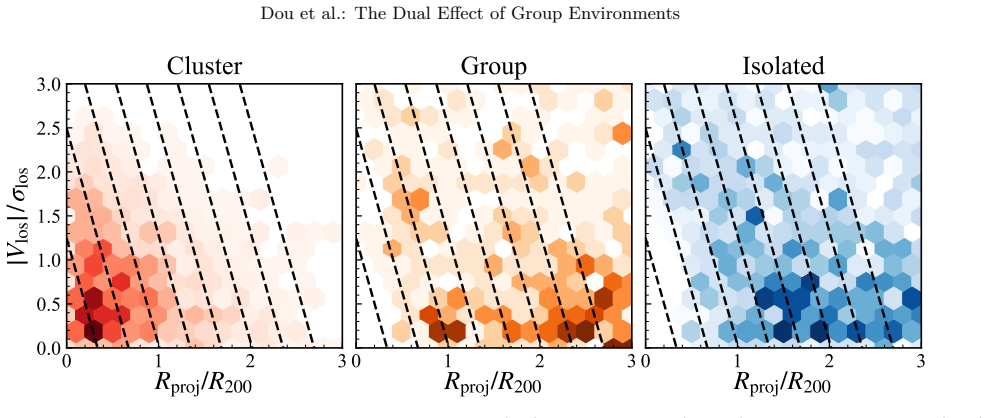
Group-scale environments pre-process galaxies to higher quenching before cluster entry and then delay their quenching inside the cluster.
A machine-rendered reading of the paper's core claim, the machinery that carries it, and where it could break.
Core claim
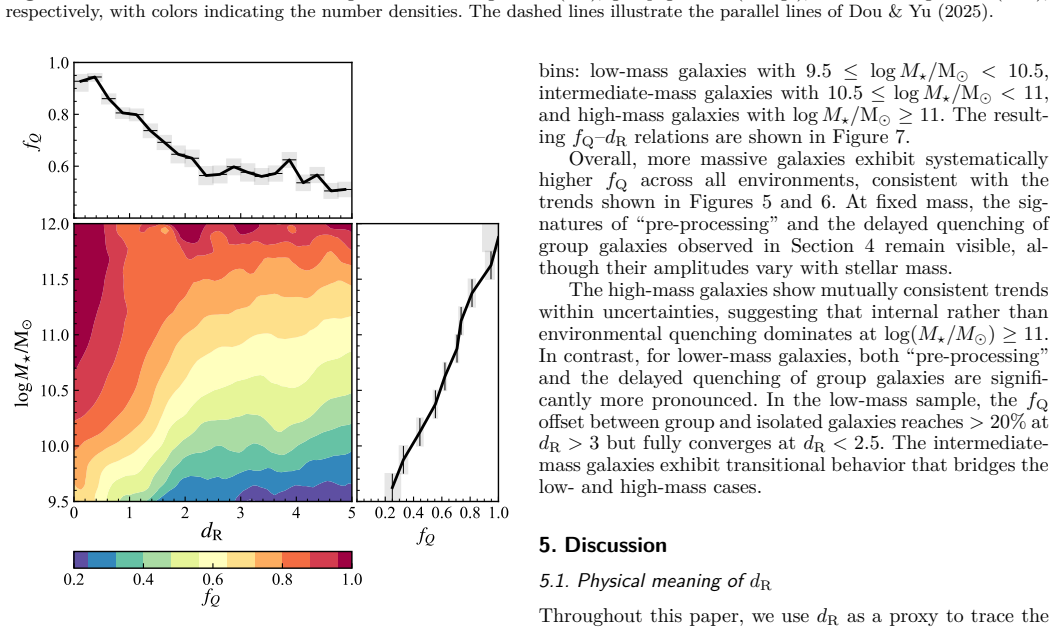
Along the infall process quantified by the d_R proxy in the R-V diagram, the quiescent fraction stays roughly constant at large radii before rising toward the cluster center around d_R ~ 2.5. Group-associated galaxies identified by the Blooming Tree algorithm show a higher quiescent fraction than isolated galaxies at early infall stages, consistent with pre-processing, yet their quiescent fraction rises only at smaller d_R values, indicating a subsequent protection effect in which group halos buffer against rapid cluster-driven quenching.
What carries the argument
The Blooming Tree algorithm for identifying group-scale substructures combined with the d_R infall proxy in the projected radius-velocity diagram to separate group-associated from isolated galaxies and track their quenching along the accretion path.
If this is right
- Group galaxies begin with elevated quiescent fractions at large d_R due to pre-processing in group halos.
- The rise in quiescent fraction for group galaxies is shifted inward to smaller d_R compared with isolated galaxies.
- Group-scale halos therefore buffer their members against rapid quenching once inside the cluster.
Where Pith is reading between the lines
- Accounting for this path dependence may be needed to match observed quenching timelines in cosmological simulations.
- The protection effect could be tested by checking whether group galaxies retain more cold gas reservoirs at intermediate cluster radii.
- Improved three-dimensional velocity data would reduce projection uncertainties and strengthen or weaken the separation of the two populations.
Load-bearing premise
The Blooming Tree algorithm and d_R proxy correctly separate group galaxies from isolated ones and measure their true position along the infall track without major bias from projection or velocity errors.
What would settle it
Repeating the analysis with an independent substructure finder or a different infall metric and finding identical quiescent-fraction tracks for group and isolated galaxies would falsify the reported dual effect.
Figures





read the original abstract
Context. It is well established that the cluster environment effectively quenches star formation in member galaxies. Amis. We aim to explore how the accretion path of infalling galaxies influences the cluster-driven quenching process. Methods. We compiled a large spectroscopic galaxy sample around 25 low-redshift, X-ray luminous massive clusters. We identified cluster substructures using the Blooming Tree algorithm and distinguished between galaxies accreted as part of group-scale structures and those accreted in isolation. The infall process was quantified using an infall proxy, $d_{\rm R}$, defined in the $R$--$V$ diagram. Results. Along the infall process, the quiescent fraction remains approximately constant at the outskirts and then increases steadily toward cluster center, with a transition occurring around $d_{\rm R}\sim 2.5$. We find that group-associated galaxies follow a distinct quenching track compared to isolated galaxies, indicating a dual effect of group-scale environments. At the early infall stages, group galaxies exhibit a higher quiescent fraction, consistent with ``pre-processing'' in group-scale halos. However, after entering the cluster environment, the rise in their quiescent fraction is delayed to smaller $d_{\rm R}$ compared to isolated galaxies. This suggests a phenomenological ``protection'' effect, in which group-scale halos buffer member galaxies against rapid cluster-driven quenching. Conclusions. We conclude that group-scale environments affect quenching in two ways: via pre-processing prior to cluster infall, and through a subsequent protection effect within the cluster environment.
Editorial analysis
A structured set of objections, weighed in public.
Referee Report
Summary. The paper analyzes a spectroscopic sample of galaxies around 25 low-redshift X-ray luminous clusters. Using the Blooming Tree algorithm to identify substructures, it separates galaxies accreted in groups from those accreted in isolation. An infall proxy d_R is defined in the projected R-V diagram to track position along the accretion path. The central claim is that group-scale environments exert a dual influence on quenching: pre-processing produces a higher quiescent fraction at large d_R (early infall), while a subsequent 'protection' effect delays the rise in quiescent fraction at small d_R inside the cluster relative to isolated galaxies. The quiescent fraction is roughly constant at large d_R then rises toward the center, with a transition near d_R ~ 2.5.
Significance. If the separation of accretion histories and the reported track offset are robust, the result adds a phenomenological 'protection' mechanism to the existing pre-processing literature and offers a way to reconcile apparently contradictory environmental quenching signals. The large cluster sample and explicit algorithmic separation of group vs. isolated accretion paths are strengths that would make the finding useful for refining semi-analytic models and hydrodynamical simulations of cluster infall.
major comments (1)
- [Methods] Methods section (Blooming Tree identification and d_R definition): the dual-effect claim rests on the assumption that the Blooming Tree algorithm cleanly separates group-associated galaxies and that d_R accurately orders galaxies along their 3D infall track. No completeness/purity metrics from mocks that incorporate projection and velocity errors are reported; without such tests the observed offset in quiescent-fraction tracks could arise from line-of-sight contamination rather than true pre-processing and protection.
minor comments (1)
- [Abstract] Abstract: 'Amis.' is a typographical error for 'Aims.'
Simulated Author's Rebuttal
We thank the referee for their constructive review and for recognizing the potential significance of the dual-effect finding. We address the single major comment below and will incorporate the requested validation in the revised manuscript.
read point-by-point responses
-
Referee: [Methods] Methods section (Blooming Tree identification and d_R definition): the dual-effect claim rests on the assumption that the Blooming Tree algorithm cleanly separates group-associated galaxies and that d_R accurately orders galaxies along their 3D infall track. No completeness/purity metrics from mocks that incorporate projection and velocity errors are reported; without such tests the observed offset in quiescent-fraction tracks could arise from line-of-sight contamination rather than true pre-processing and protection.
Authors: We agree that the current manuscript does not report completeness and purity metrics derived from mocks that include projection effects and velocity uncertainties. Although the Blooming Tree algorithm has been validated in earlier studies, dedicated tests tailored to our 25-cluster sample and the d_R definition would strengthen the claim that the observed track offset reflects physical pre-processing and protection rather than contamination. In the revised manuscript we will add a dedicated subsection to the Methods that presents mock-catalog tests quantifying completeness and purity for the group versus isolated classification, together with an assessment of how residual line-of-sight contamination would affect the quiescent-fraction trends. These additions will directly address the referee's concern. revision: yes
Circularity Check
No significant circularity; empirical sample splits and direct fraction measurements.
full rationale
The paper identifies substructures via Blooming Tree, partitions galaxies into group-associated versus isolated, defines the d_R proxy in the projected R-V diagram, and reports observed differences in quiescent fraction versus d_R. These are direct empirical measurements on the compiled spectroscopic sample rather than any fitted parameter, self-referential definition, or prediction that reduces to the input by construction. No load-bearing self-citations, uniqueness theorems, or ansatzes appear in the abstract or described chain that would force the dual-effect claim tautologically. The derivation remains self-contained observational analysis.
Axiom & Free-Parameter Ledger
Lean theorems connected to this paper
-
IndisputableMonolith/Foundation/RealityFromDistinction.leanreality_from_one_distinction unclear?
unclearRelation between the paper passage and the cited Recognition theorem.
We identified cluster substructures using the Blooming Tree algorithm and distinguished between galaxies accreted as part of group-scale structures and those accreted in isolation. The infall process was quantified using an infall proxy, d_R, defined in the R–V diagram.
-
IndisputableMonolith/Cost/FunctionalEquation.leanwashburn_uniqueness_aczel unclear?
unclearRelation between the paper passage and the cited Recognition theorem.
group galaxies exhibit a higher quiescent fraction, consistent with pre-processing... delayed to smaller d_R... phenomenological protection effect
What do these tags mean?
- matches
- The paper's claim is directly supported by a theorem in the formal canon.
- supports
- The theorem supports part of the paper's argument, but the paper may add assumptions or extra steps.
- extends
- The paper goes beyond the formal theorem; the theorem is a base layer rather than the whole result.
- uses
- The paper appears to rely on the theorem as machinery.
- contradicts
- The paper's claim conflicts with a theorem or certificate in the canon.
- unclear
- Pith found a possible connection, but the passage is too broad, indirect, or ambiguous to say the theorem truly supports the claim.
Reference graph
Works this paper leans on
-
[1]
F., Argudo-Fernández, M., & Badenes, C
Almeida, A., Anderson, S. F., Argudo-Fernández, M., & Badenes, C. 2023, ApJS, 267, 44 Astropy Collaboration, Price-Whelan, A. M., Sipőcz, B. M., et al. 2018, AJ, 156, 123 Bahé, Y. M., McCarthy, I. G., Balogh, M. L., & Font, A. S. 2013, MNRAS, 430, 3017
work page 2023
-
[2]
Balestra, I., Mercurio, A., Sartoris, B., et al. 2016, ApJS, 224, 33
work page 2016
- [3]
-
[4]
Barrett, P., Hunter, J., Miller, J. T., Hsu, J. C., & Greenfield, P. 2005, in Astronomical Society of the Pacific Conference Series, Vol. 347, Astronomical Data Analysis Software and Systems XIV, ed. P. Shopbell, M. Britton, & R. Ebert, 91
work page 2005
-
[5]
F., Wolf, C., Meisenheimer, K., et al
Bell, E. F., Wolf, C., Meisenheimer, K., et al. 2004, ApJ, 608, 752
work page 2004
- [6]
-
[7]
Berrier, J. C., Stewart, K. R., Bullock, J. S., et al. 2009, ApJ, 690, 1292
work page 2009
-
[8]
Blumenthal, G. R., Faber, S. M., Primack, J. R., & Rees, M. J. 1984, Nature, 311, 517
work page 1984
- [9]
- [10]
-
[11]
A., Amram, P., Combes, F., & Gach, J
Bournaud, F., Duc, P. A., Amram, P., Combes, F., & Gach, J. L. 2004, A&A, 425, 813
work page 2004
-
[12]
Brambila, D., Lopes, P. A. A., Ribeiro, A. L. B., & Cortesi, A. 2023, Monthly Notices of the Royal Astronomical Society, 523, 785801
work page 2023
-
[13]
Brinchmann, J., Charlot, S., White, S. D. M., et al. 2004, MNRAS, 351, 1151
work page 2004
- [14]
-
[15]
Colberg, J. M., Krughoff, K. S., & Connolly, A. J. 2005, MNRAS, 359, 272
work page 2005
- [16]
-
[17]
Croton, D. J., Springel, V., White, S. D. M., et al. 2006, MNRAS, 365, 11
work page 2006
-
[18]
Davis, M., Efstathiou, G., Frenk, C. S., & White, S. D. M. 1985, ApJ, 292, 371 De Lucia, G., Fontanot, F., Hirschmann, M., & Xie, L. 2025, arXiv e-prints, arXiv:2502.01724 DESI Collaboration, Aghamousa, A., Aguilar, J., et al. 2016, arXiv e-prints, arXiv:1611.00036
- [19]
- [20]
-
[21]
Donnari, M., Pillepich, A., Nelson, D., et al. 2021, MNRAS, 506, 4760
work page 2021
-
[22]
Dou, H. & Yu, H. 2025, A&A, 699, A95
work page 2025
-
[23]
1980, ApJ, 236, 351 Euclid Collaboration, Mellier, Y., Abdurro’uf, et al
Dressler, A. 1980, ApJ, 236, 351 Euclid Collaboration, Mellier, Y., Abdurro’uf, et al. 2025, A&A, 697, A1
work page 1980
-
[24]
Fontanot, F., De Lucia, G., Monaco, P., Somerville, R. S., & Santini, P. 2009, MNRAS, 397, 1776
work page 2009
-
[25]
Franx, M., van Dokkum, P. G., Förster Schreiber, N. M., et al. 2008, ApJ, 688, 770
work page 2008
-
[26]
2024, scipy/scipy: SciPy 1.13.0
Gommers, R., Virtanen, P., Haberland, M., et al. 2024, scipy/scipy: SciPy 1.13.0
work page 2024
-
[27]
Gunn, J. E. & Gott, J. Richard, I. 1972, ApJ, 176, 1
work page 1972
-
[28]
Haines, C. P., Pereira, M. J., Smith, G. P., et al. 2013, ApJ, 775, 126
work page 2013
-
[29]
Ilbert, O., McCracken, H. J., Le Fèvre, O., et al. 2013, A&A, 556, A55 Kauffmann, G., White, S. D. M., Heckman, T. M., et al. 2004, MN- RAS, 353, 713
work page 2013
- [30]
- [31]
- [32]
-
[33]
Kollmeier, J., Anderson, S. F., Blanc, G. A., et al. 2019, in Bulletin of the American Astronomical Society, Vol. 51, 274
work page 2019
-
[34]
Koopmann, R. A. & Kenney, J. D. P. 2004, ApJ, 613, 866
work page 2004
-
[35]
Kotecha, S., Welker, C., Zhou, Z., et al. 2022, MNRAS, 512, 926
work page 2022
- [36]
-
[37]
Euclid Definition Study Report
Laureijs, R., Amiaux, J., Arduini, S., et al. 2011, arXiv e-prints, arXiv:1110.3193
work page internal anchor Pith review Pith/arXiv arXiv 2011
-
[38]
The DESI Experiment, a whitepaper for Snowmass 2013
Levi, M., Bebek, C., Beers, T., et al. 2013, arXiv e-prints, arXiv:1308.0847
work page internal anchor Pith review Pith/arXiv arXiv 2013
-
[39]
I., van de Weygaert, R., Cautun, M., et al
Libeskind, N. I., van de Weygaert, R., Cautun, M., et al. 2018, MN- RAS, 473, 1195
work page 2018
-
[40]
Lopes, P. A. A., Ribeiro, A. L. B., & Brambila, D. 2024, MNRAS, 527, L19
work page 2024
-
[41]
McGee, S. L., Balogh, M. L., Bower, R. G., Font, A. S., & McCarthy, I. G. 2009, MNRAS, 400, 937
work page 2009
-
[42]
McGee, S. L., Balogh, M. L., Wilman, D. J., et al. 2011, MNRAS, 413, 996
work page 2011
- [43]
-
[44]
Moore, B., Katz, N., Lake, G., Dressler, A., & Oemler, A. 1996, Na- ture, 379, 613
work page 1996
- [45]
-
[46]
More, S., Diemer, B., & Kravtsov, A. V. 2015, ApJ, 810, 36
work page 2015
- [47]
- [48]
- [49]
-
[50]
Oman, K. A. & Hudson, M. J. 2016, MNRAS, 463, 3083
work page 2016
- [51]
-
[52]
Oxland, M., Parker, L. C., de Carvalho, R. R., & Sampaio, V. M. 2024, Satellite quenching and morphological transformation of galaxies in groups and clusters
work page 2024
-
[53]
Pasquali, A., Smith, R., Gallazzi, A., et al. 2019, Monthly Notices of the Royal Astronomical Society, 484, 1702, aDS Bibcode: 2019MN- RAS.484.1702P
work page 2019
-
[54]
Peng, Y.-j., Lilly, S. J., Kovač, K., et al. 2010, ApJ, 721, 193 Piffaretti, R., Arnaud, M., Pratt, G. W., Pointecouteau, E., & Melin, J. B. 2011, A&A, 534, A109
work page 2010
-
[55]
Piraino-Cerda, F., Jaffé, Y. L., Lourenço, A. C., et al. 2024, MNRAS, 528, 919
work page 2024
-
[56]
Pozzetti, L., Bolzonella, M., Zucca, E., et al. 2010, A&A, 523, A13
work page 2010
-
[57]
Primack, J. R. 2024, Annual Review of Nuclear and Particle Science, 74, 173
work page 2024
-
[58]
2023, Research in Astronomy and Astrophysics, 23, 085007
Qu, C.-G., Yu, H., Diaferio, A., Sohn, J., & Liu, D. 2023, Research in Astronomy and Astrophysics, 23, 085007
work page 2023
-
[59]
H., Basu, K., Ettori, S., et al
Reiprich, T. H., Basu, K., Ettori, S., et al. 2013, Space Sci. Rev., 177, 195
work page 2013
-
[60]
2017, The Astrophysical Journal, 843, 128, aDS Bibcode: 2017ApJ...843..128R
Rhee, J., Smith, R., Choi, H., et al. 2017, The Astrophysical Journal, 843, 128, aDS Bibcode: 2017ApJ...843..128R
work page 2017
- [61]
-
[62]
Rohr, E., Pillepich, A., Nelson, D., et al. 2023, MNRAS, 524, 3502
work page 2023
-
[63]
Salim, S., Boquien, M., & Lee, J. C. 2018, ApJ, 859, 11
work page 2018
-
[64]
Salim, S., Lee, J. C., Janowiecki, S., et al. 2016, ApJS, 227, 2
work page 2016
-
[65]
Salim, S., Rich, R. M., Charlot, S., et al. 2007, ApJS, 173, 267
work page 2007
-
[66]
Sampaio, V. M., de Carvalho, R. R., Aragón-Salamanca, A., et al. 2024, MNRAS, 532, 982
work page 2024
-
[67]
Sampaio, V. M., de Carvalho, R. R., Ferreras, I., et al. 2021, MNRAS, 503, 3065
work page 2021
-
[68]
Schawinski, K., Urry, C. M., Simmons, B. D., et al. 2014, MNRAS, 440, 889
work page 2014
-
[69]
L., Diaferio, A., Murante, G., & Borgani, S
Serra, A. L., Diaferio, A., Murante, G., & Borgani, S. 2011, MNRAS, 412, 800
work page 2011
-
[70]
Sherman, S., Jogee, S., Florez, J., et al. 2020, MNRAS, 499, 4239
work page 2020
-
[71]
Shi, K., Malavasi, N., Toshikawa, J., & Zheng, X. 2024, ApJ, 961, 39
work page 2024
-
[72]
Smith, R. J., Lucey, J. R., Price, J., Hudson, M. J., & Phillipps, S. 2012, MNRAS, 419, 3167
work page 2012
- [73]
- [74]
-
[75]
Strauss, M. A., Weinberg, D. H., Lupton, R. H., et al. 2002, AJ, 124, 1810
work page 2002
-
[76]
Taylor, E., Almaini, O., Merrifield, M., et al. 2023, MNRAS, 522, 2297
work page 2023
-
[77]
Terrazas, B. A., Bell, E. F., Pillepich, A., et al. 2020, MNRAS, 493, 1888
work page 2020
- [78]
-
[79]
2020, MNRAS, 491, 5406 van de Voort, F., Bahé, Y
Trussler, J., Maiolino, R., Maraston, C., et al. 2020, MNRAS, 491, 5406 van de Voort, F., Bahé, Y. M., Bower, R. G., et al. 2017, MNRAS, 466, 3460 van den Bosch, F. C., Aquino, D., Yang, X., et al. 2008, MNRAS, 387, 79 van der Walt, S., Colbert, S. C., & Varoquaux, G. 2011, Computing in Science and Engineering, 13, 22
work page 2020
-
[80]
Vijayaraghavan, R. & Ricker, P. M. 2013, MNRAS, 435, 2713 von der Linden, A., Wild, V., Kauffmann, G., White, S. D. M., &
work page 2013
discussion (0)
Sign in with ORCID, Apple, or X to comment. Anyone can read and Pith papers without signing in.