Selective Ambulance Dispatch Under Contextual Travel-Time Uncertainty
Pith reviewed 2026-05-25 04:36 UTC · model grok-4.3
The pith
IDEAL dispatches a second ambulance only when the optimistic travel-time gap exceeds a learned threshold, yielding better response-resource trade-offs than static or map-based methods.
A machine-rendered reading of the paper's core claim, the machinery that carries it, and where it could break.
Core claim
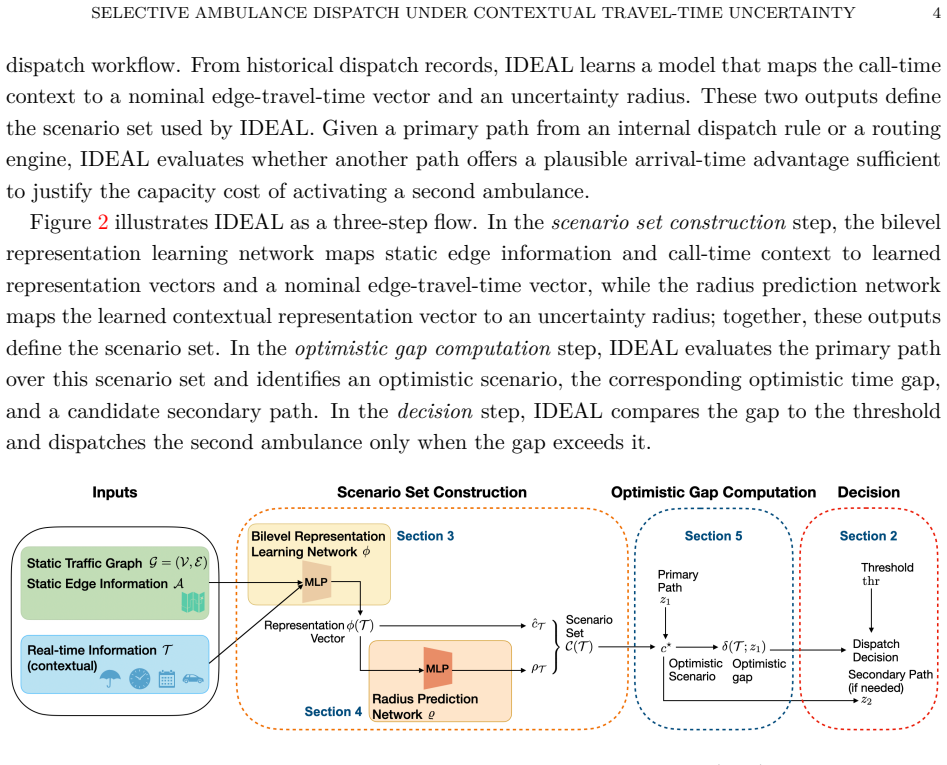
IDEAL learns context-specific edge travel times from trip-level dispatch records, including unobserved routes, via a weakly supervised bilevel representation network; it models uncertainty through Burg-divergence perturbations around a shared metric to induce correlated changes and learns context-specific radii from historical underprediction errors; the optimistic gap is then computed as a difference-of-convex program with an efficient oracle, enabling selective dual dispatch that produces stronger response-time and resource trade-offs in real-time adaptive simulations on historical OHCA data.
What carries the argument
The weakly supervised bilevel representation network that infers context-specific edge travel times from dispatch records, combined with Burg-divergence perturbations that create correlated uncertainty and context-specific radii derived from historical underprediction errors.
Load-bearing premise
The bilevel network accurately infers travel times for unobserved routes from limited dispatch data, and the radii taken from historical underprediction errors correctly quantify the uncertainty needed for real-time optimistic-gap decisions.
What would settle it
Running the real-time adaptive simulations on the Hong Kong OHCA records and finding that IDEAL does not produce a stronger response-time and resource trade-off than the region-based and Google-based baselines would falsify the performance claim.
Figures



read the original abstract
Ambulance response is time-critical in out-of-hospital cardiac arrest (OHCA), where dispatchers must balance timely arrivals with limited fleet capacity. Static territories and deterministic travel-time estimates are vulnerable to dynamic congestion, while always-dual dispatch adds redundancy but consumes fleet capacity. We propose IDEAL (Intelligent Dual dispatch of Emergency AmbuLances), a selective dual-dispatch framework that sends a second ambulance only when the optimistic gap between primary and secondary paths exceeds a threshold. IDEAL learns context-specific edge travel times from trip-level dispatch records, including unobserved routes, using a weakly supervised bilevel representation network. We train the nonsmooth model with mini-batch conservative gradients and prove an asymptotic convergence guarantee. IDEAL models uncertainty via Burg-divergence perturbations to a shared metric in the learned representation space, thereby inducing correlated changes in edge travel times and learning context-specific radii from historical underprediction errors. For real-time decisions, IDEAL casts optimistic-gap computation as a difference-of-convex program and derives an efficient oracle with complexity guarantees. In collaboration with the Hong Kong Fire Services Department, we evaluate IDEAL using historical OHCA records and real-time adaptive simulations. The results achieve a stronger response-time/resource trade-off relative to all region-based and Google-based baselines.
Editorial analysis
A structured set of objections, weighed in public.
Referee Report
Summary. The paper proposes IDEAL, a selective dual-dispatch policy for OHCA ambulance response that dispatches a second unit only when the optimistic gap between primary and secondary paths exceeds a threshold. It learns context-specific edge travel times (including unobserved routes) via a weakly supervised bilevel representation network trained on trip-level dispatch records, models uncertainty through Burg-divergence perturbations around a shared metric with radii fitted from historical underprediction errors, casts the optimistic-gap computation as a difference-of-convex program with an efficient oracle and complexity guarantees, proves asymptotic convergence of the nonsmooth training procedure, and reports superior response-time/resource trade-offs versus region-based and Google-based baselines in real-time adaptive simulations on historical Hong Kong Fire Services Department OHCA records.
Significance. If the central claims hold, the work offers a principled optimization-based approach to selective dual dispatch under contextual travel-time uncertainty, with potential practical value for emergency services given the collaboration with the Hong Kong Fire Services Department. The DC-oracle formulation and convergence guarantee for the bilevel network training are technical strengths that could advance contextual uncertainty modeling in network optimization. The empirical trade-off improvement, if independently validated, would be a meaningful contribution to operations research applications in emergency logistics.
major comments (3)
- [uncertainty modeling and evaluation sections] The context-specific radii are derived directly from historical underprediction errors on the training records and then used in the same records for the real-time adaptive simulations; this circularity (detailed in the uncertainty modeling and evaluation sections) means the reported superiority over baselines may reflect post-hoc fitting rather than out-of-sample performance, undermining the load-bearing claim of a stronger response-time/resource trade-off.
- [bilevel network training and real-time decision sections] No quantitative validation (e.g., hold-out MAE on observed edges, coverage probability of prediction errors, or accuracy metrics on a validation set of routes) is provided for the weakly supervised bilevel representation network's inferences on unobserved edges, yet this accuracy is foundational to attributing the simulation improvements to the optimistic-gap policy rather than to the learned metric itself (see the bilevel network training and real-time decision sections).
- [methods section on training and convergence] The asymptotic convergence guarantee for mini-batch conservative gradient training of the nonsmooth bilevel model is stated in the abstract and methods, but the manuscript provides no explicit statement of the assumptions (e.g., on the Burg-divergence perturbation or the representation space) under which the guarantee holds, making it impossible to assess whether the proof supports the claimed reliability of the learned travel times.
minor comments (2)
- [abstract and introduction] Notation for the optimistic gap threshold and the context-specific radii should be introduced with explicit symbols and distinguished from free parameters in the abstract and introduction to improve readability.
- [evaluation section] The description of the Google-based baseline lacks detail on how real-time queries are emulated in the historical-record simulations; a short clarification would help readers replicate the comparison.
Simulated Author's Rebuttal
We thank the referee for the careful and constructive review. We address each major comment below and indicate the revisions that will be made to strengthen the manuscript.
read point-by-point responses
-
Referee: [uncertainty modeling and evaluation sections] The context-specific radii are derived directly from historical underprediction errors on the training records and then used in the same records for the real-time adaptive simulations; this circularity (detailed in the uncertainty modeling and evaluation sections) means the reported superiority over baselines may reflect post-hoc fitting rather than out-of-sample performance, undermining the load-bearing claim of a stronger response-time/resource trade-off.
Authors: We acknowledge the concern about potential circularity. The radii are fitted from underprediction errors to reflect context-specific uncertainty, and the adaptive simulations apply the resulting policy sequentially. To address out-of-sample validity, we will revise the evaluation to use a temporal hold-out: fit radii on earlier records and evaluate the full pipeline on later records. This change will be reflected in the uncertainty modeling and results sections. revision: yes
-
Referee: [bilevel network training and real-time decision sections] No quantitative validation (e.g., hold-out MAE on observed edges, coverage probability of prediction errors, or accuracy metrics on a validation set of routes) is provided for the weakly supervised bilevel representation network's inferences on unobserved edges, yet this accuracy is foundational to attributing the simulation improvements to the optimistic-gap policy rather than to the learned metric itself (see the bilevel network training and real-time decision sections).
Authors: We agree that additional validation would help attribute improvements to the policy. Because the setting is weakly supervised, direct ground truth for unobserved edges is unavailable. We will add indirect validation in the revised manuscript, including consistency metrics on observed edges, sensitivity analysis of the learned metric, and ablation studies isolating the effect of the optimistic-gap threshold. revision: partial
-
Referee: [methods section on training and convergence] The asymptotic convergence guarantee for mini-batch conservative gradient training of the nonsmooth bilevel model is stated in the abstract and methods, but the manuscript provides no explicit statement of the assumptions (e.g., on the Burg-divergence perturbation or the representation space) under which the guarantee holds, making it impossible to assess whether the proof supports the claimed reliability of the learned travel times.
Authors: The convergence proof appears in the supplementary material. We agree that the main text should state the assumptions explicitly (compactness of the representation space and continuity of the Burg-divergence). We will add this statement to the methods section on training. revision: yes
Circularity Check
Radii fitted from underprediction errors on training records reduce uncertainty model to evaluation data
specific steps
-
fitted input called prediction
[Abstract]
"IDEAL models uncertainty via Burg-divergence perturbations to a shared metric in the learned representation space, thereby inducing correlated changes in edge travel times and learning context-specific radii from historical underprediction errors."
The radii are explicitly learned from underprediction errors on the historical dispatch/OHCA records. These same records supply the training data for the weakly supervised network and the testbed for the real-time adaptive simulations that demonstrate superiority over baselines. Consequently the uncertainty quantification used to trigger selective dual dispatch is a fitted quantity on the evaluation distribution rather than an independent bound.
full rationale
The paper's uncertainty modeling step derives context-specific radii directly from historical underprediction errors on the dispatch records used both to train the bilevel network and to run the real-time adaptive simulations. This matches the fitted_input_called_prediction pattern: the radii parameter is computed from the same data that later serves as the benchmark for claiming superior response-time/resource trade-offs. The bilevel network and DC oracle are presented as independent, but the load-bearing optimistic-gap threshold inherits its calibration from the evaluation set, creating partial circularity in the performance claims. No self-citation chains or self-definitional equations are evident from the provided text.
Axiom & Free-Parameter Ledger
free parameters (2)
- optimistic gap threshold
- context-specific radii
axioms (2)
- standard math Mini-batch conservative gradients yield asymptotic convergence for the nonsmooth bilevel model
- domain assumption The difference-of-convex formulation admits an efficient oracle with complexity guarantees
Reference graph
Works this paper leans on
-
[1]
[1]H. Abbaszadehpeivasti, E. de Klerk, and M. Zamani,On the rate of convergence of the difference-of- convex algorithm (DCA), Journal of Optimization Theory and Applications, 202 (2024), pp. 475–496. [2]F. J. Aragón Artacho, R. M. Fleming, and P. T. Vuong,Accelerating the DC algorithm for smooth functions, Mathematical Programming, 169 (2018), pp. 95–118....
work page 2024
-
[2]
[4]Audit Commission (HKSAR),Emergency Ambulance Service (Summary), Report No. 51 of the Director of Audit – Chapter 4, Audit Commission (HKSAR), 2008.https://www.aud.gov.hk/pdf_e/e51ch04sum.pdf. [5]A. Bałut, R. Brodziak, J. Bylka, and P. Zakrzewski,Ranking approach to scheduling repairs of a water distribution system for the post-disaster response and res...
work page 2008
-
[3]
A Survey on Metric Learning for Feature Vectors and Structured Data
[8]A. Bellet, A. Habrard, and M. Sebban,A survey on metric learning for feature vectors and structured data, arXiv Preprint arXiv:1306.6709, (2013). [9]A. Ben-Tal, L. El Ghaoui, and A. Nemirovski,Robust Optimization, Princeton University Press,
work page internal anchor Pith review Pith/arXiv arXiv 2013
-
[4]
[10]Y. Bengio, A. Courville, and P. Vincent,Representation learning: a review and new perspectives, IEEE Transactions on Pattern Analysis and Machine Intelligence, 35 (2013), pp. 1798–1828. [11]D. Bertsimas, D. B. Brown, and C. Caramanis,Theory and applications of robust optimization, SIAM Review, 53 (2011), pp. 464–501. [12]D. Bertsimas, V. Gupta, and N....
work page 2013
-
[5]
,Conservative set valued fields, automatic differentiation, stochastic gradient methods and deep learning, Mathematical Programming, 188 (2021), pp. 19–51. [19]J. J. Boutilier and T. C. Chan,Ambulance emergency response optimization in developing countries, Op- erations Research, 68 (2020), pp. 1315–1334. [20]J. Bracken and J. T. McGill,Mathematical progr...
-
[6]
[26]H.-A. Chen, S.-T. Hsu, M.-J. Hsieh, S.-S. Sim, S.-E. Chu, W.-S. Yang, Y.-C. Chien, Y.-C. W ang, B.-C. Lee, E. P.-C. Huang, et al.,Influence of advanced life support response time on out-of-hospital cardiac arrest patient outcomes in Taipei, PLoS One, 17 (2022), p. e0266969. [27]A. R. Chenreddy, N. Bandi, and E. Delage,Data-driven conditional robust op...
work page 2022
-
[7]
[33]M. S. Daskin,A maximum expected covering location model: formulation, properties and heuristic solution, Transportation Science, 17 (1983), pp. 48–70. [34]D. Davis, D. Drusvyatskiy, S. Kakade, and J. D. Lee,Stochastic subgradient method converges on tame functions, Foundations of Computational Mathematics, 20 (2020), pp. 119–154. [35]G. DeAngelo, M. T...
work page 1983
-
[8]
[39]C. Dugas, Y. Bengio, F. Bélisle, C. Nadeau, and R. Garcia,Incorporating second-order functional knowledge for better option pricing, Advances in Neural Information Processing Systems, 13 (2000). [40]E. Erkut, A. Ingolfsson, and G. Erdoğan,Ambulance location for maximum survival, Naval Research Logistics (NRL), 55 (2008), pp. 42–58. [41]J. Fortuny-Amat...
work page 2000
-
[9]
[52]R. Kannan, G. Bayraksan, and J. R. Luedtke,Residuals-based distributionally robust optimization with covariate information, Mathematical Programming, 207 (2024), pp. 369–425. [53]J. H. Kim, H. W. Ryoo, J.-y. Kim, J. Y. Ahn, S. Moon, D. E. Lee, and Y. H. Mun,Application of a dual-dispatch system for out-of-hospital cardiac arrest patients: will more ha...
work page 2024
-
[10]
[55]T. Kleinert, M. Labbé, I. Ljubić, and M. Schmidt,A survey on mixed-integer programming techniques in bilevel optimization, EURO Journal on Computational Optimization, 9 (2021), p. 100007. [56]D. Kuhn, S. Shafiee, and W. Wiesemann,Distributionally robust optimization, Acta Numerica, 34 (2025), pp. 579–804. [57]B. Kulis, M. Sustik, and I. Dhillon,Learni...
work page 2021
-
[11]
[58]R. C. Larson,A hypercube queuing model for facility location and redistricting in urban emergency services, Computers & Operations Research, 1 (1974), pp. 67–95. [59]H. A. Le Thi, V. N. Huynh, and T. P. Dinh,DC programming and DCA for general DC programs, In- ternational Conference on Computer Science, Applied Mathematics and Applications (ICCSAMA), Springer,
work page 1974
-
[12]
[60]H. A. Le Thi and T. Pham Dinh,DC programming and DCA: thirty years of developments, Mathematical Programming, 169 (2018), pp. 5–68. [61]Y. LeCun, Y. Bengio, and G. Hinton,Deep learning, Nature, 521 (2015), pp. 436–444. [62]Y. Li, R. Yu, C. Shahabi, and Y. Liu,Diffusion convolutional recurrent neural network: data-driven traffic forecasting, arXiv Prep...
work page internal anchor Pith review Pith/arXiv arXiv 2018
-
[13]
[68]M. S. Maxwell, M. Restrepo, S. G. Henderson, and H. Topaloglu,Approximate dynamic programming for ambulance redeployment, INFORMS Journal on Computing, 22 (2010), pp. 266–281. [69]E. McShane,Extension of range of functions, Bulletin of the American Mathematical Society, 40 (1934). [70]P. Mohajerin Esfahani and D. Kuhn,Data-driven distributionally robu...
work page 2010
-
[14]
SELECTIVE AMBULANCE DISPATCH UNDER CONTEXTUAL TRA VEL-TIME UNCERTAINTY 29 [71]P. Mohajerin Esfahani, S. Shafieezadeh-Abadeh, G. A. Hanasusanto, and D. Kuhn,Data-driven inverse optimization with imperfect information, Mathematical Programming, 167 (2018), pp. 191–234. [72]A. A. Nasrollahzadeh, A. Khademi, and M. E. Mayorga,Real-time ambulance dispatching a...
work page 2018
-
[15]
Searching for Activation Functions
[78]P. Ramachandran, B. Zoph, and Q. V. Le,Searching for activation functions, arXiv Preprint arXiv:1710.05941, (2017). [79]S. J. Reddi, S. Kale, and S. Kumar,On the convergence of Adam and beyond, International Conference on Learning Representations (ICLR),
work page internal anchor Pith review Pith/arXiv arXiv 2017
-
[16]
[81]J. H. Salum, T. Sando, P. Alluri, and A. Kitali,Impact of freeway service patrols on incident clearance duration: case study of Florida’s Road Rangers, Journal of Transportation Engineering, Part A: Systems, 146 (2020), p. 04020094. [82]K. K. Srinivasan, A. A. Prakash, and R. Seshadri,Finding most reliable paths on networks with correlated and shifted...
work page 2020
-
[17]
[85]P. D. Tao and L. H. An,Convex analysis approach to D.C. programming: theory, algorithms and applications, Acta Mathematica Vietnamica, 22 (1997), pp. 289–355. [86]P. D. Tao and L. T. H. An,A D.C. optimization algorithm for solving the trust-region subproblem, SIAM Journal on Optimization, 8 (1998), pp. 476–505. [87]C. Toregas, R. Swain, C. ReVelle, an...
work page 1997
-
[18]
[93]M.-X. W ang, W.-C. Lee, T.-Y. Fu, and G. Yu,On representation learning for road networks, ACM Trans- actions on Intelligent Systems and Technology, 12 (2020), pp. 11:1–11:27. [94]B. S. Westgate, D. B. Woodard, D. S. Matteson, and S. G. Henderson,Travel time estimation for ambulances using Bayesian data augmentation, The Annals of Applied Statistics, 7...
work page 2020
-
[19]
[97]N. Xiao, X. Hu, X. Liu, and K.-C. Toh,Adam-family methods for nonsmooth optimization with convergence guarantees, Journal of Machine Learning Research, 25 (2024), pp. 1–53. [98]Y. Ye,A new complexity result on minimization of a quadratic function with a sphere constraint, in Recent Advances in Global Optimization, 1992, pp. 19–31. [99]S. Yoon, L. A. A...
work page 2024
-
[20]
[101]P. Zattoni Scroccaro, P. van Beek, P. Mohajerin Esfahani, and B. Atasoy,Inverse optimization for routing problems, Transportation Science, 59 (2025), pp. 301–321. [102]Y. Zhang, Z.-J. M. Shen, and S. Song,Lagrangian relaxation for the reliable shortest path problem with correlated link travel times, Transportation Research Part B: Methodological, 104...
work page 2025
-
[21]
When t0 =t nominal(T),λ(tnominal(T);T)measures how sensitive clinical risk is to small changes in travel time for the current demand. Under this linear approximation, an improvement of∆tunits in travel time reduces clinical risk by approximatelyλ(t0;T)·∆t. We want the threshold function to compare this optimistic reduction with the operational cost of sen...
work page 2025
-
[22]
SELECTIVE AMBULANCE DISPATCH UNDER CONTEXTUAL TRA VEL-TIME UNCERTAINTY 34 Table 4.Environmental features for each OHCA record. Feature name Dim. Description Weather variables 5 Temperature, rainfall, relative humidity, wind speed, sea-level pressure Hour 1 Hour of day (0–23) Day of week 7 One-hot indicators for Monday to Sunday Month 12 One-hot indicators...
work page 2022
discussion (0)
Sign in with ORCID, Apple, or X to comment. Anyone can read and Pith papers without signing in.