Re-evaluation of bottleneck effect via a coupled monolayer WS₂/photonic crystal heterostructure
Pith reviewed 2026-05-25 03:42 UTC · model grok-4.3
The pith
Small Rabi splitting is the unified origin of the bottleneck effect in polariton systems.
A machine-rendered reading of the paper's core claim, the machinery that carries it, and where it could break.
Core claim
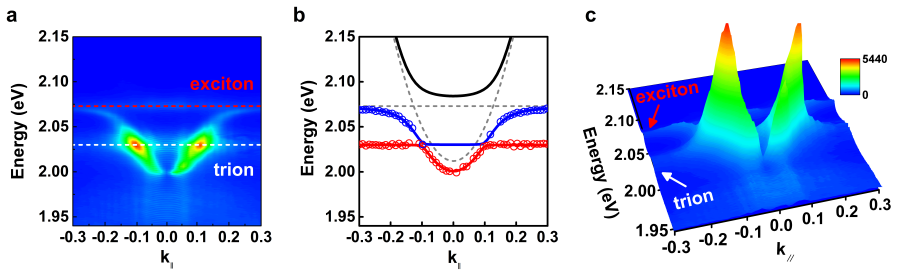
In the exciton-trion-photon coupling system realized in monolayer WS2/photonic-crystal slab heterostructures, the trion resonance shows no characteristic anticrossing because of its small ~5 meV Rabi splitting at ~12 K, while the exciton resonance exhibits ~57 meV splitting; the temperature-induced increase in polariton emission around the trion-polariton crossing is attributed to relief of the bottleneck effect, establishing small Rabi splitting as the unified origin of this effect in polariton systems.
What carries the argument
The monolayer WS2/photonic crystal slab heterostructure that realizes simultaneous exciton-trion-photon coupling, with momentum-resolved photoluminescence used to map the distinct Rabi splittings and their effect on polariton dispersion and emission.
If this is right
- Polariton relaxation to band minima is obstructed near the anticrossing when Rabi splitting remains small.
- Raising temperature relieves the bottleneck specifically at crossings with small splitting.
- The same small-splitting mechanism accounts for the bottleneck in other polariton systems.
- Systems with large Rabi splitting, such as the exciton resonance here, avoid the bottleneck.
Where Pith is reading between the lines
- Maximizing Rabi splitting through photonic-crystal design could reduce bottlenecks in future polariton devices.
- The result suggests re-checking earlier bottleneck reports in other materials for consistency with splitting size.
- Varying the photonic crystal parameters to tune splitting magnitude offers a direct test of the claim.
Load-bearing premise
The observed rise in polariton emission with temperature at the trion crossing is caused by relief of a bottleneck from the small Rabi splitting rather than other temperature-dependent processes.
What would settle it
If the same temperature-dependent emission enhancement at a crossing is observed in a comparable structure engineered to have large trion Rabi splitting, or if emission stays unchanged when Rabi splitting is deliberately varied, the link to small splitting would be falsified.
Figures


read the original abstract
Exciton-polariton condensates is an important type of Bose-Einstein condensate whose realization requires efficient relaxation of polaritons to the band-energy minima. However, this process is often obstructed by bottleneck effect near the anticrossing region of polariton dispersion. Although the exciton-polariton bottleneck effect has been extensively observed in various polariton system, but there is no a unified views of physical origin. Here, we construct an exciton-trion-photon coupling system in monolayer WS_2/photonic-crystal slab heterostructures. Momentum-resolved photoluminescence reveals the anticrossing polariton dispersions for the exciton resonance with a ~57 meV Rabi splitting and there is no characteristic anticrossing for trion resonance with a ~5 meV splitting at ~12 K. Enhanced polariton emission is observed around the trion-polariton crossing with elevating temperature. We attributes this exotic phenomenon to bottleneck effect and indicating that small Rabi splitting is the unified origin of bottleneck effect in polariton systems.
Editorial analysis
A structured set of objections, weighed in public.
Referee Report
Summary. The manuscript reports construction of a monolayer WS2/photonic-crystal-slab heterostructure in which momentum-resolved photoluminescence at ~12 K shows clear anticrossing for the exciton-polariton branch (Rabi splitting ~57 meV) but no characteristic anticrossing for the trion-polariton branch (~5 meV splitting). Enhanced polariton emission intensity is observed around the trion crossing upon increasing temperature; the authors attribute the enhancement to relief of a relaxation bottleneck whose severity is set by the small Rabi splitting and conclude that small splitting constitutes the unified origin of the bottleneck effect across polariton systems.
Significance. If the central attribution is substantiated with quantitative modeling and controls, the result would supply a simple, testable criterion (Rabi splitting magnitude) for the presence or absence of the bottleneck, with direct implications for polariton condensation thresholds. The differential coupling strengths observed in a single heterostructure are experimentally interesting even if the bottleneck interpretation requires further support.
major comments (3)
- [Abstract] Abstract: the claim that the observed rise in polariton emission intensity with temperature at the trion crossing is caused by relief of a bottleneck set by the ~5 meV splitting is presented without any rate-equation modeling of polariton relaxation, without reported fits to the temperature dependence, and without a direct comparison of the temperature slope at the large-splitting exciton branch versus the trion branch.
- [Abstract] Abstract: no error bars, fitting details, or uncertainty quantification are supplied for the reported ~5 meV trion splitting, which is load-bearing for the assertion that this small value is the origin of the bottleneck.
- [Abstract] Abstract: the manuscript provides no auxiliary data (power dependence, detuning sweeps, or phonon-scattering controls) that would exclude alternative temperature-activated processes such as increased trion population, non-radiative channels, or phonon scattering as the dominant cause of the intensity change.
minor comments (1)
- [Abstract] Abstract contains grammatical errors ('Exciton-polariton condensates is', 'there is no a unified views') that should be corrected for clarity.
Simulated Author's Rebuttal
We thank the referee for the careful reading and constructive comments. We address each major comment below and will revise the manuscript to incorporate additional analysis and details where feasible.
read point-by-point responses
-
Referee: [Abstract] Abstract: the claim that the observed rise in polariton emission intensity with temperature at the trion crossing is caused by relief of a bottleneck set by the ~5 meV splitting is presented without any rate-equation modeling of polariton relaxation, without reported fits to the temperature dependence, and without a direct comparison of the temperature slope at the large-splitting exciton branch versus the trion branch.
Authors: We agree that rate-equation modeling and explicit fits would strengthen the interpretation. In the revised manuscript we will add a rate-equation analysis showing how relaxation dynamics depend on Rabi splitting, include fits to the temperature-dependent intensity data at the trion crossing, and provide a direct side-by-side comparison of the temperature slopes for the exciton and trion branches to demonstrate the differential behavior. revision: yes
-
Referee: [Abstract] Abstract: no error bars, fitting details, or uncertainty quantification are supplied for the reported ~5 meV trion splitting, which is load-bearing for the assertion that this small value is the origin of the bottleneck.
Authors: The ~5 meV value was extracted from fitting the momentum-resolved dispersion. We will include error bars on this value, describe the fitting procedure in detail, and report the associated uncertainty in the revised manuscript. revision: yes
-
Referee: [Abstract] Abstract: the manuscript provides no auxiliary data (power dependence, detuning sweeps, or phonon-scattering controls) that would exclude alternative temperature-activated processes such as increased trion population, non-radiative channels, or phonon scattering as the dominant cause of the intensity change.
Authors: The intensity enhancement is localized to the trion-polariton crossing and absent from the exciton branch within the same heterostructure, which already argues against uniform temperature-activated mechanisms. We will add power-dependence data in revision to further constrain alternatives. Detuning sweeps are not straightforward in this fixed-structure device but will be noted as a future direction; we do not claim the present data fully exclude every alternative but maintain that the small-splitting interpretation remains the most parsimonious. revision: partial
Circularity Check
Central attribution equates observed temperature effect at ~5 meV trion crossing with bottleneck relief caused by that same small splitting
specific steps
-
self definitional
[Abstract (final sentence)]
"We attributes this exotic phenomenon to bottleneck effect and indicating that small Rabi splitting is the unified origin of bottleneck effect in polariton systems."
The exotic phenomenon is the temperature-induced emission increase at the trion-polariton crossing characterized by the measured ~5 meV splitting (where no anticrossing occurs). Defining this as bottleneck relief whose severity is set by the small splitting makes the 'unified origin' conclusion equivalent to the input observation rather than an independent derivation.
full rationale
The paper measures Rabi splittings (57 meV exciton, ~5 meV trion with no anticrossing), observes enhanced emission with rising temperature specifically at the trion-polariton crossing, and concludes that small Rabi splitting is the unified origin of the bottleneck effect. This interpretive step reduces the claim to a re-description of the input data by construction: the 'exotic phenomenon' is defined at the location of the measured small splitting, and the attribution to bottleneck relief from that splitting is taken as evidence for the origin without an independent rate-equation model, branch comparison, or control that could falsify the link. No self-citations or mathematical derivations are present; the circularity is confined to the load-bearing physical interpretation in the abstract.
Axiom & Free-Parameter Ledger
axioms (2)
- standard math Anticrossing in momentum-resolved dispersion is the signature of strong light-matter coupling with Rabi splitting equal to the minimum gap.
- domain assumption Temperature-dependent increase in emission intensity at the trion-photon crossing directly indicates relief of a relaxation bottleneck.
Lean theorems connected to this paper
-
IndisputableMonolith/Foundation/AbsoluteFloorClosure.leanreality_from_one_distinction unclear?
unclearRelation between the paper passage and the cited Recognition theorem.
small Rabi splitting is the unified origin of bottleneck effect in polariton systems
-
IndisputableMonolith/Cost/FunctionalEquation.leanwashburn_uniqueness_aczel unclear?
unclearRelation between the paper passage and the cited Recognition theorem.
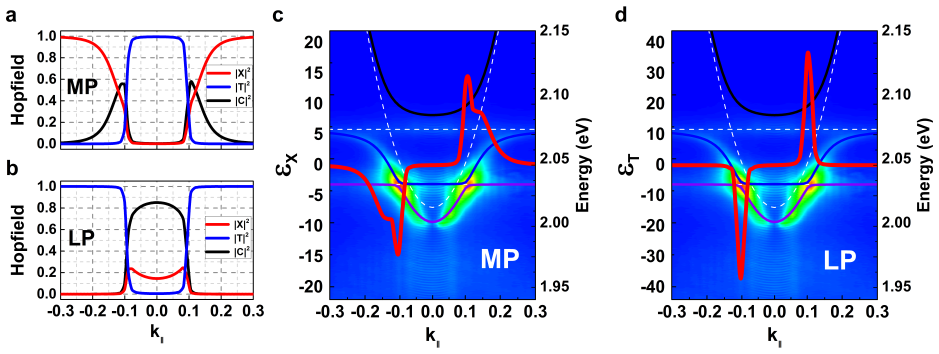
Hopfield coefficients ... ε_X = d|X|^2/dk∥ ... maximum of ~40 at |k∥|=0.10
What do these tags mean?
- matches
- The paper's claim is directly supported by a theorem in the formal canon.
- supports
- The theorem supports part of the paper's argument, but the paper may add assumptions or extra steps.
- extends
- The paper goes beyond the formal theorem; the theorem is a base layer rather than the whole result.
- uses
- The paper appears to rely on the theorem as machinery.
- contradicts
- The paper's claim conflicts with a theorem or certificate in the canon.
- unclear
- Pith found a possible connection, but the passage is too broad, indirect, or ambiguous to say the theorem truly supports the claim.
Reference graph
Works this paper leans on
-
[1]
Khitrova, G.; Gibbs, H. M.; Kira, M.; Koch, S. W.; Scherer, A. Vacuum Rabi splitting in semiconductors. Nature Physics2006,2, 81–90
-
[2]
Exciton-polariton Bose-Einstein condensation.Rev
Deng, H.; Haug, H.; Yamamoto, Y. Exciton-polariton Bose-Einstein condensation.Rev. Mod. Phys. 2010,82, 1489–1537
work page 2010
-
[3]
The road towards polaritonic devices.Nature Materials2016,15, 1061– 1073
Sanvitto, D.; Kéna-Cohen, S. The road towards polaritonic devices.Nature Materials2016,15, 1061– 1073
-
[4]
S.; Deleporte, E.; Chen, Z.; Sanvitto, D.; Liew, T
Su, R.; Fieramosca, A.; Zhang, Q.; Nguyen, H. S.; Deleporte, E.; Chen, Z.; Sanvitto, D.; Liew, T. C. H.; Xiong,Q.Perovskitesemiconductorsforroom-temperatureexciton-polaritonics.Nature Materials2021, 20, 1315–1324
-
[5]
Kasprzak, J.; Richard, M.; Kundermann, S.; Baas, A.; Jeambrun, P.; Keeling, J. M. J.; Marchetti, F. M.; Szymańska, M. H.; André, R.; Staehli, J. L.; Savona, V.; Littlewood, P. B.; Deveaud, B.; Dang, L. S. Bose–Einstein condensation of exciton polaritons.Nature2006,443, 409–414
-
[6]
Superfluidity of polaritons in semiconductor microcavities.Nature Physics2009,5, 805– 810
Amo, A.; Lefrère, J.; Pigeon, S.; Adrados, C.; Ciuti, C.; Carusotto, I.; Houdré, R.; Giacobino, E.; Bramati, A. Superfluidity of polaritons in semiconductor microcavities.Nature Physics2009,5, 805– 810
-
[7]
S.; Dominici, L.; De Giorgi, M.; Maier, S
Lerario, G.; Fieramosca, A.; Barachati, F.; Ballarini, D.; Daskalakis, K. S.; Dominici, L.; De Giorgi, M.; Maier, S. A.; Gigli, G.; Kéna-Cohen, S.; Sanvitto, D. Room-temperature superfluidity in a polariton condensate.Nature Physics2017,13, 837–841
-
[8]
G.; Wouters, M.; Richard, M.; Baas, A.; Carusotto, I.; André, R.; Dang, L
Lagoudakis, K. G.; Wouters, M.; Richard, M.; Baas, A.; Carusotto, I.; André, R.; Dang, L. S.; Deveaud- Plédran, B. Quantized vortices in an exciton–polariton condensate.Nature Physics2008,4, 706–710
-
[9]
Kéna-Cohen, S.; Forrest, S. R. Room-temperature polariton lasing in an organic single-crystal micro- cavity.Nature Photonics2010,4, 371–375
-
[10]
Ghosh, S.; Liew, T. C. H. Quantum computing with exciton-polariton condensates.npj Quantum In- formation2020,6, 16
-
[11]
Bose-Einstein Condensation of Microcavity Polaritons in a Trap.Science2007,316, 1007–1010
Balili, R.; Hartwell, V.; Snoke, D.; Pfeiffer, L.; West, K. Bose-Einstein Condensation of Microcavity Polaritons in a Trap.Science2007,316, 1007–1010
-
[12]
Condensation of Semiconductor Microcavity Exciton Polaritons.Science2002,298, 199–202
Deng, H.; Weihs, G.; Santori, C.; Bloch, J.; Yamamoto, Y. Condensation of Semiconductor Microcavity Exciton Polaritons.Science2002,298, 199–202
-
[13]
Christopoulos, S.; von Högersthal, G. B. H.; Grundy, A. J. D.; Lagoudakis, P. G.; Kavokin, A. V.; Baumberg, J. J.; Christmann, G.; Butté, R.; Feltin, E.; Carlin, J.-F.; Grandjean, N. Room-Temperature Polariton Lasing in Semiconductor Microcavities.Phys. Rev. Lett.2007,98, 126405. 9
work page 2007
-
[14]
Baumberg, J. J.; Kavokin, A. V.; Christopoulos, S.; Grundy, A. J. D.; Butté, R.; Christmann, G.; Sol- nyshkov, D. D.; Malpuech, G.; Baldassarri Höger von Högersthal, G.; Feltin, E.; Carlin, J.-F.; Grand- jean, N. Spontaneous Polarization Buildup in a Room-Temperature Polariton Laser.Phys. Rev. Lett. 2008,101, 136409
work page 2008
-
[15]
Guillet, T. et al. Polariton lasing in a hybrid bulk ZnO microcavity.Applied Physics Letters2011,99
-
[16]
Ardizzone, V. et al. Polariton Bose–Einstein condensate from a bound state in the continuum.Nature 2022,605, 447–452
work page 2022
-
[17]
Chen, X.; Alnatah, H.; Mao, D.; Xu, M.; Fan, Y.; Wan, Q.; Beaumariage, J.; Xie, W.; Xu, H.; Shi, Z.-Y.; Snoke, D.; Sun, Z.; Wu, J. Bose Condensation of Upper-Branch Exciton-Polaritons in a Transferable Microcavity.Nano Letters2023,23, 9538–9546, PMID: 37818838
-
[18]
Su, R.; Ghosh, S.; Wang, J.; Liu, S.; Diederichs, C.; Liew, T. C. H.; Xiong, Q. H. Observation of exciton polariton condensation in a perovskite lattice at room temperature.Nature Physics2020,16, 301–+
-
[19]
D.; Stöferle, T.; Mai, L.; Scherf, U.; Mahrt, R
Plumhof, J. D.; Stöferle, T.; Mai, L.; Scherf, U.; Mahrt, R. F. Room-temperature Bose–Einstein con- densation of cavity exciton–polaritons in a polymer.Nature Materials2014,13, 247–252
-
[20]
Huang, R.; Yamamoto, Y.; André, R.; Bleuse, J.; Muller, M.; Ulmer-Tuffigo, H. Exciton-polariton lasing and amplification based on exciton-exciton scattering in CdTe microcavity quantum wells.Phys. Rev. B2002,65, 165314
-
[21]
Richard, M.; Kasprzak, J.; Romestain, R.; André, R.; Dang, L. S. Spontaneous Coherent Phase Tran- sition of Polaritons in CdTe Microcavities.Phys. Rev. Lett.2005,94, 187401
work page 2005
-
[22]
Characteristics of exciton-polaritons in ZnO-based hybrid microcavities.Opt
Chen, J.-R.; Lu, T.-C.; Wu, Y.-C.; Lin, S.-C.; Hsieh, W.-F.; Wang, S.-C.; Deng, H. Characteristics of exciton-polaritons in ZnO-based hybrid microcavities.Opt. Express2011,19, 4101–4112
-
[23]
Laitz, M.; Kaplan, A. E. K.; Deschamps, J.; Barotov, U.; Proppe, A. H.; García-Benito, I.; Osherov, A.; Grancini, G.; deQuilettes, D. W.; Nelson, K. A.; Bawendi, M. G.; Bulović, V. Uncovering temperature- dependent exciton-polariton relaxation mechanisms in hybrid organic-inorganic perovskites.Nature Communications2023,14, 2426
-
[24]
Coles, D. M.; Grant, R. T.; Lidzey, D. G.; Clark, C.; Lagoudakis, P. G. Imaging the polariton relaxation bottleneck in strongly coupled organic semiconductor microcavities.Phys. Rev. B2013,88, 121303
-
[25]
Stimulated emission of a microcavity dressed exciton and suppression of phonon scattering.Phys
Pau, S.; Björk, G.; Jacobson, J.; Cao, H.; Yamamoto, Y. Stimulated emission of a microcavity dressed exciton and suppression of phonon scattering.Phys. Rev. B1995,51, 7090–7100
-
[26]
Bottleneck effects in the relaxation and photoluminescence of microcavity polaritons.Phys
Tassone, F.; Piermarocchi, C.; Savona, V.; Quattropani, A.; Schwendimann, P. Bottleneck effects in the relaxation and photoluminescence of microcavity polaritons.Phys. Rev. B1997,56, 7554–7563
-
[27]
I.; Emam-Ismail, M.; Stevenson, R
Tartakovskii, A. I.; Emam-Ismail, M.; Stevenson, R. M.; Skolnick, M. S.; Astratov, V. N.; Whit- taker, D. M.; Baumberg, J. J.; Roberts, J. S. Relaxation bottleneck and its suppression in semiconductor microcavities.Phys. Rev. B2000,62, R2283–R2286
-
[28]
Byrnes, T.; Kim, N. Y.; Yamamoto, Y. Exciton-polariton condensates.Nature Physics2014,10, 803– 813
-
[29]
Törmä, P.; Barnes, W. L. Strong coupling between surface plasmon polaritons and emitters: a review. Reports on Progress in Physics2014,78, 013901
-
[30]
Emmanuele, R. P. A.; Sich, M.; Kyriienko, O.; Shahnazaryan, V.; Withers, F.; Catanzaro, A.; Walker, P. M.; Benimetskiy, F. A.; Skolnick, M. S.; Tartakovskii, A. I.; Shelykh, I. A.; Krizhanovskii, D. N. Highly nonlinear trion-polaritons in a monolayer semiconductor.Nature Com- munications2020,11, 3589. 10
-
[31]
Hsu, C. W.; Zhen, B.; Stone, A. D.; Joannopoulos, J. D.; Soljačić, M. Bound states in the continuum. Nature Reviews Materials2016,1, 16048
-
[32]
Lan, W.; Fu, P.; Ji, C.-Y.; Wang, G.; Yao, Y.; Gu, C.; Liu, B. Visualization of photonic band structures via far-field measurements in SiNx photonic crystal slabs.Applied Physics Letters2023,122
-
[33]
Plechinger, G.; Nagler, P.; Kraus, J.; Paradiso, N.; Strunk, C.; Schüller, C.; Korn, T. Identification of excitons, trions and biexcitons in single-layer WS2.physica status solidi (RRL) – Rapid Research Letters 2015,9, 457–461
work page 2015
-
[34]
Dufferwiel, S.; Lyons, T. P.; Solnyshkov, D. D.; Trichet, A. A. P.; Withers, F.; Schwarz, S.; Malpuech, G.; Smith, J. M.; Novoselov, K. S.; Skolnick, M. S.; Krizhanovskii, D. N.; Tartakovskii, A. I. Valley- addressable polaritons in atomically thin semiconductors.Nature Photonics2017,11, 497–501
-
[35]
Purcell, E. M. Spontaneous Emission Probabilities at Radio Frequencies.Physical Review1946,69, 681–681
-
[36]
Dirnberger, F.; Bushati, R.; Datta, B.; Kumar, A.; MacDonald, A. H.; Baldini, E.; Menon, V. M. Spin- correlated exciton–polaritons in a van der Waals magnet.Nature Nanotechnology2022,17, 1060–1064
-
[37]
Hopfield, J. J. Theory of the Contribution of Excitons to the Complex Dielectric Constant of Crystals. Phys. Rev.1958,112, 1555–1567. 11
work page 1958
discussion (0)
Sign in with ORCID, Apple, or X to comment. Anyone can read and Pith papers without signing in.