Cosmic web stripping and starvation of low-mass filament galaxies in TNG50
Pith reviewed 2026-05-25 04:01 UTC · model grok-4.3
The pith
Low-mass filament galaxies develop smaller, more asymmetric cold gas discs than field galaxies of matched mass because early entrants experience altered accretion from tidal fields while late entrants undergo cosmic web stripping.
A machine-rendered reading of the paper's core claim, the machinery that carries it, and where it could break.
Core claim
When low-mass galaxies in filaments are compared to mass-matched field galaxies after excluding group and cluster members, their cold gas discs are smaller and more asymmetric. Early-entering galaxies experience cosmic web tidal fields that either produce more tangential dark matter motions and thus smaller discs or suppress accretion leading to gradual gas exhaustion through star formation. Late-entering galaxies experience cosmic web stripping that rapidly removes gas in a manner analogous to ram-pressure stripping.
What carries the argument
cosmic web tidal fields acting on early filament entrants and cosmic web stripping acting on late filament entrants, distinguished by entry time into the filament
If this is right
- Integrated galaxy properties such as stellar mass assembly and quenched fractions remain unaffected by filament membership once mass and group membership are controlled.
- Spatially resolved cold gas properties reveal environmental influences that integrated quantities miss.
- Early filament entry can produce a starvation-like path in which galaxies slowly consume their gas without new accretion.
- Late filament entry produces rapid gas loss comparable to cluster ram-pressure effects but driven by the filament environment.
Where Pith is reading between the lines
- The reported effects on gas discs could contribute to the scatter observed in gas content among low-mass galaxies in real surveys once entry-time information becomes available.
- If the mechanisms operate at still lower masses, they might help explain the morphology-density relation in the dwarf galaxy regime without invoking group-scale processes.
- Higher-resolution simulations could test whether the tangential motion channel or the suppression channel dominates at different filament densities.
Load-bearing premise
The chosen filament identification method together with stellar-mass and halo-mass matching and explicit removal of group and cluster members isolates filament-specific effects without leftover contamination from other density variations or from imprecise entry timing.
What would settle it
A direct comparison of cold gas disc sizes and asymmetries in a mass-matched observational sample of low-mass filament and field galaxies, after binning by estimated filament entry time, that finds no systematic differences would falsify the two-mechanism picture.
Figures



read the original abstract
Galaxy properties are known to correlate with their location within the cosmic web. However, the role of filaments remains poorly understood, particularly for low-mass galaxies, which are expected to be more sensitive to environmental effects. In this work, we use the TNG50-1 simulation to investigate the properties of low-mass $8 \le \log(M_{star}/M_{{sun}}) \le 10$ galaxies in filaments and in the field, when controlling for stellar and halo mass and excluding the role of groups and clusters. We find that their integrated properties, including stellar, halo mass assembly and quenched fractions, are similar between the two environments. However, we demonstrate that filament galaxies exhibit smaller and more asymmetric cold gas discs with respect to their field counterparts. We identify two main mechanisms driving these differences. For galaxies that entered filaments in the early Universe, during the phase of active accretion, cosmic web tidal fields modify the accretion of gas and dark matter. In some systems, accretion proceeds at rates comparable to the field but with a different geometry, leading to more tangential motions in the dark matter halo and, consequently, smaller gas discs. In others, the tidal field significantly suppresses both gas and dark matter accretion, leading to a starvation-like evolution, in which galaxies gradually exhaust their gas through star formation and can eventually quench. In contrast, galaxies that fall into filaments at late times can undergo cosmic web stripping, a rapid hydrodynamical removal of gas analogous to ram-pressure stripping in clusters. Our results suggest that spatially resolved gas properties are sensitive to several filament-driven environmental mechanisms.
Editorial analysis
A structured set of objections, weighed in public.
Referee Report
Summary. The paper uses TNG50-1 to compare low-mass galaxies (8 ≤ log(M_star/M_sun) ≤ 10) in filaments versus the field after stellar- and halo-mass matching and explicit removal of group/cluster members. Integrated properties (stellar/halo mass assembly, quenched fractions) are reported as similar, but filament galaxies show smaller and more asymmetric cold gas discs. The differences are attributed to two mechanisms: cosmic-web tidal fields that modify accretion geometry or suppress accretion (leading to starvation) for early filament entrants, and hydrodynamical cosmic-web stripping for late entrants.
Significance. If the attribution to filament-specific processes holds after controls, the result would demonstrate that resolved cold-gas morphology is sensitive to large-scale tidal and hydrodynamical effects even outside groups and clusters, extending environmental studies to the filament regime for low-mass systems. The simulation-based separation of early versus late entry provides a concrete, falsifiable pathway for testing these mechanisms against observations.
major comments (3)
- [methods (filament membership and mass-matching)] Sample construction (methods section on filament identification and matching): the central claim that differences arise from filament entry timing and the two cited mechanisms requires that, after stellar/halo-mass matching and group/cluster removal, residual correlations with large-scale overdensity or tidal-field strength are negligible. No quantitative test (e.g., comparison of tidal tensor eigenvalues or smoothed density outside the filament mask) is described to rule out this confound, which directly undermines unambiguous attribution.
- [results (early/late entrant split)] Mechanism separation (results on early vs. late entrants): the distinction between tidal modification of accretion for early entrants and stripping for late entrants is load-bearing, yet the paper does not show that the reported differences in gas-disc size/asymmetry remain after further matching on entry redshift or local tidal strength within each subsample.
- [results (disc size and asymmetry)] Quantitative disc measurements: the reported smaller and more asymmetric cold-gas discs are central, but the manuscript does not specify the exact operational definitions (e.g., radius enclosing 90 % of cold gas, asymmetry parameter) or demonstrate that these metrics are robust to projection effects and to the precise temperature/density cuts used to define “cold gas.”
minor comments (2)
- [abstract and §2] Notation for stellar and halo masses is inconsistent between the abstract and main text (log(M_star/M_sun) vs. log M_*); adopt a single convention.
- [figures] Figure captions should explicitly state the sample sizes for filament versus field subsamples and whether error bars include cosmic variance.
Simulated Author's Rebuttal
We thank the referee for their constructive and detailed report. We address each major comment point-by-point below, outlining the revisions that will be incorporated to strengthen the attribution of results to filament-specific processes.
read point-by-point responses
-
Referee: [methods (filament membership and mass-matching)] Sample construction (methods section on filament identification and matching): the central claim that differences arise from filament entry timing and the two cited mechanisms requires that, after stellar/halo-mass matching and group/cluster removal, residual correlations with large-scale overdensity or tidal-field strength are negligible. No quantitative test (e.g., comparison of tidal tensor eigenvalues or smoothed density outside the filament mask) is described to rule out this confound, which directly undermines unambiguous attribution.
Authors: We agree that an explicit quantitative test is needed to confirm negligible residual correlations with large-scale overdensity or tidal-field strength after our mass matching and group/cluster removal. In the revised manuscript we will add a direct comparison of tidal tensor eigenvalues and smoothed density fields (outside the filament mask) between the matched filament and field samples to demonstrate consistency. revision: yes
-
Referee: [results (early/late entrant split)] Mechanism separation (results on early vs. late entrants): the distinction between tidal modification of accretion for early entrants and stripping for late entrants is load-bearing, yet the paper does not show that the reported differences in gas-disc size/asymmetry remain after further matching on entry redshift or local tidal strength within each subsample.
Authors: We acknowledge that the mechanism separation would be more robust if the gas-disc differences are shown to persist after additional matching on entry redshift and local tidal strength within the early- and late-entrant subsamples. We will perform this further matching and present the results (including updated statistics on disc size and asymmetry) in the revised manuscript. revision: yes
-
Referee: [results (disc size and asymmetry)] Quantitative disc measurements: the reported smaller and more asymmetric cold-gas discs are central, but the manuscript does not specify the exact operational definitions (e.g., radius enclosing 90 % of cold gas, asymmetry parameter) or demonstrate that these metrics are robust to projection effects and to the precise temperature/density cuts used to define “cold gas.”
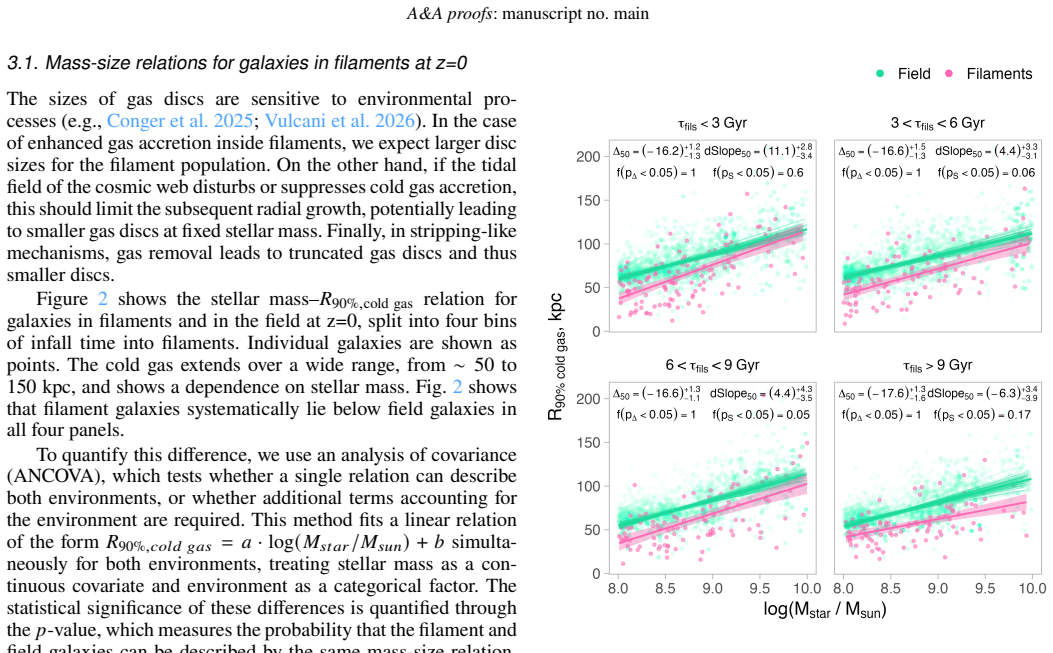
Authors: We will revise the methods section to state the precise operational definitions (radius enclosing 90% of cold-gas mass for size; the adopted asymmetry parameter) and will add explicit tests of robustness to projection effects as well as to variations in the temperature and density thresholds used to identify cold gas. revision: yes
Circularity Check
No circularity: direct simulation comparison of matched samples
full rationale
The paper reports differences in cold-gas disc properties between filament and field galaxies in TNG50 after stellar/halo-mass matching and explicit group/cluster removal. No equations, fitted parameters, or derivations are presented that reduce any reported quantity to a definition or fit drawn from the same data. The analysis consists of direct output comparisons and mechanism identification from simulation snapshots; it contains no self-definitional steps, fitted-input predictions, or load-bearing self-citations that close a loop.
Axiom & Free-Parameter Ledger
axioms (2)
- domain assumption Filament membership can be robustly identified and galaxies can be cleanly separated from groups and clusters while controlling for stellar and halo mass.
- domain assumption TNG50-1 resolution and subgrid physics are sufficient to track cold gas disc sizes and asymmetries without numerical artifacts dominating the signal.
Lean theorems connected to this paper
-
IndisputableMonolith/Cost/FunctionalEquation.leanwashburn_uniqueness_aczel unclear?
unclearRelation between the paper passage and the cited Recognition theorem.
filament galaxies exhibit smaller and more asymmetric cold gas discs... cosmic web tidal fields modify the accretion... cosmic web stripping
-
IndisputableMonolith/Foundation/RealityFromDistinction.leanreality_from_one_distinction unclear?
unclearRelation between the paper passage and the cited Recognition theorem.
We use the TNG50-1 simulation... mass-matching... DisPerSE filament finder
What do these tags mean?
- matches
- The paper's claim is directly supported by a theorem in the formal canon.
- supports
- The theorem supports part of the paper's argument, but the paper may add assumptions or extra steps.
- extends
- The paper goes beyond the formal theorem; the theorem is a base layer rather than the whole result.
- uses
- The paper appears to rely on the theorem as machinery.
- contradicts
- The paper's claim conflicts with a theorem or certificate in the canon.
- unclear
- Pith found a possible connection, but the passage is too broad, indirect, or ambiguous to say the theorem truly supports the claim.
Reference graph
Works this paper leans on
-
[1]
N.,& Stewart, J
Cox, A. N.,& Stewart, J. N. 1969,
1969
-
[2]
Tscharnuter W. M. 1987,
1987
-
[3]
1992, in ASP Conf
Terlevich, R. 1992, in ASP Conf. Ser. 31,
1992
-
[4]
F., Tytler, D
Zheng, W., Davidsen, A. F., Tytler, D. & Kriss, G. A
-
[5]
Alpaslan , M., Driver , S., Robotham , A. S. G., et al. 2015, , 451, 3249
2015
-
[6]
A., Neyrinck , M
Aragon Calvo , M. A., Neyrinck , M. C., & Silk , J. 2019, The Open Journal of Astrophysics, 2, 7
2019
-
[7]
A., van de Weygaert , R., & Jones , B
Arag \'o n-Calvo , M. A., van de Weygaert , R., & Jones , B. J. T. 2010, , 408, 2163
2010
-
[8]
Bah \'e , Y. M. & Jablonka , P. 2025, , 702, A145
2025
-
[9]
M., McCarthy , I
Bah \'e , Y. M., McCarthy , I. G., Balogh , M. L., & Font , A. S. 2013, , 430, 3017
2013
-
[10]
2022, arXiv e-prints, arXiv:2208.10767
Barsanti , S., Colless , M., Welker , C., et al. 2022, arXiv e-prints, arXiv:2208.10767
-
[11]
M., Colless , M., et al
Barsanti , S., Croom , S. M., Colless , M., et al. 2025, , 538, 2660
2025
-
[12]
Barsanti , S., Wang , D., Colless , M., et al. 2026, arXiv e-prints, arXiv:2602.14628
work page internal anchor Pith review Pith/arXiv arXiv 2026
-
[13]
S., Wechsler , R
Behroozi , P. S., Wechsler , R. H., Lu , Y., et al. 2014, , 787, 156
2014
-
[14]
F., Abadi , M
Ben \' tez-Llambay , A., Navarro , J. F., Abadi , M. G., et al. 2013, , 763, L41
2013
-
[15]
V., Busekool , E., Verheijen , M
Bilimogga , P. V., Busekool , E., Verheijen , M. A. W., & van der Hulst , J. M. 2025, arXiv e-prints, arXiv:2508.01425
-
[16]
R., Kofman , L., & Pogosyan , D
Bond , J. R., Kofman , L., & Pogosyan , D. 1996, , 380, 603
1996
-
[17]
2017, , 469, 594
Borzyszkowski , M., Porciani , C., Romano-D \' az , E., & Garaldi , E. 2017, , 469, 594
2017
-
[18]
J., & Puerari , I
Bournaud , F., Combes , F., Jog , C. J., & Puerari , I. 2005, , 438, 507
2005
-
[19]
2020, , 496, 4787
Cadiou , C., Pichon , C., Codis , S., et al. 2020, , 496, 4787
2020
-
[20]
2022 a , , 657, A9
Castignani , G., Combes , F., Jablonka , P., et al. 2022 a , , 657, A9
2022
-
[21]
A., et al
Castignani , G., Vulcani , B., Finn , R. A., et al. 2022 b , , 259, 43
2022
-
[22]
Cautun , M., van de Weygaert , R., Jones , B. J. T., & Frenk , C. S. 2014, , 441, 2923
2014
-
[23]
E., et al
Codis , S., Jindal , A., Chisari , N. E., et al. 2018, , 481, 4753
2018
-
[24]
A., et al
Conger , K., Rudnick , G., Finn , R. A., et al. 2025, , 978, 113
2025
-
[25]
P., et al
Crone Odekon , M., Hallenbeck , G., Haynes , M. P., et al. 2018, , 852, 142
2018
-
[26]
2024, , 687, A68
De Lucia , G., Fontanot , F., Xie , L., & Hirschmann , M. 2024, , 687, A68
2024
-
[27]
2009, , 703, 785
Dekel , A., Sari , R., & Ceverino , D. 2009, , 703, 785
2009
-
[28]
D., et al
Donnari , M., Pillepich , A., Joshi , G. D., et al. 2021, , 500, 4004
2021
-
[29]
2014, , 444, 1453
Dubois , Y., Pichon , C., Welker , C., et al. 2014, , 444, 1453
2014
-
[30]
2024, , 684, A63
Gal \'a rraga-Espinosa , D., Cadiou , C., Gouin , C., et al. 2024, , 684, A63
2024
-
[31]
2026, , 706, A21
Gal \'a rraga-Espinosa , D., Kauffmann , G., Bonoli , S., et al. 2026, , 706, A21
2026
-
[32]
2018, , 481, 414
Ganeshaiah Veena , P., Cautun , M., van de Weygaert , R., et al. 2018, , 481, 414
2018
-
[33]
M., Porciani , C., & Dekel , A
Hahn , O., Carollo , C. M., Porciani , C., & Dekel , A. 2007, , 381, 41
2007
-
[34]
N., Abeyta , A., et al
Hasan , F., Burchett , J. N., Abeyta , A., et al. 2023, , 950, 114
2023
-
[35]
E., et al
Hoosain , M., Blyth , S.-L., Skelton , R. E., et al. 2024, , 528, 4139
2024
-
[36]
2025, arXiv e-prints, arXiv:2509.18077
Jego , B., Kraljic , K., B \'e thermin , M., & Dav \'e , R. 2025, arXiv e-prints, arXiv:2509.18077
-
[37]
Katz , N., Keres , D., Dave , R., & Weinberg , D. H. 2003, in Astrophysics and Space Science Library, Vol. 281, The IGM/Galaxy Connection. The Distribution of Baryons at z=0, ed. J. L. Rosenberg & M. E. Putman , 185
2003
-
[38]
H., & Dav \'e , R
Kere s , D., Katz , N., Weinberg , D. H., & Dav \'e , R. 2005, , 363, 2
2005
-
[39]
A., Jones , D
Kleiner , D., Pimbblet , K. A., Jones , D. H., Koribalski , B. S., & Serra , P. 2017, , 466, 4692
2017
-
[40]
2017, Monthly Notices of the Royal Astronomical Society, 474, 547
Kraljic, K., Arnouts, S., Pichon, C., et al. 2017, Monthly Notices of the Royal Astronomical Society, 474, 547
2017
-
[41]
2021, , 504, 4626
Kraljic , K., Duckworth , C., Tojeiro , R., et al. 2021, , 504, 4626
2021
-
[42]
2017, , 600, L6
Kuutma , T., Tamm , A., & Tempel , E. 2017, , 600, L6
2017
-
[43]
2018, , 474, 5437
Laigle , C., Pichon , C., Arnouts , S., et al. 2018, , 474, 5437
2018
-
[44]
T., Primack , J
Lee , C. T., Primack , J. R., Behroozi , P., et al. 2017, , 466, 3834
2017
-
[45]
& Kauffmann , G
Lemson , G. & Kauffmann , G. 1999, , 302, 111
1999
-
[46]
C., et al
Luber , N., Stierwalt , S., Privon , G. C., et al. 2025, , 993, L14
2025
-
[47]
H., Hess , K
Luber , N., van Gorkom , J. H., Hess , K. M., et al. 2019, , 157, 254
2019
-
[48]
2018, , 480, 5113
Marinacci , F., Vogelsberger , M., Pakmor , R., et al. 2018, , 480, 5113
2018
-
[49]
C., et al
Martizzi , D., Vogelsberger , M., Artale , M. C., et al. 2019, , 486, 3766
2019
-
[50]
J., Mao , S., & White , S
Mo , H. J., Mao , S., & White , S. D. M. 1998, , 295, 319
1998
-
[51]
Mo , H. J. & White , S. D. M. 1996, , 282, 347
1996
-
[52]
L., Kere s , D., Faucher-Gigu \`e re , C.-A., et al
Muratov , A. L., Kere s , D., Faucher-Gigu \`e re , C.-A., et al. 2015, , 454, 2691
2015
-
[53]
2018, , 476, 4877
Musso , M., Cadiou , C., Pichon , C., et al. 2018, , 476, 4877
2018
-
[54]
P., Pillepich , A., Springel , V., et al
Naiman , J. P., Pillepich , A., Springel , V., et al. 2018, , 477, 1206
2018
-
[55]
Navdha , Busch , P., & White , S. D. M. 2025, , 539, 1248
2025
-
[56]
2018, , 475, 624
Nelson , D., Pillepich , A., Springel , V., et al. 2018, , 475, 624
2018
-
[57]
J., Kuchner , U., Gray , M
O'Kane , C. J., Kuchner , U., Gray , M. E., & Arag \'o n-Salamanca , A. 2024, , 534, 1682
2024
-
[58]
C., Springel , V., & van de Voort , F
Pasha , I., Mandelker , N., van den Bosch , F. C., Springel , V., & van de Voort , F. 2023, , 520, 2692
2023
-
[59]
2011, , 418, 2493
Pichon , C., Pogosyan , D., Kimm , T., et al. 2011, , 418, 2493
2011
-
[60]
2018 a , , 475, 648
Pillepich , A., Nelson , D., Hernquist , L., et al. 2018 a , , 475, 648
2018
-
[61]
2019, , 490, 3196
Pillepich , A., Nelson , D., Springel , V., et al. 2019, , 490, 3196
2019
-
[62]
2018 b , , 473, 4077
Pillepich , A., Springel , V., Nelson , D., et al. 2018 b , , 473, 4077
2018
-
[63]
Planck Collaboration , Ade , P. A. R., Aghanim , N., et al. 2016, , 594, A13
2016
-
[64]
Proshina , I. S. & Oparin , D. V. 2025, , 980, 118
2025
-
[65]
& Combes , F
Reshetnikov , V. & Combes , F. 1998, , 337, 9
1998
-
[66]
D., Brown , T., Zabel , N., et al
Roberts , I. D., Brown , T., Zabel , N., et al. 2023, , 675, A78
2023
-
[67]
& Br \"u ggen , M
Roediger , E. & Br \"u ggen , M. 2006, , 369, 567
2006
-
[68]
2019, , 632, A49
Sarron , F., Adami , C., Durret , F., & Laigle , C. 2019, , 632, A49
2019
-
[69]
2011, , 414, 350
Sousbie , T. 2011, , 414, 350
2011
-
[70]
2011, , 414, 384
Sousbie , T., Pichon , C., & Kawahara , H. 2011, , 414, 384
2011
-
[71]
2018, , 475, 676
Springel , V., Pakmor , R., Pillepich , A., et al. 2018, , 475, 676
2018
-
[72]
2016, , 591, A51
Steinhauser , D., Schindler , S., & Springel , V. 2016, , 591, A51
2016
-
[73]
2014 a , , 572, A8
Tempel , E., Kipper , R., Saar , E., et al. 2014 a , , 572, A8
2014
-
[74]
S., Mart \' nez , V
Tempel , E., Stoica , R. S., Mart \' nez , V. J., et al. 2014 b , , 438, 3465
2014
-
[75]
2026, arXiv e-prints, arXiv:2602.15142
Vulcani , B., De Lucia , G., Zakharova , D., et al. 2026, arXiv e-prints, arXiv:2602.15142
-
[76]
M., Moretti , A., et al
Vulcani , B., Poggianti , B. M., Moretti , A., et al. 2021, , 914, 27
2021
-
[77]
M., Moretti , A., et al
Vulcani , B., Poggianti , B. M., Moretti , A., et al. 2019, , 487, 2278
2019
-
[78]
M., Moretti , A., et al
Vulcani , B., Poggianti , B. M., Moretti , A., et al. 2018, , 852, 94
2018
-
[79]
J., Jing , Y
Wang , H., Mo , H. J., Jing , Y. P., Yang , X., & Wang , Y. 2011, , 413, 1973
2011
-
[80]
2014, , 445, L46
Welker , C., Devriendt , J., Dubois , Y., Pichon , C., & Peirani , S. 2014, , 445, L46
2014
discussion (0)
Sign in with ORCID, Apple, or X to comment. Anyone can read and Pith papers without signing in.