Distributed Two-Phase Processing for Modular XL-MIMO with Wireless Fronthaul under Hardware Impairments
Pith reviewed 2026-05-25 03:30 UTC · model grok-4.3
The pith
Joint optimization of UE powers and fronthaul gains maximizes uplink sum spectral efficiency in modular XL-MIMO under hardware impairments.
A machine-rendered reading of the paper's core claim, the machinery that carries it, and where it could break.
Core claim
The paper claims that a WMMSE-based alternating optimization of UE transmit powers and fronthaul amplification levels, performed while accounting for both access-side and fronthaul-side hardware distortions, produces higher uplink sum spectral efficiency than fixed transmission strategies.
What carries the argument
The WMMSE-based optimization problem that jointly adjusts UE transmit powers and fronthaul amplification levels by alternating between distortion-aware receiver design and convex power-control updates.
If this is right
- The joint optimization improves spectral efficiency particularly when the CPU has a moderate number of antennas.
- The approach quantifies the relative performance impact of access impairments versus fronthaul impairments.
- Fixed transmission strategies underperform because they fail to adapt to the combined effects of distortions and channel conditions.
- The alternating algorithm converges to solutions that respect the practical hardware constraints at both sides of the link.
Where Pith is reading between the lines
- The same joint-modeling approach could be tested on downlink transmission or on fronthaul links that use different relaying protocols.
- If the distortion model holds, hardware imperfections become less limiting when optimization crosses the access-fronthaul boundary rather than treating the two segments separately.
- Field trials could measure actual distortion statistics and check whether the reported SE gains appear at the same operating points predicted by the model.
Load-bearing premise
The access-side and fronthaul-side hardware distortions can be jointly modeled in a way that allows the WMMSE objective to accurately represent the uplink sum spectral efficiency.
What would settle it
A numerical or measurement study in which the jointly optimized powers and amplification levels produce no increase in uplink sum spectral efficiency compared with fixed strategies when the modeled hardware distortions are present.
Figures
read the original abstract
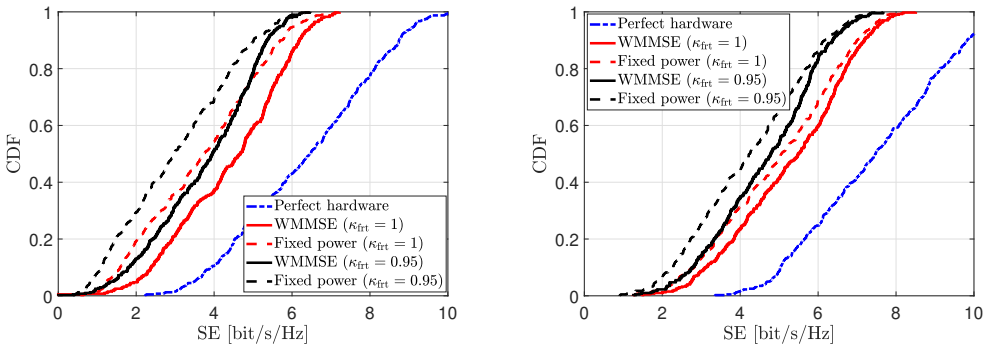
Modular extremely large-scale MIMO (XL-MIMO) architectures combined with wireless fronthaul provide a scalable alternative to monolithic arrays, but their performance is sensitive to hardware impairments and resource allocation strategies. In this paper, we consider a distributed two-phase processing framework for modular XL-MIMO systems employing amplify-and-forward wireless fronthaul under practical hardware constraints. We jointly model access-side and fronthaul-side distortions and formulate a weighted minimum mean-square error (WMMSE)-based optimization problem that maximizes the uplink sum spectral efficiency (SE) by jointly adjusting UE transmit powers and fronthaul amplification levels. The resulting algorithm alternates between distortion-aware receiver design and convex power-control updates. Numerical results demonstrate that the proposed joint optimization significantly improves spectral efficiency compared to fixed transmission strategies, particularly when the CPU has a moderate number of antennas, while also quantifying the relative impact of access and fronthaul impairments.
Editorial analysis
A structured set of objections, weighed in public.
Referee Report
Summary. The paper proposes a distributed two-phase processing framework for modular XL-MIMO systems using amplify-and-forward wireless fronthaul under hardware impairments. It jointly models access-side and fronthaul-side distortions and formulates a WMMSE-based alternating optimization that maximizes uplink sum spectral efficiency by jointly tuning UE transmit powers and fronthaul amplification levels. The algorithm alternates between distortion-aware receiver design and convex power-control subproblems. Numerical results claim significant SE gains over fixed transmission strategies, especially for moderate CPU antenna counts, while quantifying the relative impact of the two impairment types.
Significance. If the WMMSE equivalence holds under the combined distortion model, the work provides a practical joint resource allocation method for scalable XL-MIMO deployments and useful quantitative guidance on when access versus fronthaul impairments dominate.
major comments (1)
- [Optimization problem formulation and algorithm description] The central claim that the WMMSE surrogate exactly maximizes uplink sum SE rests on the assumption that the joint access+fronthaul distortion model yields an effective noise covariance compatible with standard WMMSE conditions. The wireless fronthaul amplification step may introduce coupling that renders the covariance non-diagonal or otherwise violates the equivalence, so the reported gains versus fixed strategies could be overstated. This needs explicit verification (e.g., derivation of the effective SINR and confirmation that the weighted-MSE minimization remains equivalent to sum-rate maximization).
minor comments (1)
- [Abstract] The abstract states the optimization problem but provides no equations; the manuscript should include at least the key objective and variable definitions in the abstract or introduction for clarity.
Simulated Author's Rebuttal
We thank the referee for the constructive feedback on our manuscript. We address the major comment point by point below.
read point-by-point responses
-
Referee: The central claim that the WMMSE surrogate exactly maximizes uplink sum SE rests on the assumption that the joint access+fronthaul distortion model yields an effective noise covariance compatible with standard WMMSE conditions. The wireless fronthaul amplification step may introduce coupling that renders the covariance non-diagonal or otherwise violates the equivalence, so the reported gains versus fixed strategies could be overstated. This needs explicit verification (e.g., derivation of the effective SINR and confirmation that the weighted-MSE minimization remains equivalent to sum-rate maximization).
Authors: We thank the referee for this observation. In Section III-B and III-C of the manuscript, the effective received signal model after amplify-and-forward fronthaul is derived by incorporating both access-side and fronthaul-side additive hardware distortions. The resulting effective noise covariance is diagonal because the impairments are modeled as independent across antennas and the fronthaul gains are applied per module; the amplification is folded into the effective channel matrix without introducing off-diagonal coupling under the stated assumptions. Consequently, the standard WMMSE equivalence between weighted-MSE minimization and sum-rate maximization continues to hold for the distortion-aware receiver. The alternating optimization is constructed directly from this effective model. To make the equivalence fully explicit, we will add a dedicated appendix containing the complete effective-SINR derivation and the proof that the WMMSE surrogate remains valid under the combined impairment model. revision: yes
Circularity Check
No significant circularity detected
full rationale
The paper formulates a standard WMMSE alternating optimization to maximize modeled uplink sum SE under joint access and fronthaul distortion models, then compares the resulting allocation against fixed baselines. No equation reduces by construction to a fitted parameter or self-citation; the WMMSE equivalence is an external property applied to the derived effective SINR, and numerical gains are obtained from solving the stated convex subproblems rather than from any renaming or self-referential loop. The derivation chain remains self-contained against the system model.
Axiom & Free-Parameter Ledger
Reference graph
Works this paper leans on
-
[1]
Beyond massive MIMO: The p otential of data transmission with large intelligent surfaces,
S. Hu, F. Rusek, and O. Edfors, “Beyond massive MIMO: The p otential of data transmission with large intelligent surfaces,” IEEE Transactions on Signal Processing , vol. 66, no. 10, pp. 2746–2758, 2018
work page 2018
-
[2]
E. Bj¨ ornson, C.-B. Chae, R. W. Heath Jr, T. L. Marzetta, A . Mezghani, L. Sanguinetti, F. Rusek, M. R. Castellanos, D. Jun, and ¨O. T. Demir, “Towards 6G MIMO: Massive spatial multiplexing, dense arra ys, and interplay between electromagnetics and processing,” arXiv preprint arXiv:2401.02844, 2024
-
[3]
Near-field beamfocusing, localization, and channel estimation with modular linear a rrays,
A. Kosasih, ¨O. T. Demir, and E. Bj¨ ornson, “Near-field beamfocusing, localization, and channel estimation with modular linear a rrays,” arXiv preprint arXiv:2505.07991, 2025
-
[4]
Modular extrem ely large-scale array communication: Near-field modelling and performance analysis,
X. Li, H. Lu, Y . Zeng, S. Jin, and R. Zhang, “Modular extrem ely large-scale array communication: Near-field modelling and performance analysis,” China Communications, vol. 20, no. 4, pp. 132–152, 2023
work page 2023
-
[5]
Enabling cell-free massi ve MIMO systems with wireless millimeter wave fronthaul,
U. Demirhan and A. Alkhateeb, “Enabling cell-free massi ve MIMO systems with wireless millimeter wave fronthaul,” IEEE Transactions on Wireless Communications , vol. 21, no. 11, pp. 9482–9496, 2022
work page 2022
-
[6]
Uplink perform ance of MmWave-fronthaul cell-free massive MIMO systems,
M. Ibrahim, S. Elhoushy, and W. Hamouda, “Uplink perform ance of MmWave-fronthaul cell-free massive MIMO systems,” IEEE Transac- tions on V ehicular Technology, vol. 71, no. 2, pp. 1536–1548, 2022
work page 2022
-
[7]
Ene rgy-efficient cell-free massive MIMO with wireless fronthaul,
O. A. Topal, O. T. Demir, E. Bj¨ ornson, and C. Cavdar, “Ene rgy-efficient cell-free massive MIMO with wireless fronthaul,” in 2024 58th Asilomar Conference on Signals, Systems, and Computers , 2024, pp. 1591–1596
work page 2024
-
[8]
Cell-free massive mimo with ha rdware- impaired wireless fronthaul,
¨O. T. Demir and E. Bj¨ ornson, “Cell-free massive mimo with ha rdware- impaired wireless fronthaul,” in 2025 59th Asilomar Conference on Signals, Systems, and Computers . IEEE, 2025, pp. 1656–1660
work page 2025
-
[9]
E. Bj¨ ornson, J. Hoydis, and L. Sanguinetti, Massive MIMO Networks: Spectral, Energy, and Hardware Efficiency . Hanover, MA, USA: Now Publishers Inc., 2018
work page 2018
-
[10]
Q. Shi, M. Razaviyayn, Z.-Q. Luo, and C. He, “An iterativ ely weighted mmse approach to distributed sum-utility maximization for a MIMO interfering broadcast channel,” IEEE Transactions on Signal Processing , vol. 59, no. 9, pp. 4331–4340, 2011
work page 2011
-
[11]
Foundations of user-centric cell-free massive MIMO,
¨O. T. Demir, E. Bj¨ ornson, and L. Sanguinetti, “Foundations of user-centric cell-free massive MIMO,” F oundations and Trends® in Signal Processing , vol. 14, no. 3-4, pp. 162–472, 2021. [Online]. Available: http://dx.doi.org/10.1561/2000000109
discussion (0)
Sign in with ORCID, Apple, or X to comment. Anyone can read and Pith papers without signing in.