Finite-state enumeration of adjacency-constrained 132-avoiding permutations
Pith reviewed 2026-05-25 04:00 UTC · model grok-4.3
The pith
A two-sided endpoint-state decomposition with at most (m+1)^2 states shows that the generating function for adjacency-constrained 132-avoiding permutations is rational for every fixed m.
A machine-rendered reading of the paper's core claim, the machinery that carries it, and where it could break.
Core claim
The paper claims that by decomposing the permutations according to threshold bounds on the deficiencies n-π1 and n-πn, where the thresholds are 0 through m-1 or infinity, one obtains a finite automaton with at most (m+1)^2 states whose transfer matrix gives the rational generating function A^(m)(x). This decomposition is two-sided and works uniformly for all m, allowing recovery of the m=2 case, explicit computation for m=3, and asymptotic results including the existence of the growth constant from spectral radii of cyclic components.
What carries the argument
two-sided endpoint-state decomposition tracking thresholds on endpoint deficiencies n-π1 and n-πn
If this is right
- For each fixed m the sequence satisfies an eventual constant-coefficient linear recurrence whose order is bounded by the size of the strongly connected components.
- The growth constant is the maximum spectral radius of the two main cyclic components in the state graph for m≥2.
- Explicit asymptotics with simple poles hold for m=2 and m=3.
- The growth constants increase with m and approach 4 as m tends to infinity.
- The method recovers known results for m=2 and provides new ones for m=3.
Where Pith is reading between the lines
- Similar state decompositions could apply to other pattern avoidance problems with local adjacency restrictions.
- As m increases the growth rate approaches the unrestricted 132-avoiding case, suggesting the constraint's effect diminishes asymptotically.
- The bound on the recurrence order from the strongly connected components could be tightened with further analysis of the dependency graph.
Load-bearing premise
The proposed decomposition captures exactly the set of all adjacency-constrained 132-avoiding permutations through its state transitions.
What would settle it
Enumerating all such permutations for n up to 20 when m=3 by direct search and verifying that the counts match those generated from the 16-state transition matrix.
Figures

read the original abstract
For a fixed integer $m\ge 1$, let $\mathcal{A}_n^{(m)}$ be the set of permutations $\pi\in S_n$ that avoid the pattern $132$ and satisfy the adjacency bound $|\pi_{i+1}-\pi_i|\le m$ for all $i$. Here, a pattern $132$ means three indices $i<j<k$ such that $\pi_i<\pi_k<\pi_j$. A recent study initiated the enumeration of these constrained 132-avoiding permutations, treating the case $m=2$ by deriving a rational ordinary generating function and asking for finite-state decompositions, rational generating functions, and explicit rational formulas for larger fixed $m$. We introduce a two-sided endpoint-state decomposition that works uniformly for every fixed $m$. The state variables impose threshold bounds on the endpoint deficiencies $n-\pi_1$ and $n-\pi_n$, with thresholds in $\{0,1,\ldots,m-1,\infty\}$. This gives at most $(m+1)^2$ states and proves that, for every fixed $m$, the ordinary generating function $A^{(m)}(x)$ is rational and can be computed effectively by exact linear algebra. We also identify cyclic strongly connected components of the dependency graph in the finite-state system to give an explicit upper bound for the order of an eventual constant-coefficient recurrence satisfied by the sequence $a_n^{(m)}=|\mathcal{A}_n^{(m)}|$. We then recover the known case $m=2$ from this state system and work out the case $m=3$ explicitly. On the asymptotic side, we prove that the exponential growth constant exists for every $m$; for $m\ge2$ it is obtained from the spectral radii of the two cyclic components with more than one vertex in the state system. We determine the simple-pole asymptotics for $m=2$ and $m=3$, and we prove that the growth constants are nondecreasing in $m$, strictly smaller than the Catalan growth constant $4$ for every finite $m$, and converge to $4$ as $m\to\infty$.
Editorial analysis
A structured set of objections, weighed in public.
Referee Report
Summary. The manuscript introduces a two-sided endpoint-state decomposition for the class of 132-avoiding permutations with the adjacency constraint |π_{i+1}−π_i|≤m. States track threshold bounds (in {0,1,…,m−1,∞}) on the deficiencies n−π_1 and n−π_n, producing at most (m+1)^2 states. The construction is used to prove that the ordinary generating function A^{(m)}(x) is rational for each fixed m and can be obtained by exact linear algebra on the transition matrix. The paper recovers the known m=2 generating function, computes the m=3 case explicitly, extracts eventual linear recurrences from the cyclic strongly connected components of the state graph, and establishes that the exponential growth constants exist, are strictly less than 4, are nondecreasing in m, and converge to 4 as m→∞, with simple-pole asymptotics given for m=2 and m=3.
Significance. If the state decomposition is faithful, the work supplies a uniform, effective procedure that yields rational generating functions, explicit recurrences, and precise asymptotics for every fixed m. The finite-state construction, the explicit recovery of the m=2 case, the m=3 computation, the spectral-radius analysis of the two nontrivial cyclic components, and the proof that the growth constants approach the Catalan constant 4 are concrete advances in the enumeration of pattern-avoiding permutations under local constraints.
minor comments (2)
- [Abstract / §3] The abstract states that the state system yields 'at most (m+1)^2 states'; a brief remark in §3 or §4 confirming that all threshold pairs are reachable (or identifying any unreachable pairs) would make the bound fully explicit.
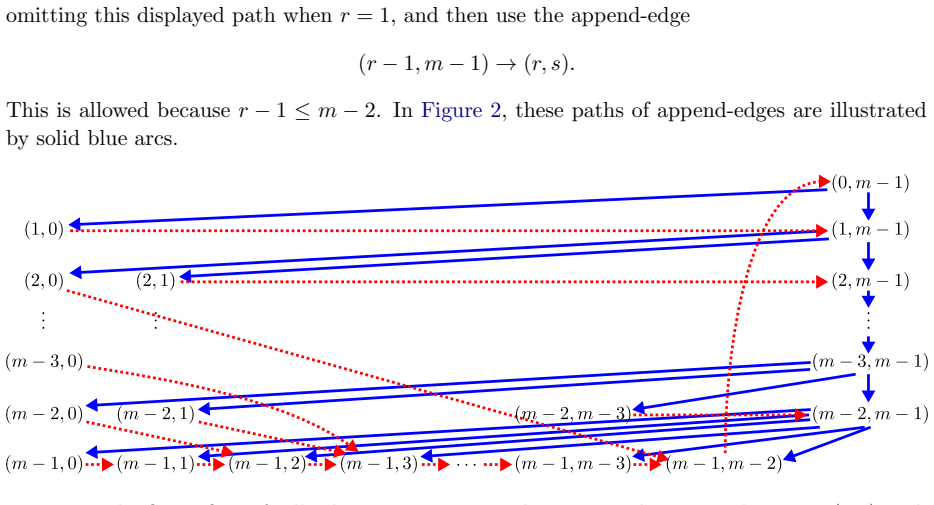
- [§5] The dependency graph and its cyclic strongly connected components are central to the recurrence-order bound; a small diagram or adjacency-matrix excerpt for the m=3 case would improve readability of the growth-rate argument.
Simulated Author's Rebuttal
We thank the referee for the positive and accurate summary of the manuscript and for the recommendation to accept.
Circularity Check
Direct combinatorial finite-state construction; no circularity
full rationale
The derivation rests on an explicit two-sided endpoint-state decomposition whose states are defined directly from threshold bounds on the endpoint deficiencies n-π1 and n-πn. The finite number of states (at most (m+1)^2) immediately yields a transition matrix whose powers enumerate the objects; rationality of the OGF is the standard consequence of a finite automaton and does not reduce to any fitted parameter or prior result by construction. Recovery of the m=2 case and explicit computation for m=3 are consistency verifications, not load-bearing inputs. No self-citation is invoked to justify the state set or the avoidance property, and the growth-rate analysis follows from the spectral radii of the explicitly constructed dependency graph. The argument is therefore self-contained against external benchmarks.
Axiom & Free-Parameter Ledger
axioms (2)
- standard math Standard properties of 132 pattern avoidance and permutations hold.
- domain assumption The adjacency constraint can be tracked via endpoint deficiencies with the given thresholds.
Reference graph
Works this paper leans on
-
[1]
Albert, Steve Linton, and Nik Ruˇ skuc
Michael H. Albert, Steve Linton, and Nik Ruˇ skuc. The insertion encoding of permutations. Electronic Journal of Combinatorics, 12(1):Research Paper 47, 2005
work page 2005
-
[2]
On uniquelyk-determined permutations.Discrete Mathematics, 308(9):1500–1507, 2008
Sergey Avgustinovich and Sergey Kitaev. On uniquelyk-determined permutations.Discrete Mathematics, 308(9):1500–1507, 2008
work page 2008
-
[3]
CRC Press, Boca Raton, 2 edition, 2012
Mikl´ os B´ ona.Combinatorics of Permutations. CRC Press, Boca Raton, 2 edition, 2012
work page 2012
-
[4]
Mikl´ os B´ ona. Surprising symmetries in objects counted by Catalan numbers.Electronic Journal of Combinatorics, 19(1):P62, 2012
work page 2012
-
[5]
Derek DeSantis, Rebecca Field, Wesley Hough, Brant Jones, Rebecca Meissen, and Jacob Ziefle. Permutation pattern avoidance and the Catalan triangle.Missouri Journal of Math- ematical Sciences, 25(1):50–60, 2013
work page 2013
-
[6]
Cambridge University Press, Cambridge, 2009
Philippe Flajolet and Robert Sedgewick.Analytic Combinatorics. Cambridge University Press, Cambridge, 2009
work page 2009
-
[7]
Maria M. Gillespie, Kenneth G. Monks, and Kenneth M. Monks. Enumerating anchored permutations with bounded gaps.Discrete Mathematics, 343(9):111957, 2020. 36
work page 2020
-
[8]
Roger A. Horn and Charles R. Johnson.Matrix Analysis. Cambridge University Press, Cambridge, 2 edition, 2012
work page 2012
-
[9]
Christian Krattenthaler. Permutations with restricted patterns and Dyck paths.Advances in Applied Mathematics, 27:510–530, 2001
work page 2001
-
[10]
On 132-Avoiding Permutations with an Adjacency Constraint
Nathaniel Nadler. On 132-avoiding permutations with an adjacency constraint, 2026. arXiv:2604.22135 [math.CO]
work page internal anchor Pith review Pith/arXiv arXiv 2026
-
[11]
Rodica Simion and Frank W. Schmidt. Restricted permutations.European Journal of Com- binatorics, 6(4):383–406, 1985
work page 1985
-
[12]
Vincent Vatter. Enumeration schemes for restricted permutations.Combinatorics, Probability and Computing, 17(1):137–159, 2008
work page 2008
-
[13]
Vincent Vatter. Permutation classes. In Mikl´ os B´ ona, editor,Handbook of Enumerative Combinatorics, pages 754–833. CRC Press, Boca Raton, 2015
work page 2015
-
[14]
Enumeration schemes and, more importantly, their automatic generation
Doron Zeilberger. Enumeration schemes and, more importantly, their automatic generation. Annals of Combinatorics, 2:185–195, 1998. 37
work page 1998
discussion (0)
Sign in with ORCID, Apple, or X to comment. Anyone can read and Pith papers without signing in.