Joint Estimation of Marginal and Heterogeneous Treatment Effects
Pith reviewed 2026-05-25 03:23 UTC · model grok-4.3
The pith
Embedding the marginal treatment effect in a joint model for outcome and covariates allows adjustment without losing marginal interpretability.
A machine-rendered reading of the paper's core claim, the machinery that carries it, and where it could break.
Core claim
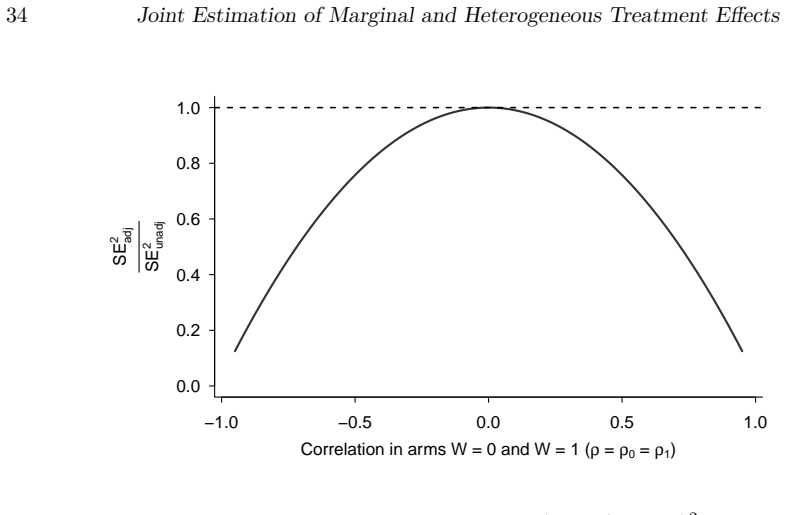
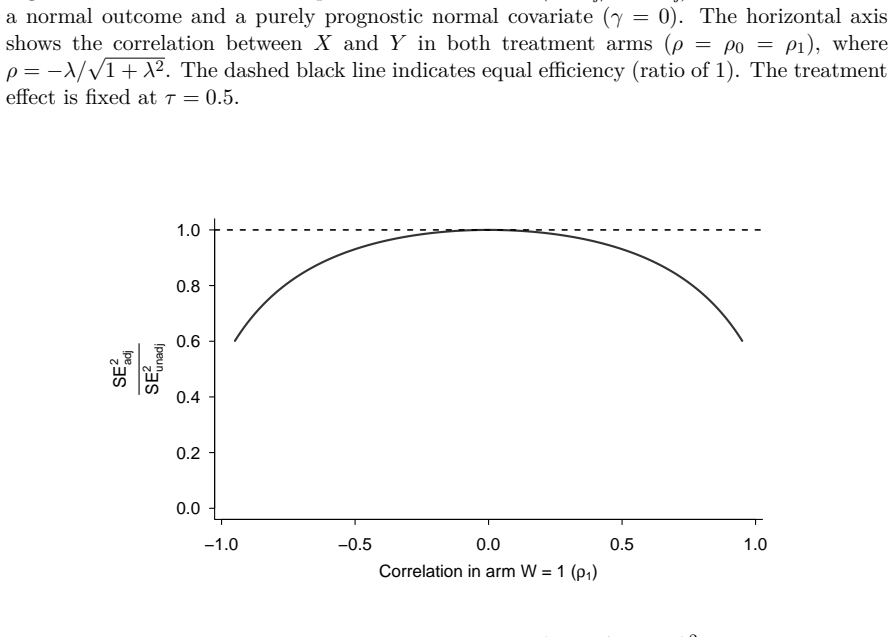
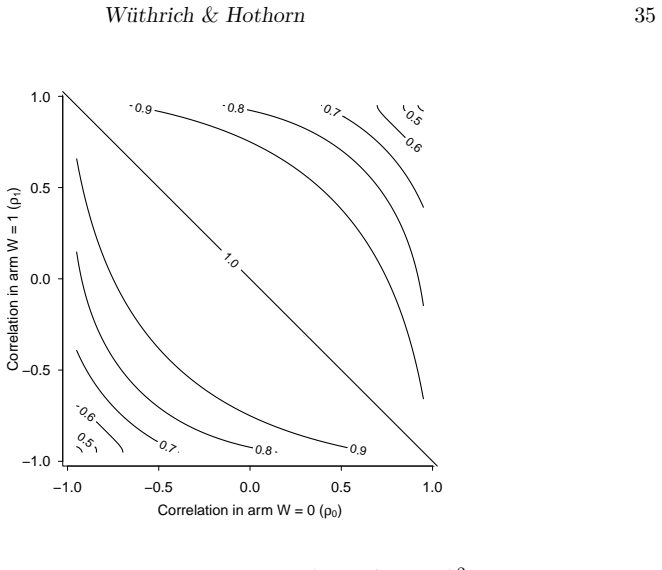
The central claim is that the joint model construction for the outcome and baseline covariates embeds the marginal treatment effect directly, thereby preserving its marginal interpretability while permitting adjustment for prognostic and predictive covariates. This yields unbiased estimation of the marginal effect (Cohen's d, log-odds ratio, or log-hazard ratio) that is more efficient than the unadjusted estimator. The paper proves that, for continuous outcomes, the asymptotic variance of the adjusted Cohen's d is never larger than the unadjusted variance, with the improvement driven mainly by prognostic effects.
What carries the argument
The joint model for outcome and baseline covariates that embeds the marginal treatment effect directly
If this is right
- The method applies to continuous, binary, ordinal, and time-to-event outcomes.
- It permits explicit estimation and ranking of prognostic and predictive covariates on a common scale.
- Efficiency gains for marginal Cohen's d arise mainly from prognostic effects, with realistic predictive effects adding little.
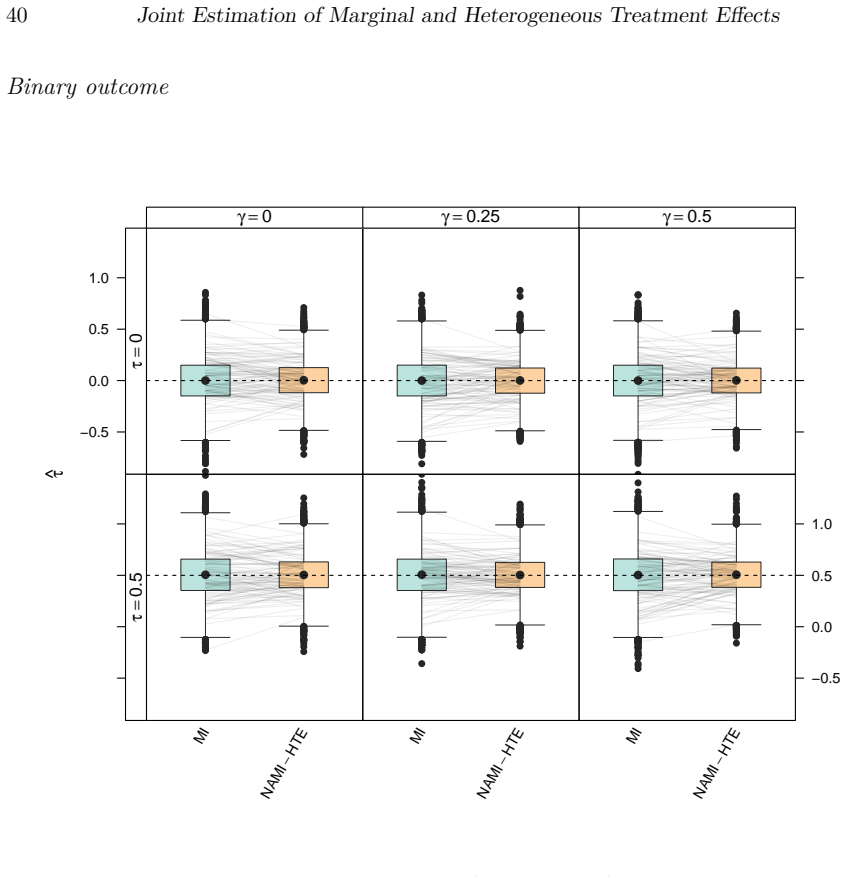
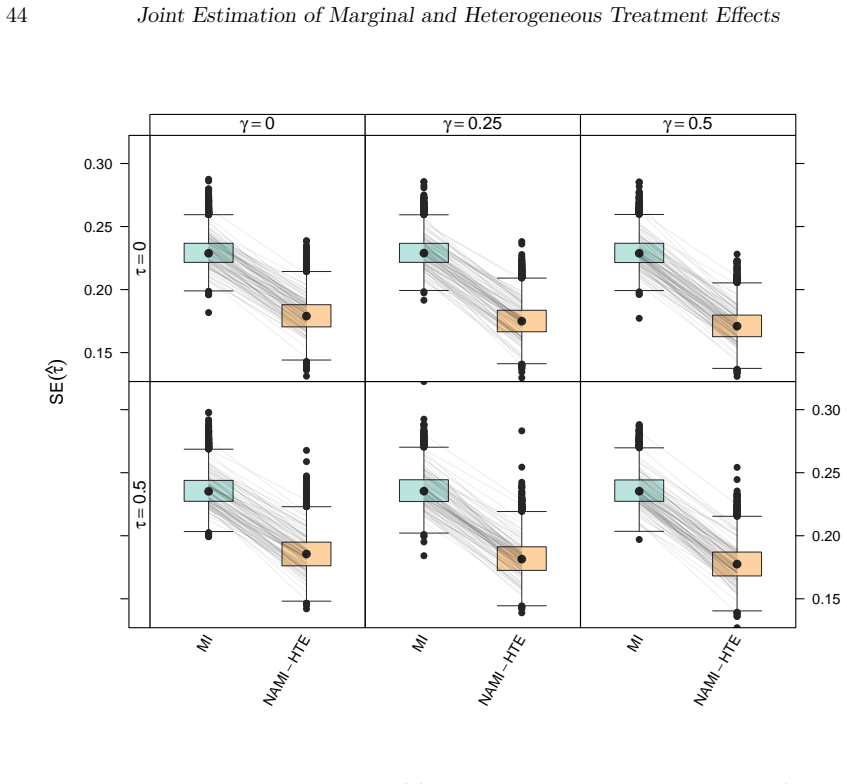
- Simulation studies confirm unbiased and more efficient estimation of marginal effects for Cohen's d, log-odds ratios, and log-hazard ratios.
Where Pith is reading between the lines
- Trial protocols could prioritize collection of strong prognostic covariates to maximize precision of the primary marginal effect.
- The framework may be useful for re-analysis of completed trials where both marginal effect and heterogeneity information are desired.
- Power calculations for future trials could incorporate expected prognostic strength to reduce required sample size.
Load-bearing premise
The joint model construction preserves the marginal interpretability of the treatment effect even when heterogeneity is present and the model is non-linear.
What would settle it
A dataset or simulation in which the joint-model estimate of the marginal Cohen's d differs from the unadjusted estimate or has larger asymptotic variance than the unadjusted estimator.
Figures





read the original abstract
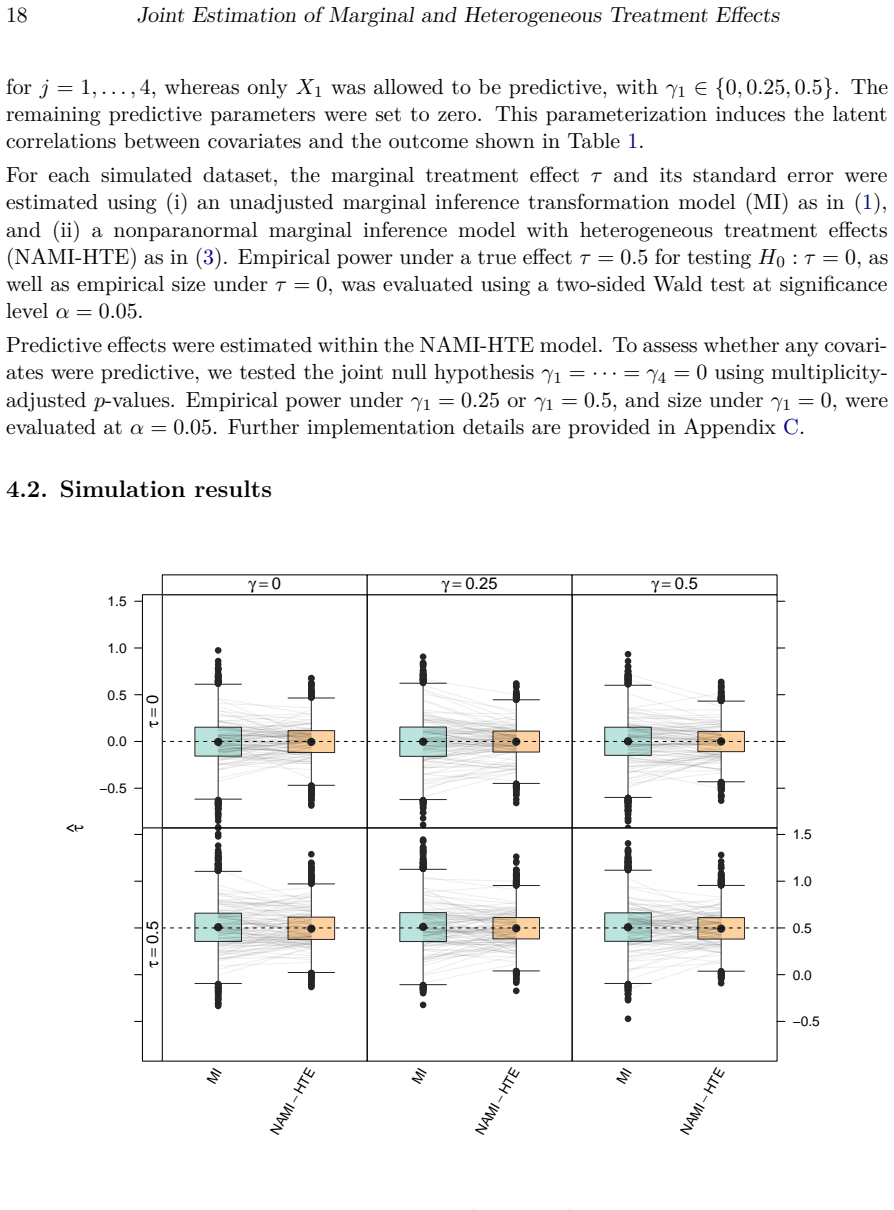
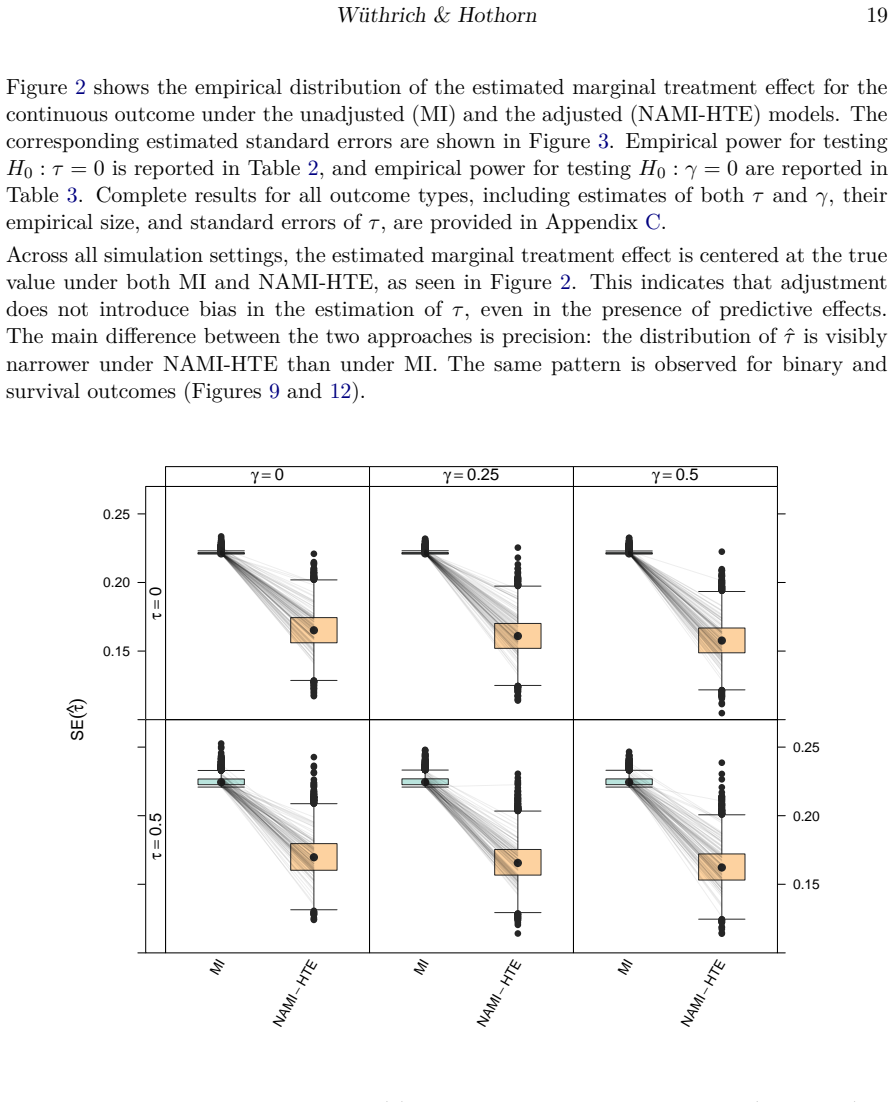
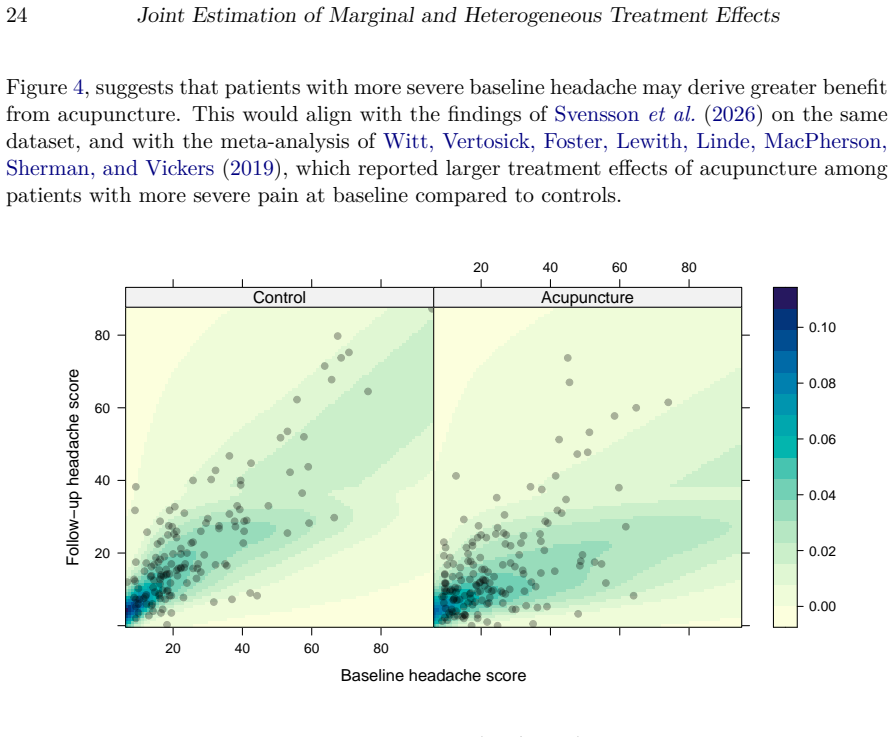
Randomized clinical trials typically aim to estimate a marginal treatment effect. While covariate adjustment can improve precision, it may change the estimand in nonlinear models due to noncollapsibility, leading to conditional rather than marginal treatment effects. At the same time, identifying prognostic and predictive covariates is important for understanding treatment effect heterogeneity and informing clinical decision-making. Keeping marginal interpretability while allowing efficiency gains and assessment of heterogeneity remains a methodological challenge. In this work, we extend nonparanormal adjusted marginal inference to allow for heterogeneous treatment effects. The proposed framework embeds the marginal treatment effect directly in a joint model for the outcome and baseline covariates. This construction preserves marginal interpretability while adjusting for potentially prognostic and/or predictive covariates. The method applies to continuous, binary, ordinal, and time-to-event outcomes and allows explicit estimation and ranking of prognostic and predictive covariates on a common scale. For continuous outcomes, we show that the asymptotic variance of the marginal treatment effect measured as Cohen's $d$ is never worse and often better under covariate adjustment than without adjustment. Efficiency gains are primarily driven by prognostic effects, with realistic predictive effects contributing little additional improvement. Simulation studies confirm these findings across outcome types and demonstrate unbiased and more efficient estimation of marginal effects for Cohen's d, log-odds ratios, and log-hazard ratios. Application to an acupuncture trial demonstrates that the method reproduces the original trial findings while improving efficiency and allowing ranking of prognostic and predictive covariates.
Editorial analysis
A structured set of objections, weighed in public.
Referee Report
Summary. The paper proposes extending nonparanormal adjusted marginal inference to heterogeneous treatment effects by embedding the marginal treatment effect directly in a joint model for the outcome and baseline covariates. This construction is claimed to preserve marginal interpretability of the treatment effect while permitting efficiency gains from adjustment and explicit estimation/ranking of prognostic and predictive covariates on a common scale. The framework applies to continuous, binary, ordinal, and time-to-event outcomes. For continuous outcomes, an asymptotic variance result is stated for the marginal treatment effect measured as Cohen's d, showing it is never worse and often better under covariate adjustment (driven primarily by prognostic effects). Simulation studies are reported to confirm unbiased and more efficient estimation across outcome types, with an application to an acupuncture trial demonstrating reproduction of original findings plus efficiency gains.
Significance. If the joint construction rigorously preserves the marginal estimand, the work would address a central tension in RCT analysis by enabling covariate-adjusted inference without shifting to a conditional estimand in non-linear models. The explicit asymptotic variance result for Cohen's d (continuous case) and the cross-outcome simulation validation constitute concrete, falsifiable contributions. The common-scale ranking of prognostic versus predictive covariates offers practical value for trial reporting. These elements would strengthen the methodological toolkit for marginal inference with heterogeneity.
major comments (3)
- [Abstract / model construction] Abstract and model construction section: The claim that embedding the marginal treatment effect in the joint model 'preserves marginal interpretability' while allowing heterogeneous (predictive) effects requires an explicit derivation showing that the implied marginal contrast equals the integral of the conditional contrast over the covariate distribution. For non-linear outcome links, noncollapsibility implies that a conditional parameter generally differs from the marginal; without this marginalization step demonstrated (e.g., via an equation integrating over the covariate distribution), the applicability to binary, ordinal, and time-to-event outcomes rests on an unverified assumption.
- [Asymptotic variance derivation] Asymptotic variance result for Cohen's d (continuous outcomes): The statement that the asymptotic variance 'is never worse and often better under covariate adjustment' and that 'efficiency gains are primarily driven by prognostic effects, with realistic predictive effects contributing little' is presented without the full derivation or the explicit variance formula. This makes it impossible to verify whether the result holds after accounting for the joint estimation of heterogeneous effects or whether post-hoc model choices affect the efficiency ordering.
- [Simulation studies] Simulation studies: The reported confirmation of unbiased and more efficient estimation across outcome types lacks details on data exclusion rules, exact joint model specifications, and how the marginal parameter is extracted from the fitted joint model. These omissions are load-bearing for the central efficiency claim, as any implicit conditioning could bias the marginal estimand in non-linear settings.
minor comments (2)
- [Abstract] The abstract introduces 'nonparanormal adjusted marginal inference' without a brief definition or citation to the base method, which would aid readers unfamiliar with the prior framework.
- [Model specification] Notation for the joint model parameters (prognostic vs. predictive) should be clarified early to distinguish their roles in the marginal contrast versus the heterogeneity assessment.
Simulated Author's Rebuttal
We thank the referee for the detailed and constructive report. The comments highlight important points for clarification, and we address each below with plans for revision.
read point-by-point responses
-
Referee: [Abstract / model construction] Abstract and model construction section: The claim that embedding the marginal treatment effect in the joint model 'preserves marginal interpretability' while allowing heterogeneous (predictive) effects requires an explicit derivation showing that the implied marginal contrast equals the integral of the conditional contrast over the covariate distribution. For non-linear outcome links, noncollapsibility implies that a conditional parameter generally differs from the marginal; without this marginalization step demonstrated (e.g., via an equation integrating over the covariate distribution), the applicability to binary, ordinal, and time-to-event outcomes rests on an unverified assumption.
Authors: We agree that an explicit marginalization step would strengthen the presentation. In the revised manuscript we will add a derivation in Section 2 showing that the marginal contrast is recovered by integrating the conditional contrast (under the nonparanormal joint model) over the covariate distribution; the same construction is used for the binary, ordinal, and time-to-event cases, thereby preserving the marginal estimand by design. revision: yes
-
Referee: [Asymptotic variance derivation] Asymptotic variance result for Cohen's d (continuous outcomes): The statement that the asymptotic variance 'is never worse and often better under covariate adjustment' and that 'efficiency gains are primarily driven by prognostic effects, with realistic predictive effects contributing little' is presented without the full derivation or the explicit variance formula. This makes it impossible to verify whether the result holds after accounting for the joint estimation of heterogeneous effects or whether post-hoc model choices affect the efficiency ordering.
Authors: The derivation appears in the supplementary appendix. We will insert the key algebraic steps and the explicit asymptotic variance expression into the main text (new subsection of Section 3), explicitly noting that the result is obtained under joint estimation of the heterogeneous effects and that the efficiency ordering is invariant to post-hoc selection of predictive covariates under the stated regularity conditions. revision: yes
-
Referee: [Simulation studies] Simulation studies: The reported confirmation of unbiased and more efficient estimation across outcome types lacks details on data exclusion rules, exact joint model specifications, and how the marginal parameter is extracted from the fitted joint model. These omissions are load-bearing for the central efficiency claim, as any implicit conditioning could bias the marginal estimand in non-linear settings.
Authors: We will expand the simulation section to report the precise joint-model specifications for each outcome type, the algorithm used to extract the marginal parameter after fitting, and any data-handling rules applied. These additions will make the unbiasedness and efficiency results fully reproducible and will confirm that the marginal estimand is recovered without implicit conditioning. revision: yes
Circularity Check
No significant circularity; marginal effect embedded by construction but variance result independently derived
full rationale
The paper defines a joint model that directly parameterizes the marginal treatment effect, then derives the asymptotic variance property for Cohen's d as a consequence of that model (prognostic effects driving efficiency). No quoted equations reduce a reported prediction or result to a fitted input by construction, nor does any load-bearing step collapse to self-citation or renaming. The preservation claim follows from the explicit embedding rather than tautology, and the efficiency finding is presented as a derived property confirmed by simulation. This is self-contained against external benchmarks with no circular reduction exhibited.
Axiom & Free-Parameter Ledger
Reference graph
Works this paper leans on
- [1]
- [2]
-
[3]
Journal of Statistical Software , year =
Most Likely Transformations: The mlt Package , author =. Journal of Statistical Software , year =
-
[4]
Simultaneous Inference in General Parametric Models , author =. Biometrical Journal , year =
- [5]
-
[6]
multcomp: Simultaneous Inference in General Parametric Models , author =. 2025 , note =
work page 2025
- [7]
-
[8]
Scandinavian Journal of Statistics , year = 2022, volume =
Nadja Klein and Torsten Hothorn and Luisa Barbanti and Thomas Kneib , title =. Scandinavian Journal of Statistics , year = 2022, volume =
work page 2022
-
[9]
Optimization and Engineering , volume =
Covariance Prediction via Convex Optimization , author =. Optimization and Engineering , volume =. 2023 , doi =
work page 2023
-
[10]
Dandl, Susanne and Hothorn, Torsten , title =. 2025 , institution =
work page 2025
-
[11]
Nonparanormal Adjusted Marginal Inference , author =. Biometrics , eid =. 2026 , doi =
work page 2026
-
[12]
George E. P. Box and David R. Cox , title =. 1964 , doi =
work page 1964
-
[13]
Torsten Hothorn and Lisa M\"ost and Peter B\"uhlmann , title =. 2018 , journal =. doi:10.1111/sjos.12291 , volume = 45, number = 1, pages =
-
[14]
Statistical Methods in Medical Research , doi =
Ainesh Sewak and Torsten Hothorn , title =. Statistical Methods in Medical Research , doi =
-
[15]
Generalized Maximally Selected Statistics
Joint Regression Analysis of Correlated Data using. Biometrics , number =. doi:10.1111/j.1541-0420.2008.01058.x , author =
-
[16]
Journal of Machine Learning Research , year =
Han Liu and John Lafferty and Larry Wasserman , title =. Journal of Machine Learning Research , year =
-
[17]
Adjusting for Covariates in Randomized Clinical Trials for Drugs and Biological Products , author =. 2023 , month =
work page 2023
-
[18]
Statistical Science , volume =
Confounding and Collapsibility in Causal Inference , author =. Statistical Science , volume =. 1999 , doi =
work page 1999
-
[19]
Biometrical Journal , author =
Making Apples From Oranges: Comparing Noncollapsible Effect Estimators and Their Standard Errors After Adjustment for Different Covariate Sets , volume =. Biometrical Journal , author =. 2021 , pages =. doi:10.1002/bimj.201900297 , number =
-
[20]
2020 , month = feb, url =
work page 2020
-
[21]
Moderators of Treatment Outcomes: Clinical, Research, and Policy Importance , author =. JAMA , volume =. 2006 , doi =
work page 2006
-
[22]
Controlled Clinical Trials , volume =
Should We Adjust for Covariates in Nonlinear Regression Analyses of Randomized Trials? , author =. Controlled Clinical Trials , volume =. 1998 , month =
work page 1998
-
[23]
Covariate Adjustment in Randomized Controlled Trials: General Concepts and Practical Considerations , author =. Clinical Trials , volume =. 2024 , month =
work page 2024
-
[24]
A Comparison of Covariate Adjustment Approaches under Model Misspecification in Individually Randomized Trials , author =. Trials , volume =. 2023 , doi =
work page 2023
-
[25]
Communications in Statistics -- Theory and Methods , volume =
Estimating a Marginal Causal Odds Ratio Subject to Confounding , author =. Communications in Statistics -- Theory and Methods , volume =. 2008 , doi =
work page 2008
-
[26]
Statistical Theory and Related Fields , volume =
Robust Variance Estimation for Covariate-Adjusted Unconditional Treatment Effect in Randomized Clinical Trials with Binary Outcomes , author =. Statistical Theory and Related Fields , volume =. 2023 , doi =
work page 2023
-
[27]
Statistics in Medicine , volume =
Covariate Adjustment for Two-Sample Treatment Comparisons in Randomized Clinical Trials: A Principled Yet Flexible Approach , author =. Statistics in Medicine , volume =. 2008 , doi =
work page 2008
-
[28]
Improving Efficiency of Inferences in Randomized Clinical Trials Using Auxiliary Covariates , author =. Biometrics , volume =. 2008 , month =
work page 2008
-
[29]
Improving the Efficiency of the Log-Rank Test Using Auxiliary Covariates , author =. Biometrika , volume =. 2008 , month =
work page 2008
-
[30]
Covariate-Adjusted Log-Rank Test: Guaranteed Efficiency Gain and Universal Applicability , author =. Biometrika , volume =. 2024 , month =
work page 2024
-
[31]
A General Form of Covariate Adjustment in Clinical Trials under Covariate-Adaptive Randomization , author =. Biometrika , volume =. 2025 , eid =
work page 2025
-
[32]
The International Journal of Biostatistics , volume =
Targeted Maximum Likelihood Learning , author =. The International Journal of Biostatistics , volume =. 2006 , doi =
work page 2006
-
[33]
Agnostic Notes on Regression Adjustments to Experimental Data: Reexamining
Lin, Winston , journal =. Agnostic Notes on Regression Adjustments to Experimental Data: Reexamining. 2013 , doi =
work page 2013
-
[34]
Journal of the American Statistical Association , volume =
Toward Better Practice of Covariate Adjustment in Analyzing Randomized Clinical Trials , author =. Journal of the American Statistical Association , volume =. 2023 , doi =
work page 2023
-
[35]
Journal of Clinical Oncology , volume =
Biomarker: Predictive or Prognostic? , author =. Journal of Clinical Oncology , volume =. 2015 , month =. doi:10.1200/JCO.2015.63.3651 , note =
-
[36]
Distinguishing Prognostic and Predictive Biomarkers: An Information Theoretic Approach , author =. Bioinformatics , volume =. 2018 , month =
work page 2018
-
[37]
Statistics in Medicine , volume =
Modern Approaches for Evaluating Treatment Effect Heterogeneity from Clinical Trials and Observational Data , author =. Statistics in Medicine , volume =. 2024 , doi =
work page 2024
-
[38]
Journal of Biopharmaceutical Statistics , volume =
Methods for Identification and Confirmation of Targeted Subgroups in Clinical Trials: A Systematic Review , author =. Journal of Biopharmaceutical Statistics , volume =. 2016 , doi =
work page 2016
-
[39]
Statistics in Medicine , volume =
Subgroup Identification Based on Differential Effect Search---A Recursive Partitioning Method for Establishing Response to Treatment in Patient Subpopulations , author =. Statistics in Medicine , volume =. 2011 , doi =
work page 2011
-
[40]
The Annals of Applied Statistics , volume =
What Makes Forest-Based Heterogeneous Treatment Effect Estimators Work? , author =. The Annals of Applied Statistics , volume =. 2024 , month =
work page 2024
-
[41]
Statistical Methods in Medical Research , volume =
Individual Treatment Effect Prediction for Amyotrophic Lateral Sclerosis Patients , author =. Statistical Methods in Medical Research , volume =. 2018 , doi =
work page 2018
-
[42]
Statistics in Medicine , volume =
Subgroup Identification from Randomized Clinical Trial Data , author =. Statistics in Medicine , volume =. 2011 , month =
work page 2011
-
[43]
Observational Studies , volume =
Estimating Treatment Effects with Causal Forests: An Application , author =. Observational Studies , volume =. 2019 , doi =
work page 2019
-
[44]
On Discovering Treatment-Effect Modifiers Using
Hermansson, Erik and Svensson, David , booktitle =. On Discovering Treatment-Effect Modifiers Using. 2021 , publisher =
work page 2021
-
[45]
Journal of Clinical Epidemiology , volume =
Simple Randomization Did Not Protect against Bias in Smaller Trials , author =. Journal of Clinical Epidemiology , volume =. 2017 , month =
work page 2017
-
[46]
Svensson, David and Hermansson, Erik and Nikolaou, Nikolaos and Sechidis, Konstantinos and Lipkovich, Ilya , journal =. Overview and Practical Recommendations on Using Shapley Values for Identifying Predictive Biomarkers via. 2026 , volume =
work page 2026
-
[47]
Statistics in Medicine , year =
Random Forests of Interaction Trees for Estimating Individualized Treatment Effects in Randomized Trials , author =. Statistics in Medicine , year =
-
[48]
Acupuncture for Chronic Headache in Primary Care: Large, Pragmatic, Randomised Trial , author =. BMJ , year =
-
[49]
Whose Data Set Is It Anyway? Sharing Raw Data from Randomized Trials , author =. Trials , year =. doi:10.1186/1745-6215-7-15 , url =
-
[50]
The Clinical Journal of Pain , volume =
The Effect of Patient Characteristics on Acupuncture Treatment Outcomes: An Individual Patient Data Meta-Analysis of 20,827 Chronic Pain Patients in Randomized Controlled Trials , author =. The Clinical Journal of Pain , volume =. 2019 , month =
work page 2019
discussion (0)
Sign in with ORCID, Apple, or X to comment. Anyone can read and Pith papers without signing in.