Entropy and stability of an extremally charged Einstein-Born-Infeld thin shell
Pith reviewed 2026-05-25 04:00 UTC · model grok-4.3
The pith
Entropy of an extremally charged Einstein-Born-Infeld thin shell depends only on gravitational radius despite nonzero pressure, with stability set by one charge-exchange inequality.
A machine-rendered reading of the paper's core claim, the machinery that carries it, and where it could break.
Core claim
For the extremally charged solution of Einstein-Born-Infeld theory, the entropy of the thin shell is characterized solely as a function of the gravitational radius. The thermodynamical stability conditions reduce to a single inequality related to exchanges of the charge at the shell, which determines the domain where both dynamical and thermodynamical stable configurations exist.
What carries the argument
Extremally charged thin-shell solution in Einstein-Born-Infeld gravity, with dynamical stability read from an effective potential and thermodynamic quantities obtained after an ansatz for the shell equations of state.
If this is right
- Dynamical stability conditions are obtained directly from the effective potential for radial perturbations.
- Thermodynamic stability is governed by one inequality on charge exchanges at the shell.
- The domain of simultaneous dynamical and thermodynamic stability is fixed by that inequality.
- Entropy remains a function of gravitational radius alone even with nonzero pressure at the shell.
Where Pith is reading between the lines
- The entropy-gravitational-radius relation may hold for thin shells in other nonlinear electrodynamics theories where pressure is present.
- The charge-exchange inequality supplies a practical criterion for locating equilibrium configurations in numerical or analog realizations of the model.
- The effective-potential approach for dynamics could be applied to test stability in nearby parameter regimes without solving the full field equations.
Load-bearing premise
Suitable equations of state exist that permit a closed analytic expression for the entropy density of the shell.
What would settle it
An explicit calculation of the shell entropy showing dependence on parameters other than gravitational radius, or a stable configuration lying outside the charge-exchange inequality domain.
Figures


read the original abstract
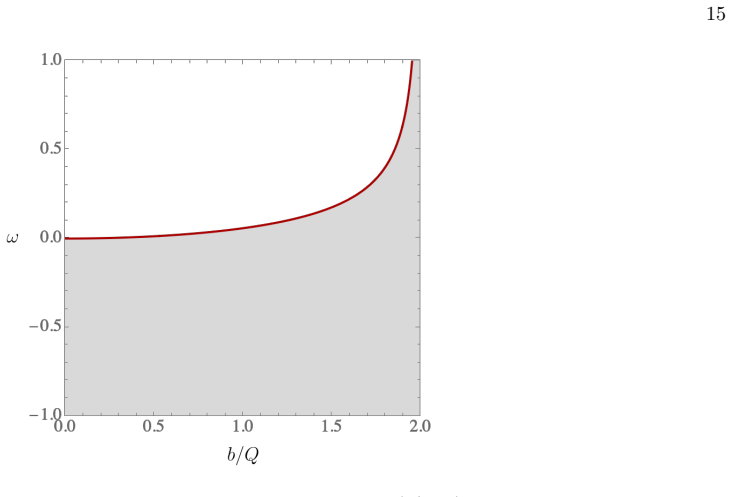
Spacetimes with a thin shell offer a framework where both the dynamical stability and the thermodynamical stability of the matter comprising the shell can be consistently studied. In the present work, we consider the dynamical and thermodynamical stability of a spherical thin shell in Einstein gravity coupled to Born-Infeld electrodynamics. For our construction, we adopt the extremally charged solution of the theory, which offers a closed analytic form for the horizon location that allows for a clear derivation of the corresponding physical quantities of interest. Under this scenario, the dynamical stability conditions under radial perturbations are readily obtained in terms of an effective potential. The complete equilibrium thermodynamics for such a shell is presented. We find that, despite a non-zero pressure at the shell (unlike the extremally charged Reissner-Nordstr\"{o}m counterpart), its entropy is solely characterized as a function of the gravitational radius. We propose a physically suitable \emph{ans\"{a}tze} for the relevant equations of state in order to obtain a closed expression for the entropy density of the shell. We find that the thermodynamical stability conditions reduce to a single inequality related to exchanges of the charge at the shell, which determines the domain where both dynamical and thermodynamical stable configurations exist.
Editorial analysis
A structured set of objections, weighed in public.
Referee Report
Summary. The manuscript studies dynamical and thermodynamical stability of a spherical thin shell in Einstein-Born-Infeld electrodynamics using the extremally charged solution. Dynamical stability follows from an effective potential under radial perturbations. Equilibrium thermodynamics is derived, with the claim that entropy depends only on gravitational radius despite nonzero shell pressure (unlike the RN case). A proposed ansatz for the equations of state yields a closed entropy-density expression, after which thermodynamical stability reduces to a single inequality on charge exchange that delineates the domain of joint dynamical-thermodynamical stability.
Significance. If the ansatz is shown to be consistent with the junction conditions and not merely chosen for analytic closure, the result would usefully extend thin-shell thermodynamics to nonlinear electrodynamics, isolating the effect of the Born-Infeld parameter on entropy and stability while preserving the extremal analytic horizon.
major comments (1)
- [Abstract / thermodynamics section] Abstract and thermodynamics section: the two central claims—that entropy is solely a function of gravitational radius and that thermodynamical stability collapses to one charge-exchange inequality—both follow directly from the proposed ansatz for the equations of state, introduced explicitly 'in order to obtain a closed expression.' No derivation from the Einstein-Born-Infeld junction conditions or matching to an independent microscopic model is indicated; if the ansatz is not the unique or required choice, both results are specific to that choice rather than general features of the extremal shell.
minor comments (1)
- [Abstract] Abstract contains a typographical error in the plural of 'ansatz' ('ansätze' is the standard form).
Simulated Author's Rebuttal
We thank the referee for the careful reading and the constructive comment on the role of the ansatz. We respond point by point below.
read point-by-point responses
-
Referee: [Abstract / thermodynamics section] Abstract and thermodynamics section: the two central claims—that entropy is solely a function of gravitational radius and that thermodynamical stability collapses to one charge-exchange inequality—both follow directly from the proposed ansatz for the equations of state, introduced explicitly 'in order to obtain a closed expression.' No derivation from the Einstein-Born-Infeld junction conditions or matching to an independent microscopic model is indicated; if the ansatz is not the unique or required choice, both results are specific to that choice rather than general features of the extremal shell.
Authors: The claim that total entropy depends only on gravitational radius is obtained from the first law of thermodynamics together with the surface pressure fixed by the Einstein-Born-Infeld junction conditions under the extremality constraint; this relation holds independently of the additional ansatz for the entropy density. The ansatz is introduced solely to furnish a closed-form expression for the entropy density, which then allows the thermodynamical stability condition to reduce to a single inequality on charge exchange. The junction conditions determine the pressure but do not fix the full equation of state relating energy density, pressure and charge density; the ansatz is a physically motivated choice (linear in the relevant densities, consistent with earlier thin-shell literature) that recovers the Reissner-Nordström limit. We agree that the stability result is tied to this ansatz and will revise the manuscript to (i) separate the general entropy-radius relation from the ansatz-dependent stability criterion and (ii) add explicit discussion of the ansatz’s domain of applicability. revision: partial
Circularity Check
No significant circularity; ansatz is explicit modeling choice
full rationale
The paper states it proposes an ansatz for the equations of state specifically 'in order to obtain a closed expression for the entropy density of the shell.' The entropy characterization as a function of gravitational radius and the reduction of stability conditions to a single inequality are presented as results obtained after adopting this ansatz and the extremal solution. No equations are shown reducing the output to the input by construction, no parameters are fitted then relabeled as predictions, and no self-citations are invoked as load-bearing uniqueness theorems. The model is self-contained once the ansatz is granted, which is a standard and transparent step rather than a hidden circularity.
Axiom & Free-Parameter Ledger
free parameters (1)
- ansatze for equations of state
Lean theorems connected to this paper
-
IndisputableMonolith/Cost/FunctionalEquation.leanwashburn_uniqueness_aczel unclear?
unclearRelation between the paper passage and the cited Recognition theorem.
We propose a physically suitable ansätze for the relevant equations of state in order to obtain a closed expression for the entropy density of the shell. ... the thermodynamical stability conditions reduce to a single inequality related to exchanges of the charge at the shell
-
IndisputableMonolith/Foundation/ArithmeticFromLogic.leanabsolute_floor_iff_bare_distinguishability unclear?
unclearRelation between the paper passage and the cited Recognition theorem.
the entropy of the shell is solely characterized as a function of the gravitational radius
What do these tags mean?
- matches
- The paper's claim is directly supported by a theorem in the formal canon.
- supports
- The theorem supports part of the paper's argument, but the paper may add assumptions or extra steps.
- extends
- The paper goes beyond the formal theorem; the theorem is a base layer rather than the whole result.
- uses
- The paper appears to rely on the theorem as machinery.
- contradicts
- The paper's claim conflicts with a theorem or certificate in the canon.
- unclear
- Pith found a possible connection, but the passage is too broad, indirect, or ambiguous to say the theorem truly supports the claim.
Reference graph
Works this paper leans on
-
[1]
led to the understanding that: (i) a black hole has an entropy, (ii) the entropy is linear with the area of the horizon and (iii) a black hole radiates (can evaporate). It is particularly important to notice that in the black hole case, the entropy scales with the area of the horizon rather than with some given volume as in other physical scenarios. These...
work page internal anchor Pith review Pith/arXiv arXiv 2026
-
[2]
C. M. Will, Living Rev. Relativ. 17, 4 (2014)
work page 2014
-
[3]
B. P. Abbott et al. (LIGO Scientific Collaboration and Virgo Collaboration), Phys. Rev. Lett. 116, 061102 (2016)
work page 2016
-
[4]
K. Akiyama et al. (Event Horizon Telescope), Astrophys. J. Lett. 875, L1 (2019)
work page 2019
-
[5]
J. M. Bardeen, B. Carter, and S. W. Hawking, Commun. Math. Phys. 31, 161 (1973)
work page 1973
-
[6]
J. D. Bekenstein, Lett. Nuovo Cim. 4, 737 (1972)
work page 1972
-
[7]
J. D. Bekenstein, Phys. Rev. D 7, 2333 (1973)
work page 1973
-
[8]
J. D. Bekenstein, Phys. Rev. D 9, 3292 (1974)
work page 1974
-
[9]
S. W. Hawking, Commun. Math. Phys. 43, 199 (1975)
work page 1975
-
[10]
J. P. Lemos, G. M. Quinta, and O. B. Zaslavskii, Phys. Rev. D 91, 104027 (2015)
work page 2015
-
[11]
J. P. S. Lemos, G. M. Quinta, and O. B. Zaslavskii, Phys. Lett. B 750, 306 (2015)
work page 2015
-
[12]
T. V. Fernandes and J. P. S. Lemos, Phys. Rev. D 106, 104008 (2022)
work page 2022
-
[13]
W. Israel, Nuovo Cim. B 44S10, 1 (1966) , [Erratum: Nuovo Cim.B 48, 463 (1967)]
work page 1966
- [14]
- [15]
-
[16]
S. H. Mazharimousavi, M. Halilsoy, and S. N. H. Amen, Int. J. Mod. Phys. D 26, 1750158 (2017)
work page 2017
-
[17]
E. A. Martinez, Phys. Rev. D 53, 7062 (1996)
work page 1996
-
[18]
S. E. P. Bergliaffa, M. Chiapparini, and L. M. Reyes, Eur. Phys. J. C 80, 719 (2020)
work page 2020
-
[19]
L. M. Reyes, M. Chiapparini, and S. E. P. Bergliaffa, Eur. Phys. J. C 82, 151 (2022)
work page 2022
-
[20]
E. F. Eiroa, G. Figueroa-Aguirre, M. L. Peñafiel, and S. E. P. Bergliaffa, Eur. Phys. J. C 84, 1160 (2024)
work page 2024
-
[21]
Plebaǹski, Lectures on Non-Linear Electrodynamics (NORDITA, Copenhagen, 1970)
J. Plebaǹski, Lectures on Non-Linear Electrodynamics (NORDITA, Copenhagen, 1970)
work page 1970
- [22]
- [23]
-
[24]
A. García D., H. Salazar I., and J. F. Plebański, Nuovo Cim. B (1971-1996) 84, 65 (1984)
work page 1971
- [25]
-
[26]
W. A. Chemissany, M. de Roo, and S. Panda, Class. Quantum Grav. 25, 225009 (2008)
work page 2008
-
[27]
F. T. Falciano, M. L. Peñafiel, and J. C. Fabris, Phys. Rev. D 103, 084046 (2021)
work page 2021
-
[28]
R. Linares, M. Maceda, and D. Martínez-Carbajal, Phys. Rev. D 92, 024052 (2015)
work page 2015
-
[29]
P. A. Sanchez, N. Bretón, and S. E. P. Bergliaffa, Ann. Phys. 393, 107 (2018)
work page 2018
- [30]
- [31]
-
[32]
E. F. Eiroa, Phys. Rev. D 73, 043002 (2006)
work page 2006
-
[33]
S. Gunasekaran, D. Kubizňák, and R. B. Mann, J. High Energy Phys. 2012, 110
work page 2012
-
[34]
E. F. Eiroa and C. Simeone, Phys. Rev. D 87, 064041 (2013)
work page 2013
-
[35]
E. F. Eiroa and C. Simeone, Phys. Rev. D 83, 104009 (2011)
work page 2011
-
[36]
E. F. Eiroa and C. Simeone, in AIP Conf. Proc. , Vol. 1458 (2012) pp. 383–386
work page 2012
-
[37]
M. G. Richarte and C. Simeone, Phys. Rev. D 81, 109903 (2009)
work page 2009
-
[38]
E. F. Eiroa and G. Figueroa Aguirre, Eur. Phys. J. C 72, 2240 (2012)
work page 2012
-
[39]
D. Olmos Cayo, Z. Oporto, and M. L. Peñafiel, Eur. Phys. J. C 85, 1240 (2025)
work page 2025
-
[40]
S. W. Hawking, Phys. Rev. D 51, 4302 (1995)
work page 1995
- [41]
- [42]
-
[43]
S. M. Carroll, M. C. Johnson, and L. Randall, J. High Energy Phys. 2009 (11), 109
work page 2009
-
[44]
J. P. S. Lemos, G. M. Quinta, and O. B. Zaslavskii, Phys. Rev. D 93, 084008 (2016)
work page 2016
- [45]
-
[46]
H. B. Callen, Thermodynamics and an Introduction to Thermostatistics , 2nd ed. (John Wiley & Sons, New York, 1985)
work page 1985
- [47]
- [48]
-
[49]
D. Kubizňák, R. B. Mann, and M. Teo, Class. Quantum Grav. 34, 063001 (2017)
work page 2017
discussion (0)
Sign in with ORCID, Apple, or X to comment. Anyone can read and Pith papers without signing in.