Coherent dynamics in chaotic spin chains via interference-protected subspaces
Pith reviewed 2026-05-25 04:05 UTC · model grok-4.3
The pith
Structured subspaces in spin-1/2 chains stay coherent at high energies because destructive interference blocks leakage into the chaotic complement.
A machine-rendered reading of the paper's core claim, the machinery that carries it, and where it could break.
Core claim
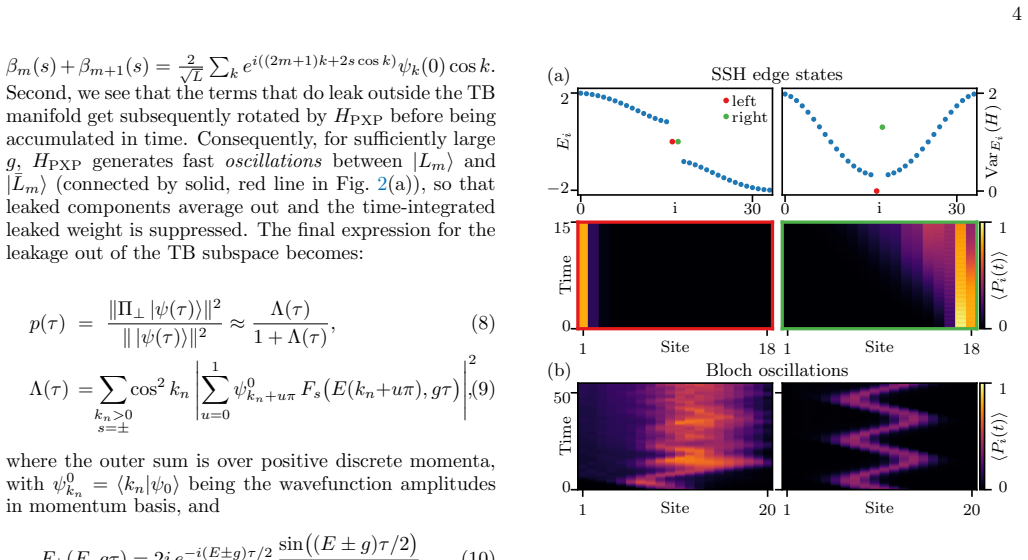
A family of local spin-1/2 chains possesses a structured subspace whose protection originates from destructive interference; this subspace supports scars, chiral quasiparticles, and approximate edge modes at high energy densities, and a leakage theory predicts which states retain coherence while fast oscillations in the complement improve stability.
What carries the argument
Structured subspace protected by destructive interference, which prevents coherent states from leaking into the thermalizing complement.
If this is right
- Initial states inside the subspace exhibit revivals and slow relaxation even at infinite temperature.
- Chiral quasiparticles propagate without backscattering inside the protected subspace.
- Approximate topological edge modes appear in open chains that are otherwise fully chaotic.
- Inducing fast oscillations outside the subspace reduces leakage rates.
- The same interference construction recovers known scars and cages as special cases.
Where Pith is reading between the lines
- The interference mechanism may generalize to higher-spin or fermionic chains without requiring fine-tuned parameters.
- Parent-Hamiltonian constructions could be reinterpreted as interference shields rather than purely algebraic objects.
- Experimental platforms with tunable interactions might realize these subspaces by engineering destructive paths between basis states.
Load-bearing premise
The subspaces in the constructed spin chains remain protected specifically because of destructive interference rather than by some other dynamical mechanism.
What would settle it
Numerical time evolution of an initial state inside one of the proposed subspaces that shows rapid growth of entanglement entropy or decay of local observables on a timescale set by the local interaction strength.
Figures



read the original abstract
Generic quantum many-body systems are expected to thermalize, scrambling initial coherence while local observables relax to equilibrium values. Weak ergodicity breaking, often associated with quantum many-body scarring of homogeneous states, provides rare exceptions with long-lived coherence. We introduce a family of local spin-1/2 chains with a structured subspace that hosts a much broader range of nonthermal phenomena, such as scars, chirally propagating quasiparticles or approximate topological edge modes. These nonthermal phenomena happening at high energy densities can be understood via structured subspaces that are protected by destructive interference. We develop a quantitative leakage theory predicting which states retain coherence and suggest ways to improve the stability by inducing fast oscillations in the complement subspace. Our framework connects asymptotic scars, quantum cages, and parent-Hamiltonian constructions, and shows that weak ergodicity breaking in chaotic systems extends well beyond revivals of homogeneous initial states.
Editorial analysis
A structured set of objections, weighed in public.
Referee Report
Summary. The manuscript introduces a family of local spin-1/2 chains possessing structured subspaces protected by destructive interference. These subspaces are claimed to host a broad range of nonthermal phenomena at high energy densities, including scars, chirally propagating quasiparticles, and approximate topological edge modes. The authors develop a quantitative leakage theory to predict coherence retention, propose stabilization via fast oscillations in the complement subspace, and present the construction as a unifying framework connecting asymptotic scars, quantum cages, and parent-Hamiltonian methods.
Significance. If the central claims hold, the work would extend the scope of weak ergodicity breaking beyond homogeneous-state revivals and supply a concrete, interference-based mechanism applicable to chaotic many-body systems. The quantitative leakage theory, if validated, could offer predictive tools for coherence engineering; the unification of scars, cages, and parent Hamiltonians would be a notable conceptual contribution.
major comments (2)
- [Abstract, paragraph 3] Abstract, paragraph 3 and the leakage-theory section: the assertion that protection arises specifically from destructive interference is load-bearing for all subsequent claims, yet the manuscript provides no explicit operator-level demonstration (e.g., vanishing matrix elements between the structured subspace and its complement) that would distinguish this mechanism from generic symmetry or integrability protection.
- [Leakage theory section] The quantitative leakage theory is presented as predictive, but the manuscript does not report a direct comparison between the theory's leakage-rate formula and exact diagonalization or time-evolution data for at least one representative Hamiltonian in the family; without this benchmark the predictive power remains unverified.
minor comments (2)
- Notation for the structured subspace and its complement is introduced without a clear table or diagram summarizing the basis states and the action of the local terms.
- The connection to parent-Hamiltonian constructions is stated but not accompanied by an explicit mapping or example showing how the present family reduces to or generalizes a known parent-Hamiltonian case.
Simulated Author's Rebuttal
We thank the referee for their careful reading and constructive comments. We address each major comment below.
read point-by-point responses
-
Referee: [Abstract, paragraph 3] Abstract, paragraph 3 and the leakage-theory section: the assertion that protection arises specifically from destructive interference is load-bearing for all subsequent claims, yet the manuscript provides no explicit operator-level demonstration (e.g., vanishing matrix elements between the structured subspace and its complement) that would distinguish this mechanism from generic symmetry or integrability protection.
Authors: We agree that an explicit operator-level demonstration strengthens the central claim. The manuscript derives the subspace protection from the specific form of the local Hamiltonian terms, which produce exact cancellation in the relevant matrix elements, but we will add a new subsection in the leakage-theory section that explicitly computes these off-diagonal elements for a representative Hamiltonian and shows they vanish due to destructive interference (distinct from symmetry or integrability). revision: yes
-
Referee: [Leakage theory section] The quantitative leakage theory is presented as predictive, but the manuscript does not report a direct comparison between the theory's leakage-rate formula and exact diagonalization or time-evolution data for at least one representative Hamiltonian in the family; without this benchmark the predictive power remains unverified.
Authors: We acknowledge that a direct numerical benchmark is required to establish the predictive power of the leakage-rate formula. In the revised manuscript we will add a dedicated figure and accompanying text that compares the analytic leakage rates against exact-diagonalization spectra and short-time evolution data for at least one representative member of the Hamiltonian family. revision: yes
Circularity Check
No significant circularity detected
full rationale
The paper introduces a family of local spin-1/2 chains whose structured subspaces are protected by destructive interference, along with a quantitative leakage theory for coherence retention. No load-bearing step reduces by construction to a fitted parameter, self-definition, or self-citation chain; the framework is presented as a constructive unification of scars, cages, and parent Hamiltonians with independent content. The derivation chain remains self-contained against external benchmarks.
Axiom & Free-Parameter Ledger
Lean theorems connected to this paper
-
IndisputableMonolith/Cost/FunctionalEquation.leanwashburn_uniqueness_aczel unclear?
unclearRelation between the paper passage and the cited Recognition theorem.
structured subspaces that are protected by destructive interference... quantitative leakage theory... HTB ≡ ΠTB HPX ΠTB acts exactly as single-particle TB Hamiltonian
What do these tags mean?
- matches
- The paper's claim is directly supported by a theorem in the formal canon.
- supports
- The theorem supports part of the paper's argument, but the paper may add assumptions or extra steps.
- extends
- The paper goes beyond the formal theorem; the theorem is a base layer rather than the whole result.
- uses
- The paper appears to rely on the theorem as machinery.
- contradicts
- The paper's claim conflicts with a theorem or certificate in the canon.
- unclear
- Pith found a possible connection, but the passage is too broad, indirect, or ambiguous to say the theorem truly supports the claim.
Reference graph
Works this paper leans on
-
[1]
Srednicki, Chaos and quantum thermalization, Phys
M. Srednicki, Chaos and quantum thermalization, Phys. Rev. E 50, 888 (1994)
work page 1994
-
[2]
J. M. Deutsch, Eigenstate thermalization hypothesis, Re- ports on Progress in Physics 81, 082001 (2018)
work page 2018
-
[3]
A. P. Luca D’Alessio, Yariv Kafri and M. Rigol, From quantum chaos and eigenstate thermalization to statisti- cal mechanics and thermodynamics, Advances in Physics 65, 239 (2016)
work page 2016
- [4]
-
[5]
A. Chandran, T. Iadecola, V. Khemani, and R. Moess- ner, Quantum many-body scars: A quasiparticle perspec- tive, Annual Review of Condensed Matter Physics 14, 6 443 (2023)
work page 2023
-
[6]
S. Moudgalya, B. A. Bernevig, and N. Regnault, Quan- tum many-body scars and Hilbert space fragmentation: A review of exact results, Reports on Progress in Physics 85, 086501 (2022)
work page 2022
-
[7]
Z. Papi´ c, Weak ergodicity breaking through the lens of quantum entanglement, in Entanglement in Spin Chains: From Theory to Quantum Technology Applica- tions, edited by A. Bayat, S. Bose, and H. Johannes- son (Springer International Publishing, Cham, 2022) pp. 341–395
work page 2022
-
[8]
H. Bernien, S. Schwartz, A. Keesling, H. Levine, A. Om- ran, H. Pichler, S. Choi, A. S. Zibrov, M. Endres, M. Greiner, et al. , Probing many-body dynamics on a 51-atom quantum simulator, Nature 551, 579 (2017)
work page 2017
-
[9]
D. Bluvstein, A. Omran, H. Levine, A. Keesling, G. Se- meghini, S. Ebadi, T. T. Wang, A. A. Michailidis, N. Maskara, W. W. Ho, et al. , Controlling quantum many-body dynamics in driven Rydberg atom arrays, Science 371, 1355 (2021)
work page 2021
-
[10]
N. Shiraishi and T. Mori, Systematic construction of counterexamples to the eigenstate thermalization hy- pothesis, Phys. Rev. Lett. 119, 030601 (2017)
work page 2017
-
[11]
P. Sala, T. Rakovszky, R. Verresen, M. Knap, and F. Pollmann, Ergodicity Breaking Arising from Hilbert Space Fragmentation in Dipole-Conserving Hamiltoni- ans, Physical Review X 10, 011047 (2020)
work page 2020
-
[12]
V. Khemani, M. Hermele, and R. Nandkishore, Localiza- tion from Hilbert space shattering: From theory to phys- ical realizations, Physical Review B 101, 174204 (2020)
work page 2020
-
[13]
A. Kerschbaumer, J.-Y. Desaules, M. Ljubotina, and M. Serbyn, Discrete solitons in Rydberg atom chains, arXiv e-Prints (2025), 2507.13196 [quant-ph]
-
[14]
A. Kerschbaumer, M. Ljubotina, M. Serbyn, and J.-Y. Desaules, Quantum many-body scars beyond the PXP model in Rydberg simulators, Phys. Rev. Lett. 134, 160401 (2025)
work page 2025
-
[15]
M. Ljubotina, J.-Y. Desaules, M. Serbyn, and Z. Papi´ c, Superdiffusive energy transport in kinetically constrained models, Phys. Rev. X 13, 011033 (2023)
work page 2023
-
[16]
G. Morettini, L. Capizzi, M. Fagotti, and L. Mazza, Transport in a system with a tower of quantum many- body scars, Phys. Rev. B 112, 134314 (2025)
work page 2025
-
[17]
P. Brighi and M. Ljubotina, Anomalous transport in the kinetically constrained quantum East-West model, Phys- ical Review B 110, L100304 (2024)
work page 2024
- [18]
-
[19]
C. Jonay and F. Pollmann, Localized Fock space cages in kinetically constrained models, Phys. Rev. B113, 134313 (2026)
work page 2026
-
[20]
E. Nicolau, M. Ljubotina, and M. Serbyn, Fragmenta- tion, zero modes, and collective bound states in con- strained models, PRX Quantum 7, 010352 (2026)
work page 2026
-
[21]
T.-L. Tan and Y.-P. Huang, Interference-caged quan- tum many-body scars: the Fock space topological lo- calization and interference zeros, arXiv e-Prints (2025), arXiv:2504.07780 [cond-mat.str-el]
-
[22]
T. Ben-Ami, M. Heyl, and R. Moessner, Many-body cages: disorder-free glassiness from flat bands in Fock space, and many-body Rabi oscillations (2025), arXiv:2504.13086 [cond-mat.quant-gas]
- [23]
- [24]
-
[25]
In the same spirit, we will use Y and Z to denote the other two Pauli matrices
-
[26]
N. Pancotti, G. Giudice, J. I. Cirac, J. P. Garrahan, and M. C. Ba˜ nuls, Quantum East model: Localization, non- thermal eigenstates, and slow dynamics, Physical Review X 10, 021051 (2020)
work page 2020
-
[27]
M. Badbaria, N. Pancotti, R. Singh, J. Marino, and R. J. Valencia-Tortora, State-dependent mobility edge in ki- netically constrained models, PRX Quantum 5, 040348 (2024)
work page 2024
-
[28]
See Supplementary Material for additional results and details
-
[29]
The original East-West Hamiltonian in Eq. (1) can be de- composed as 1 2 P j (Xj − Zj−1XjZj+1) + 2HPXP, where the first term is domain-wall conserving but the second is not. The PXP term is thus a natural perturbation to the East-West model and controls the strength of processes that create or destroy domain-walls
-
[30]
T. Dauxois and M. Peyrard, Physics of Solitons (Cam- bridge University Press, Cambridge, 2010)
work page 2010
-
[31]
J. J. Sakurai and J. Napolitano, Modern Quantum Me- chanics, 3rd ed. (Cambridge University Press, 2020)
work page 2020
- [32]
-
[33]
L. Logari´ c, J. Goold, and S. Dooley, Dynamical signa- tures of conventional and asymptotic quantum many- body scars on a trapped ion simulator (2026), version Number: 1
work page 2026
-
[34]
J. Ren, C. Liang, and C. Fang, Quasisymmetry groups and many-body scar dynamics, Phys. Rev. Lett. 126, 120604 (2021)
work page 2021
-
[35]
Coherent dynamics in chaotic spin chains via interference-protected subspaces
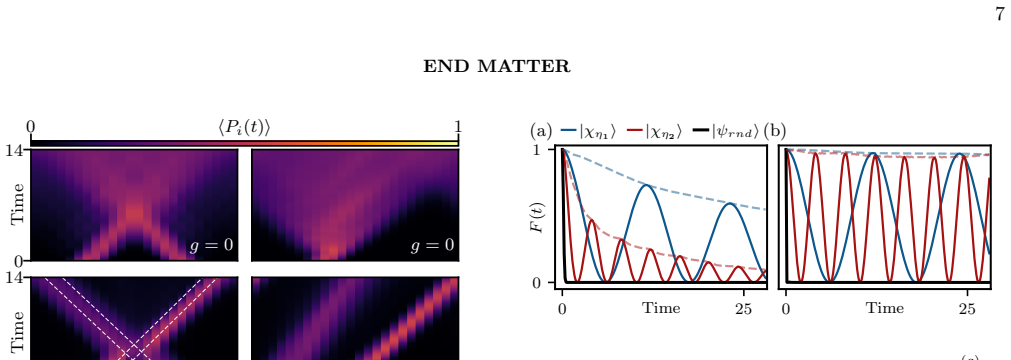
X. Cao, Quantum quenches that resemble operator growth (2026), arXiv:2605.xxxxx [quant-ph]. 7 END MA TTER 0 14 Time g = 0 g = 0 1 24Site 0 14 Time g = 10 1 24Site g = 10 0 1⟨Pi(t)⟩ FIG. 4. Dynamics of quasiparticles under time evolution with H (g) PX. (Top) Evolution without suppression ( g = 0). In the left panel, the initial state |χα,β⟩ is the same as ...
work page 2026
discussion (0)
Sign in with ORCID, Apple, or X to comment. Anyone can read and Pith papers without signing in.