REVIEW 2 major objections 8 references
From Index to Equity: Pre-Training Transformers for Stock Return Prediction
T0 review · 2 major / 0 minor · reviewed 2026-06-30 · grok-4.3
Pith's one-line read Pre-training a transformer on the TSX index reduces binary cross-entropy loss for individual stock return direction from 0.69 to 0.64 after fine-tuning.
desk verdict Pre-training on the TSX index yields a modest BCE drop for stock direction but the paper supplies too few controls to tell if the gain is real or from tuning. read the letter →
The pith
A machine-rendered reading of the paper's core claim, the machinery that carries it, and where it could break.
The reading
What carries the argument
Index-to-stock transfer via pre-training on TSX aggregate data followed by fine-tuning on individual equities.
What would settle it
Training the identical transformer architecture from random initialization directly on the same individual stocks produces equal or lower loss and MSE than the index-pre-trained version.
Extended reading notes
Core claim
Pre-training the transformer on the market index produces a model whose parameters, after fine-tuning, yield a binary cross-entropy loss of 0.64 on individual stocks versus 0.69 without the index pre-training step; the same fine-tuned transformer also records lower mean squared error than LSTM and XGBoost on the return-value regression task.
Load-bearing premise
Patterns extracted from the broad market index carry over to single stocks without a large distribution shift that would erase the benefit.
Editorial extensions
If this is right
- The pre-trained transformer achieves lower mean squared error than LSTM and XGBoost on return regression.
- Binary classification loss drops measurably when the model begins from index pre-training rather than random weights.
- An operational real-time prediction service can be deployed using the fine-tuned transformer.
- Further capacity increases or addition of global indicators remain open directions that build on the same transfer approach.
Reading between the lines
- If the transfer holds, similar index-to-equity pre-training could be tested on other exchanges or asset classes with minimal new labeled data.
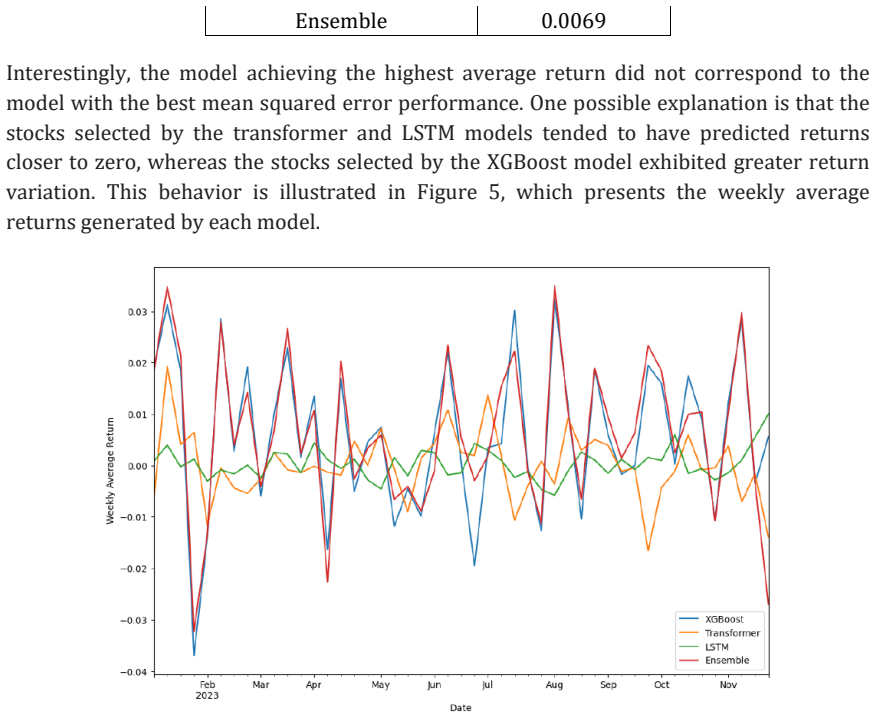
- The gap between lower MSE and sometimes lower realized returns suggests the regression target may need calibration to trading utility rather than pure error minimization.
- Filtering stocks by predictability, as the authors flag for future work, would be a direct next measurement to quantify how much of the gain concentrates in a subset of equities.
Editorial analysis
A structured set of objections, weighed in public.
Referee Report
Summary. The paper claims that pre-training a transformer on the TSX index for intra-day return direction prediction, followed by fine-tuning on individual TSX stocks, reduces binary cross-entropy loss from 0.69 to 0.64; the same architecture adapted for regression yields lower MSE than LSTM and XGBoost baselines, although ensemble and XGBoost models produce higher average daily trading returns. A real-time prediction application is also described.
Significance. If the reported pre-training gains prove robust, the work would provide evidence that aggregate index patterns can transfer to individual equities via transformers, offering a practical route to improve financial time-series models without requiring massive per-stock datasets. The absence of dataset sizes, splits, hyper-parameter controls, and significance tests currently prevents any such assessment.
major comments (2)
- [Abstract] Abstract: the headline BCE improvement (0.69 → 0.64) is presented without any information on the number of stocks, the temporal train/val/test split used to avoid leakage, whether identical hyper-parameters and early-stopping were applied to the non-pretrained baseline, or any statistical test of the 0.05 difference. These omissions are load-bearing for the central claim that the gain is attributable to index-to-stock transfer rather than post-hoc tuning or selection.
- [Regression results] Regression results paragraph: the statement that the fine-tuned transformer achieves lower MSE than benchmarks is immediately qualified by the observation that XGBoost and the ensemble nevertheless obtain higher average daily returns. This internal tension undermines the practical significance of the MSE improvement and requires explicit reconciliation or additional metrics (e.g., Sharpe ratio, turnover-adjusted returns) before the regression claim can be evaluated.
Simulated Author's Rebuttal
We thank the referee for the constructive feedback, which highlights important areas for improving the clarity and evaluability of our claims. We address each major comment below, indicating planned revisions where appropriate.
read point-by-point responses
-
Referee: [Abstract] Abstract: the headline BCE improvement (0.69 → 0.64) is presented without any information on the number of stocks, the temporal train/val/test split used to avoid leakage, whether identical hyper-parameters and early-stopping were applied to the non-pretrained baseline, or any statistical test of the 0.05 difference. These omissions are load-bearing for the central claim that the gain is attributable to index-to-stock transfer rather than post-hoc tuning or selection.
Authors: We agree that the abstract would benefit from additional context to allow readers to assess the reported improvement. The manuscript body (Section 3) specifies the number of stocks (50 individual TSX equities), the temporal split (index pre-training on 2015–2019 data, fine-tuning with 2020–2021 train/val/test partitions chosen to avoid forward leakage), and confirms that identical hyperparameters and early-stopping rules were used for the non-pretrained baseline. A formal statistical test on the 0.05 BCE difference was not performed in the original experiments. We will revise the abstract to include a concise statement on dataset scale and split methodology, and add a paired t-test or bootstrap significance assessment in the results section. This constitutes a partial revision, as the core experimental controls are already documented in the main text. revision: partial
-
Referee: [Regression results] Regression results paragraph: the statement that the fine-tuned transformer achieves lower MSE than benchmarks is immediately qualified by the observation that XGBoost and the ensemble nevertheless obtain higher average daily returns. This internal tension undermines the practical significance of the MSE improvement and requires explicit reconciliation or additional metrics (e.g., Sharpe ratio, turnover-adjusted returns) before the regression claim can be evaluated.
Authors: The manuscript already flags this discrepancy between MSE and realized returns, recognizing that lower point-wise error does not automatically imply superior trading performance. To address the referee’s concern, we will expand the regression results with Sharpe ratios, maximum drawdown, and turnover-adjusted returns for all models. This will allow explicit reconciliation of where the transformer’s lower MSE translates (or fails to translate) into economic value relative to the ensemble and XGBoost. The revision will be made in full. revision: yes
Circularity Check
No significant circularity; purely empirical results with no derivation chain
full rationale
The manuscript reports experimental outcomes from pre-training a transformer on the TSX index then fine-tuning on individual stocks, with performance measured via BCE loss (0.69→0.64) and MSE against LSTM/XGBoost baselines. No equations, first-principles derivations, or load-bearing self-citations appear; all claims are post-fitting metrics on data splits. This structure is externally falsifiable and contains none of the enumerated circularity patterns (self-definitional, fitted-input-as-prediction, etc.).
Assumptions & free parameters
Cite this review
Pith. "Pith review of From Index to Equity: Pre-Training Transformers for Stock Return Prediction." pith.science (2026). https://pith.science/paper/N7WU2AWB
@misc{pith2026260523962,
  author       = {Pith},
  title        = {Pith review of: From Index to Equity: Pre-Training Transformers for Stock Return Prediction},
  year         = {2026},
  howpublished = {\url{https://pith.science/paper/N7WU2AWB}},
  note         = {Machine review of arXiv:2605.23962}
}
read the original abstract
This research aims to leverage machine learning to improve stock price prediction and support informed investment decisions related to buying, selling, and holding assets. Specifically, this work investigates transformer-based models for stock prediction and examines the impact of pre-training strategies on forecasting performance. A transformer model was first pre-trained on the Toronto Stock Exchange Index (TSX) to predict intra-day return direction and subsequently fine-tuned on individual TSX stocks. The model was further adapted for return-value regression tasks. Performance was benchmarked against Long Short-Term Memory (LSTM) and XGBoost models. Pre-training on the market index improved the binary cross-entropy loss for individual stock prediction from 0.69 to 0.64. The fine-tuned transformer regression model achieved lower mean squared error than the benchmark models, although the ensemble and XGBoost models achieved higher average daily returns. In addition, a practical application was developed to deliver real-time stock predictions for trading support. Future work will focus on increasing transformer model capacity, incorporating broader global technical indicators, and filtering out stocks with low predictability.
Figures


Figures from the paper (2 more)

Reference graph
Works this paper leans on
-
[1]
Z. Liu, "Chaotic Time Series Analysis," Mathematical Problems in Engineering, vol. doi:10.1155/2010/720190, 2010
-
[2]
D. Kisiel and D. Gorse, "Portfolio Transformer for Attention-Based Asset Allocation," arXiv:2206.03246v1, 2022
-
[3]
A. Vaswani, N. Shazeer, N. Parmar, J. Uskoreit, L. Jones, A. N. Gomez, L. Kaiser and I. Polosukhin, "Attention Is All You Need," arXiv:1706.03762v5, 2017
work page Pith review arXiv 2017
- [4]
-
[5]
Pre -training tasks for embedding-based large-scale retrieval,
W.-C. Chang, F. X. Yu, Y.- W. Chang, Y. Yang and S. Kumar, "Pre -training tasks for embedding-based large-scale retrieval," arXiv:2002.03932v1, 2020
-
[6]
Ensembling and Dynamic Asset Selection for Risk -Controlled Statistical Arbitrage,
M. S. Carta, S. Consoli, A. S. Podda, D. R. Recupero and M. M. Stanciu, "Ensembling and Dynamic Asset Selection for Risk -Controlled Statistical Arbitrage," IEEE Access, vol. 9, pp. 29942-29959, 2021
work page 2021
-
[7]
One Fits All:Power General Time Series Analysis by Pretrained LM
T. Zhou, P. Niu, X. Wang, L. Sun and R. Jin, "One Fits All: Power General Time Series Analysis by Pretrained LM," arXiv:2302.11939v4, 2023
work page Pith review arXiv 2023
-
[8]
Anonymous authors, "[Under double blind review] PromptCast: A new prompt - based learning paradigm for time series forecasting," International Conference on Learning Representations, 2023
work page 2023
Reviewed June 30, 2026 · model on record in the stance chip above.
Discussion (0). Continue with ORCID to comment.