Intent-Driven Computing: A Computational Model for Governed Autonomous Systems
Pith reviewed 2026-06-30 16:25 UTC · model grok-4.3
The pith
Reifying all effects as finite intent values shifts governance of autonomous systems from undecidable semantics to decidable data.
A machine-rendered reading of the paper's core claim, the machinery that carries it, and where it could break.
Core claim
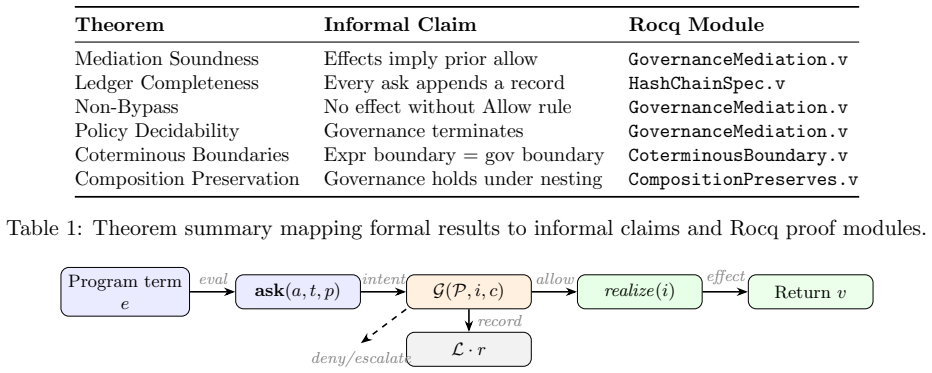
Intent-driven computing is defined by programs that produce only finite intent values, with a governed runtime that examines each intent against a decidable policy language, records every decision in a tamper-evident ledger, and realizes the effect only after approval. The language provides no alternative path to effects. By constraining the language so that every effectful interaction is reified as a finite intent value, governance shifts from the undecidable domain of program semantics to the decidable domain of intent data. This yields emergent properties including event sourcing by construction, governance simulation via intent replay, structural audit completeness, and improved human co
What carries the argument
Reification of every effectful action as a finite intent value, which moves all governance decisions onto decidable data.
If this is right
- Event sourcing occurs automatically because every action begins as a recorded intent.
- Governance policies can be tested by replaying recorded intents without executing live effects.
- Audit completeness follows directly from the requirement that all effects pass through the ledger.
- The approach applies only to properties decidable on finite data, consistent with Rice's theorem.
- The implementation compiles to the BEAM virtual machine and matches the formal specification under extensive testing.
Where Pith is reading between the lines
- Systems built this way could support regulatory compliance checks performed entirely on ledger data.
- Human operators might review proposed actions at the intent level before any runtime effect occurs.
- The model could be adapted to other runtime environments beyond BEAM if the intent reification constraint is preserved.
- Intent replay might allow offline simulation of governance outcomes for policy refinement.
Load-bearing premise
Every possible effectful action in an autonomous system can be represented as a finite intent value without unacceptable loss of expressiveness or functionality.
What would settle it
An autonomous system action whose necessary effect cannot be captured by any finite data value without losing required behavior or expressiveness.
Figures

read the original abstract
Programming languages assume programs directly execute effects. When autonomous systems generate behavior dynamically, this assumption becomes problematic: there is no structural mediation point between deciding to act and acting. We define intent-driven computing: a programming model where programs produce intents (finite data values describing proposed actions) rather than directly executing effects. A governed runtime examines each intent against a decidable policy language, records every decision in a tamper-evident ledger, and only then realizes the effect. The language provides no alternative path to effects. The model does not decide arbitrary behavioral properties of programs (which Rice's theorem shows is impossible). Instead, it constrains the language so that all effectful interaction is reified as finite intent values, shifting governance from the undecidable domain of program semantics to the decidable domain of intent data. This yields emergent properties: event sourcing by construction, governance simulation via intent replay, structural audit completeness, and improved human comprehensibility. We specify the model formally, implement it in a concrete language compiling to the BEAM virtual machine, and verify key properties in Rocq (454 theorems, 36 modules, zero admitted lemmas). Property-based testing (70,000+ random inputs, zero disagreements) validates that the implementation matches the specification.
Editorial analysis
A structured set of objections, weighed in public.
Referee Report
Summary. The paper defines intent-driven computing as a programming model in which programs produce finite intent data values describing proposed actions instead of directly executing effects. A governed runtime evaluates each intent against a decidable policy, records the decision in a tamper-evident ledger, and only then realizes the effect. The model is specified formally, implemented in a language targeting the BEAM virtual machine, and key properties are verified in Rocq with 454 theorems across 36 modules (zero admitted lemmas) and validated with over 70,000 property-based tests (zero disagreements). It claims to shift governance to the decidable domain of intent data, yielding properties such as event sourcing by construction and structural audit completeness.
Significance. If the central claim holds, this work is significant for programming language design in autonomous systems, as it provides a structural way to make governance decidable without violating Rice's theorem by constraining the language to intent-based effects. The extensive machine-checked verification and property testing are notable strengths that lend credibility to the realizability of the model and its emergent properties.
minor comments (2)
- [Abstract] Abstract: the sentence beginning 'The model does not decide arbitrary behavioral properties' could be clarified by explicitly cross-referencing the section that states the language constraint (no alternative path to effects) to avoid any implication that the model attempts undecidable checks.
- The verification claims (454 theorems, 36 modules) are strong but would benefit from a brief table or list in the verification section enumerating the main properties proved (e.g., intent-only effects, ledger tamper-evidence) to make the machine-checked results more immediately usable by readers.
Simulated Author's Rebuttal
We thank the referee for their positive assessment of the manuscript and the recommendation to accept. The summary accurately captures the core model, formal verification, and emergent properties.
Circularity Check
No significant circularity identified
full rationale
The paper defines a language constraint that reifies effects as finite intents, then verifies the resulting decidability and emergent properties (event sourcing, audit completeness) via an independent Rocq formalization (454 theorems, zero admitted lemmas) and property-based testing on 70k+ inputs with zero disagreements. No equations reduce results to fitted parameters or self-referential definitions; the 'by construction' properties are explicitly stated as consequences of the language restriction rather than derived predictions. The central claim does not rely on self-citations or imported uniqueness theorems. The derivation chain is self-contained against external benchmarks.
Axiom & Free-Parameter Ledger
axioms (1)
- standard math Rice's theorem establishes that arbitrary behavioral properties of programs are undecidable.
invented entities (1)
-
intent (finite data value describing proposed action)
no independent evidence
Reference graph
Works this paper leans on
-
[1]
doi: 10.1109/LICS.2003.1210062. James P. Anderson. Computer security technology planning study. InTechnical Report ESD-TR- 73-51,
-
[2]
Constitutional AI: Harmlessness from AI Feedback
Yuntao Bai, Saurav Kadavath, Sandipan Kundu, Amanda Askell, Jackson Kernion, Andy Jones, Anna Chen, Anna Goldie, Azalia Mirhoseini, Cameron McKinnon, et al. Constitutional AI: Harmlessness from AI feedback.arXiv preprint arXiv:2212.08073,
work page internal anchor Pith review Pith/arXiv arXiv
-
[3]
doi: 10.1016/j.jlamp.2014. 02.001. Peter Buneman, Sanjeev Khanna, and Wang-Chiew Tan. Why and where: A characterization of data provenance. pages 316–330,
-
[4]
doi: 10.1007/3-540-44503-X
-
[5]
doi: 10.1145/2898442.2898444. Jack B. Dennis and Earl C. Van Horn. Programming semantics for multiprogrammed computations. Communications of the ACM, 9(3):143–155,
-
[6]
doi: 10.1145/365230.365252. Martin Fowler. Event sourcing. https://martinfowler.com/eaaDev/EventSourcing.html,
-
[7]
Oleg Kiselyov and Hiromi Ishii
doi: 10.1145/3062341.3062363. Oleg Kiselyov and Hiromi Ishii. Freer monads, more extensible effects. InProceedings of the 2015 ACM SIGPLAN Symposium on Haskell, pages 94–105,
-
[8]
Ben Laurie, Adam Langley, and Emilia K¨ asper
doi: 10.1145/2804302.2804319. Ben Laurie, Adam Langley, and Emilia K¨ asper. Certificate transparency. InRFC 6962,
-
[9]
Martin Leucker and Christian Schallhart
doi: 10.1145/3009837.3009872. Martin Leucker and Christian Schallhart. A brief account of runtime verification.The Journal of Logic and Algebraic Programming, 78(5):293–303,
-
[10]
Paul Blain Levy.Call-By-Push-Value: A Functional/Imperative Synthesis
doi: 10.1016/j.jlap.2008.08.004. Paul Blain Levy.Call-By-Push-Value: A Functional/Imperative Synthesis. Semantics Structures in Computation. Springer,
-
[11]
doi: 10.1007/978-94-007-0954-6. Alan L. McCann. Effect-transparent governance for AI workflow architectures: Semantic preservation, expressive minimality, and decidability boundaries.arXiv preprint arXiv:2605.01030, 2026a. Alan L. McCann. Mechanized foundations of structural governance: Machine-checked proofs for governed intelligence.arXiv preprint arXiv...
work page internal anchor Pith review Pith/arXiv arXiv doi:10.1007/978-94-007-0954-6
-
[12]
Handlers of algebraic effects
Gordon Plotkin and Matija Pretnar. Handlers of algebraic effects. InProgramming Languages and Systems (ESOP 2009), volume 5502 ofLNCS, pages 80–94. Springer,
2009
-
[13]
Traian Rebedea, Razvan Dinu, Makesh Sreedhar, Christopher Parisien, and Jonathan Cohen. Nemo guardrails: A toolkit for controllable and safe LLM applications with programmable rails.arXiv preprint arXiv:2310.10501,
-
[14]
doi: 10.2307/1990888. Andrei Sabelfeld and Andrew C. Myers. Language-based information-flow security.IEEE Journal on Selected Areas in Communications, 21(1):5–19,
-
[15]
doi: 10.1109/JSAC.2002.806121. 18
discussion (0)
Sign in with ORCID, Apple, or X to comment. Anyone can read and Pith papers without signing in.