fMRI-Diffusion: Generating fMRI Time Series Via a Temporal Transformer Diffusion Model for Major Depressive Disorder Diagnosis
Pith reviewed 2026-06-30 16:28 UTC · model grok-4.3
The pith
Synthesizing fMRI time series with a temporal transformer diffusion model improves MDD diagnostic accuracy when used for data augmentation.
A machine-rendered reading of the paper's core claim, the machinery that carries it, and where it could break.
Core claim
A temporal transformer placed inside a denoising diffusion probabilistic model, after supervised pretraining, produces synthetic fMRI time series whose derived functional connectivity matrices augment training data and raise MDD classification accuracy by up to 3.7 points over strong FC-based baselines while keeping distributional fidelity metrics below 0.06.
What carries the argument
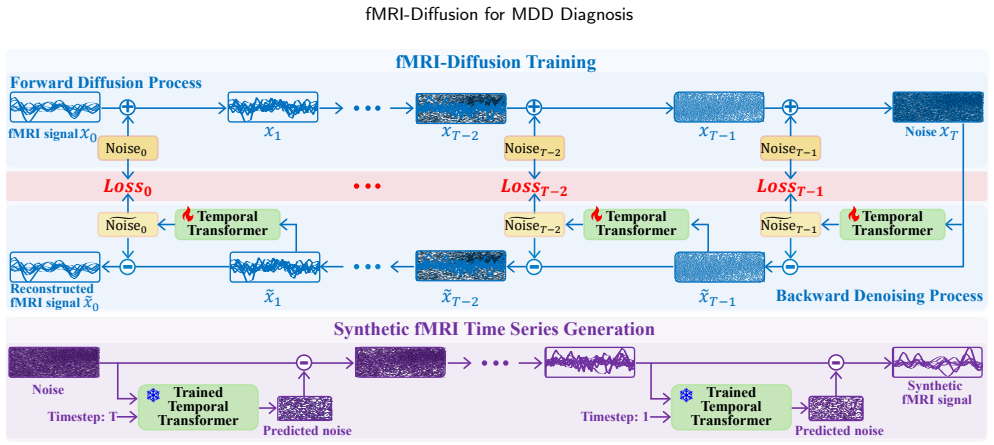
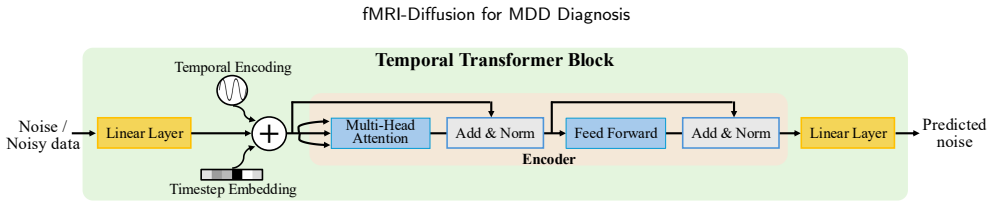
The Temporal Transformer denoising network inside the diffusion model, which treats each time point as a token and applies self-attention to capture temporal dependencies before FC matrices are computed from the output series.
If this is right
- Augmenting with the generated time series beats five recent FC-matrix synthesis methods on the same dataset and evaluation protocol.
- The gains hold across ten different classifiers and six different brain parcellation atlases.
- Ablation tests show both the transformer architecture and the supervised pretraining step contribute to the observed improvements.
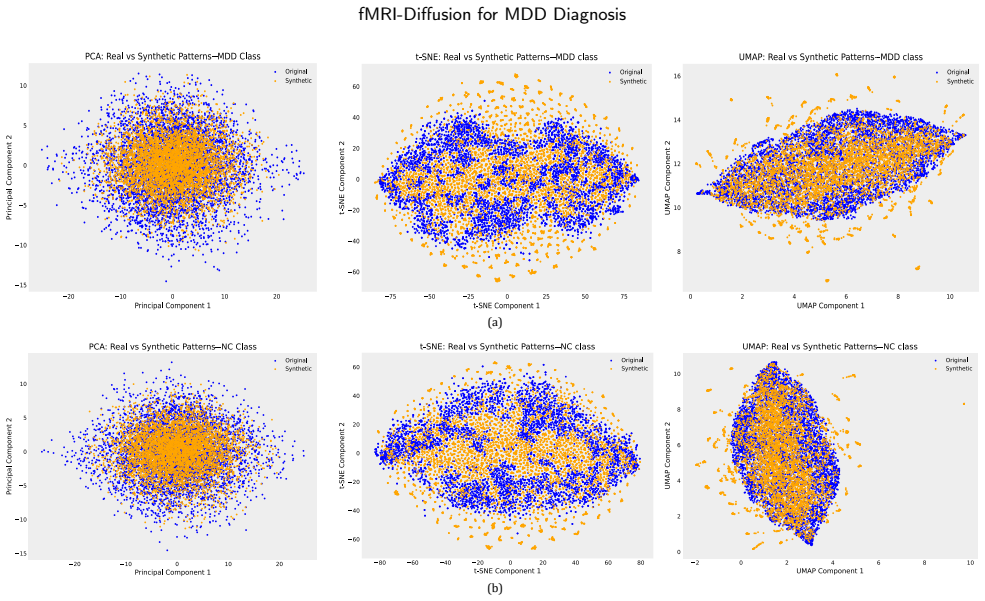
- The synthetic series maintain close distributional agreement with real data as measured by multiple fidelity metrics.
Where Pith is reading between the lines
- The same time-series synthesis step could be tested on other psychiatric conditions that also rely on fMRI connectivity for diagnosis under small-sample regimes.
- One could measure whether the generated series improve performance when the downstream task is changed from binary MDD diagnosis to severity regression or treatment-response prediction.
Load-bearing premise
That accuracy gains measured on augmented training sets from the REST-meta-MDD dataset will appear on new clinical scans without introducing artifacts or shifts that reduce real diagnostic value.
What would settle it
Running the same classifiers on an independent clinical fMRI collection drawn from scanners and sites outside the original three acquisition centers and checking whether the synthetic-augmented models still outperform the unaugmented and matrix-only baselines.
Figures
read the original abstract
Diagnosing Major Depressive Disorder (MDD) from functional magnetic resonance imaging (fMRI) using functional connectivity (FC) analysis requires large amounts of labeled data that are scarce in clinical settings. Existing augmentation methods synthesize FC matrices, which compress fMRI recordings into static pairwise summaries and discard temporal information. We propose fMRI-Diffusion, a framework that synthesizes region-of-interest (ROI)-level fMRI time series rather than FC matrices. A Temporal Transformer serves as the denoising network within a denoising diffusion probabilistic model, treating each time point as a token to capture temporal dependencies through self-attention. A supervised pretraining strategy initializes the Transformer with task-relevant representations before diffusion training, and FC matrices are derived from the synthesized time series for classification. Experiments on the REST-meta-MDD dataset show that augmenting training data with synthetic time series consistently improves diagnostic accuracy across ten classifiers, six parcellation atlases, and three acquisition sites. The method outperforms five recent FC-based synthesis approaches, with accuracy gains of up to 3.7 percentage points over the strongest baseline. Ablation studies confirm the contributions of both the Transformer-based denoiser and the pretraining strategy. Distributional fidelity metrics remain below 0.06 across all conditions, indicating close agreement between real and synthetic distributions. These findings suggest that synthesizing fMRI time series before FC computation preserves temporal information lost in matrix-level augmentation and provides a practical strategy for MDD diagnosis under limited data.
Editorial analysis
A structured set of objections, weighed in public.
Referee Report
Summary. The manuscript introduces fMRI-Diffusion, a denoising diffusion probabilistic model whose denoiser is a Temporal Transformer that treats time points as tokens to synthesize ROI-level fMRI time series. Synthetic series are converted to FC matrices and used to augment limited labeled data for MDD classification. On the REST-meta-MDD dataset the approach yields accuracy gains of up to 3.7 percentage points over five recent FC-matrix synthesis baselines across ten classifiers, six parcellation atlases and three acquisition sites; distributional fidelity metrics remain below 0.06 and ablations attribute gains to the transformer architecture and supervised pretraining.
Significance. If the reported gains prove robust, the work offers a practical route to data augmentation that retains temporal structure lost when synthesizing FC matrices directly. The breadth of the evaluation (multiple classifiers, atlases and sites) supplies evidence that the benefit is not confined to a single experimental configuration. The absence of any external-cohort validation, however, limits the immediate clinical significance; the result remains an in-distribution demonstration on a single public dataset.
major comments (2)
- [Experiments] Experiments section: accuracy gains up to 3.7 pp are stated without reported p-values, confidence intervals or correction for multiple comparisons across the ten classifiers and six atlases; this information is required to substantiate the claim of 'consistent' improvement.
- [Methods] Methods section: the supervised pretraining objective and the precise task used to initialize the Temporal Transformer are described at a high level only; without the loss formulation or the amount of labeled data used for pretraining it is impossible to assess how much of the final performance is attributable to this step versus the diffusion training itself.
minor comments (1)
- [Abstract] Abstract: the distributional fidelity metric is reported only as 'below 0.06' without naming the distance (MMD, Wasserstein, etc.) or the precise features on which it is computed.
Simulated Author's Rebuttal
We thank the referee for the constructive comments, which help strengthen the manuscript. We address each major point below and will revise accordingly.
read point-by-point responses
-
Referee: [Experiments] Experiments section: accuracy gains up to 3.7 pp are stated without reported p-values, confidence intervals or correction for multiple comparisons across the ten classifiers and six atlases; this information is required to substantiate the claim of 'consistent' improvement.
Authors: We agree that statistical rigor is essential to support the claim of consistent improvement. In the revised manuscript we will add p-values (using paired Wilcoxon signed-rank tests on the per-fold accuracies), 95% confidence intervals, and Bonferroni correction for the 60 comparisons (10 classifiers × 6 atlases). Updated tables and text will report these statistics. revision: yes
-
Referee: [Methods] Methods section: the supervised pretraining objective and the precise task used to initialize the Temporal Transformer are described at a high level only; without the loss formulation or the amount of labeled data used for pretraining it is impossible to assess how much of the final performance is attributable to this step versus the diffusion training itself.
Authors: We acknowledge the description is high-level. The pretraining attaches a linear classification head to the Temporal Transformer and optimizes cross-entropy loss on the MDD binary label using the labeled training subjects from REST-meta-MDD. We will expand the Methods section with the exact loss equation, head architecture, and the precise number of labeled subjects used for pretraining (distinct from the diffusion-stage data) so readers can evaluate its contribution. revision: yes
Circularity Check
No circularity: empirical augmentation results are independent of fitted parameters
full rationale
The paper proposes a temporal transformer diffusion model to synthesize ROI-level fMRI time series, derives FC matrices from them, and reports accuracy gains (up to 3.7 pp) when augmenting classifiers on REST-meta-MDD. These are direct experimental outcomes measured on held-out real data splits across 10 classifiers, 6 atlases, and 3 sites. No equations, uniqueness theorems, or self-citations are invoked to derive the performance numbers; the gains are not forced by construction from any fitted input or prior author work. Distributional fidelity (<0.06) is reported as a separate check but does not define the accuracy metric. The evaluation is self-contained against external benchmarks.
Axiom & Free-Parameter Ledger
free parameters (2)
- diffusion model hyperparameters
- pretraining objective weights
axioms (1)
- domain assumption Self-attention over time-point tokens captures clinically relevant temporal dependencies in fMRI signals
Reference graph
Works this paper leans on
-
[1]
Mark L Vickers, Hong Yin Chan, Stephen Elliott, Sarangan Ketheesan, Vinay Ramineni, Lars Eriksson, Kirsten McMahon, Be- linda Oddy, and James G Scott. Stimulant medications in the management of bulimia nervosa and anorexia nervosa in patients with and without comorbid attention deficit hyperactivity disorder: A systematic review.Eating Behaviors, page 101...
2024
-
[2]
Unveiling the interoception impairment in various majordepressivedisorderstages.CNSNeuroscience&Therapeutics, 30:e14923, 2024
Hongliang Zhou, Jikang Liu, Yuqing Wu, Zixuan Huang, Wenliang Wang, Yuhang Ma, Haohao Zhu, Zhenhe Zhou, Jun Wang, and Chenguang Jiang. Unveiling the interoception impairment in various majordepressivedisorderstages.CNSNeuroscience&Therapeutics, 30:e14923, 2024. ISSN 1755-5930
2024
-
[3]
AmirQaseem,DouglasKOwens,ItziarEtxeandia-Ikobaltzeta,Janice Tufte, J Thomas Cross Jr, Timothy J Wilt, and Clinical Guide- lines Committee of the American College of Physicians. Nonphar- macologicand pharmacologictreatments ofadultsin theacute phase of major depressive disorder: a living clinical guideline from the american college of physicians.Annals of ...
2023
-
[4]
Applicationsoffunctionalmag- netic resonance imaging to the study of functional connectivity and activation in neurological disease: a scoping review of the literature
Sandra Leskinen, Souvik Singha, Neel H Mehta, Mica Quelle, Har- shalAShah,andRandySD’Amico. Applicationsoffunctionalmag- netic resonance imaging to the study of functional connectivity and activation in neurological disease: a scoping review of the literature. World Neurosurgery, 2024. ISSN 1878-8750
2024
-
[5]
Characterization of the blood oxygen level dependent hemodynamic response function in human subcortical regions with high spatiotemporal resolution
Jung Hwan Kim, Amanda J Taylor, Marc Himmelbach, Gisela E Hagberg, Klaus Scheffler, and David Ress. Characterization of the blood oxygen level dependent hemodynamic response function in human subcortical regions with high spatiotemporal resolution. Frontiers in Neuroscience, 16:1009295, 2022. ISSN 1662-453X
2022
-
[6]
Convolutional neural networkwithsparsestrategiestoclassifydynamicfunctionalconnec- tivity.IEEEJournalofBiomedicalandHealthInformatics,26:1219– 1228, 2021
Junzhong Ji, Zhihui Chen, and Cuicui Yang. Convolutional neural networkwithsparsestrategiestoclassifydynamicfunctionalconnec- tivity.IEEEJournalofBiomedicalandHealthInformatics,26:1219– 1228, 2021. ISSN 2168-2194
2021
-
[7]
A novel cnn framework to extract multi- levelmodularfeaturesfortheclassificationofbrainnetworks.Applied Intelligence, pages 1–18, 2022
Junzhong Ji and Yao Yao. A novel cnn framework to extract multi- levelmodularfeaturesfortheclassificationofbrainnetworks.Applied Intelligence, pages 1–18, 2022. ISSN 0924-669X
2022
-
[8]
The classification of brain network for major depressive disorder patients based on deep graph convolutionalneuralnetwork.FrontiersinHumanNeuroscience,17: 1094592, 2023
Manyun Zhu, Yu Quan, and Xuan He. The classification of brain network for major depressive disorder patients based on deep graph convolutionalneuralnetwork.FrontiersinHumanNeuroscience,17: 1094592, 2023. ISSN 1662-5161
2023
-
[9]
fmri functional connectivity augmentation usingconvolutionalgenerativeadversarialnetworksforbraindisorder classification
Yee-Fan Tan, Chee-Ming Ting, Fuad Noman, Raphaël C-W Phan, and Hernando Ombao. fmri functional connectivity augmentation usingconvolutionalgenerativeadversarialnetworksforbraindisorder classification. In2024IEEEInternationalSymposiumonBiomedical Imaging (ISBI), pages 1–5. IEEE, 2024. ISBN 9798350313338
2024
-
[10]
A weighted patient network- based framework for predicting chronic diseases using graph neural networks.Scientific reports, 11:22607, 2021
Haohui Lu and Shahadat Uddin. A weighted patient network- based framework for predicting chronic diseases using graph neural networks.Scientific reports, 11:22607, 2021. ISSN 2045-2322
2021
-
[11]
Graph-based con- ditional generative adversarial networks for major depressive dis- order diagnosis with synthetic functional brain network generation
Ji-Hye Oh, Deok-Joong Lee, Chang-Hoon Ji, Dong-Hee Shin, Ji- Wung Han, Young-Han Son, and Tae-Eui Kam. Graph-based con- ditional generative adversarial networks for major depressive dis- order diagnosis with synthetic functional brain network generation. IEEE journal of biomedical and health informatics, 28(3):1504– 1515, 2023
2023
-
[12]
Multivariate information theory uncovers synergistic subsystems of the human cerebral cortex.Communications biology, 6:451, 2023
Thomas F Varley, Maria Pope, Joshua Faskowitz, and Olaf Sporns. Multivariate information theory uncovers synergistic subsystems of the human cerebral cortex.Communications biology, 6:451, 2023. ISSN 2399-3642
2023
-
[13]
Higher-order organization in the human brain from matrix-basedrényi’sentropy
Qiang Li, Shujian Yu, Kristoffer H Madsen, Vince D Calhoun, and Armin Iraji. Higher-order organization in the human brain from matrix-basedrényi’sentropy. In2023IEEEInternationalConference onAcoustics,Speech,andSignalProcessingWorkshops(ICASSPW), pages 1–5. IEEE, 2023. ISBN 9798350302615
2023
-
[14]
Denoising diffusion probabilistic models.Advances in neural information processing systems, 33:6840–6851, 2020
Jonathan Ho, Ajay Jain, and Pieter Abbeel. Denoising diffusion probabilistic models.Advances in neural information processing systems, 33:6840–6851, 2020
2020
-
[15]
Functional brain network identification and fmri augmentation using a vae-gan framework.Computers in Biology and Medicine, 165:107395, 2023
Ning Qiang, Jie Gao, Qinglin Dong, Huiji Yue, Hongtao Liang, Lili Liu, Jingjing Yu, Jing Hu, Shu Zhang, and Bao Ge. Functional brain network identification and fmri augmentation using a vae-gan framework.Computers in Biology and Medicine, 165:107395, 2023. ISSN 0010-4825
2023
-
[16]
Fmri data augmentation via synthesis
PeiyeZhuang,AlexanderGSchwing,andOluwasanmiKoyejo. Fmri data augmentation via synthesis. In2019 IEEE 16th international symposium on biomedical imaging (ISBI 2019), pages 1783–1787. IEEE, 2019. ISBN 1538636417
2019
-
[17]
Brain- netgan: Data augmentation of brain connectivity using generative adversarialnetworkfordementiaclassification.InMICCAIWorkshop on Deep Generative Models, pages 103–111
Chao Li, Yiran Wei, Xi Chen, and Carola-Bibiane Schönlieb. Brain- netgan: Data augmentation of brain connectivity using generative adversarialnetworkfordementiaclassification.InMICCAIWorkshop on Deep Generative Models, pages 103–111. Springer, 2021
2021
-
[18]
Improving brain dysfunction prediction by gan: A functional-connectivity generator approach
DaYan,ShengbinWu,MirzaTanzimSami,AbdullateefAlmudaifer, ZheJiang,HaiquanChen,DRangaprakash,GopikrishnaDeshpande, and Yueen Ma. Improving brain dysfunction prediction by gan: A functional-connectivity generator approach. In2021 IEEE Interna- tional Conference on Big Data (Big Data), pages 1514–1522. IEEE,
-
[19]
Conditional gans with auxiliary discriminative classifier
Liang Hou, Qi Cao, Huawei Shen, Siyuan Pan, Xiaoshuang Li, and Xueqi Cheng. Conditional gans with auxiliary discriminative classifier. InInternational Conference on Machine Learning, pages 8888–8902. PMLR, 2022. ISBN 2640-3498. M.A. Hasan et al.:Preprint submitted to ElsevierPage 12 of 13 fMRI-Diffusion for MDD Diagnosis
2022
-
[20]
At- tention is all you need.Advances in neural information processing systems, 30, 2017
AshishVaswani,NoamShazeer,NikiParmar,JakobUszkoreit,Llion Jones, Aidan N Gomez, Łukasz Kaiser, and Illia Polosukhin. At- tention is all you need.Advances in neural information processing systems, 30, 2017
2017
-
[21]
Scalable diffusion models with transformers
William Peebles and Saining Xie. Scalable diffusion models with transformers. InProceedings of the IEEE/CVF international confer- ence on computer vision, pages 4195–4205, 2023
2023
-
[22]
Denoisingpre- trainingforsemanticsegmentation
Emmanuel Asiedu Brempong, Simon Kornblith, Ting Chen, Niki Parmar,MatthiasMinderer,andMohammadNorouzi. Denoisingpre- trainingforsemanticsegmentation. InProceedingsoftheIEEE/CVF conference on computer vision and pattern recognition, pages 4175– 4186, 2022
2022
-
[23]
De- noisingdiffusionautoencodersareunifiedself-supervisedlearners
Weilai Xiang, Hongyu Yang, Di Huang, and Yunhong Wang. De- noisingdiffusionautoencodersareunifiedself-supervisedlearners. In ProceedingsoftheIEEE/CVFInternationalConferenceonComputer Vision, pages 15802–15812, 2023
2023
-
[24]
The direct consortium and the rest-meta- mdd project: towards neuroimaging biomarkers of major depressive disorder.Psychoradiology, 2:32–42, 2022
Xiao Chen, Bin Lu, Hui-Xian Li, Xue-Ying Li, Yu-Wei Wang, Francisco Xavier Castellanos, Li-Ping Cao, Ning-Xuan Chen, Wei Chen, and Yu-Qi Cheng. The direct consortium and the rest-meta- mdd project: towards neuroimaging biomarkers of major depressive disorder.Psychoradiology, 2:32–42, 2022. ISSN 2634-4416
2022
-
[25]
pipeline
Chaogan Yan and Yufeng Zang. Dparsf: a matlab toolbox for" pipeline" data analysis of resting-state fmri.Frontiers in systems neuroscience, 4:1377, 2010. ISSN 1662-5137
2010
-
[26]
Using graph convolutional network to characterize individuals with major depressivedisorderacrossmultipleimagingsites.EBioMedicine,78,
Kun Qin, Du Lei, Walter H L Pinaya, Nanfang Pan, Wenbin Li, Ziyu Zhu, John A Sweeney, Andrea Mechelli, and Qiyong Gong. Using graph convolutional network to characterize individuals with major depressivedisorderacrossmultipleimagingsites.EBioMedicine,78,
-
[27]
JianlongZhao,JinjieHuang,DongmeiZhi,WeizhengYan,Xiaohong Ma, Xiao Yang, Xianbin Li, Qing Ke, Tianzi Jiang, and Vince D Calhoun. Functional network connectivity (fnc)-based generative adversarial network (gan) and its applications in classification of mental disorders.Journal of neuroscience methods, 341:108756,
-
[28]
Spectral graphneuralnetwork-basedmulti-atlasbrainnetworkfusionformajor depressive disorder diagnosis.IEEE Journal of Biomedical and Health Informatics, 2024
Deok-Joong Lee, Dong-Hee Shin, Young-Han Son, Ji-Wung Han, Ji- Hye Oh, Da-Hyun Kim, Ji-Hoon Jeong, and Tae-Eui Kam. Spectral graphneuralnetwork-basedmulti-atlasbrainnetworkfusionformajor depressive disorder diagnosis.IEEE Journal of Biomedical and Health Informatics, 2024. ISSN 2168-2194
2024
-
[29]
Graph autoencoders for embedding learning in brain networks and major depressive disorder identification.IEEE Journal of Biomedical and Health Informatics, 2024
FuadNoman,Chee-MingTing,HakmookKang,RaphaëlC-WPhan, and Hernando Ombao. Graph autoencoders for embedding learning in brain networks and major depressive disorder identification.IEEE Journal of Biomedical and Health Informatics, 2024. ISSN 2168- 2194
2024
-
[30]
Graph neural network with modular attention for identifying brain disorders.Biomedical Signal Processing and Control, 102:107252,
Wei Si, Guangyu Wang, Lei Liu, Limei Zhang, and Lishan Qiao. Graph neural network with modular attention for identifying brain disorders.Biomedical Signal Processing and Control, 102:107252,
-
[31]
Dsam: A deep learning framework for analyzing temporal and spatial dynamics in brain networks.Medical Image Analysis, page 103462, 2025
Bishal Thapaliya, Robyn Miller, Jiayu Chen, Yu Ping Wang, Esra Akbas,RamSapkota,BhaskarRay,PranavSuresh,SantoshGhimire, Vince D Calhoun, et al. Dsam: A deep learning framework for analyzing temporal and spatial dynamics in brain networks.Medical Image Analysis, page 103462, 2025
2025
-
[32]
Con- volutional neural networks on graphs with fast localized spectral filtering.Advances in neural information processing systems, 29, 2016
MichaëlDefferrard,XavierBresson,andPierreVandergheynst. Con- volutional neural networks on graphs with fast localized spectral filtering.Advances in neural information processing systems, 29, 2016
2016
-
[33]
Brainnetcnn: Convolutional neural networks for brain networks; to- wards predicting neurodevelopment.NeuroImage, 146:1038–1049,
Jeremy Kawahara, Colin J Brown, Steven P Miller, Brian G Booth, Vann Chau, Ruth E Grunau, Jill G Zwicker, and Ghassan Hamarneh. Brainnetcnn: Convolutional neural networks for brain networks; to- wards predicting neurodevelopment.NeuroImage, 146:1038–1049,
-
[34]
Petar Veličković, Guillem Cucurull, Arantxa Casanova, Adriana Romero, Pietro Lio, and Yoshua Bengio. Graph attention networks. arXiv preprint arXiv:1710.10903, 2017
work page internal anchor Pith review Pith/arXiv arXiv 2017
-
[35]
How Powerful are Graph Neural Networks?
Keyulu Xu, Weihua Hu, Jure Leskovec, and Stefanie Jegelka. How powerful are graph neural networks?arXiv preprint arXiv:1810.00826, 2018
work page internal anchor Pith review Pith/arXiv arXiv 2018
-
[36]
Graph transformer networks.Advances in neural information processing systems, 32, 2019
Seongjun Yun, Minbyul Jeong, Raehyun Kim, Jaewoo Kang, and Hyunwoo J Kim. Graph transformer networks.Advances in neural information processing systems, 32, 2019
2019
-
[37]
Inductive repre- sentation learning on large graphs.Advances in neural information processing systems, 30, 2017
Will Hamilton, Zhitao Ying, and Jure Leskovec. Inductive repre- sentation learning on large graphs.Advances in neural information processing systems, 30, 2017
2017
-
[38]
ISSN 1053-8119
Edmund T Rolls, Chu-Chung Huang, Ching-Po Lin, Jianfeng Feng, andMarcJoliot.Automatedanatomicallabellingatlas3.Neuroimage, 206:116189, 2020. ISSN 1053-8119
2020
-
[39]
Gyriofthehumanneocortex: anmri-basedanalysisofvolumeandvariance.CerebralCortex(New York, NY: 1991), 8:372–384, 1998
David N Kennedy, Nicholas Lange, Nikos Makris, Julianna Bates, JamesMeyer,andVerneSCavinessJr. Gyriofthehumanneocortex: anmri-basedanalysisofvolumeandvariance.CerebralCortex(New York, NY: 1991), 8:372–384, 1998. ISSN 1460-2199
1991
-
[40]
A whole brain fmri atlas generated via spatially constrained spectral clustering.Human brain mapping, 33:1914–1928, 2012
R Cameron Craddock, G Andrew James, Paul E Holtzheimer III, Xiaoping P Hu, and Helen S Mayberg. A whole brain fmri atlas generated via spatially constrained spectral clustering.Human brain mapping, 33:1914–1928, 2012. ISSN 1065-9471
1914
-
[41]
Whole-brain anatomical networks: does the choice of nodes matter?Neuroimage, 50:970–983, 2010
Andrew Zalesky, Alex Fornito, Ian H Harding, Luca Cocchi, Murat Yücel, Christos Pantelis, and Edward T Bullmore. Whole-brain anatomical networks: does the choice of nodes matter?Neuroimage, 50:970–983, 2010. ISSN 1053-8119
2010
-
[42]
Spurious but systematic corre- lations in functional connectivity mri networks arise from subject motion.Neuroimage, 59:2142–2154, 2012
Jonathan D Power, Kelly A Barnes, Abraham Z Snyder, Bradley L Schlaggar, and Steven E Petersen. Spurious but systematic corre- lations in functional connectivity mri networks arise from subject motion.Neuroimage, 59:2142–2154, 2012. ISSN 1053-8119
2012
-
[43]
ISSN 0036-8075
NicoUFDosenbach,BinyamNardos,AlexanderLCohen,DamienA Fair,JonathanDPower,JessicaAChurch,StevenMNelson,GaganS Wig,AleciaCVogel,andChristinaNLessov-Schlaggar.Predictionof individualbrainmaturityusingfmri.Science,329:1358–1361,2010. ISSN 0036-8075
2010
-
[44]
Mm-gtunets: Unified multi-modal graph deep learning for brain disorders prediction.IEEE Transactions on Medical Imaging, 2025
Luhui Cai, Weiming Zeng, Hongyu Chen, Hua Zhang, Yueyang Li, Yu Feng, Hongjie Yan, Lingbin Bian, Wai Ting Siok, and Nizhuan Wang. Mm-gtunets: Unified multi-modal graph deep learning for brain disorders prediction.IEEE Transactions on Medical Imaging, 2025. M.A. Hasan et al.:Preprint submitted to ElsevierPage 13 of 13
2025
discussion (0)
Sign in with ORCID, Apple, or X to comment. Anyone can read and Pith papers without signing in.