Program Synthesis for Non-Linear Real Arithmetic: Going Beyond Realizability
Pith reviewed 2026-06-30 13:54 UTC · model grok-4.3
The pith
Synthesis from nonlinear real arithmetic specifications can produce programs that either output a solution or report none exists, even for unrealizable cases.
A machine-rendered reading of the paper's core claim, the machinery that carries it, and where it could break.
Core claim
The central claim is that synthesis from arbitrary NRA specifications over rationals is possible in the single-output case via a sound and complete algorithm that produces programs reporting non-existence when appropriate, while for realizable specifications a SyGuS-generated program over reals directly solves the rational version; the general multi-output case admits only a sound algorithm, as the problem is undecidable for loop-free programs and equivalent in hardness to a long-standing open problem in number theory.
What carries the argument
The sound and complete synthesis algorithm for single-output NRA specifications, which uses decision procedures for nonlinear real arithmetic satisfiability over the rationals to decide output existence and construct the program.
If this is right
- For realizable NRA specifications, existing SyGuS tools can be reused to obtain solutions that work correctly over rationals.
- The single-output algorithm provides both existence and non-existence reports, enabling synthesis from specifications that are not always realizable.
- The general algorithm remains sound for multiple outputs, guaranteeing that any program it produces is correct even if it misses some solvable cases.
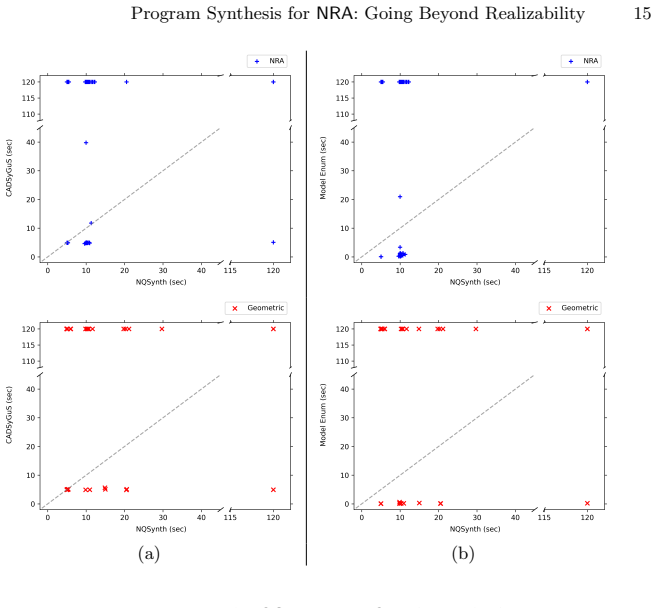
- Many previously unreachable benchmarks become solvable by the new approach even when specifications are made realizable.
Where Pith is reading between the lines
- The hardness reduction to an open number theory problem suggests that further progress on NRA synthesis may depend on advances in deciding rational points on varieties.
- The single-output completeness result could be tested for scalability by generating families of specifications with increasing degree or number of variables.
- The rational restriction avoids floating-point issues and may allow direct transfer of the technique to other decidable fragments of real arithmetic.
Load-bearing premise
Effective decision procedures exist for satisfiability of nonlinear real arithmetic formulas over the rationals.
What would settle it
A concrete single-output NRA specification over rationals on which the synthesis algorithm either fails to terminate with a correct program when one exists or outputs a program that produces an invalid result or fails to report non-existence on some input.
Figures
read the original abstract
We study the problem of synthesizing programs from nonlinear real arithmetic (NRA) specifications. Existing techniques, such as syntax-guided synthesis (SyGuS), fail to synthesize programs when the specification is unrealizable. We argue this is unsatisfactory in many situations, and aim to synthesize programs from arbitrary NRA specifications, such that for any input, the synthesized program either produces outputs satisfying the specification or reports non-existence of any such output. To avoid rounding errors inherent in floating-point arithmetic, we restrict our programs to work on rational inputs and outputs. We first show that our variant of the synthesis problem is as hard as a long-standing open problem in number theory, and that synthesizing loop-free programs from arbitrary NRA specifications with rational inputs and outputs is impossible in general. Second, we present a sound and complete synthesis algorithm for the case where the specification involves a single output variable. We also show that for realizable specifications, a program generated by SyGuS for NRA (real inputs and outputs) serves as a solution to our problem, where inputs and outputs are rationals. Third, we provide a sound (but necessarily incomplete) synthesis algorithm for the general case of specifications. We have implemented our approach in a prototype tool called NQSynth that solves many benchmarks beyond the reach of state-of-the-art SyGuS tools, even when we render the specifications realizable.
Editorial analysis
A structured set of objections, weighed in public.
Referee Report
Summary. The paper studies synthesis of programs from nonlinear real arithmetic (NRA) specifications over rational inputs/outputs, requiring the program to either produce a satisfying output or report non-existence. It proves the problem is as hard as an open number-theory question and that loop-free synthesis is impossible in general; presents a sound-and-complete algorithm for single-output specifications; shows that SyGuS solutions for realizable NRA specs over reals can be reused for the rational case; gives a sound but incomplete algorithm for the general case; and evaluates an implementation (NQSynth) that solves benchmarks beyond current SyGuS tools.
Significance. If the single-output algorithm is effective and the hardness result is tight, the work would meaningfully extend synthesis beyond realizability assumptions while staying inside rational arithmetic. The implementation and benchmark results constitute a concrete strength, as does the explicit reduction to an external open problem rather than an ad-hoc limitation.
major comments (2)
- [Abstract] Abstract: the soundness-and-completeness claim for the single-output case requires an effective decision procedure for NRA satisfiability over the rationals. The manuscript's own hardness reduction ties the general problem to an open question in number theory; without an explicit argument showing why the single-output fragment escapes this status (or a reduction that stays inside a known decidable fragment), the completeness claim is not yet supported.
- [Abstract] Abstract: the manuscript asserts soundness for the general-case algorithm and soundness/completeness for the single-output case, yet supplies no derivation, proof sketch, or error analysis for these claims. Because the central contribution is the existence of these algorithms, the absence of supporting reasoning is load-bearing.
minor comments (1)
- [Abstract] The abstract could more explicitly distinguish the single-output algorithm from the general-case algorithm and from the SyGuS reduction, to help readers locate the novel technical content.
Simulated Author's Rebuttal
We thank the referee for the careful review and constructive feedback on the abstract. We agree that the claims regarding soundness and completeness require explicit justification and supporting reasoning, which we will add in the revision.
read point-by-point responses
-
Referee: [Abstract] Abstract: the soundness-and-completeness claim for the single-output case requires an effective decision procedure for NRA satisfiability over the rationals. The manuscript's own hardness reduction ties the general problem to an open question in number theory; without an explicit argument showing why the single-output fragment escapes this status (or a reduction that stays inside a known decidable fragment), the completeness claim is not yet supported.
Authors: We agree that the abstract does not explicitly distinguish why the single-output fragment admits a complete algorithm. The full paper (Section 4) presents an algorithm that reduces single-output synthesis to a finite number of NRA satisfiability checks over Q, each involving only a single existentially quantified output variable; this fragment is handled by a decision procedure based on quantifier elimination for the existential theory of the reals (which remains effective when restricted to one output). The hardness reduction in Section 3 applies only to the multi-output case, which can encode arbitrary Diophantine equations. We will revise the abstract to include a one-sentence justification of this separation and add a short paragraph in Section 4 with the reduction details. revision: yes
-
Referee: [Abstract] Abstract: the manuscript asserts soundness for the general-case algorithm and soundness/completeness for the single-output case, yet supplies no derivation, proof sketch, or error analysis for these claims. Because the central contribution is the existence of these algorithms, the absence of supporting reasoning is load-bearing.
Authors: The referee is correct that the abstract provides no derivation or sketch. The body contains the full algorithms and proofs (Sections 4 and 5), but we acknowledge the abstract should convey the high-level reasoning. We will revise the abstract to include a brief outline: for the single-output case, completeness follows from exhaustive enumeration of candidate rational functions up to a degree bound derived from the specification, combined with a decision procedure for the resulting NRA queries; soundness of the general algorithm follows from a conservative over-approximation of non-realizability via interval arithmetic and Gröbner bases, with incompleteness explicitly noted due to the open hardness result. A short error analysis for the general case will also be added. revision: yes
Circularity Check
No circularity; claims reduce to external open problem rather than self-reference
full rationale
The paper explicitly reduces the general synthesis problem's hardness to a long-standing open question in number theory and states that loop-free synthesis is impossible in general, while presenting the single-output algorithm as a new construction whose completeness depends on an external (undecided) NRA satisfiability oracle over Q. No equations or steps equate a derived result to its own inputs by construction, no fitted parameters are relabeled as predictions, and no load-bearing self-citations or uniqueness theorems from the authors' prior work are invoked. The SyGuS reduction for realizable cases is presented as an independent observation rather than a definitional loop. The derivation chain is therefore self-contained against external benchmarks.
Axiom & Free-Parameter Ledger
axioms (2)
- standard math Satisfiability of nonlinear real arithmetic formulas over the reals is decidable
- domain assumption The synthesis problem reduces to a long-standing open problem in number theory
Reference graph
Works this paper leans on
-
[1]
´Abrah´ am, E., Davenport, J.H., England, M., Kremer, G.: Deciding the consis- tency of non-linear real arithmetic constraints with a conflict driven search using cylindrical algebraic coverings. J. Log. Algebraic Methods Program.119(2021)
2021
-
[2]
In: LPAR
Akshay, S., Chakraborty, S., Goharshady, A.K., Govind, R., Motwani, H.J., Varanasi, S.T.: Automated synthesis of decision lists for polynomial specifications over integers. In: LPAR. EPiC Series in Computing, vol. 100, pp. 484–502. Easy- Chair (2024)
2024
-
[3]
In: Dependable Software Systems Engineering, NATO Science for Peace and Security Series, D: Information and Communication Security, vol
Alur, R., Bod´ ık, R., Dallal, E., Fisman, D., Garg, P., Juniwal, G., Kress-Gazit, H., Madhusudan, P., Martin, M.M.K., Raghothaman, M., Saha, S., Seshia, S.A., Singh, R., Solar-Lezama, A., Torlak, E., Udupa, A.: Syntax-guided synthesis. In: Dependable Software Systems Engineering, NATO Science for Peace and Security Series, D: Information and Communicatio...
2015
-
[4]
In: FMCAD
Alur, R., Bod´ ık, R., Juniwal, G., Martin, M.M.K., Raghothaman, M., Seshia, S.A., Singh, R., Solar-Lezama, A., Torlak, E., Udupa, A.: Syntax-guided synthesis. In: FMCAD. pp. 1–8 (2013)
2013
-
[5]
Alur, R., Singh, R., Fisman, D., Solar-Lezama, A.: Search-based program synthesis. Commun. ACM61(12), 84–93 (2018)
2018
-
[6]
Barbosa, H., Barrett, C.W., Brain, M., Kremer, G., Lachnitt, H., Mann, M., Mo- hamed, A., Mohamed, M., Niemetz, A., N¨ otzli, A., Ozdemir, A., Preiner, M., 18 S. Akshay, S. Chakraborty, R. Govind and A. R. Joshi Reynolds, A., Sheng, Y., Tinelli, C., Zohar, Y.: cvc5: A versatile and industrial- strength SMT solver. In: Fisman, D., Rosu, G. (eds.) Tools and...
-
[7]
Springer Berlin, Heidelberg (2006)
Basu, S., Pollack, R., Roy, M.F.: Algorithms in Real Algebraic Geometry. Springer Berlin, Heidelberg (2006)
2006
-
[8]
Brown, C.W.: Improved projection for cylindrical algebraic decomposition. J. Symb. Comput.32(5), 447–465 (2001)
2001
-
[9]
Chen, C., Maza, M.M.: Quantifier elimination by cylindrical algebraic decomposi- tion based on regular chains. J. Symb. Comput.75, 74–93 (2016)
2016
-
[10]
In: Proceedings of the International Congress of Mathematicians
Church, A.: Logic, arithmetic, and automata. In: Proceedings of the International Congress of Mathematicians. pp. 23–35 (1962)
1962
-
[11]
Code with C: Mastering rational root theorem: A practical guide (2024),https:// www.codewithc.com/mastering-rational-root-theorem-a-practical-guide/
2024
-
[12]
In: Brakhage, H
Collins, G.E.: Quantifier elimination for real closed fields by cylindrical algebraic decompostion. In: Brakhage, H. (ed.) Automata Theory and Formal Languages. Springer Berlin Heidelberg (1975)
1975
-
[13]
In: Caviness, B.F., Johnson, J.R
Collins, G.E.: Quantifier elimination by cylindrical algebraic decomposition — twenty years of progress. In: Caviness, B.F., Johnson, J.R. (eds.) Quantifier Elim- ination and Cylindrical Algebraic Decomposition. Springer Vienna (1998)
1998
-
[14]
In: SYMSACC
Collins, G.E., Akritas, A.G.: Polynomial real root isolation using descarte’s rule of signs. In: SYMSACC. pp. 272–275. ACM (1976)
1976
-
[15]
Collins, G.E., Hong, H.: Partial cylindrical algebraic decomposition for quantifier elimination. J. Symb. Comput.12(3), 299–328 (1991)
1991
-
[16]
diophantine equations: positive aspects of a negative solution
Davis, M., Matijasevic, Y., Robinson, J.: Hilbert’s tenth problem. diophantine equations: positive aspects of a negative solution. In: Proceedings of symposia in pure mathematics. vol. 28, pp. 323–378 (1976)
1976
-
[17]
Dorato, P., Yang, W., Abdallah, C.T.: Robust multi-objective feedback design by quantifier elimination. J. Symb. Comput.24(2), 153–159 (1997)
1997
-
[18]
Transactions of the American Mathematical Society369(11), pp
Eisentr¨ aeger, K., Miller, R., Park, J., Shlapentokh, A.: As easy asQ: Hilbert’s tenth problem for subrings of the rationals and number fields. Transactions of the American Mathematical Society369(11), pp. 8291–8315 (2017)
2017
-
[19]
Field, J.V.: The historical roots of elementary mathematics. lucas n. h. bunt, phillip s. jones, jack d. bedient. Isis69(2), 274–274 (1978).https://doi.org/10.1086/ 352020
1978
-
[20]
Formal Methods Syst
Fisman, D., Singh, R., Solar-Lezama, A.: Special issue on syntax-guided synthesis preface. Formal Methods Syst. Des.58(3), 469–470 (2021)
2021
-
[21]
Goharshady, A.K., Hitarth, S., Mohammadi, F., Motwani, H.J.: Template-based program synthesis using stellens¨ atze. CoRRabs/2209.03602(2022)
-
[22]
Goharshady, A.K., Hitarth, S., Mohammadi, F., Motwani, H.J.: Algebro-geometric algorithms for template-based synthesis of polynomial programs. Proc. ACM Pro- gram. Lang.7(OOPSLA1), 727–756 (2023)
2023
-
[23]
ACM Computing Surveys23(1), 5–48 (1991).https://doi.org/10
Goldberg, D.: What every computer scientist should know about floating-point arithmetic. ACM Computing Surveys23(1), 5–48 (1991).https://doi.org/10. 1145/103162.103163
-
[24]
Hong, H., Liska, R., Steinberg, S.L.: Testing stability by quantifier elimination. J. Symb. Comput.24(2), 161–187 (1997) Program Synthesis forNRA: Going Beyond Realizability 19
1997
-
[25]
Reconciling Enumerative and Symbolic Search in Syntax-Guided Synthesis
Huang, K., Qiu, X., Tian, Q., Wang, Y.: Reconciling enumerative and symbolic search in syntax-guided synthesis. CoRRabs/1802.04428(2018)
work page internal anchor Pith review Pith/arXiv arXiv 2018
-
[26]
In: Graduate texts in mathematics (1982),https://api.semanticscholar.org/ CorpusID:117927943
Ireland, K., Rosen, M.I.: A classical introduction to modern number theory. In: Graduate texts in mathematics (1982),https://api.semanticscholar.org/ CorpusID:117927943
1982
-
[27]
Jirstrand, M.: Nonlinear control system design by quantifier elimination. J. Symb. Comput.24(2), 137–152 (1997)
1997
-
[28]
In: IJCAR
Jovanovic, D., de Moura, L.M.: Solving non-linear arithmetic. In: IJCAR. pp. 339– 354 (2012)
2012
-
[29]
and now for real! In: ISSAC
Kobel, A., Rouillier, F., Sagraloff, M.: Computing real roots of real polynomials ... and now for real! In: ISSAC. pp. 303–310. ACM (2016)
2016
-
[30]
Kremer, G., ´Abrah´ am, E.: Fully incremental cylindrical algebraic decomposition. J. Symb. Comput.100, 11–37 (2020)
2020
-
[31]
In: PLDI
Kuncak, V., Mayer, M., Piskac, R., Suter, P.: Complete functional synthesis. In: PLDI. pp. 316–329. ACM (2010)
2010
-
[32]
Kuncak, V., Mayer, M., Piskac, R., Suter, P.: Functional synthesis for lin- ear arithmetic and sets. Software Tools for Technology Transfer14(1), 1– 22 (2012).https://doi.org/10.1007/s10009-011-0217-7,https://doi.org/ 10.1007/s10009-011-0217-7
-
[33]
Lafferriere, G., Pappas, G.J., Yovine, S.: Symbolic reachability computation for families of linear vector fields. J. Symb. Comput.32(3), 231–253 (2001)
2001
-
[34]
Lazard, S.: Real root isolation: A survey. Theoretical Computer Science410(20), 1839–1850 (2009).https://doi.org/10.1016/j.tcs.2009.04.039,https://doi. org/10.1016/j.tcs.2009.04.039
-
[35]
McCallum, S.: Solving polynomial strict inequalities using cylindrical algebraic decomposition. Comput. J.36(5), 432–438 (1993)
1993
-
[36]
Electronic Proceedings of the IMACS ACA (1995)
McCallum, S.: Partial solution of a path finding problem using the cad method. Electronic Proceedings of the IMACS ACA (1995)
1995
-
[37]
In: ISSAC
McCallum, S.: On projection in cad-based quantifier elimination with equational constraint. In: ISSAC. pp. 145–149. ACM (1999)
1999
-
[38]
In: ISSAC
McCallum, S.: On propagation of equational constraints in cad-based quantifier elimination. In: ISSAC. pp. 223–231. ACM (2001)
2001
-
[39]
McCullum, J., Tiwari, P.: Lower bounds for cylindrical algebraic decomposition and applications to quantifier elimination. Theoretical Computer Science507, 38– 56 (2013).https://doi.org/10.1016/j.tcs.2013.05.035,https://doi.org/10. 1016/j.tcs.2013.05.035
-
[40]
In: Buchberger, B., Collins, G.E., Loos, R., Albrecht, R
Mignotte, M.: Some useful bounds. In: Buchberger, B., Collins, G.E., Loos, R., Albrecht, R. (eds.) Computer Algebra: Symbolic and Algebraic Computation, pp. 259–263. Computing Supplementa, Springer Vienna, 2 edn. (1983).https://doi. org/10.1007/978-3-7091-7551-4
-
[41]
Monniaux, D.: Quantifier elimination by lazy model enumeration. In: CAV. Lecture Notes in Computer Science, vol. 6174, pp. 585–599. Springer (2010)
2010
-
[42]
Mathematics of Computation 47(175), 265–273 (1986)
Mosier, R.G.: Root neighborhoods of a polynomial. Mathematics of Computation 47(175), 265–273 (1986)
1986
-
[43]
In: TACAS
de Moura, L.M., Bjørner, N.S.: Z3: an efficient SMT solver. In: TACAS. pp. 337–
-
[44]
Lecture Notes in Computer Science, Springer (2008)
2008
-
[45]
Preiner, M., Schurr, H.J., Barrett, C., Fontaine, P., Niemetz, A., Tinelli, C.: Smt-lib release 2024 (incremental benchmarks) (May 2024).https://doi.org/10.5281/ zenodo.11186591,https://doi.org/10.5281/zenodo.11186591
-
[46]
Proceedings of the American Mathematical Society10(6), 950–957 (1959) 20 S
Robinson, J.: The undecidability of algebraic rings and fields. Proceedings of the American Mathematical Society10(6), 950–957 (1959) 20 S. Akshay, S. Chakraborty, R. Govind and A. R. Joshi
1959
-
[47]
ACM Commun
Sadeghimanesh, A., England, M.: An SMT solver for non-linear real arithmetic inside maple. ACM Commun. Comput. Algebra56(2), 76–79 (2022)
2022
-
[48]
In: Proceedings of the ACM SIGPLAN 2005 Con- ference on Programming Language Design and Implementation, Chicago, IL, USA, June 12-15, 2005
Solar-Lezama, A., Rabbah, R.M., Bod´ ık, R., Ebcioglu, K.: Programming by sketch- ing for bit-streaming programs. In: Proceedings of the ACM SIGPLAN 2005 Con- ference on Programming Language Design and Implementation, Chicago, IL, USA, June 12-15, 2005. pp. 281–294 (2005)
2005
-
[49]
https://gmplib.org/(2000), accessed: 2025-02-01
Stewart, T., Dupont, E.: The gnu multiple precision arithmetic library (gmp). https://gmplib.org/(2000), accessed: 2025-02-01
2000
-
[50]
Strzebonski, A.W.: Solving systems of strict polynomial inequalities. J. Symb. Comput.29(3), 471–480 (2000)
2000
-
[51]
McKinsey
Tarski, A.: A Decision Method for Elementary Algebra and Geometry: Prepared for Publication with the Assistance of J.C.C. McKinsey. RAND Corporation, Santa Monica, CA (1951)
1951
-
[52]
The Sage Developers: SageMath, the Sage Mathematics Software System (Version 10.2) (2023),https://www.sagemath.org
2023
-
[53]
Turing, A.M.: On computable numbers, with an application to the entschei- dungsproblem. Proceedings of the London Mathematical Society42(2), 230–265 (1936).https://doi.org/10.1112/plms/s2-42.1.230
-
[54]
McGraw-Hill (1948)
Uspensky, J.V.: Theory of Equations. McGraw-Hill (1948)
1948
-
[55]
Vincent, R.: The roots of polynomials with real coefficients. Math- ematics of Computation27(123), 359–369 (1973).https://doi.org/ 10.1090/S0025-5718-1973-0337792-1,https://doi.org/10.1090/ S0025-5718-1973-0337792-1
-
[56]
Weispfenning, V.: Semilinear motion planning in REDLOG. Appl. Algebra Eng. Commun. Comput.12(6), 455–475 (2001)
2001
-
[57]
Wikipedia: Real-root isolation — Wikipedia, the free encyclopedia (2023),https: //en.wikipedia.org/wiki/Real-root_isolation
2023
-
[58]
enter numerator and denominator of ˆx:
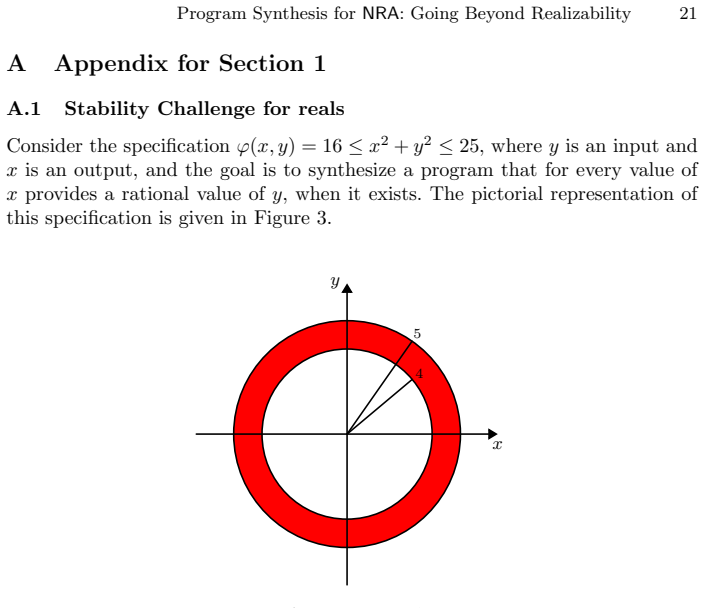
Wilkinson, J.H.: The evaluation of the zeros of ill-conditioned polynomials. part i. Numerische Mathematik1, 150–166 (1959) Program Synthesis forNRA: Going Beyond Realizability 21 A Appendix for Section 1 A.1 Stability Challenge for reals Consider the specificationφ(x, y) = 16≤x 2 +y 2 ≤25, whereyis an input and xis an output, and the goal is to synthesiz...
1959
discussion (0)
Sign in with ORCID, Apple, or X to comment. Anyone can read and Pith papers without signing in.