Elevator-LIO: Robust LiDAR-Inertial Odometry for Multi-Floor Navigation under Elevator-Induced Non-Inertial Motion
Pith reviewed 2026-06-30 13:13 UTC · model grok-4.3
The pith
Elevator-LIO maintains continuous localization accuracy inside elevators by using a decoupled state model in its Kalman filter.
A machine-rendered reading of the paper's core claim, the machinery that carries it, and where it could break.
Core claim
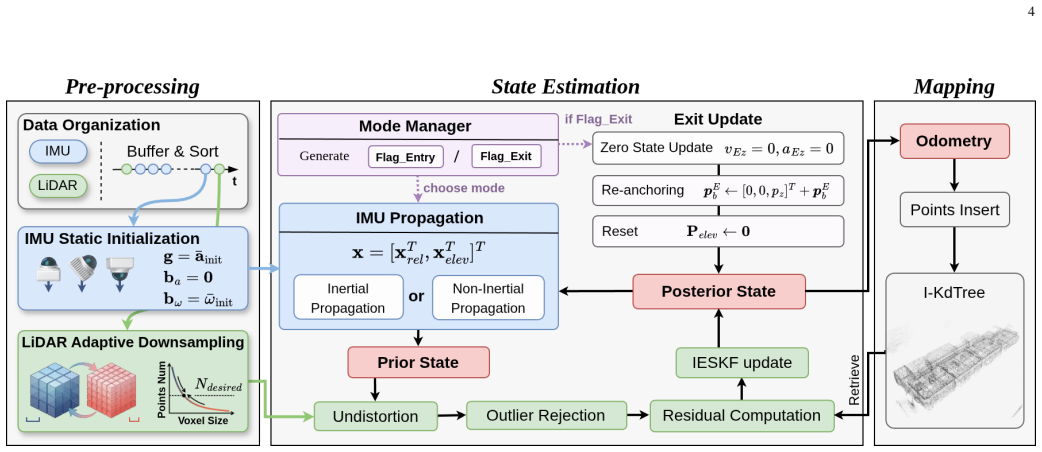
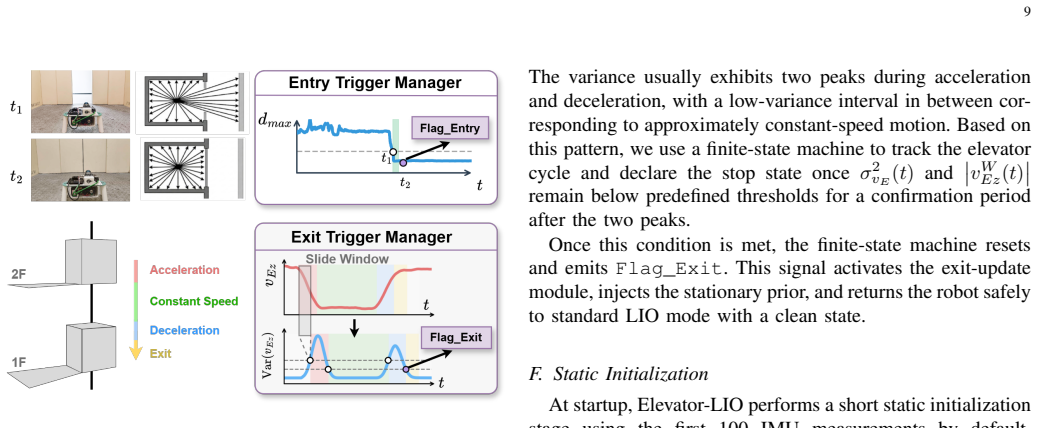
Elevator-LIO establishes a decoupled state-estimation model that separately models the robot motion relative to the elevator and the elevator motion itself, and embeds it into a mode-dependent iterated error-state Kalman filter framework. This framework degenerates to conventional LIO estimation in ordinary indoor environments, while enabling the propagation and constrained update of elevator-related states in elevator non-inertial environments, thereby achieving continuous and stable localization. An elevator mode manager detects elevator entry and exit events using LiDAR ranging statistics and estimated states, and introduces event-triggered zero-velocity and zero-acceleration updates when
What carries the argument
Decoupled state-estimation model for robot and elevator motions, integrated into a mode-dependent iterated error-state Kalman filter with an elevator mode manager.
Load-bearing premise
The system relies on correctly detecting when the robot enters and exits the elevator using LiDAR data and state estimates, and that the separate motion models stay accurate during the ride.
What would settle it
Running the system on a new elevator sequence and measuring if the final height error stays below 1 cm, or if it maintains tracking without failure, would test the claim of continuous accuracy.
Figures





read the original abstract
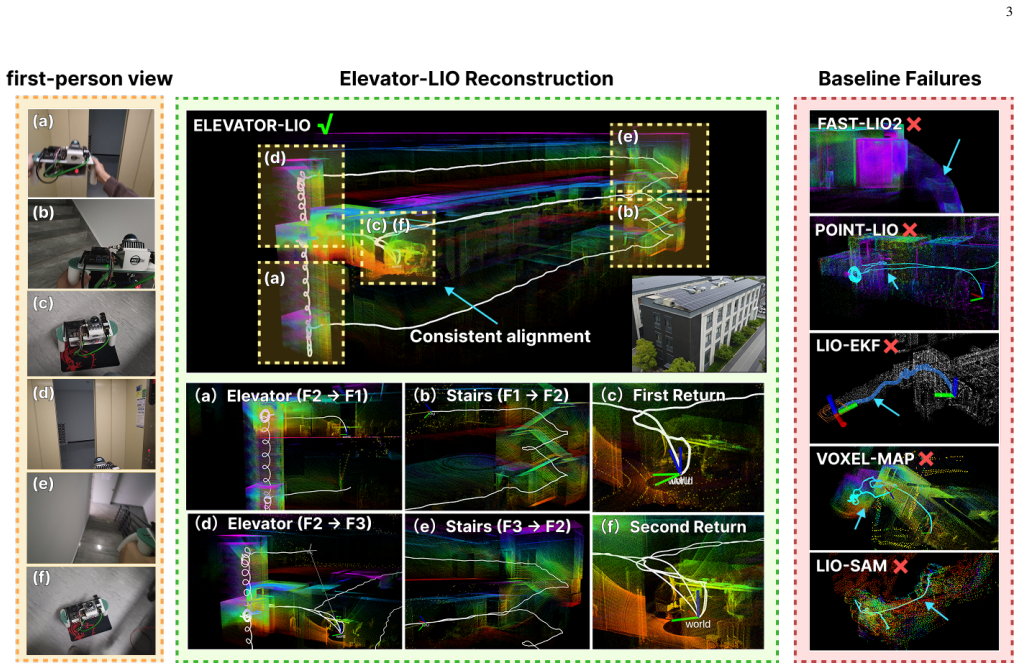
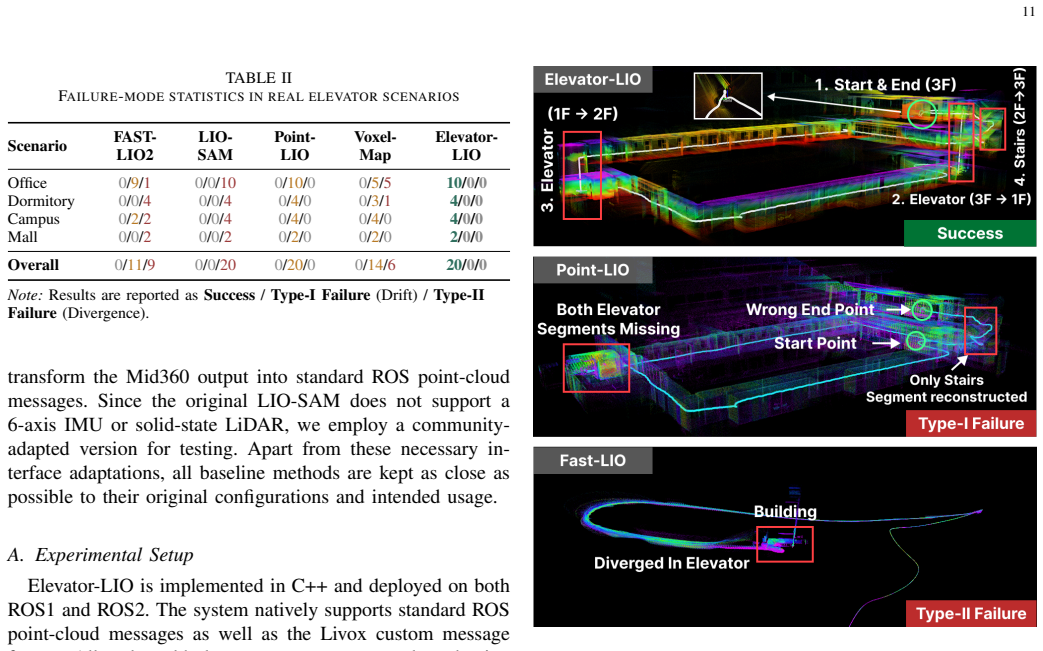
This paper presents Elevator-LIO, a LiDAR-inertial odometry framework designed to achieve continuous robot localization during elevator travel, thereby supporting cross-floor robotic tasks. To address the state-estimation problem in non-inertial frames, Elevator-LIO establishes a decoupled state-estimation model that separately models the robot motion relative to the elevator and the elevator motion itself, and embeds it into a mode-dependent iterated error-state Kalman filter framework. This framework degenerates to conventional LIO estimation in ordinary indoor environments, while enabling the propagation and constrained update of elevator-related states in elevator non-inertial environments, thereby achieving continuous and stable localization. An elevator mode manager detects elevator entry and exit events using LiDAR ranging statistics and estimated states, and introduces event-triggered zero-velocity and zero-acceleration updates when the elevator stops to suppress accumulated vertical drift. In addition, this paper adopts an adaptive voxel downsampling strategy to maintain a stable number of effective points under significant environmental scale changes. We conduct extensive experiments on 20 real-world sequences containing 79 elevator rides, including practical challenges such as large-scale spaces, long vertical travel, dynamic pedestrian interference, and mirror reflections. The results show that Elevator-LIO maintains continuous localization accuracy in all sequences, with terminal height error below 1 cm in 17 sequences. In contrast, existing representative localization systems perform poorly on these elevator sequences. Tests on the Hilti 2022/2023 datasets further show that the proposed method remains competitive in standard indoor scenarios. The project page is available at https://xiaofan4122.github.io/Elevator_LIO_Page/.
Editorial analysis
A structured set of objections, weighed in public.
Referee Report
Summary. The paper presents Elevator-LIO, a LiDAR-inertial odometry framework for continuous localization during elevator travel. It introduces a decoupled state-estimation model that separately handles robot motion relative to the elevator and elevator motion itself, embedded in a mode-dependent iterated error-state Kalman filter. The framework includes an elevator mode manager that detects entry/exit events from LiDAR ranging statistics and estimated states to trigger event-driven zero-velocity and zero-acceleration updates, plus adaptive voxel downsampling. Experiments on 20 real-world sequences containing 79 elevator rides (with challenges including large-scale spaces, long vertical travel, dynamic pedestrians, and mirror reflections) report continuous accuracy in all sequences and terminal height error below 1 cm in 17 sequences, while remaining competitive on the Hilti 2022/2023 datasets.
Significance. If the mode detection and decoupled model perform as described, the work fills a practical gap in multi-floor robotic navigation where standard LIO systems accumulate vertical drift in non-inertial elevator frames. The explicit degeneration to conventional LIO in ordinary environments supports deployability. The scale of the evaluation—79 real elevator rides across diverse conditions—provides concrete evidence of robustness that is stronger than typical synthetic or limited elevator tests in the literature.
major comments (2)
- [Elevator mode manager] Mode manager section (method description of elevator entry/exit detection): The central performance claims (continuous localization across all 79 rides and terminal height error <1 cm in 17 sequences) depend on reliable triggering of the decoupled model and zero-velocity/zero-acceleration updates. The manuscript states that detection uses LiDAR ranging statistics plus estimated states but supplies no precision/recall figures, threshold values, latency analysis, or failure cases under the explicitly listed challenges (dynamic pedestrians, mirror reflections, large-scale spaces). Without these, it is not possible to confirm that mismatched constraints or missed detections did not occur.
- [Decoupled state-estimation model] Decoupled state model and filter equations (core method section): The abstract and introduction claim a decoupled model for non-inertial frames, but the provided text does not include the explicit propagation equations, measurement models, or covariance handling for the elevator-related states. This leaves the load-bearing claim that the filter remains valid throughout the ride without independent verification.
minor comments (2)
- [Abstract] The abstract reports results on 20 sequences but does not state the total number of elevator rides per sequence or the error statistics for the three sequences that did not achieve <1 cm terminal height error.
- [Experiments] Trajectory figures in the experiments section would benefit from explicit annotation of elevator segments to allow readers to visually correlate performance with mode-manager activation periods.
Simulated Author's Rebuttal
We thank the referee for the constructive review and for acknowledging the practical significance of Elevator-LIO for multi-floor navigation. We address each major comment below and will revise the manuscript accordingly to improve transparency and verifiability.
read point-by-point responses
-
Referee: [Elevator mode manager] Mode manager section (method description of elevator entry/exit detection): The central performance claims (continuous localization across all 79 rides and terminal height error <1 cm in 17 sequences) depend on reliable triggering of the decoupled model and zero-velocity/zero-acceleration updates. The manuscript states that detection uses LiDAR ranging statistics plus estimated states but supplies no precision/recall figures, threshold values, latency analysis, or failure cases under the explicitly listed challenges (dynamic pedestrians, mirror reflections, large-scale spaces). Without these, it is not possible to confirm that mismatched constraints or missed detections did not occur.
Authors: We agree that the absence of quantitative detection metrics limits independent assessment of the mode manager's reliability. The manuscript reports only end-to-end localization results. In the revised version we will add a new subsection with precision/recall statistics for entry/exit detection, the exact threshold values and ranging statistics used, measured detection latency, and explicit discussion of failure cases or edge conditions under dynamic pedestrians, mirror reflections, and large-scale spaces, supported by additional experimental figures drawn from the 20 sequences. revision: yes
-
Referee: [Decoupled state-estimation model] Decoupled state model and filter equations (core method section): The abstract and introduction claim a decoupled model for non-inertial frames, but the provided text does not include the explicit propagation equations, measurement models, or covariance handling for the elevator-related states. This leaves the load-bearing claim that the filter remains valid throughout the ride without independent verification.
Authors: We acknowledge that the explicit propagation equations, measurement models, and covariance handling for the elevator-related states were omitted from the method section. The revised manuscript will insert the complete mathematical formulation of the decoupled state model inside the mode-dependent iterated error-state Kalman filter, including the state transition for robot-relative and elevator motion, the corresponding measurement models for zero-velocity/zero-acceleration updates, and the covariance propagation and update steps. This addition will allow direct verification of filter validity during elevator travel. revision: yes
Circularity Check
No significant circularity; modeling choices remain independent of reported results
full rationale
The paper defines a decoupled state-estimation model, mode-dependent IEKF, elevator mode manager, and event-triggered updates as explicit design decisions that degenerate to standard LIO outside elevators. Terminal height errors are presented as empirical outcomes on 20 sequences rather than quantities that reduce by the paper's own equations to parameters fitted from those same sequences. No self-definitional loop, fitted-input prediction, or load-bearing self-citation chain is exhibited in the provided text; the framework is self-contained against external benchmarks.
Axiom & Free-Parameter Ledger
Reference graph
Works this paper leans on
-
[1]
VINS-Mono: A robust and versatile monoc- ular visual-inertial state estimator,
T. Qin, P. Li, and S. Shen, “VINS-Mono: A robust and versatile monoc- ular visual-inertial state estimator,”IEEE Transactions on Robotics, vol. 34, no. 4, pp. 1004–1020, 2018
2018
-
[2]
ORB-SLAM3: An accurate open-source library for visual, visual-inertial, and multi-map SLAM,
C. Campos, R. Elvira, J. J. G ´omez Rodr´ıguez, J. M. M. Montiel, and J. D. Tard´os, “ORB-SLAM3: An accurate open-source library for visual, visual-inertial, and multi-map SLAM,”IEEE Transactions on Robotics, vol. 37, no. 6, pp. 1874–1890, 2021
2021
-
[3]
DROID-SLAM: Deep visual SLAM for monoc- ular, stereo, and RGB-D cameras,
Z. Teed and J. Deng, “DROID-SLAM: Deep visual SLAM for monoc- ular, stereo, and RGB-D cameras,” inAdvances in Neural Information Processing Systems, 2021
2021
-
[4]
SVO: Semidirect visual odometry for monocular and multicamera systems,
C. Forster, Z. Zhang, M. Gassner, M. Werlberger, and D. Scaramuzza, “SVO: Semidirect visual odometry for monocular and multicamera systems,”IEEE Transactions on Robotics, vol. 33, no. 2, pp. 249–265, 2017
2017
-
[5]
Direct sparse odometry,
J. Engel, V . Koltun, and D. Cremers, “Direct sparse odometry,”IEEE Transactions on Pattern Analysis and Machine Intelligence, vol. 40, no. 3, pp. 611–625, 2017
2017
-
[6]
LeGO-LOAM: Lightweight and ground- optimized LiDAR odometry and mapping on variable terrain,
T. Shan and B. Englot, “LeGO-LOAM: Lightweight and ground- optimized LiDAR odometry and mapping on variable terrain,” in2018 IEEE/RSJ International Conference on Intelligent Robots and Systems (IROS). IEEE, 2018, pp. 4758–4765
2018
-
[7]
Robust and effi- cient quadrotor trajectory generation for fast autonomous flight,
B. Zhou, F. Gao, L. Wang, C. Liu, and S. Shen, “Robust and effi- cient quadrotor trajectory generation for fast autonomous flight,”IEEE Robotics and Automation Letters, vol. 4, no. 4, pp. 3529–3536, 2019
2019
-
[8]
FAST-LIO: A fast, robust LiDAR-Inertial odom- etry package by tightly-coupled iterative Kalman filter,
W. Xu and F. Zhang, “FAST-LIO: A fast, robust LiDAR-Inertial odom- etry package by tightly-coupled iterative Kalman filter,”IEEE Robotics and Automation Letters, vol. 6, no. 2, pp. 3317–3324, 2021
2021
-
[9]
FAST-LIO2: Fast direct LiDAR-Inertial odometry,
W. Xu, Y . Cai, D. He, J. Lin, and F. Zhang, “FAST-LIO2: Fast direct LiDAR-Inertial odometry,”IEEE Transactions on Robotics, vol. 38, no. 4, pp. 2053–2073, 2022
2053
-
[10]
Point-LIO: Robust high-bandwidth light detection and ranging inertial odometry,
D. He, W. Xu, N. Chen, F. Kong, C. Yuan, and F. Zhang, “Point-LIO: Robust high-bandwidth light detection and ranging inertial odometry,” Advanced Intelligent Systems, vol. 5, no. 7, p. 2200459, 2023
2023
-
[11]
Autonomous operation of elevator buttons for multi-floor navigation,
Z. Zhao, J. Zhao, and Y . Lou, “Autonomous operation of elevator buttons for multi-floor navigation,” inProceedings of 2020 Chinese Intelligent Systems Conference. Springer, 2020, pp. 161–170
2020
-
[12]
MuNES: Multifloor navi- gation including elevators and stairs,
D. Jung, C. Kim, J.-K. Cho, and S.-W. Kim, “MuNES: Multifloor navi- gation including elevators and stairs,” arXiv preprint arXiv:2402.04535, 2024
-
[13]
Charlie rides the elevator: Integrating vision, navigation and manipulation towards multi-floor robot locomo- tion,
D. Troniak, J. Sattar, A. Gupta, J. J. Little, W. Chan, E. Calisgan, E. Croft, and M. Van der Loos, “Charlie rides the elevator: Integrating vision, navigation and manipulation towards multi-floor robot locomo- tion,” in2013 International Conference on Computer and Robot Vision. IEEE, 2013, pp. 1–8
2013
-
[14]
Tightly coupled 3d LiDAR inertial odometry and mapping,
H. Ye, Y . Chen, and M. Liu, “Tightly coupled 3d LiDAR inertial odometry and mapping,” in2019 IEEE International Conference on Robotics and Automation (ICRA), 2019
2019
-
[15]
LIO- SAM: Tightly-coupled LiDAR inertial odometry via smoothing and mapping,
T. Shan, B. Englot, D. Meyers, W. Wang, C. Ratti, and D. Rus, “LIO- SAM: Tightly-coupled LiDAR inertial odometry via smoothing and mapping,” in2020 IEEE/RSJ International Conference on Intelligent Robots and Systems (IROS), 2020, pp. 5135–5142
2020
-
[16]
Towards high-performance solid- state-LiDAR-inertial odometry and mapping,
K. Li, M. Li, and U. D. Hanebeck, “Towards high-performance solid- state-LiDAR-inertial odometry and mapping,”IEEE Robotics and Au- tomation Letters, vol. 6, no. 3, pp. 5167–5174, 2021
2021
-
[17]
Direct LiDAR-Inertial odome- try: Lightweight LIO with continuous-time motion correction,
K. Chen, R. Nemiroff, and B. T. Lopez, “Direct LiDAR-Inertial odome- try: Lightweight LIO with continuous-time motion correction,” in2023 IEEE International Conference on Robotics and Automation (ICRA), 2023, pp. 3980–3986
2023
-
[18]
LIO-EKF: High frequency LiDAR-inertial odometry using extended Kalman filters,
Y . Wu, T. Guadagnino, L. Wiesmann, L. Klingbeil, C. Stachniss, and H. Kuhlmann, “LIO-EKF: High frequency LiDAR-inertial odometry using extended Kalman filters,” in2024 IEEE International Conference on Robotics and Automation (ICRA), 2024
2024
-
[19]
Faster-LIO: Lightweight tightly coupled LiDAR-Inertial odometry using parallel sparse incremental voxels,
C. Bai, T. Xiao, Y . Chen, H. Wang, F. Zhang, and X. Gao, “Faster-LIO: Lightweight tightly coupled LiDAR-Inertial odometry using parallel sparse incremental voxels,”IEEE Robotics and Automation Letters, vol. 7, no. 2, pp. 4861–4868, 2022
2022
-
[20]
V oxelMap++: Mergeable voxel mapping method for online LiDAR(-Inertial) odome- try,
Y . Yuan, C. Wu, Y . You, X. Kong, Y . Zhang, and Q. Li, “V oxelMap++: Mergeable voxel mapping method for online LiDAR(-Inertial) odome- try,” arXiv preprint arXiv:2308.02799, 2023
-
[21]
AKF-LIO: LiDAR-inertial odometry with gaussian map by adaptive Kalman filter,
X. Xie, R. Geng, J. Ma, and B. Zhou, “AKF-LIO: LiDAR-inertial odometry with gaussian map by adaptive Kalman filter,” in2025 IEEE/RSJ International Conference on Intelligent Robots and Systems (IROS). IEEE, 2025, pp. 1274–1281
2025
-
[22]
RI-LIO: Reflectivity image assisted tightly-coupled LiDAR-inertial odometry,
Y . Zhang, Y . Tian, W. Wang, G. Yang, Z. Li, F. Jing, and M. Tan, “RI-LIO: Reflectivity image assisted tightly-coupled LiDAR-inertial odometry,”IEEE Robotics and Automation Letters, vol. 8, no. 3, pp. 1802–1809, 2023
2023
-
[23]
COIN-LIO: Complementary intensity-augmented LiDAR inertial odometry,
P. Pfreundschuh, H. Oleynikova, C. Cadena, R. Siegwart, and O. Ander- sson, “COIN-LIO: Complementary intensity-augmented LiDAR inertial odometry,” in2024 IEEE International Conference on Robotics and Automation (ICRA). IEEE, 2024, pp. 1730–1737
2024
-
[24]
GaRLIO: Gravity enhanced radar-LiDAR-inertial odometry,
C. Noh, W. Yang, M. Jung, S. Jung, and A. Kim, “GaRLIO: Gravity enhanced radar-LiDAR-inertial odometry,” in2025 IEEE International Conference on Robotics and Automation (ICRA), Atlanta, GA, USA, May 2025
2025
-
[25]
Ground-Fusion: A low- cost ground SLAM system robust to corner cases,
J. Yin, A. Li, W. Xi, W. Yu, and D. Zou, “Ground-Fusion: A low- cost ground SLAM system robust to corner cases,” arXiv preprint arXiv:2402.14308, 2024
-
[26]
Visual- inertial-wheel odometry with online calibration,
W. Lee, K. Eckenhoff, Y . Yang, P. Geneva, and G. Huang, “Visual- inertial-wheel odometry with online calibration,” in2020 IEEE/RSJ International Conference on Intelligent Robots and Systems (IROS), 2020, pp. 4559–4566
2020
-
[27]
Zero-velocity detection—an algorithm evaluation,
I. Skog, J.-O. Nilsson, P. H ¨andel, and J. Rantakokko, “Zero-velocity detection—an algorithm evaluation,”IEEE Transactions on Biomedical Engineering, vol. 57, no. 11, pp. 2657–2666, 2010
2010
-
[28]
VILENS: Visual, inertial, Li- DAR, and leg odometry for all-terrain legged robots,
D. Wisth, M. Camurri, and M. Fallon, “VILENS: Visual, inertial, Li- DAR, and leg odometry for all-terrain legged robots,”IEEE Transactions on Robotics, vol. 39, no. 1, pp. 309–326, 2023
2023
-
[29]
Leg-KILO: Legged kinematic- inertial-LiDAR odometry with contact-aware pseudo-observations,
Y . Sun, R. Qiao, X. Ma, and J. Wang, “Leg-KILO: Legged kinematic- inertial-LiDAR odometry with contact-aware pseudo-observations,” IEEE Robotics and Automation Letters, vol. 9, no. 2, pp. 1221–1228, 2024
2024
-
[30]
LIKO: LiDAR, inertial, and kinematic odometry for bipedal robots,
Q. Zhao, M. Li, Y . Shi, X. Chen, Z. Yu, L. Han, Z. Fu, J. Zhang, C. Li, Y . Zhang, and Q. Huang, “LIKO: LiDAR, inertial, and kinematic odometry for bipedal robots,” arXiv preprint arXiv:2404.18047, 2024
-
[31]
LVIO-Fusion: Tightly- coupled LiDAR-visual-inertial odometry and mapping in degenerate environments,
H. Zhang, L. Du, S. Bao, J. Yuan, and S. Ma, “LVIO-Fusion: Tightly- coupled LiDAR-visual-inertial odometry and mapping in degenerate environments,”IEEE Robotics and Automation Letters, vol. 9, no. 4, pp. 3783–3790, 2024
2024
-
[32]
AD-LIO: Adaptive voxel LiDAR-Inertial odometry based on scene degradation factor,
H. Wang, X. Zheng, H. Wang, Y . Tao, B. Kong, and Z. Li, “AD-LIO: Adaptive voxel LiDAR-Inertial odometry based on scene degradation factor,”IEEE Internet of Things Journal, 2026
2026
-
[33]
ikd-tree: An incremental kd tree for robotic applications,
Y . Cai, W. Xu, and F. Zhang, “ikd-Tree: An incremental kd tree for robotic applications,” arXiv preprint arXiv:2102.10808, 2021
-
[34]
Efficient and prob- abilistic adaptive voxel mapping for accurate online LiDAR odometry,
C. Yuan, W. Xu, X. Liu, X. Hong, and F. Zhang, “Efficient and prob- abilistic adaptive voxel mapping for accurate online LiDAR odometry,” IEEE Robotics and Automation Letters, vol. 7, no. 3, pp. 8518–8525, 2022
2022
discussion (0)
Sign in with ORCID, Apple, or X to comment. Anyone can read and Pith papers without signing in.