Vision-Language Binding in In-Context Image Generation
Pith reviewed 2026-06-30 13:58 UTC · model grok-4.3
The pith
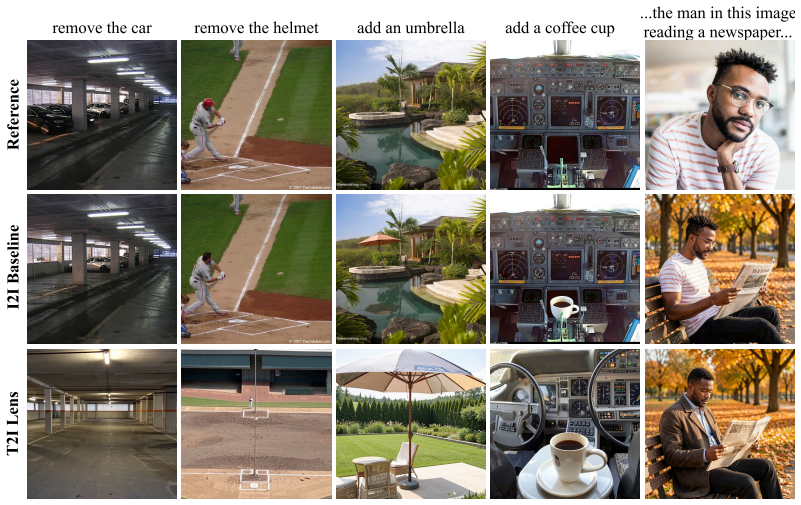
Text tokens in unified-attention image models absorb reference image content like color and style and carry it to the output image.
A machine-rendered reading of the paper's core claim, the machinery that carries it, and where it could break.
Core claim
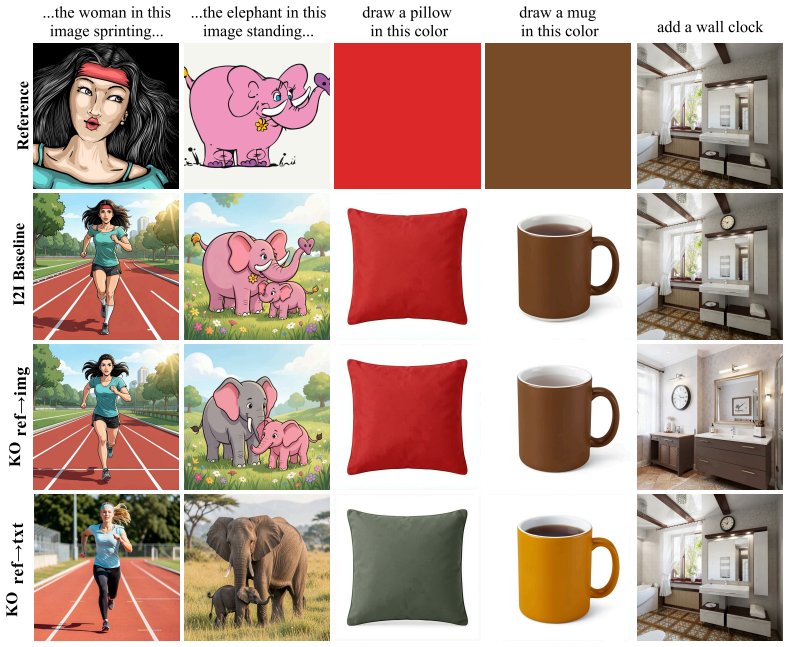
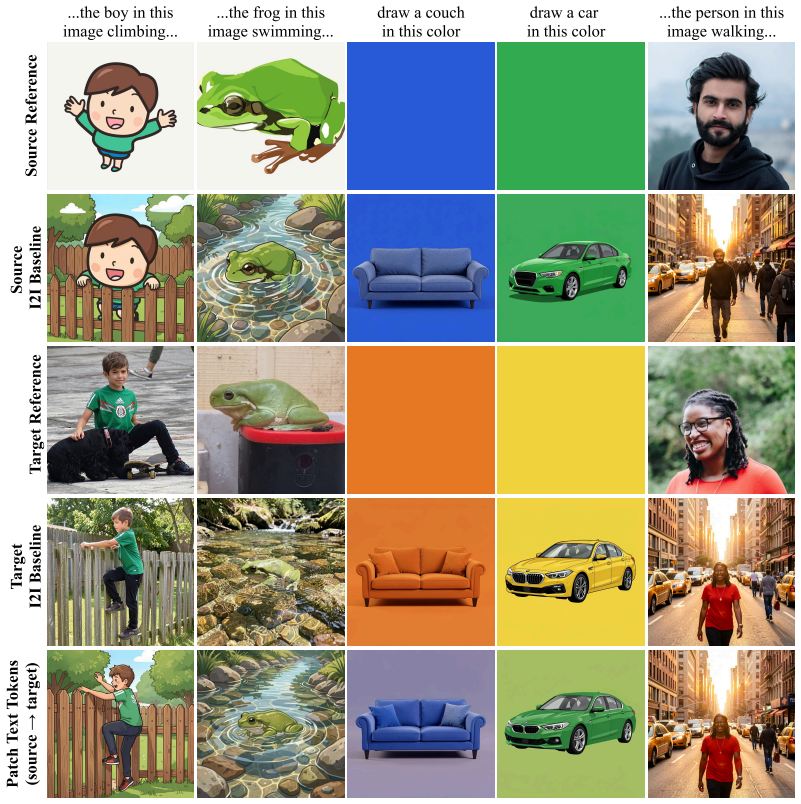
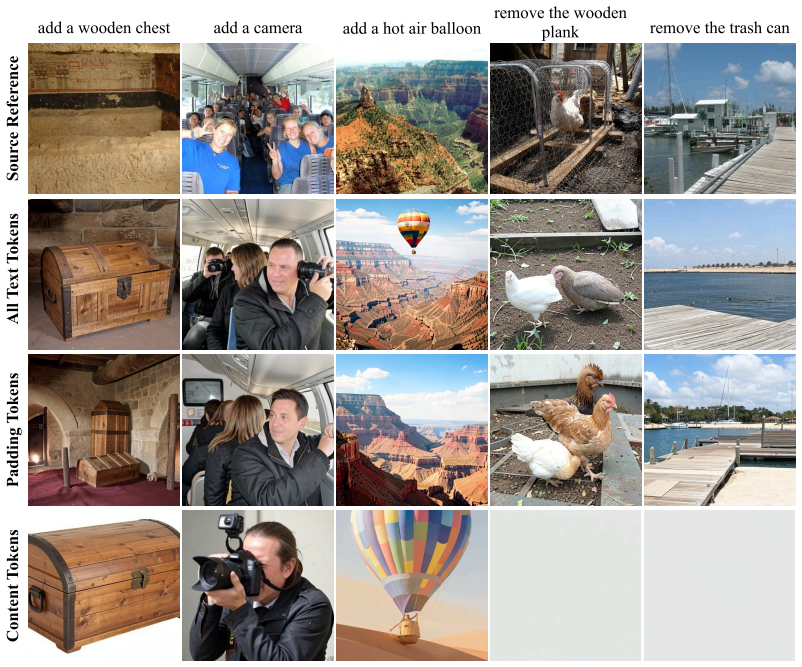
An implicit cross-modal binding emerges between the text tokens and the reference image: the text tokens absorb visual reference content during the forward pass, and that absorbed content causally influences the generated output. Properties like color, style, and scene setting are first written into the text tokens, which carry them to the generated image; pixel-exact properties bypass the text tokens and flow directly from reference to image through image-to-image attention. The binding localizes to padding tokens.
What carries the argument
The implicit cross-modal binding between text tokens and reference image, isolated by T2I Lens decoding of intermediate activations, Attention Knockout of specific edges, and I2I-to-I2I Patching of token activations across editing runs.
If this is right
- Color, style, and scene setting from a reference image route through text tokens to the output.
- Pixel-exact details such as specific faces or identities travel directly via image-to-image attention.
- The reference-text binding occurs specifically at padding tokens within the text sequence.
- Text tokens function as a structured channel that actively transports reference content rather than serving only as prompt holders.
Where Pith is reading between the lines
- The division of labor between token-mediated and direct paths may appear in other DiT-based multimodal generators that concatenate modalities in one attention stream.
- Targeted editing of padding-token activations could allow selective transfer of stylistic properties without altering identity.
- The observed routing suggests that modality-specific token roles shape information flow even when all inputs share unified attention.
Load-bearing premise
The three causal interventions isolate the model's natural information flow without introducing artifacts or rerouting that would not occur in normal operation.
What would settle it
If text-token activations decoded through a text-to-image path show no reconstruction of reference color or style, or if severing text-to-reference attention edges leaves those properties unchanged in the output, the binding claim fails.
Figures

read the original abstract
In-context image generation models such as FLUX.2 take a text prompt and an optional reference image as visual conditioning for the output. Internally, all three inputs -- text, reference image, and the noise tokens -- are concatenated and processed through a single attention stream, where all tokens can attend to one another. This leaves open how reference information flows through the model to produce the output image. We show that an implicit cross-modal binding emerges between the text tokens and the reference image: the text tokens absorb visual reference content during the forward pass, and that absorbed content causally influences the generated output. We surface this binding with three causal interventions on FLUX.2: T2I Lens, which decodes intermediate text-token activations through a text-to-image path; Attention Knockout, which severs specific attention edges; and I2I-to-I2I Patching, which copies text token activations between editing runs. Across 2,875 editing tasks on various images, including SUN397 and DreamBench++ datasets and images collected online, we observe a consistent division of labor: properties of the reference image, like color, style, and scene setting, are first written into the text tokens, which carry them to the generated image; pixel-exact properties like a specific face or instance identity bypass the text tokens and flow directly from reference to image through image-to-image attention. We further localize the reference-text binding to the padding tokens of the text sequence. These results show that text tokens in a multimodal DiT are not just prompt holders, but a structured channel for reference image content. More broadly, they suggest that even in unified-attention multimodal generative models, token modality structures how conditioning information is represented and routed across the network.
Editorial analysis
A structured set of objections, weighed in public.
Referee Report
Summary. The paper claims that in in-context image generation models such as FLUX.2, an implicit cross-modal binding emerges between text tokens and the reference image: text tokens absorb visual reference content during the forward pass and causally influence the generated output. Properties like color, style, and scene setting are written into text tokens (localized to padding tokens), which carry them to the output, while pixel-exact properties bypass via direct I2I attention. This is surfaced via three causal interventions (T2I Lens decoding, Attention Knockout, I2I-to-I2I Patching) across 2,875 editing tasks on SUN397, DreamBench++, and other images, showing text tokens as a structured channel in multimodal DiTs.
Significance. If the causal claims hold, the work provides concrete empirical evidence on information routing in unified-attention multimodal generative models, showing that token modality structures conditioning flow rather than treating text tokens as passive prompt holders. The scale (2,875 tasks on named datasets) and intervention-based approach strengthen the observations if controls confirm no artifacts; this could inform model interpretability and design in DiT-based systems.
major comments (1)
- Abstract and methods description: the central claim that the three interventions (T2I Lens, Attention Knockout, I2I-to-I2I Patching) reveal natural information flow without artifacts depends on unshown quantitative controls, such as activation statistics pre/post-intervention or ablations on non-binding edges. Without these, it remains unclear whether observed effects (e.g., division of labor between text-routed and direct I2I properties) match unmodified forward passes or reflect intervention-induced routing changes.
minor comments (1)
- Clarify exact definitions of the 2,875 tasks and provide a table summarizing per-dataset breakdowns and success metrics for each intervention to aid reproducibility.
Simulated Author's Rebuttal
We thank the referee for their constructive feedback. We address the major comment below and agree that additional controls will strengthen the manuscript.
read point-by-point responses
-
Referee: [—] Abstract and methods description: the central claim that the three interventions (T2I Lens, Attention Knockout, I2I-to-I2I Patching) reveal natural information flow without artifacts depends on unshown quantitative controls, such as activation statistics pre/post-intervention or ablations on non-binding edges. Without these, it remains unclear whether observed effects (e.g., division of labor between text-routed and direct I2I properties) match unmodified forward passes or reflect intervention-induced routing changes.
Authors: We agree this is a valid concern: the manuscript does not currently include quantitative controls such as pre/post-intervention activation statistics or ablations on non-binding edges. In the revised version we will add these, including L2-norm and cosine-similarity comparisons of text-token and image-token activations before versus after each intervention, plus targeted ablations that sever non-binding attention edges while preserving the reported pathways. These results will be reported in an expanded Methods section and supplementary figures to confirm that the observed division of labor is not an artifact of the interventions. revision: yes
Circularity Check
No significant circularity; empirical interventions on external model
full rationale
The paper is an empirical study using three causal interventions (T2I Lens, Attention Knockout, I2I-to-I2I Patching) on the external FLUX.2 model to observe information flow. No derivations, equations, fitted parameters, or predictions are present. Central claims rest on external model behavior and datasets (SUN397, DreamBench++) rather than internal definitions or self-citations. No load-bearing self-citation chains, ansatzes, or renamings of known results are identified. This is a standard non-circular empirical finding.
Axiom & Free-Parameter Ledger
Reference graph
Works this paper leans on
-
[1]
Claude Opus 4.7 system card
Anthropic. Claude Opus 4.7 system card. Technical report, Anthropic, 2026. URL https://anthropic. com/claude-opus-4-7-system-card
2026
-
[2]
Localizing and editing knowledge in text-to-image generative models
Samyadeep Basu, Nanxuan Zhao, Vlad Morariu, Soheil Feizi, and Varun Manjunatha. Localizing and editing knowledge in text-to-image generative models. InInternational Conference on Learning Represen- tations, 2024
2024
-
[3]
Instructpix2pix: Learning to follow image editing instructions
Tim Brooks, Aleksander Holynski, and Alexei A Efros. Instructpix2pix: Learning to follow image editing instructions. InProceedings of the IEEE/CVF conference on computer vision and pattern recognition, pages 18392–18402, 2023
2023
-
[4]
Scaling rectified flow transformers for high-resolution image synthesis
Patrick Esser, Sumith Kulal, Andreas Blattmann, Rahim Entezari, Jonas Müller, Harry Saini, Yam Levi, Dominik Lorenz, Axel Sauer, Frederic Boesel, et al. Scaling rectified flow transformers for high-resolution image synthesis. InForty-first international conference on machine learning, 2024
2024
-
[5]
Dissecting recall of factual associations in auto-regressive language models
Mor Geva, Jasmijn Bastings, Katja Filippova, and Amir Globerson. Dissecting recall of factual associations in auto-regressive language models. InProceedings of the 2023 Conference on Empirical Methods in Natural Language Processing, pages 12216–12235, 2023
2023
-
[6]
How to use and interpret activation patching
Stefan Heimersheim and Neel Nanda. How to use and interpret activation patching.arXiv preprint arXiv:2404.15255, 2024
work page internal anchor Pith review Pith/arXiv arXiv 2024
-
[7]
Con- ceptattention: Diffusion transformers learn highly interpretable features
Alec Helbling, Tuna Han Salih Meral, Benjamin Hoover, Pinar Yanardag, and Duen Horng Chau. Con- ceptattention: Diffusion transformers learn highly interpretable features. InForty-second International Conference on Machine Learning, 2025
2025
-
[8]
Prompt-to- prompt image editing with cross-attention control
Amir Hertz, Ron Mokady, Jay Tenenbaum, Kfir Aberman, Yael Pritch, and Daniel Cohen-Or. Prompt-to- prompt image editing with cross-attention control. InThe Eleventh International Conference on Learning Representations, 2023
2023
-
[9]
What’s in the image? a deep-dive into the vision of vision language models
Omri Kaduri, Shai Bagon, and Tali Dekel. What’s in the image? a deep-dive into the vision of vision language models. InProceedings of the Computer Vision and Pattern Recognition Conference, pages 14549–14558, 2025
2025
-
[10]
Follow the Flow: On Information Flow Across Textual Tokens in Text-to-Image Models
Guy Kaplan, Michael Toker, Yuval Reif, Yonatan Belinkov, and Roy Schwartz. Follow the flow: On information flow across textual tokens in text-to-image models.arXiv preprint arXiv:2504.01137, 2025
work page internal anchor Pith review Pith/arXiv arXiv 2025
-
[11]
FLUX.2: Frontier Visual Intelligence.https://bfl.ai/blog/flux-2, 2025
Black Forest Labs. FLUX.2: Frontier Visual Intelligence.https://bfl.ai/blog/flux-2, 2025. 10
2025
-
[12]
Black Forest Labs, Stephen Batifol, Andreas Blattmann, Frederic Boesel, Saksham Consul, Cyril Diagne, Tim Dockhorn, Jack English, Zion English, Patrick Esser, et al. Flux. 1 kontext: Flow matching for in-context image generation and editing in latent space.arXiv preprint arXiv:2506.15742, 2025
work page internal anchor Pith review Pith/arXiv arXiv 2025
-
[13]
I2am: Interpreting image-to-image latent diffusion models via bi- attribution maps
Junseo Park and Hyeryung Jang. I2am: Interpreting image-to-image latent diffusion models via bi- attribution maps. InInternational Conference on Learning Representations, 2025
2025
-
[14]
Scalable diffusion models with transformers
William Peebles and Saining Xie. Scalable diffusion models with transformers. InProceedings of the IEEE/CVF international conference on computer vision, pages 4195–4205, 2023
2023
-
[15]
Dreambench++: A human-aligned benchmark for personalized image generation
Yuang Peng, Yuxin Cui, Haomiao Tang, Zekun Qi, Runpei Dong, Jing Bai, Chunrui Han, Zheng Ge, Xiangyu Zhang, and Shu-Tao Xia. Dreambench++: A human-aligned benchmark for personalized image generation. InInternational Conference on Learning Representations, 2025
2025
-
[16]
U-net: Convolutional networks for biomedical image segmentation
Olaf Ronneberger, Philipp Fischer, and Thomas Brox. U-net: Convolutional networks for biomedical image segmentation. InInternational Conference on Medical image computing and computer-assisted intervention, pages 234–241. Springer, 2015
2015
-
[17]
Diffusion lens: Interpreting text encoders in text-to-image pipelines
Michael Toker, Hadas Orgad, Mor Ventura, Dana Arad, and Yonatan Belinkov. Diffusion lens: Interpreting text encoders in text-to-image pipelines. InProceedings of the 62nd Annual Meeting of the Association for Computational Linguistics (Volume 1: Long Papers), pages 9713–9728, 2024
2024
-
[18]
Padding tone: A mechanistic analysis of padding tokens in t2i models
Michael Toker, Ido Galil, Hadas Orgad, Rinon Gal, Yoad Tewel, Gal Chechik, and Yonatan Belinkov. Padding tone: A mechanistic analysis of padding tokens in t2i models. InProceedings of the 2025 Conference of the Nations of the Americas Chapter of the Association for Computational Linguistics: Human Language Technologies (Volume 1: Long Papers), pages 7618–...
2025
-
[19]
Probable inference, the law of succession, and statistical inference.Journal of the American Statistical Association, 22(158):209–212, 1927
Edwin B Wilson. Probable inference, the law of succession, and statistical inference.Journal of the American Statistical Association, 22(158):209–212, 1927
1927
-
[20]
Chenfei Wu, Jiahao Li, Jingren Zhou, Junyang Lin, Kaiyuan Gao, Kun Yan, Sheng ming Yin, Shuai Bai, Xiao Xu, Yilei Chen, Yuxiang Chen, Zecheng Tang, Zekai Zhang, Zhengyi Wang, An Yang, Bowen Yu, Chen Cheng, Dayiheng Liu, Deqing Li, Hang Zhang, Hao Meng, Hu Wei, Jingyuan Ni, Kai Chen, Kuan Cao, Liang Peng, Lin Qu, Minggang Wu, Peng Wang, Shuting Yu, Tingkun...
work page internal anchor Pith review Pith/arXiv arXiv 2025
-
[21]
Sun database: Large- scale scene recognition from abbey to zoo
Jianxiong Xiao, James Hays, Krista A Ehinger, Aude Oliva, and Antonio Torralba. Sun database: Large- scale scene recognition from abbey to zoo. In2010 IEEE computer society conference on computer vision and pattern recognition, pages 3485–3492. IEEE, 2010
2010
-
[22]
Omnigen: Unified image generation
Shitao Xiao, Yueze Wang, Junjie Zhou, Huaying Yuan, Xingrun Xing, Ruiran Yan, Chaofan Li, Shuting Wang, Tiejun Huang, and Zheng Liu. Omnigen: Unified image generation. InProceedings of the IEEE/CVF Conference on Computer Vision and Pattern Recognition, pages 13294–13304, 2025
2025
-
[23]
Group relative attention guidance for image editing.arXiv preprint arXiv:2510.24657, 2025
Xuanpu Zhang, Xuesong Niu, Ruidong Chen, Dan Song, Jianhao Zeng, Penghui Du, Haoxiang Cao, Kai Wu, and An-an Liu. Group relative attention guidance for image editing.arXiv preprint arXiv:2510.24657, 2025
-
[24]
Enabling instructional image editing with in-context generation in large scale diffusion transformer.Advances in Neural Information Processing Systems, 2026
Zechuan Zhang, Ji Xie, Yu Lu, Zongxin Yang, and Yi Yang. Enabling instructional image editing with in-context generation in large scale diffusion transformer.Advances in Neural Information Processing Systems, 2026
2026
-
[25]
Add a lamp post,
Lianmin Zheng, Wei-Lin Chiang, Ying Sheng, Siyuan Zhuang, Zhanghao Wu, Yonghao Zhuang, Zi Lin, Zhuohan Li, Dacheng Li, Eric Xing, et al. Judging llm-as-a-judge with mt-bench and chatbot arena. Advances in neural information processing systems, 36:46595–46623, 2023. 11 Appendix A Specific choice of layers in FLUX.2 Klein 9B to patch For the experiments in ...
2023
-
[26]
add_object
ADD: a single object NOT currently in the image but plausibly fits the scene. If no scene-agnostic addition fits, set "add_object": null
-
[27]
REMOVE: a single object IS visible and could be plausibly removed (not the entire subject; the scene would still read coherently without it). If nothing meets that bar, set "remove_object": null. SCENE-AGNOSTIC RULE: the proposed object names must NOT reveal the specific scene/location depicted. For a volcano photo, "lava plume" or "volcanic crater" is fo...
discussion (0)
Sign in with ORCID, Apple, or X to comment. Anyone can read and Pith papers without signing in.