Scalable High-Dimensional Bayesian Field Reconstruction with Finite Elements: Application to 3D Porous Media Flow
Pith reviewed 2026-06-30 11:54 UTC · model grok-4.3
The pith
A finite-element variational method delivers full-covariance Gaussian posteriors for Bayesian field reconstruction at over 400000 dimensions.
A machine-rendered reading of the paper's core claim, the machinery that carries it, and where it could break.
Core claim
The framework delivers a full-covariance Gaussian variational posterior on a three-dimensional curved finite-element discretization at a stochastic field dimension exceeding 400000. The spatial prior is derived from the stochastic PDE connection and formulated natively in terms of finite-element operators. The sparse Gaussian variational distribution is parameterized via its precision Cholesky factor, with the sparsity pattern inherited from the domain's Laplacian. Unlike covariance-based sparse parameterizations, which encode only short-range correlations, the sparse precision implicitly represents dense posterior covariances through its sparse inverse, yielding smooth, physically plausible
What carries the argument
Sparse precision Cholesky factor of the variational Gaussian distribution, inheriting its sparsity pattern from the domain Laplacian so that the matrix inverse encodes dense covariances.
If this is right
- Full-covariance posteriors become feasible at stochastic dimensions exceeding 400000 on curved three-dimensional finite-element meshes.
- Smooth physically plausible field samples are generated at linear memory cost through the sparse precision parameterization.
- All prior and likelihood hyperparameters are marginalized analytically inside a variational Bayes EM loop.
- Natural gradient updates stabilize convergence of the evidence lower bound optimization.
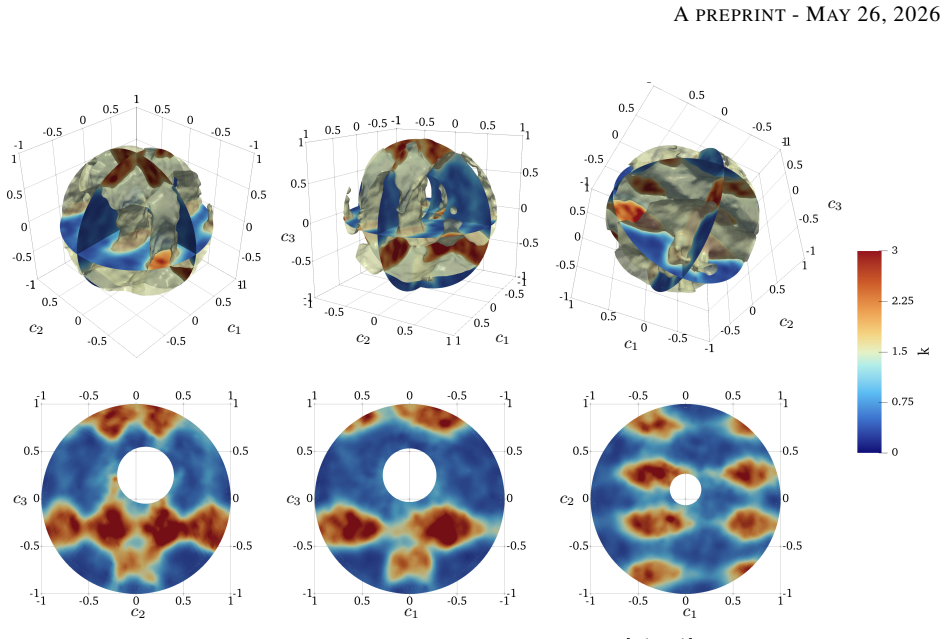
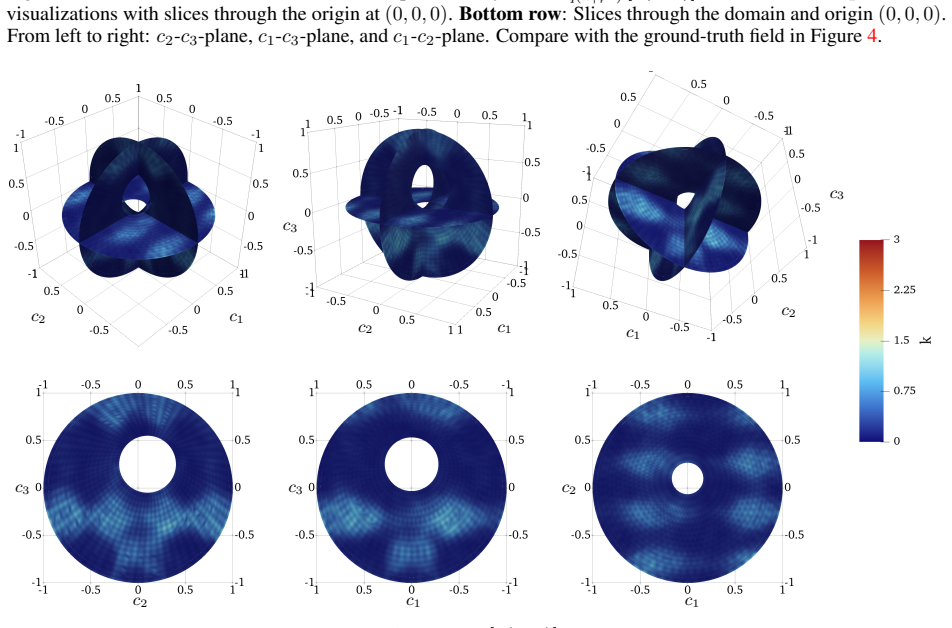
- The recovered permeability fields match all major spatial features of the target in the porous-media demonstration.
Where Pith is reading between the lines
- The same finite-element-native prior construction could be applied to other nonlinear inverse problems that admit an SPDE representation.
- The linear-memory property opens the possibility of embedding this reconstruction step inside larger real-time simulation workflows.
- Alternative sparsity patterns or different factorizations of the precision matrix might further reduce iteration count or improve conditioning.
- Direct head-to-head timing and accuracy comparisons against Hessian-Laplace low-rank methods on identical meshes would quantify the practical trade-off.
Load-bearing premise
Parameterizing the sparse Gaussian variational distribution via its precision Cholesky factor yields an accurate approximation to the true posterior for nonlinear PDE-governed problems.
What would settle it
On a smaller instance of the same porous-media problem where MCMC sampling remains tractable, compare moments or predictive statistics of the variational posterior against the MCMC reference; systematic mismatch would falsify the approximation claim.
Figures


read the original abstract
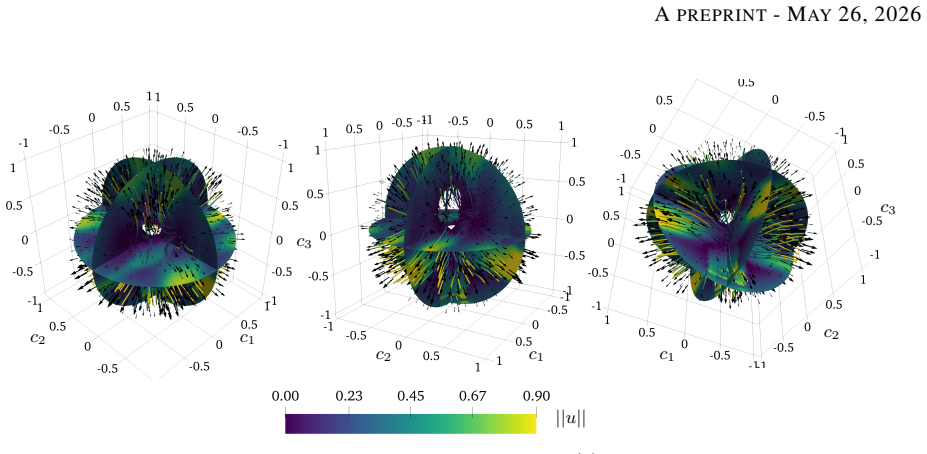
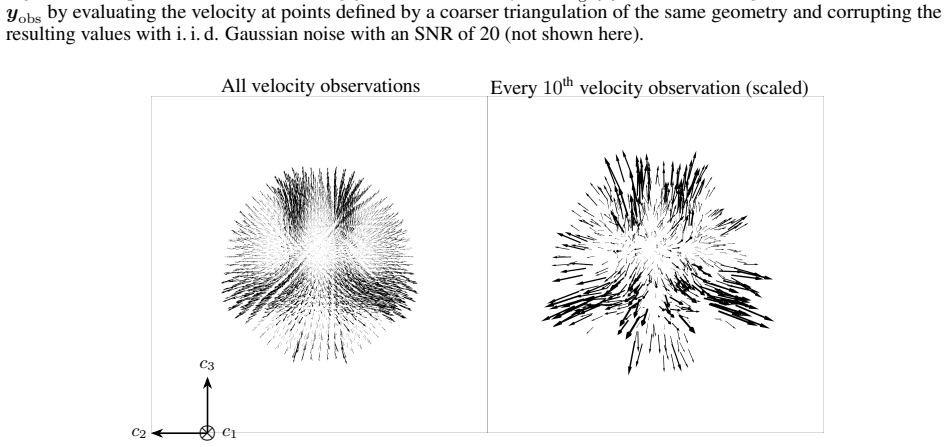
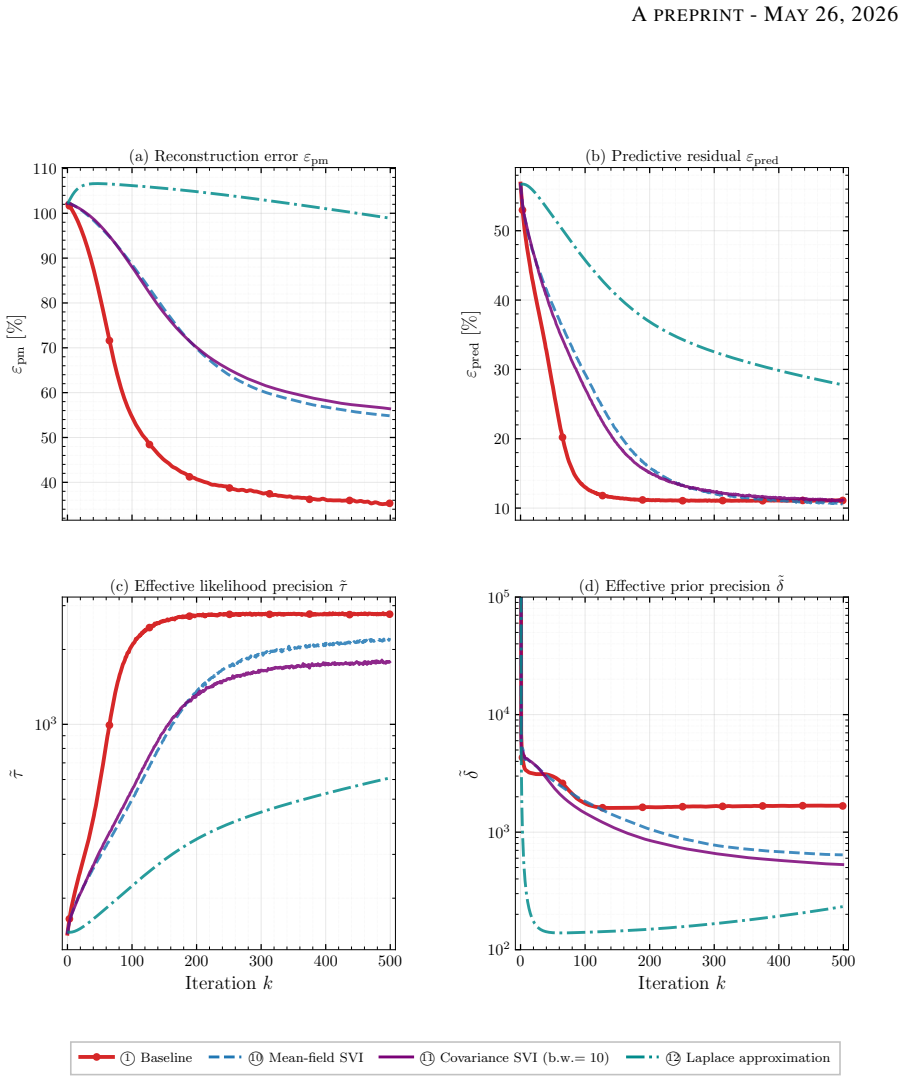
We present a unified, finite-element-native variational inference framework for very high-dimensional Bayesian spatial field reconstruction in physics-based problems governed by partial differential equations (PDEs) that are nonlinear in the inferred parameters. The framework delivers a full-covariance Gaussian variational posterior, with a probabilistic treatment of all prior and likelihood hyperparameters, on a three-dimensional curved finite-element discretization at a stochastic field dimension exceeding 400000. To our knowledge, this is the first full-covariance variational reconstruction at this scale, complementing the low-rank Hessian-Laplace approaches that dominate extreme-scale Bayesian inversion. The spatial prior is derived from the stochastic PDE (SPDE) connection and formulated natively in terms of finite-element (FE) operators. The sparse Gaussian variational distribution is parameterized via its precision Cholesky factor, with the sparsity pattern inherited from the domain's Laplacian. Unlike covariance-based sparse parameterizations, which encode only short-range correlations, the sparse precision implicitly represents dense posterior covariances through its sparse inverse, yielding smooth, physically plausible samples at O(n) memory cost and enabling direct evidence-lower-bound (ELBO) gradients via the path-derivative (sticking-the-landing) estimator. Natural gradient strategies stabilize convergence, while a variational Bayes expectation-maximization (VB-EM) loop marginalizes all hyperparameters analytically and induces an automatic coarse-to-fine continuation. The framework is demonstrated on Bayesian permeability field reconstruction for a porous-media flow problem, recovering all major spatial features with high fidelity. Algorithmic ablation and comparison with alternative inference methods quantify the improvements over state-of-the-art baselines.
Editorial analysis
A structured set of objections, weighed in public.
Referee Report
Summary. The paper presents a finite-element variational inference framework for high-dimensional Bayesian spatial field reconstruction in nonlinear PDE problems. It uses an SPDE-derived prior and parameterizes a full-covariance Gaussian variational posterior via the Cholesky factor of a sparse precision matrix whose sparsity follows the domain Laplacian, enabling O(n) memory at >400k dimensions. A VB-EM loop handles hyperparameters, and the method is demonstrated on 3D porous-media permeability reconstruction, with claims of major feature recovery, algorithmic ablations, and improvements over baselines.
Significance. If the variational approximation remains accurate for nonlinear likelihoods, the work would represent a notable advance in scalable full-covariance Bayesian inversion, extending beyond the low-rank Hessian-Laplace methods that currently dominate extreme-scale applications. The native FE formulation and path-derivative ELBO estimator are technically sound contributions that could support uncertainty quantification in large physics-based inverse problems.
major comments (2)
- [§3.2] §3.2: The central modeling assumption is that a Gaussian variational family whose precision Cholesky factor inherits fixed Laplacian sparsity (and thus encodes dense covariances via the inverse) yields an accurate approximation to the true posterior. For nonlinear PDE-governed problems this sparsity pattern is determined solely by the prior and does not adapt to likelihood-induced long-range or non-stationary correlations; no diagnostic (KL to reference posterior, posterior predictive coverage, or held-out calibration) is supplied to bound the approximation error at 400k dimensions.
- [§5] §5 (porous-media demonstration): The claim that the method recovers 'all major spatial features with high fidelity' and that ablations 'quantify the improvements over state-of-the-art baselines' rests on qualitative description alone. No numerical metrics (RMSE, coverage probabilities, ELBO values, or direct comparison tables) are reported, leaving the quantitative support for the scalability and accuracy claims unverified.
minor comments (2)
- [Abstract and §5] The abstract states that 'Algorithmic ablation and comparison … quantify the improvements,' yet the experimental section supplies no tabulated numerical results or statistical significance tests; a concise results table would strengthen the presentation.
- [§3.3] Notation for the path-derivative (sticking-the-landing) estimator and the natural-gradient updates could be clarified with an explicit algorithmic listing or pseudocode block to aid reproducibility.
Simulated Author's Rebuttal
We thank the referee for the thoughtful and constructive comments on our manuscript. We address each of the major comments below and outline the revisions we plan to make.
read point-by-point responses
-
Referee: [§3.2] §3.2: The central modeling assumption is that a Gaussian variational family whose precision Cholesky factor inherits fixed Laplacian sparsity (and thus encodes dense covariances via the inverse) yields an accurate approximation to the true posterior. For nonlinear PDE-governed problems this sparsity pattern is determined solely by the prior and does not adapt to likelihood-induced long-range or non-stationary correlations; no diagnostic (KL to reference posterior, posterior predictive coverage, or held-out calibration) is supplied to bound the approximation error at 400k dimensions.
Authors: We agree that the fixed sparsity pattern, inherited from the prior Laplacian, represents a modeling choice that prioritizes scalability over full adaptability to posterior correlations induced by the nonlinear likelihood. This choice enables the O(n) memory scaling at dimensions exceeding 400,000. While direct computation of KL divergence to a reference posterior is infeasible at this scale, we have validated the approach through algorithmic ablations on smaller problems and through qualitative and comparative results in the 3D demonstration. In the revision, we will add an explicit discussion of this approximation's limitations and include additional posterior predictive checks on a reduced-dimensionality version of the problem to provide further evidence of accuracy. revision: partial
-
Referee: [§5] §5 (porous-media demonstration): The claim that the method recovers 'all major spatial features with high fidelity' and that ablations 'quantify the improvements over state-of-the-art baselines' rests on qualitative description alone. No numerical metrics (RMSE, coverage probabilities, ELBO values, or direct comparison tables) are reported, leaving the quantitative support for the scalability and accuracy claims unverified.
Authors: We acknowledge that the current presentation relies primarily on visual inspection of the reconstructed fields and ablation studies without accompanying numerical tables. This is a valid point that weakens the quantitative support for our claims. In the revised manuscript, we will include numerical metrics such as RMSE against ground truth (where available), posterior predictive coverage probabilities, ELBO values across methods, and a table comparing performance metrics with the baseline methods to provide verifiable quantitative evidence. revision: yes
Circularity Check
No significant circularity; derivation relies on standard SPDE-FE and variational methods
full rationale
The paper's central framework combines the established SPDE connection for priors with finite-element operators and a sparse-precision Gaussian variational family. No load-bearing step reduces by construction to a fitted quantity, self-defined prediction, or self-citation chain; the sparsity pattern is explicitly inherited from the Laplacian prior (standard) and the ELBO/path-derivative estimator follows known variational inference practice. The abstract and description reference these as external foundations without re-deriving them from the present results or authors' prior fitted models. The variational approximation is stated as an assumption rather than proven equivalent to the posterior by definition.
Axiom & Free-Parameter Ledger
axioms (2)
- domain assumption The spatial prior derived from the stochastic PDE (SPDE) connection is suitable for the permeability field in porous media flow.
- domain assumption A Gaussian variational posterior provides a sufficient approximation for the target posterior in this nonlinear PDE setting.
Reference graph
Works this paper leans on
-
[1]
Sampling Conductivity Images via MCMC
C. Fox and G. K. Nicholls. “Sampling Conductivity Images via MCMC”. In:The Art and Science of Bayesian Image Analysis, Proceedings of the Leeds Annual Statistical Research Workshop (LASR). Ed. by K. V . Mardia, C. A. Gill, and R. G. Aykroyd. Leeds University Press, July 1997, pp. 91–100
1997
-
[3]
Chen.Reservoir Simulation: Mathematical Techniques in Oil Recovery
Z. Chen.Reservoir Simulation: Mathematical Techniques in Oil Recovery. CBMS-NSF Regional Conference Series in Applied Mathematics 77. SIAM, 2007.ISBN: 978-0-89871-640-5.DOI: 10.1137/1.9780898717075
-
[4]
P. Moireau and D. Chapelle. “Reduced-order Unscented Kalman Filtering with application to parameter identification in large-dimensional systems”. In:ESAIM: Control, Optimisation and Calculus of Variations 17.2 (Mar. 2010), pp. 380–405.ISSN: 1262-3377.DOI:10.1051/cocv/2010006
-
[5]
Calibration of parameters for cardiovascular models with application to arterial growth
S. Kehl and M. W. Gee. “Calibration of parameters for cardiovascular models with application to arterial growth”. In:International journal for numerical methods in biomedical engineering33.5 (2017), e2822.DOI: 10.1002/cnm.2822
-
[6]
J. Nitzler, B. Z. Temür, P.-S. Koutsourelakis, and W. A. Wall. “Efficient Bayesian multi-fidelity inverse analysis for expensive and non-differentiable physics-based simulations in high stochastic dimensions”. In:Computer Methods in Applied Mechanics and Engineering448 (2026), p. 118442.DOI: 10.1016/j.cma.2025.118442
-
[7]
Statistical inverse problems: discretization, model reduction and inverse crimes
J. P. Kaipio and E. Somersalo. “Statistical inverse problems: discretization, model reduction and inverse crimes”. In:Journal of computational and applied mathematics198.2 (2007), pp. 493–504.DOI: 10.1016/j.cam. 2005.09.027
-
[8]
A Tutorial on Bayesian Inference to Identify Material Parameters in Solid Mechanics
H. Rappel, L. A. A. Beex, J. S. Hale, L. Noels, and S. P. A. Bordas. “A Tutorial on Bayesian Inference to Identify Material Parameters in Solid Mechanics”. In:Archives of Computational Methods in Engineering27.2 (Jan. 2019), pp. 361–385.ISSN: 1886-1784.DOI:10.1007/s11831-018-09311-x. 28 APREPRINT- MAY26, 2026
-
[9]
I. Papaioannou and D. Straub. “Learning soil parameters and updating geotechnical reliability estimates under spatial variability – theory and application to shallow foundations”. In:Georisk: Assessment and Management of Risk for Engineered Systems and Geohazards11.1 (Nov. 2016), pp. 116–128.ISSN: 1749-9526.DOI: 10.1080/17499518.2016.1250280
-
[10]
Inverse problems: A Bayesian perspective
A. M. Stuart. “Inverse problems: A Bayesian perspective”. In:Acta numerica19 (2010), pp. 451–559.DOI: 10.1017/s0962492910000061
-
[11]
Challenges for quantum software engineering: An industrial application scenario perspective,
M. Dashti and A. M. Stuart. “The Bayesian approach to inverse problems”. In:Handbook of Uncertainty Quantification. Ed. by R. Ghanem, D. Higdon, and H. Oishi. Springer, 2017, pp. 311–428.DOI: 10.1007/978- 3-319-12385-1_7
-
[12]
A Conceptual Introduction to Hamiltonian Monte Carlo
M. Betancourt. “A conceptual introduction to Hamiltonian Monte Carlo”. In: (2017).DOI: 10.48550/arXiv. 1701.02434. arXiv:1701.02434
work page internal anchor Pith review Pith/arXiv arXiv doi:10.48550/arxiv 2017
-
[13]
Riemann manifold Langevin and Hamiltonian Monte Carlo methods
M. Girolami and B. Calderhead. “Riemann manifold Langevin and Hamiltonian Monte Carlo methods”. In: Journal of the Royal Statistical Society: Series B (Statistical Methodology)73.2 (2011), pp. 123–214.DOI: 10.1111/j.1467-9868.2010.00765.x
-
[14]
The No-U-Turn Sampler: Adaptively Setting Path Lengths in Hamiltonian Monte Carlo
M. D. Hoffman, A. Gelman, et al. “The No-U-Turn Sampler: Adaptively Setting Path Lengths in Hamiltonian Monte Carlo”. In:J. Mach. Learn. Res.15.47 (2014), pp. 1593–1623.URL: http://jmlr.org/papers/v15/ hoffman14a.html
2014
-
[15]
MCMC methods for functions: modifying old algorithms to make them faster
S. L. Cotter, G. O. Roberts, A. M. Stuart, and D. White. “MCMC methods for functions: modifying old algorithms to make them faster”. In:Statistical Science(2013), pp. 424–446.DOI:10.1214/13-sts421
-
[16]
T. Cui, J. Martin, Y . M. Marzouk, A. Solonen, and A. Spantini. “Likelihood-informed dimension reduction for nonlinear inverse problems”. In:Inverse Problems30.11 (2014), p. 114015.DOI: 10.1088/0266- 5611/30/11/114015
-
[17]
Dimension-independent likelihood-informed MCMC
T. Cui, K. J. Law, and Y . M. Marzouk. “Dimension-independent likelihood-informed MCMC”. In:Journal of Computational Physics304 (2016), pp. 109–137.DOI:10.1016/j.jcp.2015.10.008
-
[18]
A Bayesian approach to multiscale inverse problems using the sequential Monte Carlo method
J. Wan and N. Zabaras. “A Bayesian approach to multiscale inverse problems using the sequential Monte Carlo method”. In:Inverse Problems27.10 (2011), p. 105004.DOI:10.1088/0266-5611/27/10/105004
-
[19]
Bayesian multiscale deep generative model for the solution of high-dimensional inverse problems
Y . Xia and N. Zabaras. “Bayesian multiscale deep generative model for the solution of high-dimensional inverse problems”. In:Journal of Computational Physics455 (2022), p. 111008.DOI: 10.1016/j.jcp.2022.111008
-
[20]
Model reduction for large-scale systems with high-dimensional parametric input space
T. Bui-Thanh, K. Willcox, and O. Ghattas. “Model reduction for large-scale systems with high-dimensional parametric input space”. In:SIAM Journal on Scientific Computing30.6 (2008), pp. 3270–3288.DOI: 10. 1137/070694855
2008
-
[22]
U. Villa, N. Petra, and O. Ghattas. “hipPYlib: An extensible software framework for large-scale inverse problems governed by PDEs: Part I: Deterministic inversion and linearized Bayesian inference”. In:ACM Transactions on Mathematical Software47.2 (2021), pp. 1–34.DOI:10.1145/3428447
-
[23]
Fast algorithms for Bayesian uncertainty quantification in large-scale linear inverse problems based on low-rank partial Hessian approximations
H. P. Flath, L. C. Wilcox, V . Akçelik, J. Hill, B. van Bloemen Waanders, and O. Ghattas. “Fast algorithms for Bayesian uncertainty quantification in large-scale linear inverse problems based on low-rank partial Hessian approximations”. In:SIAM Journal on Scientific Computing33.1 (2011), pp. 407–432.DOI: 10.1137/ 090780717
2011
-
[24]
T. Bui-Thanh, O. Ghattas, J. Martin, and G. Stadler. “A computational framework for infinite-dimensional Bayesian inverse problems Part I: The linearized case, with application to global seismic inversion”. In:SIAM Journal on Scientific Computing35.6 (2013), A2494–A2523.DOI:doi.org/10.1137/12089586x
-
[25]
S. Henneking, S. Venkat, V . Dobrev, J. Camier, T. Kolev, M. Fernando, A. -A. Gabriel, and O. Ghattas. “Real-time Bayesian inference at extreme scale: A digital twin for tsunami early warning applied to the Cascadia subduction zone”. In:Proceedings of the International Conference for High Performance Computing, Networking, Storage and Analysis (SC25). ACM...
-
[26]
Bayesian Calibration of Nonlinear Cardiovascular Models for the Predictive Simulation of Arterial Growth
S. Kehl. “Bayesian Calibration of Nonlinear Cardiovascular Models for the Predictive Simulation of Arterial Growth”. Dissertation. Munich, Germany: Technische Universität München, 2017
2017
-
[27]
Ensemble Kalman methods for inverse problems
M. A. Iglesias, K. J. H. Law, and A. M. Stuart. “Ensemble Kalman methods for inverse problems”. In:Inverse Problems29.4 (2013), p. 045001.DOI:10.1088/0266-5611/29/4/045001
-
[28]
Analysis of the ensemble Kalman filter for inverse problems
C. Schillings and A. M. Stuart. “Analysis of the ensemble Kalman filter for inverse problems”. In:SIAM Journal on Numerical Analysis55.3 (2017), pp. 1264–1290.DOI:10.1137/16M105959X. 29 APREPRINT- MAY26, 2026
-
[29]
L. Yang, X. Meng, and G. E. Karniadakis. “B-PINNs: Bayesian physics-informed neural networks for forward and inverse PDE problems with noisy data”. In:Journal of Computational Physics425 (2021), p. 109913.DOI: 10.1016/j.jcp.2020.109913
-
[31]
Accelerating Hamiltonian Monte Carlo for Bayesian inference in neural networks and neural operators
P. Thiagarajan, T. A. Zaki, and M. D. Shields. “Accelerating Hamiltonian Monte Carlo for Bayesian inference in neural networks and neural operators”. In:Computer Methods in Applied Mechanics and Engineering447 (2025), p. 118401.DOI:10.1016/j.cma.2025.118401
-
[32]
Y . Zhu, N. Zabaras, P.-S. Koutsourelakis, and P. Perdikaris. “Physics-constrained deep learning for high- dimensional surrogate modeling and uncertainty quantification without labeled data”. In:Journal of Computa- tional Physics394 (2019), pp. 56–81.DOI:10.1016/j.jcp.2019.05.024
-
[33]
M. Chatzopoulos and P.-S. Koutsourelakis. “Physics-Aware Neural Implicit Solvers for multiscale, parametric PDEs with applications in heterogeneous media”. In:Computer Methods in Applied Mechanics and Engineering 432 (Dec. 2024), p. 117342.ISSN: 0045-7825.DOI:10.1016/j.cma.2024.117342
-
[34]
Solution of physics-based Bayesian inverse problems with deep generative priors
D. V . Patel, D. Ray, and A. A. Oberai. “Solution of physics-based Bayesian inverse problems with deep generative priors”. In:Computer Methods in Applied Mechanics and Engineering400 (2022), p. 115428.DOI: 10.1016/j.cma.2022.115428
-
[35]
Semi-supervised invertible neural operators for Bayesian inverse problems
S. Kaltenbach, P. Perdikaris, and P.-S. Koutsourelakis. “Semi-supervised invertible neural operators for Bayesian inverse problems”. In:Computational Mechanics72 (2023), pp. 451–470.DOI: 10.1007/s00466-023- 02298-8
-
[36]
V . C. Scholz, Y . Zang, and P.-S. Koutsourelakis. “Weak neural variational inference for solving Bayesian inverse problems without forward models: Applications in elastography”. In:Computer Methods in Applied Mechanics and Engineering433 (Jan. 2025), p. 117493.ISSN: 0045-7825.DOI:10.1016/j.cma.2024.117493
-
[37]
Stochastic variational inference
M. D. Hoffman, D. M. Blei, C. Wang, and J. Paisley. “Stochastic variational inference”. In:The Journal of Machine Learning Research14.40 (2013), pp. 1303–1347.URL: http://jmlr.org/papers/v14/ hoffman13a.html
2013
-
[38]
Variational inference: A review for statisticians
D. M. Blei, A. Kucukelbir, and J. D. McAuliffe. “Variational inference: A review for statisticians”. In:Journal of the American statistical Association112.518 (2017), pp. 859–877.DOI: 10.1080/01621459.2017.1285773
-
[39]
I. M. Franck and P. Koutsourelakis. “Sparse Variational Bayesian approximations for nonlinear inverse problems: Applications in nonlinear elastography”. In:Computer Methods in Applied Mechanics and Engineering299 (2016), pp. 215–244.DOI:10.1016/j.cma.2015.10.015
-
[40]
Variational Bayesian strategies for high-dimensional, stochastic design problems
P.-S. Koutsourelakis. “Variational Bayesian strategies for high-dimensional, stochastic design problems”. In: Journal of Computational Physics308 (2016), pp. 124–152.DOI:10.1016/j.jcp.2015.12.031
-
[41]
L. Bruder and P.-S. Koutsourelakis. “Beyond black-boxes in Bayesian inverse problems and model validation: applications in solid mechanics of elastography”. In:International Journal for Uncertainty Quantification8.5 (2018).DOI:10.1615/int.j.uncertaintyquantification.2018025837
work page doi:10.1615/int.j.uncertaintyquantification.2018025837 2018
-
[42]
P.-S. Koutsourelakis. “A novel Bayesian strategy for the identification of spatially varying material properties and model validation: an application to static elastography”. In:International Journal for Numerical Methods in Engineering91.3 (2012), pp. 249–268.DOI:10.1002/nme.4261
-
[43]
Black Box Variational Inference
R. Ranganath, S. Gerrish, and D. Blei. “Black Box Variational Inference”. In:Proceedings of the Seventeenth International Conference on Artificial Intelligence and Statistics. Ed. by S. Kaski and J. Corander. V ol. 33. Proceedings of Machine Learning Research. Reykjavik, Iceland: PMLR, 2014, pp. 814–822.URL: https: //proceedings.mlr.press/v33/ranganath14.html
2014
-
[44]
Automatic Differentiation Variational Inference
A. Kucukelbir, D. Tran, R. Ranganath, A. Gelman, and D. M. Blei. “Automatic Differentiation Variational Inference”. In:Journal of Machine Learning Research18.14 (2017), pp. 1–45.URL: http://jmlr.org/ papers/v18/16-107.html
2017
-
[45]
A Black Box Variational Inference Scheme for Inverse Problems with Demanding Physics-Based Models
G. R. Rei, C. P. Schmidt, J. Nitzler, M. Dinkel, and W. A. Wall. “A Black Box Variational Inference Scheme for Inverse Problems with Demanding Physics-Based Models”. In: (2025).DOI: 10.48550/arXiv.2510.25038. arXiv:2510.25038
-
[46]
Variational Inference with Normalizing Flows
D. J. Rezende and S. Mohamed. “Variational Inference with Normalizing Flows”. In:Proceedings of the 32nd International Conference on Machine Learning. Ed. by F. Bach and D. Blei. V ol. 37. Proceedings of Machine Learning Research. PMLR, 2015, pp. 1530–1538.URL: https://proceedings.mlr.press/v37/ rezende15.html. 30 APREPRINT- MAY26, 2026
2015
-
[47]
Variational Bayesian approximation of inverse problems using sparse precision matrices
J. Povala, I. Kazlauskaite, E. Febrianto, F. Cirak, and M. Girolami. “Variational Bayesian approximation of inverse problems using sparse precision matrices”. In:Computer Methods in Applied Mechanics and Engineering393 (2022), p. 114712.DOI:10.1016/j.cma.2022.114712
-
[48]
Gaussian Processes in Machine Learning
C. E. Rasmussen. “Gaussian Processes in Machine Learning”. In:Advanced Lectures on Machine Learning. Ed. by O. Bousquet, U. von Luxburg, and G. Rätsch. V ol. 3176. Lecture Notes in Computer Science. Springer, 2004, pp. 63–71.DOI:10.1007/978-3-540-28650-9_4
-
[49]
Can one use total variation prior for edge-preserving Bayesian inversion?
M. Lassas and S. Siltanen. “Can one use total variation prior for edge-preserving Bayesian inversion?” In: Inverse problems20.5 (2004), p. 1537.DOI:10.1088/0266-5611/20/5/013
-
[50]
Cauchy Markov random field priors for Bayesian inversion
J. Suuronen, N. K. Chada, and L. Roininen. “Cauchy Markov random field priors for Bayesian inversion”. In: Statistics and computing32.2 (2022), p. 33.DOI:10.1007/s11222-022-10089-z
-
[51]
Besov priors for Bayesian inverse problems
A. Stuart, S. Harris, and M. Dashti. “Besov priors for Bayesian inverse problems”. In:Inverse Problems and Imaging6.2 (2012), pp. 183–200.DOI:10.3934/ipi.2012.6.183
-
[52]
Gaussian Processes for Big Data
J. Hensman, N. Fusi, and N. D. Lawrence. “Gaussian Processes for Big Data”. In:Proceedings of the Twenty- Ninth Conference on Uncertainty in Artificial Intelligence. Ed. by A. Nicholson and P. Smyth. V ol. 29. AUAI Press, 2013, pp. 282–290.URL:http://auai.org/uai2013/prints/papers/244.pdf
2013
-
[53]
Gaussian Markov random field priors for inverse problems
J. M. Bardsley. “Gaussian Markov random field priors for inverse problems”. In:Inverse Problems & Imaging 7.2 (2013), pp. 397–416.DOI:10.3934/ipi.2013.7.397
-
[54]
H. Rue and L. Held.Gaussian Markov Random Fields: Theory and Applications. 1st. New York: Chapman and Hall/CRC, 2005.ISBN: 978-0-429-20882-9.DOI:10.1201/9780203492024
-
[55]
F. Lindgren, H. Rue, and J. Lindström. “An explicit link between Gaussian fields and Gaussian Markov random fields: the stochastic partial differential equation approach”. In:Journal of the Royal Statistical Society Series B: Statistical Methodology73.4 (2011), pp. 423–498.DOI:10.1111/j.1467-9868.2011.00777.x
-
[56]
L. Roininen, J. M. J. Huttunen, and S. Lasanen. “Whittle-Matérn priors for Bayesian statistical inversion with applications in electrical impedance tomography”. In:Inverse Problems & Imaging8.2 (2014), pp. 561–586. DOI:10.3934/ipi.2014.8.561
-
[57]
Maximum likelihood from incomplete data via the EM algorithm
A. P. Dempster, N. M. Laird, and D. B. Rubin. “Maximum likelihood from incomplete data via the EM algorithm”. In:Journal of the Royal Statistical Society: Series B (Methodological)39.1 (1977), pp. 1–22.DOI: 10.1111/j.2517-6161.1977.tb01600.x
-
[58]
The Bayesian framework for inverse problems in heat transfer
J. P. Kaipio and C. Fox. “The Bayesian framework for inverse problems in heat transfer”. In:Heat Transfer Engineering32.9 (2011), pp. 718–753.DOI:10.1080/01457632.2011.525137
-
[59]
J. Wang and N. Zabaras. “A Markov random field model of contamination source identification in porous media flow”. In:International Journal of Heat and Mass Transfer49.5-6 (2006), pp. 939–950.DOI: 10.1016/j. ijheatmasstransfer.2005.09.016
work page doi:10.1016/j 2006
-
[60]
H. K. H. Lee, D. M. Higdon, Z. Bi, M. A. R. Ferreira, and M. West. “Markov Random Field Models for High-Dimensional Parameters in Simulations of Fluid Flow in Porous Media”. In:Technometrics44.3 (2002), pp. 230–241.DOI:10.1198/004017002188618419
-
[61]
H. Rue, S. Martino, and N. Chopin. “Approximate Bayesian inference for latent Gaussian models by using integrated nested Laplace approximations”. In:Journal of the Royal Statistical Society: Series B (Statistical Methodology)71.2 (2009), pp. 319–392.DOI:10.1111/j.1467-9868.2008.00700.x
-
[62]
Extreme-scale UQ for Bayesian inverse problems governed by PDEs
T. Bui-Thanh, C. Burstedde, O. Ghattas, J. Martin, G. Stadler, and L. C. Wilcox. “Extreme-scale UQ for Bayesian inverse problems governed by PDEs”. In:2012 International Conference for High Performance Computing, Networking, Storage and Analysis. IEEE, Nov. 2012, pp. 1–11.DOI:10.1109/sc.2012.56
-
[63]
Gaussian Variational Approximation with Sparse Precision Matrices
L. S. L. Tan and D. J. Nott. “Gaussian Variational Approximation with Sparse Precision Matrices”. In:Statistics and Computing28.2 (2018), pp. 259–275.DOI:10.1007/s11222-017-9729-7
-
[64]
Sticking the Landing: Simple, Lower-Variance Gradient Estimators for Variational Inference
G. Roeder, Y . Wu, and D. K. Duvenaud. “Sticking the Landing: Simple, Lower-Variance Gradient Estimators for Variational Inference”. In:Advances in Neural Information Processing Systems. V ol. 30. 2017, pp. 6925–6934. DOI:10.48550/arXiv.1703.09194
work page internal anchor Pith review Pith/arXiv arXiv doi:10.48550/arxiv.1703.09194 2017
-
[65]
Local and Global Sparse Gaussian Process Approximations
E. Snelson and Z. Ghahramani. “Local and Global Sparse Gaussian Process Approximations”. In:Proceedings of the Eleventh International Conference on Artificial Intelligence and Statistics. Ed. by M. Meila and X. Shen. V ol. 2. Proceedings of Machine Learning Research. San Juan, Puerto Rico: PMLR, 2007, pp. 524–531.URL: https://proceedings.mlr.press/v2/snel...
2007
-
[66]
On stationary processes in the plane
P. Whittle. “On stationary processes in the plane”. In:Biometrika41.3–4 (1954), pp. 434–449.DOI: 10.1093/ biomet/41.3-4.434
1954
-
[67]
Markov Fields on Finite Graphs and Lattices
J. M. Hammersley and P. Clifford. “Markov Fields on Finite Graphs and Lattices”. Unpublished manuscript. 1971.URL:https://www.statslab.cam.ac.uk/~grg/books/hammfest/hamm-cliff.pdf. 31 APREPRINT- MAY26, 2026
1971
-
[68]
Spatial Interaction and the Statistical Analysis of Lattice Systems
J. Besag. “Spatial Interaction and the Statistical Analysis of Lattice Systems”. In:Journal of the Royal Statistical Society Series B: Statistical Methodology36.2 (Jan. 1974), pp. 192–225.DOI: 10.1111/j.2517- 6161.1974.tb00999.x
-
[69]
Multi-fidelity modelling via recursive co-kriging and Gaussian–Markov random fields
P. Perdikaris, D. Venturi, J. O. Royset, and G. E. Karniadakis. “Multi-fidelity modelling via recursive co-kriging and Gaussian–Markov random fields”. In:Proceedings of the Royal Society A: Mathematical, Physical and Engineering Sciences471.2179 (2015), p. 20150018.DOI:10.1098/rspa.2015.0018
-
[70]
Information theory and statistical mechanics
E. T. Jaynes. “Information theory and statistical mechanics”. In:Physical Review106.4 (1957), pp. 620–630. DOI:10.1103/PhysRev.106.620
-
[71]
Auto-Encoding Variational Bayes
D. P. Kingma and M. Welling. “Auto-Encoding Variational Bayes”. In:International Conference on Learning Representations. 2014.URL:https://openreview.net/forum?id=33X9fd2-9FyZd
2014
-
[72]
Adjoint and Its Roles in Sciences, Engineering, and Mathematics: A Tutorial
T. Bui-Thanh. “Adjoint and Its Roles in Sciences, Engineering, and Mathematics: A Tutorial”. In: (2023).DOI: 10.48550/arXiv.2306.09917. arXiv:2306.09917
-
[73]
A tutorial on the adjoint method for inverse problems
D. Givoli. “A tutorial on the adjoint method for inverse problems”. In:Computer Methods in Applied Mechanics and Engineering380 (2021), p. 113810.DOI:10.1016/j.cma.2021.113810
-
[74]
Adam: A Method for Stochastic Optimization
D. P. Kingma and J. Ba. “Adam: A Method for Stochastic Optimization”. In:International Conference on Learning Representations. 2015.DOI:10.48550/arXiv.1412.6980
work page internal anchor Pith review Pith/arXiv arXiv doi:10.48550/arxiv.1412.6980 2015
-
[75]
J. Biehler, J. Nitzler, S. Brandstaeter, M. Dinkel, V . Gravemeier, L. J. Haeusel, G. R. Rei, H. Willmann, B. Wirthl, and W. A. Wall. “QUEENS: An Open-Source Python Framework for Solver-Independent Analyses of Large-Scale Computational Models”. In: (2025).DOI:10.48550/arXiv.2508.16316. arXiv:2508.16316
-
[76]
Simulation of stationary non-Gaussian translation processes
M. Grigoriu. “Simulation of stationary non-Gaussian translation processes”. In:Journal of engineering me- chanics124.2 (1998), pp. 121–126.DOI:10.1061/(asce)0733-9399(1998)124:2(121)
-
[77]
Normalizing flows for probabilistic modeling and inference
G. Papamakarios, E. Nalisnick, D. J. Rezende, S. Mohamed, and B. Lakshminarayanan. “Normalizing flows for probabilistic modeling and inference”. In:The Journal of Machine Learning Research22.1 (2021), pp. 2617– 2680.URL:https://jmlr.org/papers/v22/19-1028.html
2021
-
[78]
Fast and Simple Natural-Gradient Variational Inference with Mixture of Exponential-family Approximations
W. Lin, M. E. Khan, and M. Schmidt. “Fast and Simple Natural-Gradient Variational Inference with Mixture of Exponential-family Approximations”. In:Proceedings of the 36th International Conference on Machine Learning. Ed. by K. Chaudhuri and R. Salakhutdinov. V ol. 97. Proceedings of Machine Learning Research. PMLR, 2019, pp. 3992–4002.URL:https://proceedi...
2019
-
[79]
Natural gradient works efficiently in learning
S. Amari. “Natural gradient works efficiently in learning”. In:Neural Computation10.2 (1998), pp. 251–276. DOI:10.1162/089976698300017746
-
[80]
Conjugate-Computation Variational Inference: Converting Variational Inference in Non-Conjugate Models to Inferences in Conjugate Models
M. E. Khan and W. Lin. “Conjugate-Computation Variational Inference: Converting Variational Inference in Non-Conjugate Models to Inferences in Conjugate Models”. In:Proceedings of the 20th International Conference on Artificial Intelligence and Statistics. Ed. by A. Singh and J. Zhu. V ol. 54. Proceedings of Machine Learning Research. PMLR, 2017, pp. 878–...
2017
-
[81]
Analytic natural gradient updates for Cholesky factor in Gaussian variational approximation
L. S. Tan. “Analytic natural gradient updates for Cholesky factor in Gaussian variational approximation”. In:Journal of the Royal Statistical Society Series B: Statistical Methodology87.4 (2025), pp. 930–956.DOI: 10.1093/jrsssb/qkaf001
-
[82]
Formation of a Sparse Bus Impedance Matrix and Its Application to Short Circuit Study
K. Takahashi, J. Fagan, and M.-S. Chin. “Formation of a Sparse Bus Impedance Matrix and Its Application to Short Circuit Study”. In:Proceedings of the 8th PICA Conference. Minneapolis, MN, 1973, pp. 63–69
1973
-
[83]
M. J. Beal and Z. Ghahramani. “The Variational Bayesian EM Algorithm for Incomplete Data: With Application to Scoring Graphical Model Structures”. en. In:Bayesian Statistics 7. Ed. by V . Lindley, J. M. Bernardo, M. J. Bayarri, J. O. Berger, A. P. Dawid, D. Heckerman, A. F. Smith, and M. West. Oxford University PressOxford, July 2003, pp. 453–463.ISBN: 97...
discussion (0)
Sign in with ORCID, Apple, or X to comment. Anyone can read and Pith papers without signing in.