Self-consistent analysis of the Kuramoto model with higher-order interactions
Pith reviewed 2026-06-30 12:00 UTC · model grok-4.3
The pith
The critical triadic coupling for bistability in the Kuramoto model on hypergraphs depends on correlations between dyadic adjacency eigenvectors and the triadic structure.
A machine-rendered reading of the paper's core claim, the machinery that carries it, and where it could break.
Core claim
A hierarchy of self-consistent approximations for local and global order parameters shows that the critical triadic coupling strength governing the onset of bistability is determined by correlations between the eigenvectors of the dyadic adjacency matrix and the triadic interaction structure, with the framework applying to both homogeneous and heterogeneous hypergraphs without requiring all-to-all coupling.
What carries the argument
Generalized local order parameters capturing combined dyadic and triadic phase correlations, together with the derived hierarchy of approximation schemes for synchronization order parameters.
If this is right
- Critical coupling strengths for the onset of synchronization and bistability follow directly from the eigenvector correlations.
- The approximation hierarchy produces distinct regimes of accuracy for homogeneous versus heterogeneous hypergraphs.
- Generalized local order parameters allow tracking of combined pairwise and three-body phase correlations.
- Numerical simulations confirm the theory across different hypergraph structures.
Where Pith is reading between the lines
- The same correlation-based dependence could be tested in models with four-body or higher interactions.
- Hypergraph design choices that minimize or maximize the relevant eigenvector correlations might be used to control the width of the bistable region.
- The framework suggests a route to extend the analysis to directed or weighted hypergraphs without changing the core self-consistency step.
Load-bearing premise
The hierarchy of approximations for the local and global synchronization order parameters remains accurate for finite hypergraph realizations and specific frequency distributions.
What would settle it
A direct numerical simulation on a finite hypergraph realization where the observed onset of bistability deviates from the value predicted by the eigenvector-correlation formula for the critical triadic coupling.
Figures

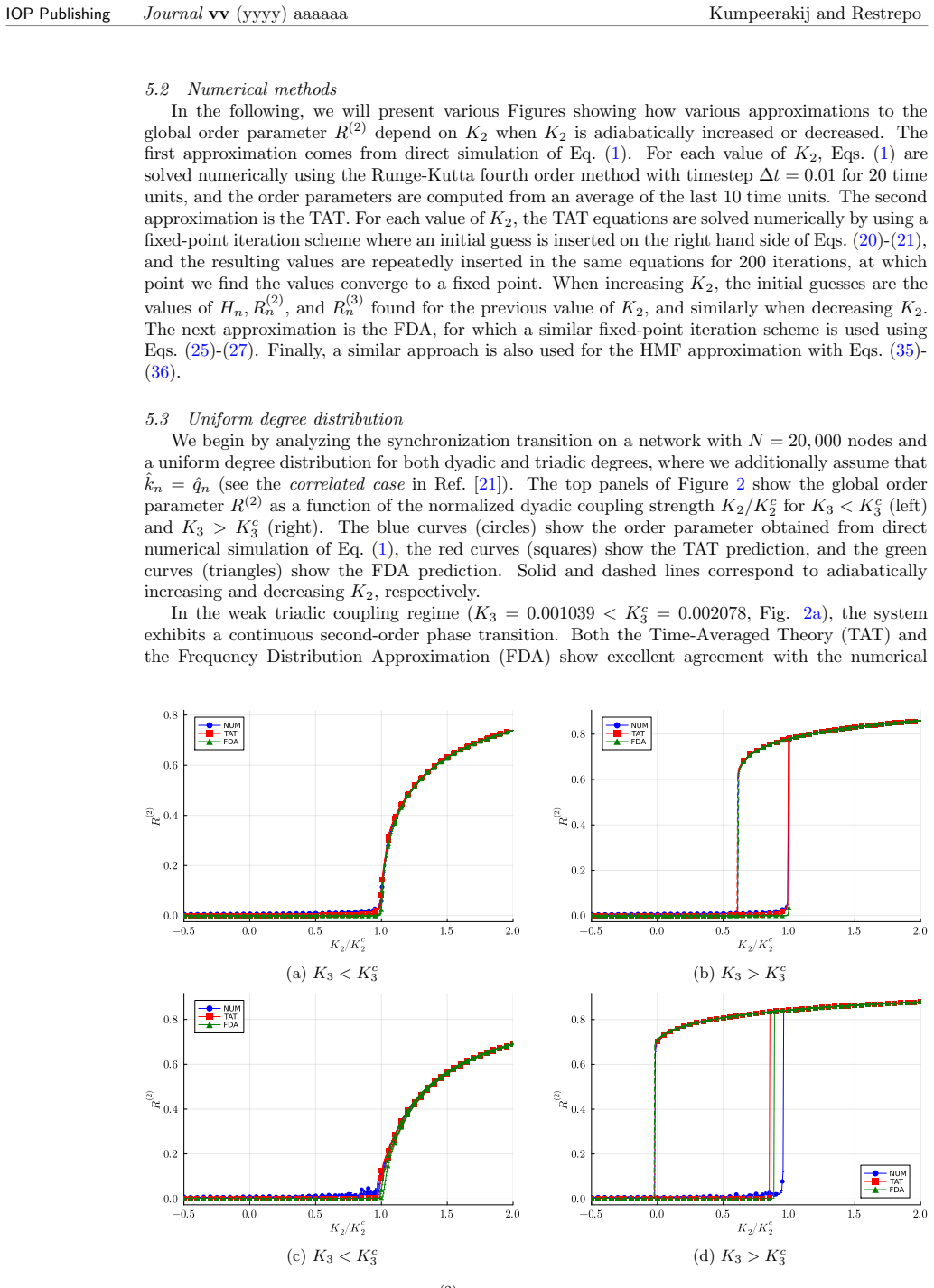
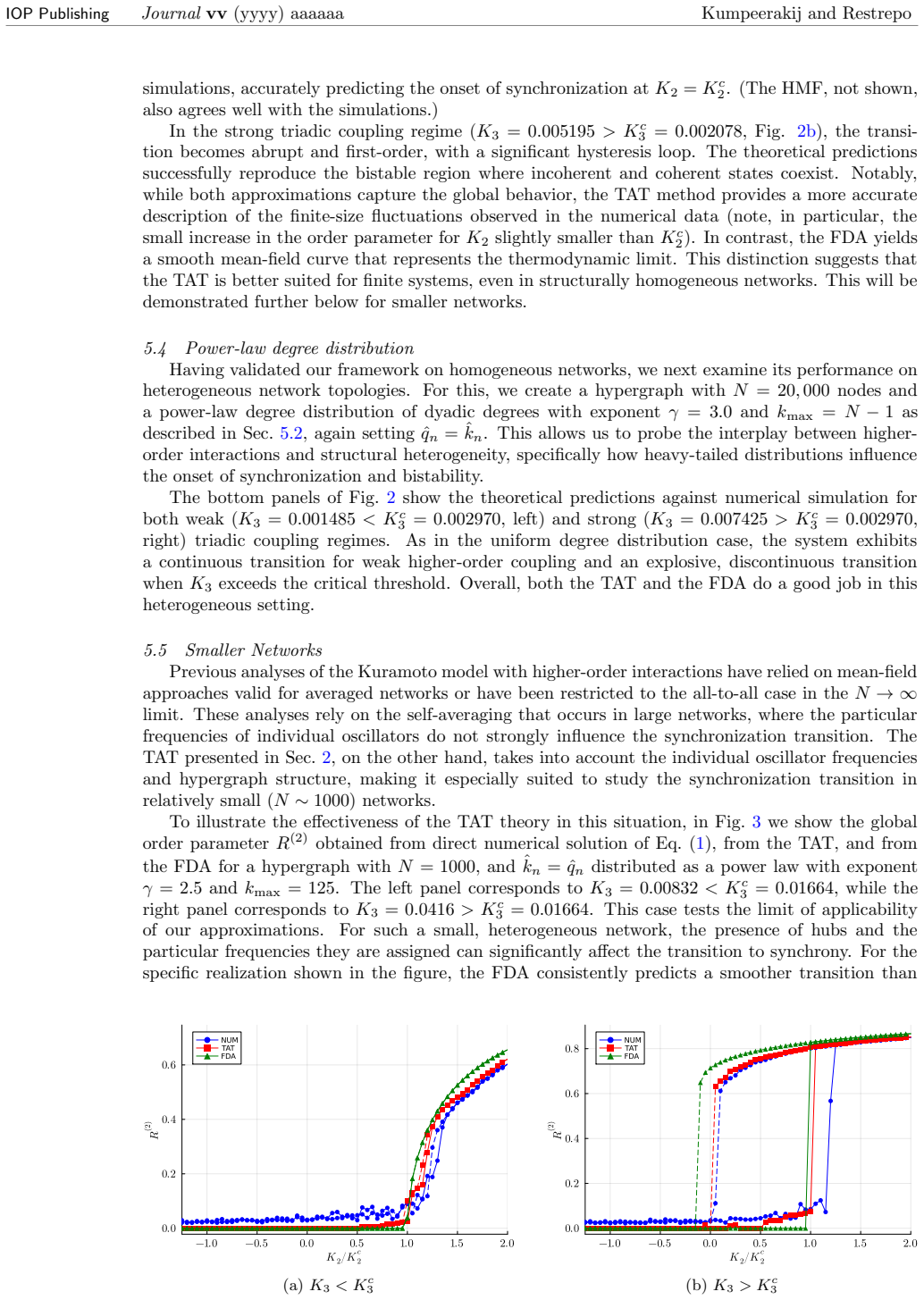
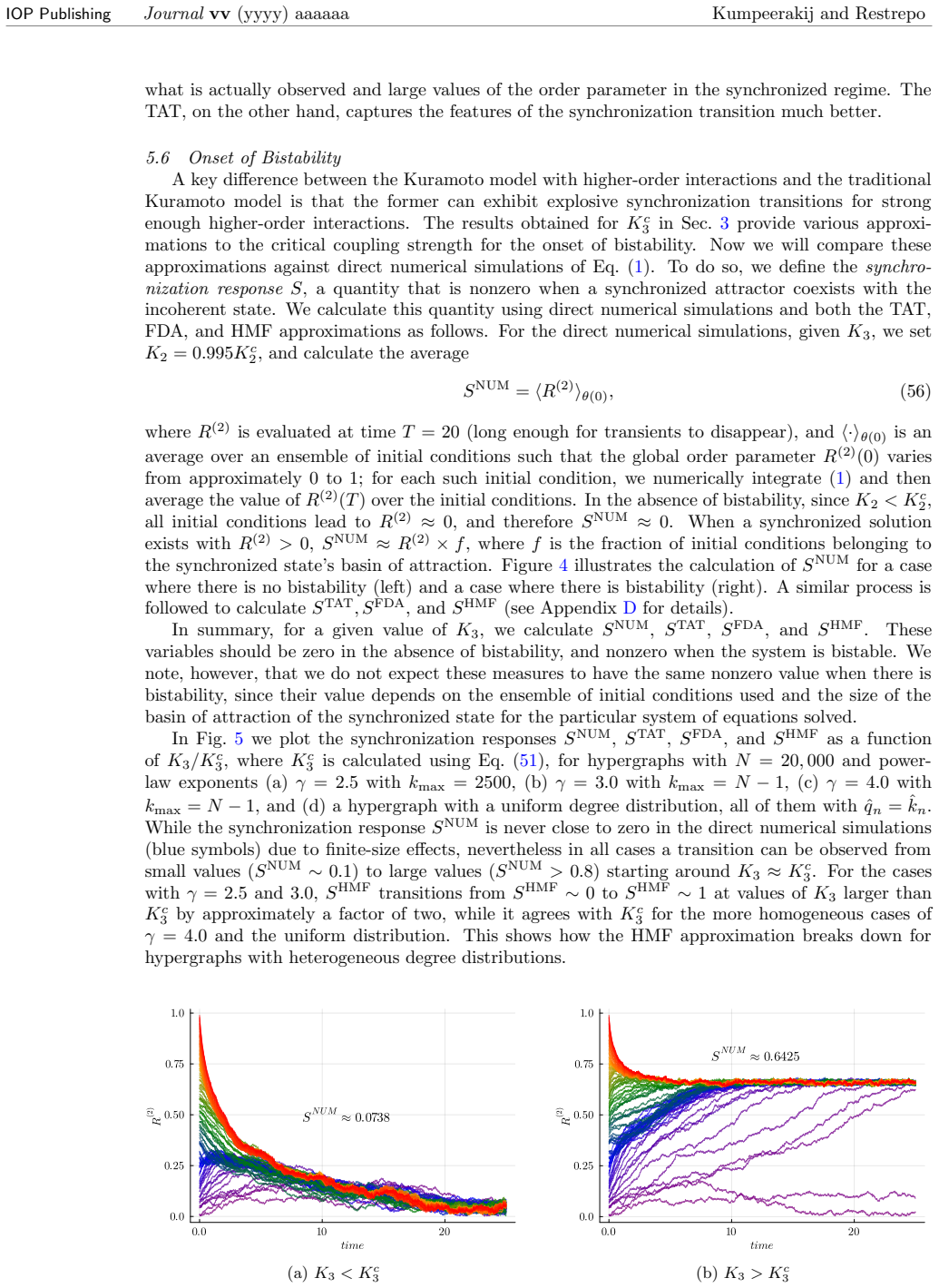
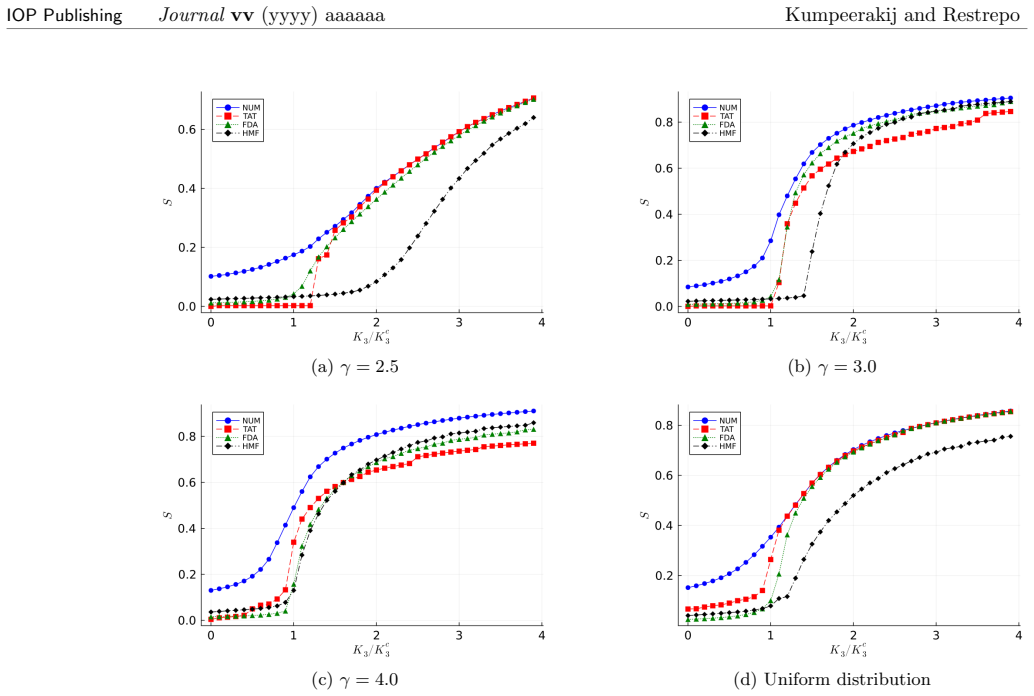


read the original abstract
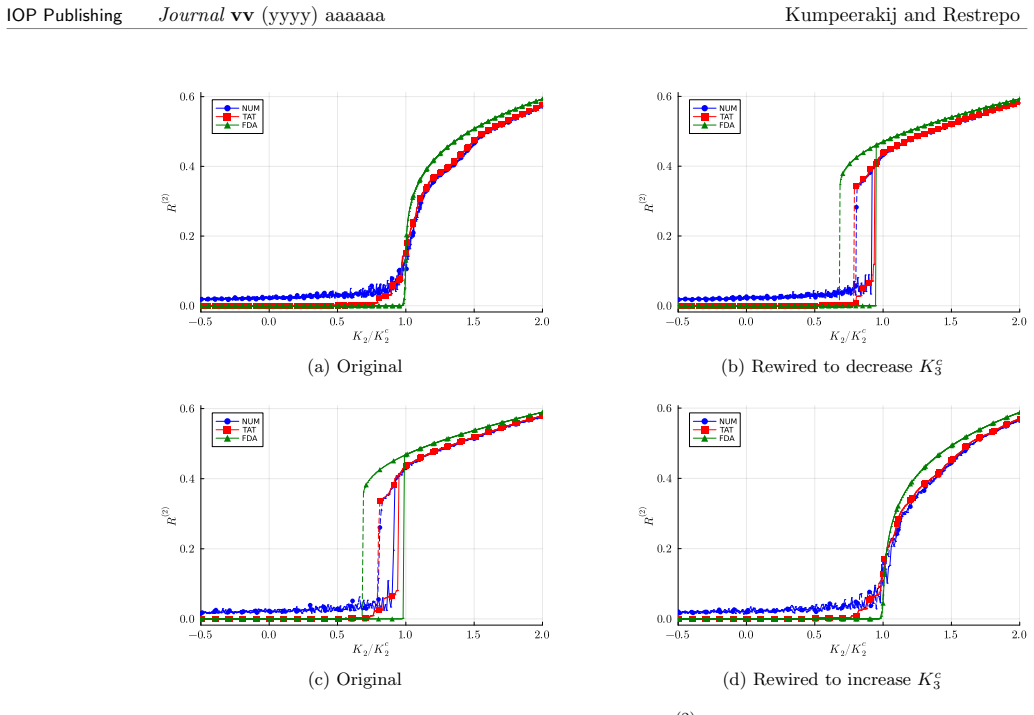
The Kuramoto model with higher-order interactions has recently been shown to exhibit bistability, explosive synchronization transitions, and rich collective dynamics. Existing analytical approaches, however, typically rely on all-to-all coupling or mean-field approximations of the underlying hypergraph structure. While these methods describe typical networks in the thermodynamic limit, they generally fail to capture the effects of finite hypergraph and oscillator frequency realizations. To address this limitation, we develop a self-consistent analytical framework for the Kuramoto model with dyadic and triadic interactions on hypergraphs. We introduce generalized local order parameters that capture the combined effects of dyadic and triadic phase correlations, and derive a hierarchy of approximation schemes for the local and global synchronization order parameters. Using these approximations, we determine critical coupling strengths for the onset of synchronization and bistability. In particular, we show that the critical triadic coupling strength governing the onset of bistability depends on correlations between the eigenvectors of the dyadic adjacency matrix and the triadic interaction structure. Numerical simulations on homogeneous and heterogeneous hypergraphs validate the theory and illustrate the distinct regimes of applicability of the approximation schemes.
Editorial analysis
A structured set of objections, weighed in public.
Referee Report
Summary. The manuscript develops a self-consistent analytical framework for the Kuramoto model with both dyadic and triadic interactions on hypergraphs. It introduces generalized local order parameters that incorporate combined dyadic-triadic phase correlations and derives a hierarchy of approximation schemes for local and global synchronization order parameters. Using these, the authors obtain critical coupling strengths for the onset of synchronization and bistability, with the central claim that the critical triadic coupling governing bistability depends on correlations between the eigenvectors of the dyadic adjacency matrix and the triadic interaction structure. The framework is tested via numerical simulations on homogeneous and heterogeneous hypergraphs.
Significance. If the hierarchy of approximations remains quantitatively accurate for finite hypergraphs and general frequency distributions, the work would provide a useful advance over thermodynamic-limit or all-to-all mean-field treatments by linking bistability thresholds directly to structural eigenvector correlations in higher-order networks.
major comments (1)
- [Hierarchy of approximation schemes for local and global order parameters] The derivation of the hierarchy of approximation schemes (described in the abstract and the section introducing the self-consistent equations): the central claim that the critical triadic coupling depends on eigenvector correlations is obtained by closing the equations for the generalized local order parameters via truncation or averaging of higher-order phase correlations. The manuscript must supply explicit conditions, error estimates, or numerical diagnostics showing that this closure does not shift the effective threshold by an O(1) amount on typical finite-N hypergraphs with non-uniform frequencies; otherwise the claimed structural dependence cannot be guaranteed to appear in the actual dynamics.
minor comments (1)
- [Abstract] The abstract states that the framework 'contrasts with thermodynamic-limit or all-to-all methods' but does not specify the precise form of the generalized local order parameters or the truncation level used in each scheme in the hierarchy; adding one sentence on these points would improve clarity.
Simulated Author's Rebuttal
We thank the referee for the careful reading and constructive major comment. We respond point-by-point below.
read point-by-point responses
-
Referee: The derivation of the hierarchy of approximation schemes (described in the abstract and the section introducing the self-consistent equations): the central claim that the critical triadic coupling depends on eigenvector correlations is obtained by closing the equations for the generalized local order parameters via truncation or averaging of higher-order phase correlations. The manuscript must supply explicit conditions, error estimates, or numerical diagnostics showing that this closure does not shift the effective threshold by an O(1) amount on typical finite-N hypergraphs with non-uniform frequencies; otherwise the claimed structural dependence cannot be guaranteed to appear in the actual dynamics.
Authors: We thank the referee for this important observation on the validity of the closures. The manuscript already reports numerical simulations on finite-N homogeneous and heterogeneous hypergraphs with non-uniform frequency distributions; these show quantitative agreement with the predicted critical triadic couplings and their dependence on dyadic-triadic eigenvector correlations, indicating that the truncations do not produce O(1) threshold shifts in the tested cases. In revision we will add explicit numerical diagnostics (error between closed-form and simulated order parameters versus N and frequency variance) together with a short discussion of the observed applicability regimes. We note that fully rigorous a-priori error bounds for arbitrary hypergraphs remain outside the present scope. revision: partial
Circularity Check
No circularity detected; derivation self-contained via independent approximations
full rationale
The provided abstract and context describe a self-consistent framework deriving critical couplings from generalized local order parameters and a hierarchy of approximations on hypergraphs. No equations or sections are available to quote that would exhibit self-definitional reduction, fitted inputs renamed as predictions, or load-bearing self-citations. The central claim on eigenvector correlations for bistability onset is presented as emerging from the derived hierarchy rather than by construction from inputs, and the paper explicitly positions the approach as independent of thermodynamic-limit assumptions. This is the expected honest non-finding for a derivation that remains self-contained against external benchmarks.
Axiom & Free-Parameter Ledger
invented entities (1)
-
generalized local order parameters
no independent evidence
Reference graph
Works this paper leans on
-
[1]
Rohden M, Sorge A, Timme M and Witthaut D 2012Physical Review Letters109ISSN 1079- 7114 URLhttp://dx.doi.org/10.1103/PhysRevLett.109.064101 17 IOP PublishingJournalvv(yyyy) aaaaaa Kumpeerakij and Restrepo
-
[2]
Varela F, Lachaux J P, Rodriguez E and Martinerie J 2001Nature Reviews Neuroscience2 229–239 URLhttps://doi.org/10.1038/35067550
-
[3]
Breakspear M 2017Nature Neuroscience20340–351 URLhttps://www.nature.com/ articles/nn.4497
-
[4]
N´ eda Z, Ravasz E, Vicsek T, Brechet Y and Barab´ asi A L 2000Phys. Rev. E61(6) 6987–6992 URLhttps://link.aps.org/doi/10.1103/PhysRevE.61.6987
-
[5]
Castellano C, Fortunato S and Loreto V 2009Rev. Mod. Phys.81(2) 591–646 URLhttps: //link.aps.org/doi/10.1103/RevModPhys.81.591
-
[6]
Acebr´ on J A, Bonilla L L, P´ erez Vicente C J, Ritort F and Spigler R 2005Rev. Mod. Phys. 77(1) 137–185 URLhttps://link.aps.org/doi/10.1103/RevModPhys.77.137
-
[7]
Kuramoto YSelf-entrainment of a population of coupled non-linear oscillators(Springer-Verlag) p 420–422 ISBN 3540071741 URLhttp://dx.doi.org/10.1007/BFb0013365
-
[8]
Strogatz S H 2000Physica D: Nonlinear Phenomena1431–20 ISSN 0167-2789 URLhttp: //dx.doi.org/10.1016/S0167-2789(00)00094-4
-
[9]
Iacopini I, Karsai M and Barrat A 2024Nature Communications15ISSN 2041-1723 URL http://dx.doi.org/10.1038/s41467-024-50918-5
-
[10]
Yu S, Yang H, Nakahara H, Santos G S, Nikoli´ c D and Plenz D 2011The Journal of Neu- roscience3117514–17526 ISSN 1529-2401 URLhttp://dx.doi.org/10.1523/JNEUROSCI. 3127-11.2011
-
[11]
Combrisson E, Basanisi R, Neri M, Auzias G, Petri G, Marinazzo D, Panzeri S and Brov- elli A 2025Nature Communications16ISSN 2041-1723 URLhttp://dx.doi.org/10.1038/ s41467-025-62507-1
2041
-
[12]
Bullmore E and Sporns O 2009Nature Reviews Neuroscience10312–312 ISSN 1471-0048 URL http://dx.doi.org/10.1038/nrn2618
-
[13]
Ashwin P and Rodrigues A 2016Physica D: Nonlinear Phenomena32514–24 ISSN 0167-2789 URLhttps://www.sciencedirect.com/science/article/pii/S0167278915300439
-
[14]
Le´ on I and Paz´ o D 2019Phys. Rev. E100(1) 012211 URLhttps://link.aps.org/doi/10. 1103/PhysRevE.100.012211
-
[15]
Battiston F, Cencetti G, Iacopini I, Latora V, Lucas M, Patania A, Young J G and Petri G 2020 Physics Reports8741–92 ISSN 0370-1573 URLhttp://dx.doi.org/10.1016/j.physrep. 2020.05.004
-
[16]
doi.org/10.1038/s42005-020-00485-0
Skardal P S and Arenas A 2020Communications Physics3ISSN 2399-3650 URLhttp://dx. doi.org/10.1038/s42005-020-00485-0
-
[17]
Skardal P S and Arenas A 2019Phys. Rev. Lett.122(24) 248301 URLhttps://link.aps.org/ doi/10.1103/PhysRevLett.122.248301
-
[18]
Skardal P S, Arola-Fern´ andez L, Taylor D and Arenas A 2021Phys. Rev. Res.3(4) 043193 URL https://link.aps.org/doi/10.1103/PhysRevResearch.3.043193
-
[19]
Xu C, Wang X and Skardal P S 2020Phys. Rev. Res.2(2) 023281 URLhttps://link.aps. org/doi/10.1103/PhysRevResearch.2.023281
-
[20]
Sabhahit N G, Khurd A S and Jalan S 2024Physical Review E109ISSN 2470-0053 URL http://dx.doi.org/10.1103/PhysRevE.109.024212
-
[21]
Adhikari S, Restrepo J G and Skardal P S 2023Chaos: An Interdisciplinary Journal of Nonlinear Science33ISSN 1089-7682 URLhttp://dx.doi.org/10.1063/5.0116747
-
[22]
Iacopini I, Petri G, Barrat A and Latora V 2019Nature Communications102485 URLhttps: //www.nature.com/articles/s41467-019-10431-6
-
[23]
de Arruda G F, Petri G and Moreno Y 2020Physical Review Research2023032 URLhttps: //journals.aps.org/prresearch/abstract/10.1103/PhysRevResearch.2.023032 18 IOP PublishingJournalvv(yyyy) aaaaaa Kumpeerakij and Restrepo
-
[24]
Landry N W and Restrepo J G 2022Chaos: An Interdisciplinary Journal of Nonlinear Science 32ISSN 1089-7682 URLhttp://dx.doi.org/10.1063/5.0086905
-
[25]
Grilli J, Barab´ as G, Michalska-Smith M J and Allesina S 2017Nature548210–213 URLhttps: //www.nature.com/articles/nature23273
-
[26]
Ott E and Antonsen T M 2008Chaos: An Interdisciplinary Journal of Nonlinear Science18 ISSN 1089-7682 URLhttp://dx.doi.org/10.1063/1.2930766
-
[27]
Restrepo J G, Ott E and Hunt B R 2005Physical Review E71ISSN 1550-2376 URLhttp: //dx.doi.org/10.1103/PhysRevE.71.036151
-
[28]
Ichinomiya T 2004Phys. Rev. E70(2) 026116 URLhttps://link.aps.org/doi/10.1103/ PhysRevE.70.026116
-
[29]
Lee D S 2005Phys. Rev. E72(2) 026208 URLhttps://link.aps.org/doi/10.1103/ PhysRevE.72.026208
-
[30]
Barlev G, Antonsen T M and Ott E 2011Chaos: An Interdisciplinary Journal of Nonlinear Science21025103 ISSN 1054-1500 (Preprinthttps://pubs.aip.org/aip/ cha/article-pdf/doi/10.1063/1.3596711/14605917/025103_1_online.pdf) URLhttps: //doi.org/10.1063/1.3596711
work page doi:10.1063/1.3596711/14605917/025103_1_online.pdf
-
[31]
Restrepo J G and Ott E 2014Europhysics Letters10760006 URLhttps://doi.org/10.1209/ 0295-5075/107/60006
-
[32]
Rodrigues F A, Peron T K D, Ji P and Kurths J 2016Physics Reports6101–98 ISSN 0370-1573 the Kuramoto model in complex networks URLhttps://www.sciencedirect.com/science/ article/pii/S0370157315004408
-
[33]
Wang X, Zheng Z and Xu C 2021Phys. Rev. E104(5) 054208 URLhttps://link.aps.org/ doi/10.1103/PhysRevE.104.054208
-
[34]
Xu C, Zhai Y, Wu Y, Zheng Z and Guan S 2023Chaos, Solitons & Fractals 170113343 ISSN 0960-0779 URLhttps://www.sciencedirect.com/science/article/pii/ S0960077923002448
-
[35]
Mill´ an A P, Torres J J and Bianconi G 2020Phys. Rev. Lett.124(21) 218301 URLhttps: //link.aps.org/doi/10.1103/PhysRevLett.124.218301
-
[36]
Bick C, Gross E, Harrington H A and Schaub M T 2023SIAM Review65686–731 URL https://doi.org/10.1137/21M1414024
-
[37]
Pastor-Satorras R, Castellano C, Van Mieghem P and Vespignani A 2015Rev. Mod. Phys.87(3) 925–979 URLhttps://link.aps.org/doi/10.1103/RevModPhys.87.925
-
[38]
Dorogovtsev S N, Goltsev A V and Mendes J F F 2008Rev. Mod. Phys.80(4) 1275–1335 URL https://link.aps.org/doi/10.1103/RevModPhys.80.1275
-
[39]
Castellano C and Pastor-Satorras R 2010Phys. Rev. Lett.105(21) 218701 URLhttps://link. aps.org/doi/10.1103/PhysRevLett.105.218701
-
[40]
Goltsev A V, Dorogovtsev S N, Oliveira J G and Mendes J F F 2012Phys. Rev. Lett.109(12) 128702 URLhttps://link.aps.org/doi/10.1103/PhysRevLett.109.128702
-
[41]
Chung F and Lu L 2002Annals of Combinatorics6125–145 ISSN 0218-0006 URLhttp: //dx.doi.org/10.1007/PL00012580
-
[42]
Zhou D, Huang J and Sch¨ olkopf B 2007Learning with Hypergraphs: Clustering, Classification, and Embedding(The MIT Press) p 1601–1608 ISBN 9780262256919 URLhttp://dx.doi.org/ 10.7551/mitpress/7503.003.0205
-
[43]
Stasi D, Sadeghi K, Rinaldo A, Petrovi´ c S and Fienberg S E 2014βmodels for random hyper- graphs with a given degree sequence URLhttps://arxiv.org/abs/1407.1004
work page internal anchor Pith review Pith/arXiv arXiv
-
[44]
Matamalas J T, G´ omez S and Arenas A 2020Physical Review Research2012049 URLhttps: //journals.aps.org/prresearch/abstract/10.1103/PhysRevResearch.2.012049 19 IOP PublishingJournalvv(yyyy) aaaaaa Kumpeerakij and Restrepo
-
[45]
Kumpeerakij C 2024 Self-consistence-km: Numerical simulations and analytical framework for higher-order kuramoto modelshttps://github.com/chku-ucb/self-consistence-km.git
2024
-
[46]
Newman M E 2003Physical review E67026126 URLhttps://journals.aps.org/pre/ abstract/10.1103/PhysRevE.67.026126 Appendix A Derivation of Eq. (13) To derive Eq. (13), we need to show that the second and third terms on the right-hand side of Eq. (12) are zero. The second term can be rewritten as X |ωm|≤Hm Anm ωm Hm = NX m=1 Anm ωm Hm I[−Hm,Hm](ωm) (58) = NX m...
discussion (0)
Sign in with ORCID, Apple, or X to comment. Anyone can read and Pith papers without signing in.