Energy Shields for Fairness
Pith reviewed 2026-06-30 11:40 UTC · model grok-4.3
The pith
Energy shields intervene probabilistically using energy functions to deliver both short-term safety and long-term liveness for runtime fairness.
A machine-rendered reading of the paper's core claim, the machinery that carries it, and where it could break.
Core claim
An energy shield is a lightweight adaptive controller that monitors a sequence of decisions and intervenes probabilistically, utilizing physics-inspired energy functions to nudge the sequence toward fairness: the more unfair the decisions, the stronger the nudging force becomes. This makes energy shields the first fairness shields to provide both short-term safety (the running fairness measure stays within a running target interval with high probability) and long-term liveness guarantees (the limit of the fairness measure lies within the limit target interval), together with a synthesis procedure for constructing the least intrusive energy shield for a given target specification.
What carries the argument
Physics-inspired energy functions that scale the probability of probabilistic interventions according to accumulated unfairness in the decision sequence.
If this is right
- The running fairness measure remains inside its short-term target interval with high probability throughout operation.
- The fairness measure converges to its long-term target interval in the limit.
- A synthesis algorithm produces the least intrusive controller meeting any supplied pair of short-term and long-term targets.
- Experimental comparisons show the synthesized shields are efficient relative to prior deterministic fairness shields.
Where Pith is reading between the lines
- The same energy-function approach could be reused to enforce other accumulating runtime properties such as bounded regret or safety margins.
- Because interventions remain probabilistic, the shields could be combined with learned predictors that estimate the probability of each possible decision.
- The least-intrusive synthesis criterion directly reduces the expected number of overrides, which matters in high-stakes sequential decision settings.
Load-bearing premise
A synthesis procedure exists that can construct, for any given target specification, an energy shield whose probabilistic interventions achieve the stated safety and liveness properties while remaining the least intrusive.
What would settle it
A fairness specification for which either no energy shield satisfies both the high-probability short-term bound and the long-term limit condition, or the synthesized shield produces more interventions than a deterministic baseline while violating the probabilistic guarantee.
Figures

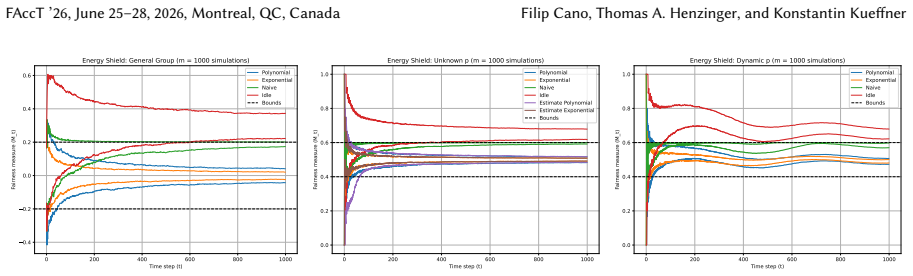
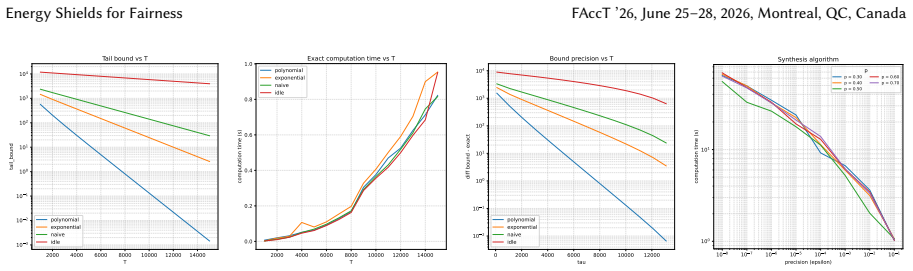
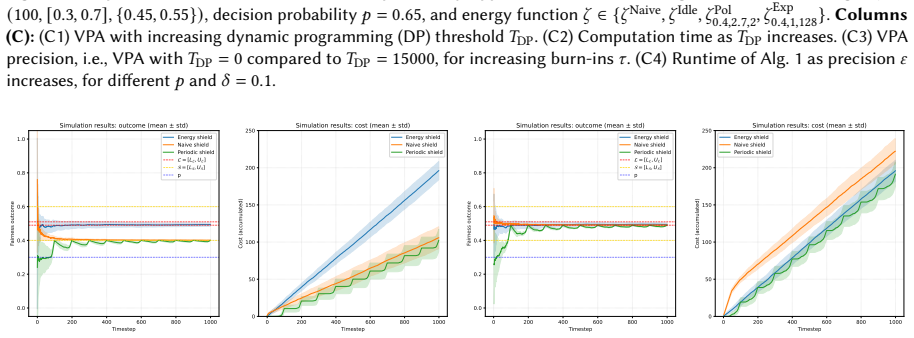
read the original abstract
Runtime fairness is not a one-time constraint but a dynamic property evaluated over a sequence of decisions. To ensure fairness at runtime, it is necessary to account for past decisions, information neglected by conventional, static classifiers. Traditional fairness shields enforce runtime fairness abruptly, by intervening \emph{deterministically} whenever a sequence of decisions violates the target for a running fairness measure. This motivates our \emph{main conceptual contribution: \textbf{energy shields}.} An energy shield is a novel, lightweight, adaptive controller that monitors a sequence of decisions and intervenes \emph{probabilistically} to ensure runtime fairness smoothly, by utilizing physics-inspired energy functions to nudge the sequence toward fairness: the more unfair the decisions, the stronger the nudging force becomes. This makes energy shields the \emph{\textbf{first}} fairness shields to provide both \emph{short-term safety and long-term liveness guarantees}. Safety ensures that the running fairness measure stays within a running target interval with high probability, and liveness ensures that the limit of the fairness measure lies within the limit target interval. Intuitively, the short-term specifies the tolerated fairness values and the long-term specifies the desired fairness values. We also provide a synthesis procedure for constructing the least intrusive energy shield for a given target specification, and demonstrate its efficiency experimentally. We evaluate our energy shields against existing fairness shields through the lens of short- and long-term fairness.
Editorial analysis
A structured set of objections, weighed in public.
Referee Report
Summary. The paper introduces energy shields as probabilistic, physics-inspired controllers for enforcing runtime fairness over sequences of decisions. Unlike deterministic fairness shields that intervene abruptly on violations of a running fairness measure, energy shields monitor decisions and apply probabilistic nudges whose strength increases with unfairness, using energy functions. The central claims are that these shields are the first to simultaneously provide short-term safety (the running fairness measure remains in a target interval with high probability) and long-term liveness (the limiting fairness measure lies in the target interval), that a synthesis procedure exists to construct the least-intrusive such shield for any given target specification, and that experiments demonstrate efficiency relative to prior shields.
Significance. If the formal construction, probabilistic guarantees, and synthesis procedure hold, the work would advance runtime fairness enforcement by replacing abrupt deterministic interventions with smoother, tunable probabilistic ones while supplying both finite-horizon safety and asymptotic liveness. The explicit separation of short-term tolerated intervals from long-term desired intervals, together with the least-intrusive synthesis, could make fairness shields more practical in sequential settings such as lending or hiring pipelines.
major comments (2)
- [Abstract / Synthesis Procedure] The abstract asserts that a synthesis procedure constructs the least-intrusive energy shield achieving both the high-probability short-term safety bound and the long-term liveness condition, yet supplies no derivation, complexity statement, or statement of the conditions under which the procedure is guaranteed to succeed. This is load-bearing for the practicality claim.
- [Related Work] The claim that energy shields are the 'first' to provide both short-term safety and long-term liveness requires an explicit comparison, in the related-work section, to all prior deterministic and probabilistic fairness shields; without it the novelty statement cannot be evaluated.
minor comments (1)
- [Abstract] The abstract would be clearer if it briefly indicated the experimental domains and the concrete fairness measures used in the evaluation against existing shields.
Simulated Author's Rebuttal
We thank the referee for the thoughtful review and positive recommendation. We address each major comment below and will incorporate revisions as indicated.
read point-by-point responses
-
Referee: [Abstract / Synthesis Procedure] The abstract asserts that a synthesis procedure constructs the least-intrusive energy shield achieving both the high-probability short-term safety bound and the long-term liveness condition, yet supplies no derivation, complexity statement, or statement of the conditions under which the procedure is guaranteed to succeed. This is load-bearing for the practicality claim.
Authors: The comment is correct: the current manuscript states that a synthesis procedure exists but does not include its derivation, complexity analysis, or success conditions. We will revise the paper to add these elements. Specifically, we will include a formal derivation of the least-intrusive shield (based on minimizing the expected energy deviation subject to the probabilistic safety constraint), state its polynomial complexity under finite decision alphabets, and specify the conditions (non-empty target intervals and continuous energy functions). These additions will appear in Section 4 and the abstract will be updated to reference them. revision: yes
-
Referee: [Related Work] The claim that energy shields are the 'first' to provide both short-term safety and long-term liveness requires an explicit comparison, in the related-work section, to all prior deterministic and probabilistic fairness shields; without it the novelty statement cannot be evaluated.
Authors: We agree that the novelty claim requires substantiation through explicit comparison. The manuscript discusses prior shields but lacks a systematic side-by-side analysis. We will revise the related-work section to add a comparison table (or structured paragraph) that enumerates all cited deterministic and probabilistic fairness shields, indicating which guarantees each provides or lacks. This will directly support the 'first' claim by showing the absence of both short-term safety and long-term liveness in prior work. revision: yes
Circularity Check
No significant circularity
full rationale
The paper defines a new controller class (energy shields) via physics-inspired energy functions and states that a synthesis procedure exists to construct the least-intrusive instance meeting the stated safety/liveness properties. No equations, fitted parameters, or self-citations appear in the provided text that would reduce any claimed prediction or guarantee to an input by construction. The central claims rest on the novel definition and the asserted existence of the synthesis procedure rather than on any renaming, self-referential fitting, or load-bearing prior result from the same authors.
Axiom & Free-Parameter Ledger
invented entities (1)
-
energy shield
no independent evidence
Reference graph
Works this paper leans on
-
[1]
Alekh Agarwal, Alina Beygelzimer, Miroslav Dudík, John Langford, and Hanna Wallach. 2018. A reductions approach to fair classification. InInternational Conference on Machine Learning (ICML). PMLR, 60–69
2018
-
[2]
Alamdari, Toryn Q
Parand A. Alamdari, Toryn Q. Klassen, Elliot Creager, and Sheila A. Mcilraith. 2024. Remembering to Be Fair: Non-Markovian Fairness in Sequential Decision Making. InProceedings of the International Conference on Machine Learning (ICML), Vol. 235. 906–920
2024
-
[3]
Aws Albarghouthi, Loris D’Antoni, Samuel Drews, and Aditya V Nori. 2017. Fairsquare: probabilistic verification of program fairness. Proceedings of the ACM on Programming Languages1, OOPSLA (2017), 1–30
2017
-
[4]
Aws Albarghouthi and Samuel Vinitsky. 2019. Fairness-aware programming. InProceedings of the Conference on Fairness, Accountability, and Transparency. 211–219
2019
-
[5]
Mohammed Alshiekh, Roderick Bloem, Rüdiger Ehlers, Bettina Könighofer, Scott Niekum, and Ufuk Topcu. 2018. Safe reinforcement learning via shielding. InProceedings of the AAAI conference on artificial intelligence
2018
-
[6]
Baier, B
C. Baier, B. Haverkort, H. Hermanns, and J.-P. Katoen. 2003. Model-checking algorithms for continuous-time Markov chains.IEEE Transactions on Software Engineering29, 6 (2003), 524–541
2003
-
[7]
2008.Principles of model checking
Christel Baier and Joost-Pieter Katoen. 2008.Principles of model checking. MIT press
2008
-
[8]
Ezio Bartocci, Jyotirmoy Deshmukh, Alexandre Donzé, Georgios Fainekos, Oded Maler, Dejan Ničković, and Sriram Sankaranarayanan
-
[9]
InLectures on Runtime Verification
Specification-based monitoring of cyber-physical systems: a survey on theory, tools and applications. InLectures on Runtime Verification. Springer, 135–175
-
[10]
Osbert Bastani, Xin Zhang, and Armando Solar-Lezama. 2019. Probabilistic verification of fairness properties via concentration. Proceedings of the ACM on Programming Languages3, OOPSLA (2019), 1–27
2019
-
[11]
Jan Baumeister, Bernd Finkbeiner, Frederik Scheerer, Julian Siber, and Tobias Wagenpfeil. 2025. Stream-Based Monitoring of Algorithmic Fairness. InInternational Conference on Tools and Algorithms for the Construction and Analysis of Systems. Springer, 60–81
2025
-
[12]
Barry Becker and Ronny Kohavi. 1996. Adult. UCI Machine Learning Repository. DOI: https://doi.org/10.24432/C5XW20
-
[13]
Vivek S. Borkar. 2008.Stochastic approximation: a dynamical systems viewpoint. Springer
2008
-
[14]
Henzinger, and Konstantin Kueffner
Filip Cano, Thomas A. Henzinger, and Konstantin Kueffner. 2025. Algorithmic Fairness: A Runtime Perspective. InProceedings of the International Conference on Runtime Verification (RV). 1–21
2025
-
[15]
Henzinger, Bettina Könighofer, Konstantin Kueffner, and Kaushik Mallik
Filip Cano, Thomas A. Henzinger, Bettina Könighofer, Konstantin Kueffner, and Kaushik Mallik. 2025. Fairness Shields: Safeguarding against Biased Decision Makers.Proceedings of the AAAI Conference on Artificial Intelligence39, 15 (2025), 15659–15668
2025
-
[16]
Steven Carr, Nils Jansen, Sebastian Junges, and Ufuk Topcu. 2023. Safe reinforcement learning via shielding under partial observability. InProceedings of the AAAI conference on artificial intelligence, Vol. 37. 14748–14756
2023
-
[17]
Simon Caton and Christian Haas. 2020. Fairness in machine learning: A survey.Comput. Surveys(2020)
2020
-
[18]
Ching-Yao Chuang and Youssef Mroueh. 2021. Fair Mixup: Fairness via Interpolation. InInternational Conference on Learning Represen- tations (ICLR). OpenReview.net. Energy Shields for Fairness FAccT ’26, June 25–28, 2026, Montreal, QC, Canada
2021
-
[19]
Filip Cano Córdoba, Alexander Palmisano, Martin Fränzle, Roderick Bloem, and Bettina Könighofer. 2023. Safety shielding under delayed observation. InProceedings of the International Conference on Automated Planning and Scheduling, Vol. 33. 80–85
2023
-
[20]
Alexander D’Amour, Hansa Srinivasan, James Atwood, Pallavi Baljekar, David Sculley, and Yoni Halpern. 2020. Fairness is not static: deeper understanding of long term fairness via simulation studies. InProceedings of the Conference on Fairness, Accountability, and Transparency (FAccT). 525–534
2020
-
[21]
Alexandre Donzé and Oded Maler. 2010. Robust satisfaction of temporal logic over real-valued signals. InInternational Conference on Formal Modeling and Analysis of Timed Systems. Springer, 92–106
2010
-
[22]
Cynthia Dwork, Moritz Hardt, Toniann Pitassi, Omer Reingold, and Richard Zemel. 2012. Fairness through awareness. InProceedings of the 3rd innovations in theoretical computer science conference. 214–226
2012
-
[23]
Peter Faymonville, Bernd Finkbeiner, Maximilian Schwenger, and Hazem Torfah. 2017. Real-time stream-based monitoring.arXiv preprint arXiv:1711.03829
work page internal anchor Pith review Pith/arXiv arXiv 2017
-
[24]
Michael Feldman, Sorelle A Friedler, John Moeller, Carlos Scheidegger, and Suresh Venkatasubramanian. 2015. Certifying and removing disparate impact. InProceedings of the 21th ACM SIGKDD International Conference on Knowledge Discovery and Data Mining (KDD). 259–268
2015
-
[25]
Bishwamittra Ghosh, Debabrota Basu, and Kuldeep S Meel. 2021. Justicia: A stochastic SAT approach to formally verify fairness. In Proceedings of the AAAI Conference on Artificial Intelligence (AAAI), Vol. 35. 7554–7563
2021
-
[26]
Paula Gordaliza, Eustasio Del Barrio, Gamboa Fabrice, and Jean-Michel Loubes. 2019. Obtaining fairness using optimal transport theory. InInternational Conference on Machine Learning (ICML). PMLR, 2357–2365
2019
-
[27]
Henzinger, Konstantin Kueffner, Kaushik Mallik, and David Pape
Ashutosh Gupta, Thomas A. Henzinger, Konstantin Kueffner, Kaushik Mallik, and David Pape. 2025. Monitoring Robustness and Individual Fairness. InKDD 2025
2025
-
[28]
Moritz Hardt, Eric Price, and Nati Srebro. 2016. Equality of Opportunity in Supervised Learning. InAdvances in Neural Information Processing Systems (NeurIPS). 3315–3323
2016
-
[29]
Henzinger, Mahyar Karimi, Konstantin Kueffner, and Kaushik Mallik
Thomas A. Henzinger, Mahyar Karimi, Konstantin Kueffner, and Kaushik Mallik. 2023. Runtime Monitoring of Dynamic Fairness Properties. InProceedings of the ACM Conference on Fairness, Accountability, and Transparency (FAccT). ACM, 604–614
2023
-
[30]
Thomas A Henzinger, Nicolas Mazzocchi, and N Ege Saraç. 2023. Quantitative Safety and Liveness.. InFoSSaCS. 349–370
2023
-
[31]
Hans Hofmann. 1994. Statlog (German Credit Data). UCI Machine Learning Repository. DOI: https://doi.org/10.24432/C5NC77
-
[32]
Nils Jansen, Bettina Könighofer, Sebastian Junges, Alex Serban, and Roderick Bloem. 2020. Safe Reinforcement Learning Using Probabilistic Shields (Invited Paper). InCONCUR (LIPIcs, Vol. 171). Schloss Dagstuhl - Leibniz-Zentrum für Informatik, 3:1–3:16
2020
-
[33]
Rajeeva Laxman Karandikar and Mathukumalli Vidyasagar. 2024. Convergence rates for stochastic approximation: Biased noise with unbounded variance, and applications.Journal of Optimization Theory and Applications203, 3 (2024), 2412–2450
2024
-
[34]
Joost-Pieter Katoen. 2016. The probabilistic model checking landscape. InProceedings of the 31st Annual ACM/IEEE Symposium on Logic in Computer Science. 31–45
2016
-
[35]
Lauren Kirchner, Surya Mattu, Jeff Larson, and Julia Angwin. 2016. Machine Bias.ProPublica(2016). https://www.propublica.org/ article/machine-bias-risk-assessments-in-criminal-sentencing
2016
-
[36]
Leslie Lamport. 1977. Proving the correctness of multiprocess programs.IEEE transactions on software engineering2 (1977), 125–143
1977
-
[37]
Yannan Li, Jingbo Wang, and Chao Wang. 2023. Certifying the Fairness of KNN in the Presence of Dataset Bias. InInternational Conference on Computer Aided Verification (CA V). Springer
2023
-
[38]
Lydia T Liu, Sarah Dean, Esther Rolf, Max Simchowitz, and Moritz Hardt. 2018. Delayed impact of fair machine learning. InInternational Conference on Machine Learning. PMLR, 3150–3158
2018
-
[39]
Oded Maler and Dejan Nickovic. 2004. Monitoring temporal properties of continuous signals. InInternational Symposium on Formal Techniques in Real-Time and Fault-Tolerant Systems. Springer, 152–166
2004
-
[40]
Ninareh Mehrabi, Fred Morstatter, Nripsuta Saxena, Kristina Lerman, and Aram Galstyan. 2021. A survey on bias and fairness in machine learning.ACM Computing Surveys (CSUR)54, 6 (2021), 1–35
2021
-
[41]
Anna Meyer, Aws Albarghouthi, and Loris D’Antoni. 2021. Certifying Robustness to Programmable Data Bias in Decision Trees. Advances in Neural Information Processing Systems (NeurIPS)34 (2021), 26276–26288
2021
-
[42]
Adrián Pérez-Suay, Valero Laparra, Gonzalo Mateo-García, Jordi Muñoz-Marí, Luis Gómez-Chova, and Gustau Camps-Valls. 2017. Fair Kernel Learning. InMachine Learning and Knowledge Discovery in Databases (KDD), Michelangelo Ceci, Jaakko Hollmén, Ljupčo Todorovski, Celine Vens, and Sašo Džeroski (Eds.). Springer International Publishing, Cham, 339–355
2017
-
[43]
Herbert Robbins and David Siegmund. 1971. A convergence theorem for non negative almost supermartingales and some applications. InOptimizing methods in statistics. Elsevier, 233–257
1971
-
[44]
Scott D Stoller, Ezio Bartocci, Justin Seyster, Radu Grosu, Klaus Havelund, Scott A Smolka, and Erez Zadok. 2011. Runtime verification with state estimation. InInternational conference on runtime verification. Springer, 193–207
2011
-
[45]
Bing Sun, Jun Sun, Ting Dai, and Lijun Zhang. 2021. Probabilistic verification of neural networks against group fairness. InInternational Symposium on Formal Methods. Springer, 83–102. FAccT ’26, June 25–28, 2026, Montreal, QC, Canada Filip Cano, Thomas A. Henzinger, and Konstantin Kueffner
2021
-
[46]
Min Wen, Osbert Bastani, and Ufuk Topcu. 2021. Algorithms for fairness in sequential decision making. InInternational Conference on Artificial Intelligence and Statistics (AISTATS). PMLR, 1144–1152
2021
-
[47]
Wen-Chi Yang, Giuseppe Marra, Gavin Rens, and Luc De Raedt. 2023. Safe Reinforcement Learning via Probabilistic Logic Shields. In IJCAI. ijcai.org, 5739–5749
2023
-
[48]
almost surely
Muhammad Bilal Zafar, Isabel Valera, Manuel Gomez-Rodriguez, and Krishna P Gummadi. 2019. Fairness constraints: A flexible approach for fair classification.The Journal of Machine Learning Research20, 1 (2019), 2737–2778. A Detailed Proofs Claim 1(Shielded decision process).The shielded decision process generated by the energy shield can be written as a se...
2019
discussion (0)
Sign in with ORCID, Apple, or X to comment. Anyone can read and Pith papers without signing in.