Approximation algorithms for the prize-collecting rural postman problem
Pith reviewed 2026-06-30 00:01 UTC · model grok-4.3
The pith
A polynomial-time approximation algorithm for the prize-collecting rural postman problem achieves a ratio strictly smaller than 1.6.
A machine-rendered reading of the paper's core claim, the machinery that carries it, and where it could break.
Core claim
The authors prove the existence of a polynomial-time approximation algorithm for PCRPP with approximation ratio strictly smaller than 1.6 by means of a direct algorithmic construction that does not rely on solving a PCTSP instance.
What carries the argument
A direct algorithmic construction for PCRPP instances that produces solutions with objective value less than 1.6 times the optimum.
If this is right
- The PCRPP admits better approximation than the factor-two limit imposed by PCTSP reductions.
- Practical solutions for PCRPP on graphs with edge lengths and profits can be computed efficiently with small optimality gaps.
- Similar problems in postman and routing with prizes may benefit from direct constructions rather than reductions.
Where Pith is reading between the lines
- If the ratio can be improved further, it might approach the best known ratios for related problems like the rural postman problem.
- The benchmark performance suggests the algorithm could be useful in applications like network maintenance with optional edges.
Load-bearing premise
The central claim depends on the existence and correctness of a specific algorithmic construction whose ratio analysis stays below 1.6.
What would settle it
Finding a PCRPP instance where the new algorithm produces a solution whose cost is at least 1.6 times the optimal cost would falsify the ratio claim.
Figures
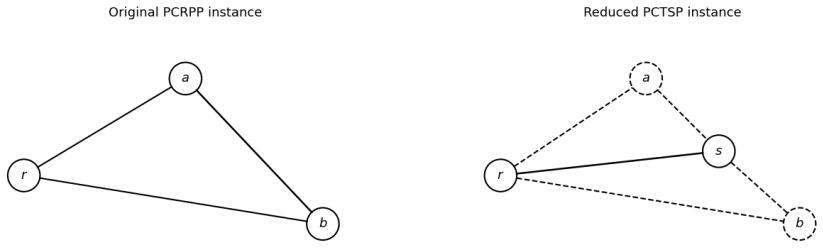
read the original abstract
In this paper, we study the prize-collecting rural postman problem (PCRPP), a variant of the rural postman problem. Given a PCRPP instance consisting of an undirected graph whose edges have nonnegative lengths and nonnegative profits, together with a root vertex, the goal is to find a closed walk that starts and ends at the root vertex and minimizes the sum of its length and the profits of all edges that the walk does not traverse. A natural way to design an approximation algorithm for the PCRPP is to construct a prize-collecting traveling salesman problem (PCTSP) instance from the given PCRPP instance, apply an approximation algorithm to the PCTSP instance, and then convert the resulting PCTSP solution into a PCRPP solution. We show that this approach has an inherent factor-two barrier: even if the constructed PCTSP instance is solved exactly, the resulting PCRPP solution can have objective value arbitrarily close to twice the optimum value of the original PCRPP instance. Our main result is a polynomial-time approximation algorithm with approximation ratio strictly smaller than 1.6 for the PCRPP. On a public 118-instance benchmark set, the proposed algorithm has average and maximum optimality gaps of 3.39\% and 12.12\%, respectively.
Editorial analysis
A structured set of objections, weighed in public.
Referee Report
Summary. The manuscript studies the prize-collecting rural postman problem (PCRPP) on undirected graphs with edge lengths and profits. It proves that any reduction to the prize-collecting TSP yields solutions whose PCRPP objective can be arbitrarily close to twice the optimum, even when the PCTSP instance is solved exactly. The central contribution is a distinct polynomial-time algorithm, constructed via prize-collecting matching followed by tree-doubling steps, whose charging argument establishes an approximation ratio strictly less than 1.6. On a 118-instance public benchmark the algorithm reports average and maximum optimality gaps of 3.39% and 12.12%.
Significance. The explicit factor-2 barrier clarifies a structural limitation of the natural reduction and justifies the need for a bespoke construction. The new ratio below 1.6 is a concrete improvement for a classic routing problem; the charging argument that splits the optimum into traversed and untraversed components appears self-contained and may extend to related prize-collecting problems. The reported benchmark gaps indicate that the theoretical guarantee is accompanied by practical performance.
minor comments (3)
- [Abstract] The exact numerical ratio achieved by the new algorithm (beyond the strict inequality <1.6) is not stated in the abstract or introduction; stating the concrete bound would make the improvement easier to compare with prior work.
- The description of the 118-instance benchmark set does not specify the source or generation procedure of the instances; adding a reference or brief generation summary would improve reproducibility.
- Notation for the prize-collecting matching subroutine and the subsequent tree-doubling step could be introduced with a short table of symbols to reduce cross-referencing in the analysis section.
Simulated Author's Rebuttal
We thank the referee for the positive summary of our work, the recognition of the factor-2 barrier result, and the recommendation of minor revision. The referee's description of the manuscript is accurate.
Circularity Check
No significant circularity identified
full rationale
The paper's central result is a new algorithmic construction for PCRPP (via prize-collecting matching and tree-doubling) whose <1.6 ratio is proved by a direct charging argument that bounds the returned walk against an optimal solution by splitting into traversed and untraversed components. This analysis is independent of the PCTSP reduction (which the paper separately shows has an inherent 2-barrier via an explicit family of instances) and contains no fitted parameters, self-definitional equations, or load-bearing self-citations. The derivation is self-contained and externally falsifiable on the 118-instance benchmark.
Axiom & Free-Parameter Ledger
axioms (1)
- standard math Undirected graphs with nonnegative edge lengths and nonnegative profits admit the stated problem definition and algorithmic constructions.
Reference graph
Works this paper leans on
-
[1]
Aráoz, J., Fernández, E., & Zoltan, C. (2006). Privatized rural postman problems.Computers & Operations Research,33(12), 3432–3449.https://doi.org/10.1016/j.cor.2005.02.013. Aráoz, J., Fernández, E., & Meza, O. (2009). Solving the prize-collecting rural postman problem.European Journal of Opera- tional Research,196(3), 886–896.https://doi.org/10.1016/j.ej...
-
[2]
Archetti, C., & Speranza, M. G. (2015). Arc routing problems with profits. In Á. Corberán & G. Laporte (Eds.),Arc Routing:
2015
-
[3]
Problems, Methods, and Applications(pp. 281–299). SIAM.https://doi.org/10.1137/1.9781611973679.ch12
-
[4]
Archetti, C., Guastaroba, G., & Speranza, M. G. (2014). An ILP-refined tabu search for the directed profitable rural postman problem.Discrete Applied Mathematics,163, 3–16.https://doi.org/10.1016/j.dam.2012.06.002. Ávila, T., Corberán, Á., Plana, I., & Sanchis, J. M. (2016). A branch-and-cut algorithm for the profitable windy rural postman problem.Europea...
-
[6]
X., Simchi-Levi, D., & Williamson, D
Bienstock, D., Goemans, M. X., Simchi-Levi, D., & Williamson, D. (1993). A note on the prize-collecting traveling salesman problem.Mathematical Programming,59(1), 413–420.https://doi.org/10.1007/BF01581256
-
[7]
Black, D., Eglese, R., & Wøhlk, S. (2013). The time-dependent prize-collecting arc routing problem.Computers & Operations Research,40(2), 526–535.https://doi.org/10.1016/j.cor.2012.08.001
-
[8]
Blauth, J., & Nägele, M. (2023). An improved approximation guarantee for prize-collecting TSP. InProceedings of the 55th Annual ACM Symposium on Theory of Computing(pp. 1848–1861). ACM.https://doi.org/10.1145/3564246.3585159
-
[9]
Blauth, J., Klein, N., & Nägele, M. (2026). A better-than-1.6-approximation for prize-collecting TSP.Mathematical Program- ming,216(1–2), 87–109.https://doi.org/10.1007/s10107-025-02221-4
-
[10]
Colombi, M., & Mansini, R. (2014). New results for the directed profitable rural postman problem.European Journal of Operational Research,238(3), 760–773.https://doi.org/10.1016/j.ejor.2014.05.006. Corberán, A., Fernández, E., Franquesa, C., & Sanchis, J. M. (2011). The windy clustered prize-collecting arc-routing problem. Transportation Science,45(3), 31...
work page internal anchor Pith review Pith/arXiv arXiv doi:10.1016/j.ejor.2014.05.006 2014
-
[11]
Edmonds, J., & Johnson, E. L. (1973). Matching, Euler tours and the Chinese postman.Mathematical Programming,5, 88–124. https://doi.org/10.1007/BF01580113
-
[12]
Frank, A. (1992). On a theorem of Mader.Discrete Mathematics,101, 49–57.https://doi.org/10.1016/0012-365X(92) 90589-8
-
[13]
Goemans, M. X., & Williamson, D. P. (1995). A general approximation technique for constrained forest problems.SIAM Journal on Computing,24(2), 296–317.https://doi.org/10.1137/S0097539793242618
-
[14]
Goemans, M. X. (2009). Combining approximation algorithms for the prize-collecting TSP.arXiv preprint arXiv:0910.0553. https://arxiv.org/abs/0910.0553. 32 Grötschel, M., Lovász, L., & Schrijver, A. (1981). The ellipsoid method and its consequences in combinatorial optimization. Combinatorica,1(2), 169–197.https://doi.org/10.1007/BF02579273
work page internal anchor Pith review Pith/arXiv arXiv doi:10.1007/bf02579273 2009
-
[15]
Khachiyan, L. G. (1979). A polynomial algorithm in linear programming (English translation).Soviet Mathematics Doklady, 20, 191–194. Lovász, L. (1976). On some connectivity properties of Eulerian graphs.Acta Mathematica Academiae Scientiarum Hungarica, 28, 129–138.https://doi.org/10.1007/BF01902503
-
[16]
Mader, W. (1978). A reduction method for edge-connectivity in graphs.Annals of Discrete Mathematics,3, 145–164.https: //doi.org/10.1016/S0167-5060(08)70504-1
-
[17]
Orloff, C. S. (1974). A fundamental problem in vehicle routing.Networks,4(1), 35–64.https://doi.org/10.1002/net. 3230040105
work page doi:10.1002/net 1974
-
[18]
Palma, G. (2011). A tabu search heuristic for the prize-collecting rural postman problem.Electronic Notes in Theoretical Computer Science,281, 85–100.https://doi.org/10.1016/j.entcs.2011.11.027
-
[19]
Pan, P., & Zhu, H. (2024). Approximation algorithms for the restrictedk-Chinese postman problems with penalties.Optimiza- tion Letters,18, 307–318.https://doi.org/10.1007/s11590-023-01992-z
-
[20]
Zhu, H., & Pan, P. (2021). The restricted Chinese postman problems with penalties.Operations Research Letters,49(6), 851–854.https://doi.org/10.1016/j.orl.2021.10.002. 33
discussion (0)
Sign in with ORCID, Apple, or X to comment. Anyone can read and Pith papers without signing in.