Circular Induction
Pith reviewed 2026-06-29 23:59 UTC · model grok-4.3
The pith
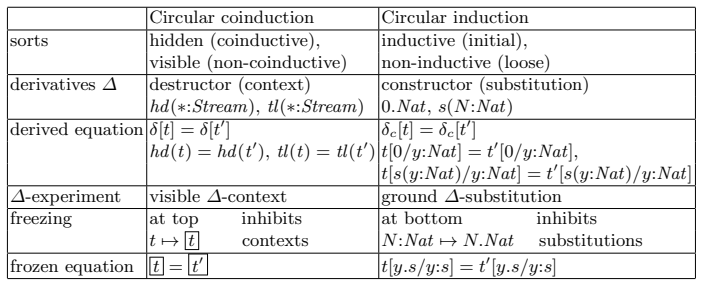
The Circularity Principle can be adapted to develop a sound inductive proving technique that combines easily with circular coinduction.
A machine-rendered reading of the paper's core claim, the machinery that carries it, and where it could break.
Core claim
The Circularity Principle can be used to develop circular induction, a proving technique for inductive properties that parallels circular coinduction. The adaptation requires no substantial additional conditions or changes to the underlying logic, so that the two techniques can be combined without friction during verification.
What carries the argument
The Circularity Principle, which justifies assuming a goal as a hypothesis and deriving the goal from that assumption in a circular derivation.
If this is right
- Induction and coinduction steps can be interleaved freely inside one verification process.
- Circular induction supplies a uniform framework for integrating distinct proving schemes.
- The approach is realized directly in the CIRC prover built around the Circularity Principle.
Where Pith is reading between the lines
- The uniformity could reduce engineering effort when building tools that must reason about both finite and infinite structures.
- The same circularity mechanism might be lifted to other formalisms that already contain circular coinduction.
- Implementation details in CIRC could be reused as a template for adding circular induction to existing inductive provers.
Load-bearing premise
The Circularity Principle can be directly adapted from its coinductive use to induction without requiring substantial additional conditions or changes to the logic.
What would settle it
An inductive property that is valid yet cannot be proved by the circular induction rules, or an unsound derivation that the rules accept as a proof.
Figures

read the original abstract
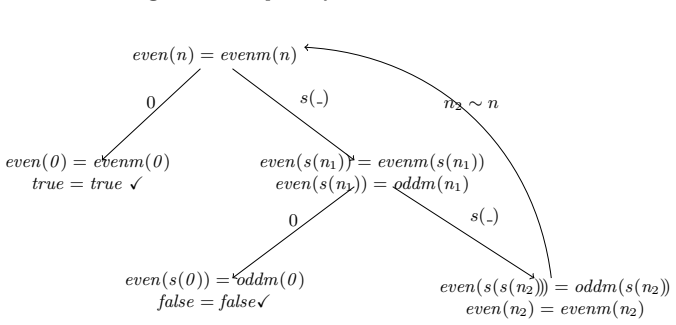
The Circularity Principle was successfully applied for developing a coinductive proving technique, known as circular coinduction. In this paper, we show that the same principle can be used to develop an inductive proving technique. A main advantage of this uniform approach is that the two proving techniques can be easily combined during the verification process. Circular induction is simple, flexible, generic, and therefore it is a good candidate framework for combining different proving schemes into a competitive tool. We exhibit this potential by presenting how the circular induction is implemented in CIRC, a prover built around the Circularity Principle. Disclaimer. This paper was written in 2010, at the time the CIRC prover was developed, and the main body reflects the state of the work and of the prover as of that date. For this arXiv technical report, only the related-work discussion (Section 6) and the concluding section have been revised: Section 6 has been extended to situate circular induction within the cyclic-proof and infinite-descent literature that has appeared or matured since 2010. No other part of the paper-its definitions, results, proofs, examples, or implementation description-has been modified, and the technical content should be read as a 2010 contribution. References to developments after 2010 appear only in the updated related-work section.
Editorial analysis
A structured set of objections, weighed in public.
Referee Report
Summary. The paper claims that the Circularity Principle, previously used to develop circular coinduction, can be directly adapted to yield a sound circular induction technique. A key advantage is that inductive and coinductive proofs can be freely interleaved within the same CIRC prover; the manuscript describes the technique's implementation in CIRC and presents it as simple, flexible, and generic for combining proving schemes.
Significance. If the adaptation holds, the uniform Circularity Principle framework enables straightforward mixing of induction and coinduction during verification, which could support more competitive automated tools. The concrete implementation in CIRC supplies a working demonstration of the approach.
minor comments (3)
- [Abstract] Abstract: the central claim is stated at a high level without any definitions, proof sketches, or small examples, which makes the technical contribution hard to evaluate from the abstract alone (though the full manuscript supplies these).
- [Disclaimer] Disclaimer (and §1): the note that only the related-work section and conclusion were revised is useful, but the introduction should explicitly flag that all definitions, theorems, and implementation details remain exactly as in the 2010 version.
- [Introduction] The related-work section (now updated) situates the work in the cyclic-proof literature, but a brief forward reference from the introduction to §6 would help readers locate the modern context.
Simulated Author's Rebuttal
We thank the referee for the positive assessment of the manuscript, the recognition of its potential advantages for interleaving inductive and coinductive proofs, and the recommendation of minor revision. No specific major comments appear in the report.
Circularity Check
No significant circularity; direct adaptation of prior principle
full rationale
The paper presents circular induction as an adaptation of the pre-existing Circularity Principle (originally for coinduction) without introducing self-referential definitions, fitted predictions, or load-bearing self-citations that reduce the central claim to its own inputs. The abstract states the principle 'was successfully applied' for coinduction and 'can be used' for induction, with the disclaimer confirming the technical content is unchanged from 2010. No equations or steps in the provided material exhibit the enumerated circular patterns; the derivation remains self-contained against the cited external principle.
Axiom & Free-Parameter Ledger
axioms (1)
- domain assumption The Circularity Principle applies to inductive proofs in the same manner as to coinductive proofs
Reference graph
Works this paper leans on
-
[1]
Bouhoula, A.: Automated theorem proving by test set induction. J. Symb. Comput.23(1), 47–77 (1997), https://doi.org/10.1006/jsco.1996.0076
-
[2]
Bouhoula, A., Rusinowitch, M.: SPIKE: A system for automatic inductive proofs. In: Alagar, V.S., Nivat, M. (eds.) Algebraic Methodology and Software Technology, 4th International Conference, AMAST ’95, Montreal, Canada, July 3-7, 1995, Proceedings. pp. 576–577. Lecture Notes in Computer Science, Springer (1995), https://doi.org/10.1007/3-540-60043-4_79
-
[3]
In: M¨ uller-Olm, M., Seidl, H
Brotherston, J., Gorogiannis, N.: Cyclic abduction of inductively defined safety and termination precon- ditions. In: M¨ uller-Olm, M., Seidl, H. (eds.) Static Analysis - 21st International Symposium, SAS 2014, Munich, Germany, September 11-13, 2014. Proceedings. pp. 68–84. Lecture Notes in Computer Science, Springer (2014),https://doi.org/10.1007/978-3-3...
-
[4]
Brotherston, J., Gorogiannis, N., Petersen, R.L.: A generic cyclic theorem prover. In: Jhala, R., Igarashi, A. (eds.) Programming Languages and Systems - 10th Asian Symposium, APLAS 2012, Kyoto, Japan, December 11-13, 2012. Proceedings. pp. 350–367. Lecture Notes in Computer Science, Springer (2012),https: //doi.org/10.1007/978-3-642-35182-2_25
-
[5]
Brotherston, J., Simpson, A.: Complete sequent calculi for induction and infinite descent. In: 22nd IEEE Symposium on Logic in Computer Science (LICS 2007), 10-12 July 2007, Wroclaw, Poland, Proceedings. pp. 51–62. IEEE Computer Society (2007),https://doi.org/10.1109/LICS.2007.16
-
[6]
In: Robinson, J.A., Voronkov, A
Bundy, A.: The automation of proof by mathematical induction. In: Robinson, J.A., Voronkov, A. (eds.) Handbook of Automated Reasoning (in 2 volumes), pp. 845–911. Elsevier and MIT Press (2001),https: //doi.org/10.1016/b978-044450813-3/50015-1
-
[7]
(eds.): All About Maude - A High-Performance Logical Framework, How to Specify, Program and Verify Systems in Rewriting Logic, Lecture Notes in Computer Science, vol
Clavel, M., Dur´ an, F., Eker, S., Lincoln, P., Mart´ ı-Oliet, N., Meseguer, J., Talcott, C.L. (eds.): All About Maude - A High-Performance Logical Framework, How to Specify, Program and Verify Systems in Rewriting Logic, Lecture Notes in Computer Science, vol. 4350. Springer (2007)
2007
-
[8]
In: Peltier, N., Sofronie-Stokkermans, V
Cohen, L., Rowe, R.N.S.: Integrating induction and coinduction via closure operators and proof cycles. In: Peltier, N., Sofronie-Stokkermans, V. (eds.) Automated Reasoning - 10th International Joint Conference, IJCAR 2020, Paris, France, July 1-4, 2020, Proceedings, Part I. pp. 375–394. Lecture Notes in Computer Science, Springer (2020),https://doi.org/10...
-
[9]
Cohen, L., Rowe, R.N.S., Shaked, M.: Cyclone: A heterogeneous tool for verifying infinite descent. In: Gurfinkel, A., Heule, M. (eds.) Tools and Algorithms for the Construction and Analysis of Systems - 31st International Conference, TACAS 2025, Held as Part of the International Joint Conferences on Theory and Practice of Software, ETAPS 2025, Hamilton, O...
-
[10]
In: Robinson, J.A., Voronkov, A
Comon, H.: Inductionless induction. In: Robinson, J.A., Voronkov, A. (eds.) Handbook of Automated Reasoning (in 2 volumes), pp. 913–962. Elsevier and MIT Press (2001),https://doi.org/10.1016/ b978-044450813-3/50016-3
2001
-
[11]
In: Bruni, A., Momigliano, A., Pradella, M., Rossi, M., Cheney, J
Dur´ an, F.J., Escobar, S., Meseguer, J., Sapi˜ na, J.: Nuitp: An inductive theorem prover for equational program verification. In: Bruni, A., Momigliano, A., Pradella, M., Rossi, M., Cheney, J. (eds.) Proceedings of the 26th International Symposium on Principles and Practice of Declarative Programming, PPDP 2024, Milano, Italy, September 9-11, 2024. pp. ...
-
[12]
In: LPAR
Falke, S., Kapur, D.: Inductive decidability using implicit induction. In: LPAR. Lecture Notes in Computer Science, vol. 4246, pp. 45–59. Springer (2006)
2006
-
[13]
Caltais, E
G. Caltais, E. Goriac, D.L., Grigora¸ s, G.: A Rewrite Stack Machine forROC!In: 10th International Sympo- sium on Symbolic and Numeric Algorithms for Scientific Computing. IEEE Computer Society (2008)
2008
-
[14]
In: WADT
Goguen, J., Lin, K., Ro¸ su, G.: Conditional circular coinductive rewriting with case analysis. In: WADT. Lecture Notes in Computer Science, vol. 2755, pp. 216–232. Springer (2002)
2002
-
[15]
Theoretical Computer Science105(2), 217–273 (1992)
Goguen, J., Meseguer, J.: Order-sorted algebra I: Equational deduction for multiple inheritance, overloading, exceptions and partial operations. Theoretical Computer Science105(2), 217–273 (1992)
1992
-
[16]
In: 12th International Sym- posium on Symbolic and Numeric Algorithms for Scientific Computing
Goriac, E., Caltais, G., Lucanu, D.: Simplification and Generalization in CIRC. In: 12th International Sym- posium on Symbolic and Numeric Algorithms for Scientific Computing. IEEE Computer Society (2009)
2009
-
[17]
Jones, E., Ong, C.L., Ramsay, S.J.: Cycleq: an efficient basis for cyclic equational reasoning. In: Jhala, R., Dillig, I. (eds.) PLDI ’22: 43rd ACM SIGPLAN International Conference on Programming Language Design and Implementation, San Diego, CA, USA, June 13 - 17, 2022. pp. 395–409. ACM (2022),https: //doi.org/10.1145/3519939.3523731
-
[18]
https://doi.org/10.5281/zenodo.20345982,https://github.com/ dlucanu/circ
Lucanu, D.: Circ v1.5 (May 2026). https://doi.org/10.5281/zenodo.20345982,https://github.com/ dlucanu/circ
-
[19]
In: CALCO 2009
Lucanu, D., Goriac, E.I., Caltais, G., Ro¸ su, G.: CIRC : A behavioral verification tool based on circular coinduction. In: CALCO 2009. LNCS, vol. 5728, pp. 433–442. Springer (2009)
2009
-
[20]
In: ICFEM
Lucanu, D., Ro¸ su, G.: Circular coinduction with special contexts. In: ICFEM. LNCS, vol. 5885, pp. 639–659. Springer (2009)
2009
-
[21]
Reddy, U.S.: Term rewriting induction. In: Stickel, M.E. (ed.) 10th International Conference on Automated Deduction, Kaiserslautern, FRG, July 24-27, 1990, Proceedings. pp. 162–177. Lecture Notes in Computer Science, Springer (1990),https://doi.org/10.1007/3-540-52885-7_86
-
[22]
In: CALCO 2009
Ro¸ su, G., Lucanu, D.: Circular Coinduction – A Proof Theoretical Foundation. In: CALCO 2009. LNCS, vol. 5728, pp. 127–144. Springer (2009)
2009
-
[23]
Zhang, H., Kapur, D., Krishnamoorthy, M.S.: A mechanizable induction principle for equational specifica- tions. In: Lusk, E.L., Overbeek, R.A. (eds.) 9th International Conference on Automated Deduction, Argonne, Illinois, USA, May 23-26, 1988, Proceedings. pp. 162–181. Lecture Notes in Computer Science, Springer (1988),https://doi.org/10.1007/BFb0012831 17
discussion (0)
Sign in with ORCID, Apple, or X to comment. Anyone can read and Pith papers without signing in.