A Guided Tour of Modern Domain Decomposition: From Schwarz Iterations to Robust Preconditioners and HPC Implementations
Pith reviewed 2026-06-29 23:36 UTC · model grok-4.3
The pith
Domain decomposition methods unify scalable solutions of partial differential equations by combining local subdomain solves with coarse space corrections for global convergence.
A machine-rendered reading of the paper's core claim, the machinery that carries it, and where it could break.
Core claim
Domain decomposition methods supply a unifying framework for scalable numerical solution of partial differential equations: local subdomain solves provide robustness and parallelism while coarse space corrections guarantee global convergence rates independent of mesh size and frequency in indefinite and high-frequency regimes.
What carries the argument
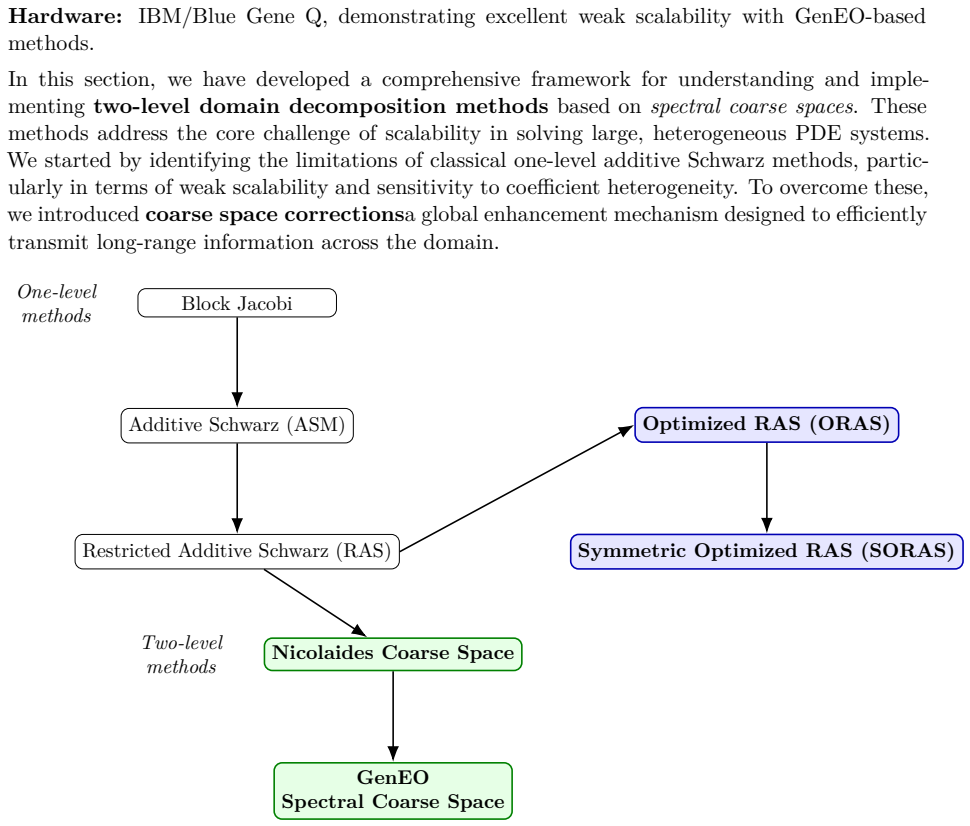
Coarse space corrections (GenEO and DtN-based approaches) inserted into additive or restricted Schwarz preconditioners to control the spectrum of the preconditioned operator in Krylov solvers.
If this is right
- Large-scale simulations of partial differential equations become feasible on distributed-memory architectures without iteration counts that grow with problem size.
- Algebraic interpretations of Schwarz methods allow direct implementation inside existing Krylov libraries.
- Robust coarse spaces extend the applicability of domain decomposition beyond elliptic problems to indefinite and high-frequency wave problems.
- High-performance computing implementations can exploit the natural subdomain parallelism while retaining theoretical convergence bounds.
Where Pith is reading between the lines
- The same coarse-space design principles might be tested on time-dependent or nonlinear problems not covered in the survey.
- Algebraic versions of the reviewed methods could be compared directly with algebraic multigrid on the same set of indefinite test cases.
- The practice-oriented guide could be used to select a coarse space for a new application by matching the problem's indefiniteness level to the GenEO or DtN construction.
Load-bearing premise
Insights and performance guarantees drawn from earlier literature on GenEO and DtN coarse spaces continue to hold for the indefinite and high-frequency regimes described.
What would settle it
Numerical experiments on a sequence of increasingly fine meshes or higher frequencies showing that iteration counts in the preconditioned Krylov solver grow without bound when the coarse space is omitted.
Figures






read the original abstract
Domain decomposition methods (DDMs) provide a unifying framework for the scalable numerical solution of partial differential equations. Originating from Schwarz's alternating method, they have evolved into a rich family of algorithms that combine local robustness with global convergence acceleration and natural parallelism. Over the past decades, domain decomposition has played a central role in enabling large-scale simulations in numerous applications. This chapter presents an overview of modern DDMs, with a particular emphasis on scalable preconditioning techniques for challenging problems, including indefinite and high-frequency regimes. We revisit the fundamental concepts - overlapping decompositions, partition of unity, additive and restricted Schwarz formulations - and explain their algebraic interpretations. We then clarify their role as preconditioners in Krylov subspace solvers and discuss the necessity of coarse space corrections for scalability. Beyond a the survey aspect, the chapter distills key theoretical insights and practical design principles that have emerged over the past twenty years. Special attention is given to robust coarse spaces (GenEO, DtN-based approaches) and high-performance implementations. The goal is to provide both a coherent overview of the field and a concise, practice-oriented guide for readers seeking to understand and apply domain decomposition methods without navigating the entire literature.
Editorial analysis
A structured set of objections, weighed in public.
Referee Report
Summary. This manuscript is a survey chapter on domain decomposition methods (DDMs) for scalable numerical solution of PDEs. It traces the evolution from Schwarz alternating iterations through overlapping decompositions, partition of unity, additive/restricted Schwarz formulations and their algebraic interpretations, to their use as preconditioners in Krylov solvers. The central emphasis is the necessity of coarse-space corrections (e.g., GenEO and DtN-based) for scalability in indefinite and high-frequency regimes, together with practical design principles and HPC implementation considerations drawn from the literature of the past twenty years.
Significance. If the distillation of existing theoretical insights and design principles is accurate, the chapter provides a coherent, practice-oriented guide that unifies concepts across the DDM literature and highlights robust coarse-space constructions needed for challenging regimes. This could reduce the barrier for readers applying these methods to large-scale simulations without surveying the full body of prior work.
minor comments (2)
- [Abstract] Abstract: the phrase 'Beyond a the survey aspect' contains a typographical error and should read 'Beyond the survey aspect'.
- The manuscript would benefit from explicit pointers (section or equation numbers) to the specific theorems or numerical results in the cited GenEO and DtN literature that underpin the claimed robustness in indefinite/high-frequency regimes.
Simulated Author's Rebuttal
We thank the referee for the careful reading and positive overall assessment of the manuscript. The referee's summary accurately reflects the scope, emphasis on robust coarse spaces, and practical orientation of the survey. We note the recommendation for minor revision.
Circularity Check
No circularity: survey chapter with no internal derivations or predictions
full rationale
The manuscript is framed as a survey that revisits established concepts from the literature (Schwarz methods, GenEO, DtN coarse spaces) and distills prior insights without new proofs, equations, or performance claims of its own. No load-bearing steps exist that could reduce by construction to self-citations, fitted inputs, or self-definitions, as confirmed by the absence of any derivation chain or novel quantitative results.
Axiom & Free-Parameter Ledger
axioms (1)
- domain assumption Standard assumptions of existence, uniqueness, and well-posedness for the underlying PDE boundary value problems
Reference graph
Works this paper leans on
-
[1]
Badia, S., Verdugo, F.: Gridap: An extensible finite element toolbox in Julia. J. Open Source Softw. 5(52), 2520 (2020)
2020
-
[2]
F., Benson, S., Brown, J., Brune, P., Buschelman, K., Constantinescu, E., Dalcin, L., Dener, A., Eijkhout, V., Faibussowitsch, J., Gropp, W
Balay, S., Abhyankar, S., Adams, M. F., Benson, S., Brown, J., Brune, P., Buschelman, K., Constantinescu, E., Dalcin, L., Dener, A., Eijkhout, V., Faibussowitsch, J., Gropp, W. D., Hapla, V., Isaac, T., Jolivet, P., Karpeev, D., Kaushik, D., Knepley, M. G., Kong, F., Kruger, S., May, D. A., McInnes, L. C., Mills, R. T., Mitchell, L., Munson, T., Roman, J....
2025
-
[3]
Bonazzoli, M., Dolean, V., Graham, I.G., Spence, E.A., Tournier, P.-H.: Domain decom- position preconditioning for the high-frequency time-harmonic Maxwell equations with ab- sorption. Math. Comp. 88(320), 2559–2604 (2019). doi:10.1090/mcom/3447
-
[4]
Bootland, N., Dolean, V., Jolivet, P., Tournier, P.-H.: A comparison of coarse spaces for Helmholtz problems in the high-frequency regime. Comput. Math. Appl. 98, 239–253 (2021). doi:10.1016/j.camwa.2021.07.011
-
[5]
Bootland, N., Dolean, V., Graham, I.G., Ma, C., Scheichl, R.: Overlapping Schwarz methods with GenEO coarse spaces for indefinite and non-self-adjoint problems. IMA J. Numer. Anal. (2022). doi:10.1093/imanum/drac036
-
[6]
Bootland, N., Dolean, V.: Can DtN and GenEO coarse spaces be sufficiently ro- bust for heterogeneous Helmholtz problems? Math. Comput. Appl. 27(3) (2022). doi:10.3390/mca27030035
-
[7]
Cai, X.-C., Sarkis, M.: A restricted additive Schwarz preconditioner for general sparse linear systems. SIAM J. Sci. Comput. 21(2), 792–797 (1999). doi:10.1137/S106482759732678X
-
[8]
Chevalier, C., Pellegrini, F.: PT-Scotch: A tool for efficient parallel graph ordering. Parallel Comput. 34(6–8), 318–331 (2008). doi:10.1016/j.parco.2007.12.001
-
[9]
Conen, L., Dolean, V., Krause, R., Nataf, F.: A coarse space for heterogeneous Helmholtz problems based on the Dirichlet-to-Neumann operator. J. Comput. Appl. Math. 271, 83–99 (2014). doi:10.1016/j.cam.2014.03.031
-
[10]
SIAM, Philadelphia (2015)
Dolean, V., Jolivet, P., Nataf, F.: An introduction to domain decomposition methods: Algo- rithms, theory, and parallel implementation . SIAM, Philadelphia (2015)
2015
-
[11]
Dolean, V., Fry, M., Langer, M.: Can symmetric positive definite (SPD) coarse spaces perform well for indefinite Helmholtz problems? J. Comput. Appl. Math. 484(1) (2026)
2026
-
[12]
Graham, I.G., Spence, E.A., Vainikko, E.: Domain decomposition preconditioning for high- frequency Helmholtz problems with absorption. Math. Comp. 86(307), 2089–2127 (2017)
2089
-
[13]
Jolivet, P., Dolean, V., Hecht, F., Nataf, F., Prud’Homme, C., Spillane, N.: High perfor- mance domain decomposition methods on massively parallel architectures with FreeFem++. J. Numer. Math. 20(3–4), 287–302 (2012). doi:10.1515/jnum-2012-0015
-
[14]
Hecht, F.: New Developments in FreeFem++. J. Numer. Math. 20(3–4), 251–265 (2012). doi:10.1515/jnum-2012-0013
-
[15]
E., Zampini, S.: KSPHPDDM and PCHPDDM: Extending PETSc with advanced Krylov methods and robust multilevel overlapping Schwarz preconditioners
Jolivet, P., Roman, J. E., Zampini, S.: KSPHPDDM and PCHPDDM: Extending PETSc with advanced Krylov methods and robust multilevel overlapping Schwarz preconditioners. Comput. Math. Appl. 84, 277–295 (2021)
2021
-
[16]
Karypis, G., Kumar, V.: A fast and high-quality multilevel scheme for partitioning irregular graphs. SIAM J. Sci. Comput. 20(1), 359–392 (1998). 44
1998
-
[17]
Nataf, F., Xiang, H., Dolean, V., Spillane, N.: A coarse space construction based on local Dirichlet-to-Neumann maps. SIAM J. Sci. Comput. 33(4), 1623–1642 (2011). doi:10.1137/100796376
-
[18]
Nicolaides, R.A.: Deflation of conjugate gradients with applications to boundary value problems. SIAM J. Numer. Anal. 24(2), 355–365 (1987)
1987
-
[19]
Operto, S., Amestoy, P., Aghamiry, H.S., Beller, S., Buttari, A., Combe, L., Dolean, V., Gerest, M., Guo, G., Jolivet, P., L’Excellent, J.-Y., Mamfoumbi, F., Mary, T., Puglisi, C., Ribodetti, A., Tournier, P.-H.: Is 3D frequency-domain full-waveform inversion of full- azimuth/long-offset OBN data feasible? The Gorgon-data FWI case study. Lead. Edge 42 (2023)
2023
-
[20]
Saad, Y., Schultz, M.H.: GMRES: A generalized minimal residual algorithm for solv- ing nonsymmetric linear systems. SIAM J. Sci. Stat. Comput. 7(3), 856–869 (1986). doi:10.1137/0907058
-
[21]
Society for Industrial and Applied Mathematics, Philadelphia (2003)
Saad, Y: Iterative Methods for Sparse Linear Systems. Society for Industrial and Applied Mathematics, Philadelphia (2003)
2003
-
[22]
Spillane, N., Dolean, V., Nataf, F., Pechstein, C., Scheichl, R.: Abstract robust coarse spaces for systems of PDEs via generalized eigenproblems in the overlaps. Numer. Math. 126(4), 741–770 (2014)
2014
-
[23]
Springer Ser
Toselli, A., Widlund, O.: Domain decomposition methods—Algorithms and theory . Springer Ser. Comput. Math., vol. 34. Springer, Berlin (2005)
2005
-
[24]
Tournier, P.-H., Bonazzoli, M., Dolean, V., Rapetti, F., Hecht, F., Nataf, F., Aliferis, I., El Kanfoud, I., Migliaccio, C., de Buhan, M., Darbas, M., Semenov, S., Pichot, C.: Nu- merical modeling and high-speed parallel computing: New perspectives on tomographic microwave imaging for brain stroke detection and monitoring. IEEE Antennas Propag. Mag. 59(5)...
-
[25]
Tournier, P.-H., Jolivet, P., Dolean, V., Aghamiry, H.S., Operto, S., Riffo, S.: Three- dimensional finite-difference finite-element frequency-domain wave simulation with multi- level optimized additive Schwarz domain decomposition preconditioner: A tool for FWI of sparse node datasets. Geophysics (2022). doi:10.1190/geo2021-0702.1 45
discussion (0)
Sign in with ORCID, Apple, or X to comment. Anyone can read and Pith papers without signing in.