Shear Particle Acceleration in Structured Gamma-Ray Burst Jets: IV. Thermal {em vs.} Non-thermal Emission of the Jet Cocoon
Pith reviewed 2026-06-29 23:41 UTC · model grok-4.3
The pith
A structured jet model reproduces the quasi-thermal keV-MeV component and broadband non-thermal spectrum of GRB 090902B from cocoon heating plus core synchrotron.
A machine-rendered reading of the paper's core claim, the machinery that carries it, and where it could break.
Core claim
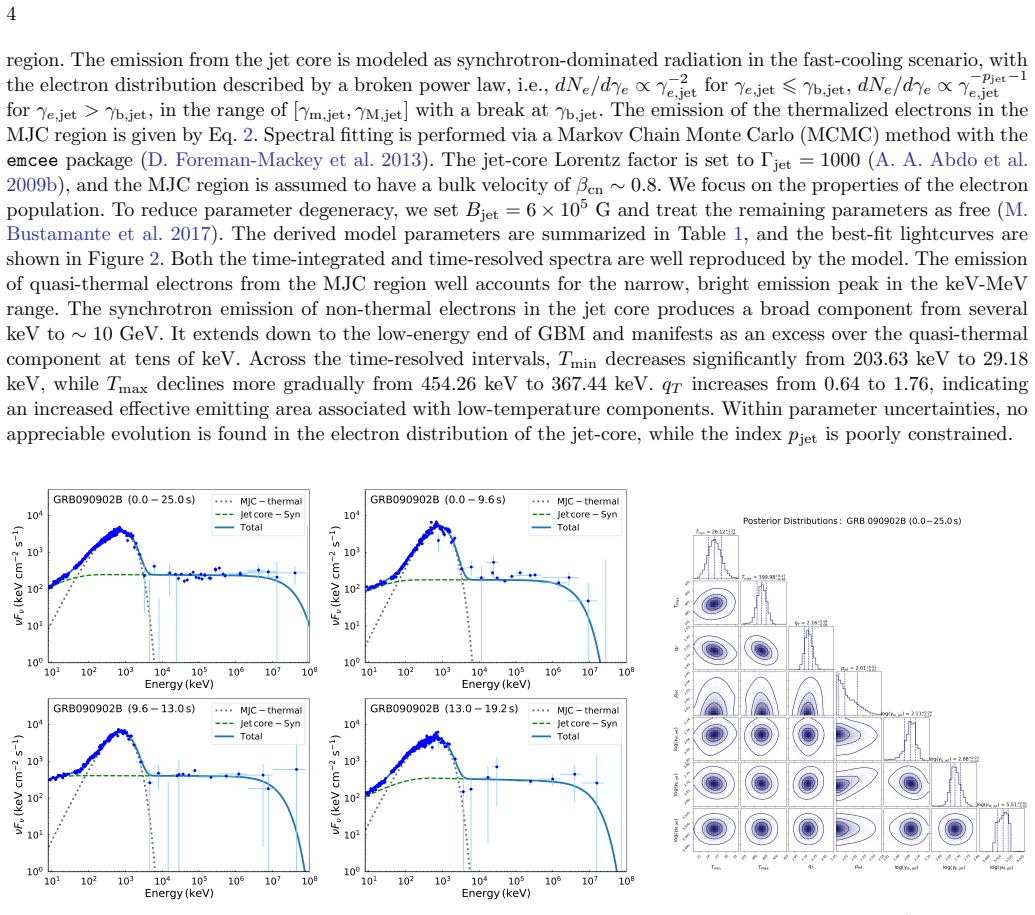
In the weak-scattering regime with inefficient shear acceleration, electrons pre-energized in the thin jet-cocoon interaction layer are further heated in the mixed jet-cocoon region, forming a quasi-thermal electron distribution. With the radial temperature profile parameterized as a power law of index q_T, the peak flux and spectral width of the resulting thermal component prove sensitive to the maximum temperature T_max and to q_T. When this component is added to synchrotron radiation from shock-accelerated electrons in the jet core, the combined spectrum matches both the time-integrated and time-resolved observations of GRB 090902B.
What carries the argument
The mixed jet-cocoon (MJC) region, where pre-energized electrons form a quasi-thermal distribution under weak scattering and inefficient shear acceleration, parameterized by radial temperature power-law index q_T.
If this is right
- The thermal component's peak flux and width vary directly with maximum temperature T_max and the temperature power-law index q_T.
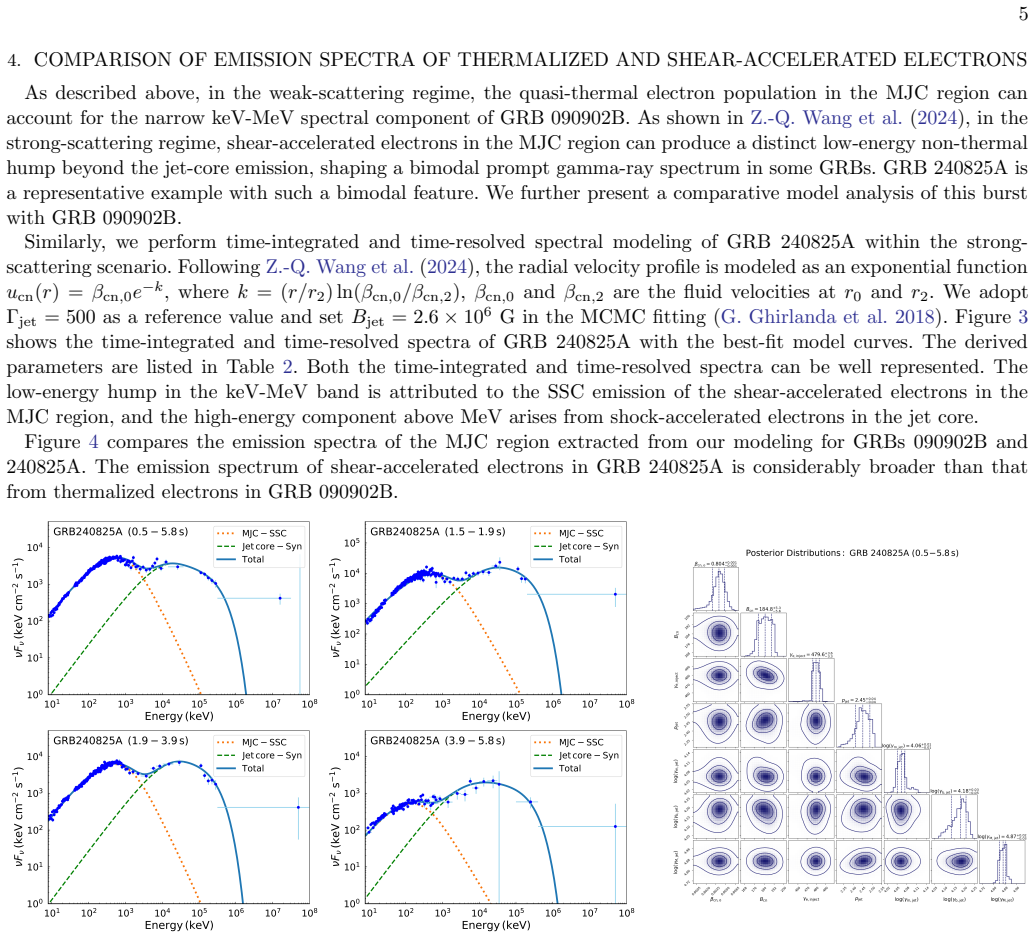
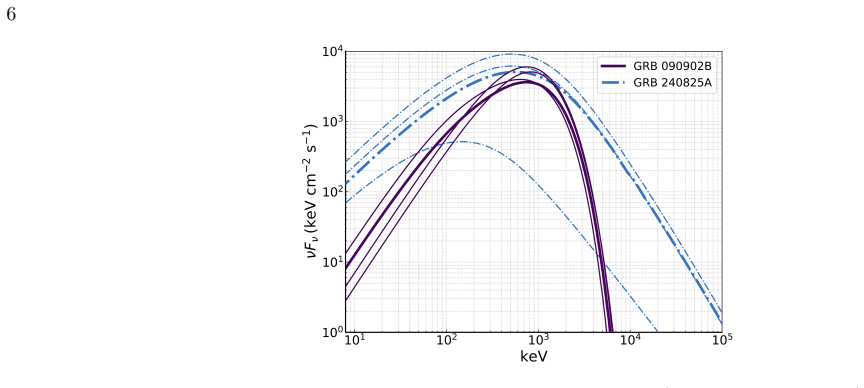
- Shear-accelerated electrons in the strong-scattering regime produce broader spectra than thermalized electrons in the weak-scattering regime.
- GRB spectral diversity arises from the additional emission component originating in the mixed jet-cocoon region under different physical conditions.
Where Pith is reading between the lines
- The same MJC heating mechanism could be tested on other GRBs that display clear quasi-thermal components to check whether a narrow range of q_T values consistently fits.
- Time-resolved polarization or high-energy cutoff measurements could distinguish weak-scattering thermalization from strong-scattering shear acceleration without relying solely on spectral fitting.
- If the radial temperature profile deviates from a simple power law in real jets, the model would require an additional degree of freedom to maintain fits to the observed thermal width.
Load-bearing premise
Electrons pre-energized in the thin interaction layer form a quasi-thermal distribution when further heated in the mixed jet-cocoon region under weak scattering with inefficient shear acceleration.
What would settle it
Failure to reproduce the observed keV-MeV quasi-thermal peak shape and flux in GRB 090902B time-resolved spectra for any choice of T_max and q_T while holding jet-core parameters fixed.
Figures

read the original abstract
A distinct thermal or quasi-thermal spectral component is occasionally observed in gamma-ray burst (GRB) prompt emission spectra. Taking GRB 090902B as a case study, we investigate its origin within a structured jet framework, in which the outflow consists of an ultra-relativistic uniform core surrounded by a structured cocoon. In the weak-scattering regime with inefficient shear acceleration, electrons pre-energized in the thin jet-cocoon interaction layer are further heated in the mixed jet-cocoon (MJC) region, forming a quasi-thermal electron distribution. Parameterizing the radial temperature profile of electrons as a power law with index $q_T$, we demonstrate that both the peak flux and spectral width of the thermal component are sensitive to maximum temperature $T_{\max}$ and $q_T$. Combined with the synchrotron emission of shock-accelerated electrons in the jet core, our model reproduces both the quasi-thermal component in the keV-MeV range and the broadband non-thermal emission observed in the time-integrated and time-resolved spectra of GRB 090902B. A comparative analysis of GRB 240825A within a shear-acceleration dominated (strong-scattering) scenario shows that shear-accelerated electrons produce broader spectra than thermalized electrons in the weak-scattering regime. These results indicate that GRB spectral diversity likely arises from the additional emission component originating in the MJC region under different physical conditions.
Editorial analysis
A structured set of objections, weighed in public.
Referee Report
Summary. The manuscript investigates the origin of quasi-thermal spectral components in GRB prompt emission within a structured jet model consisting of an ultra-relativistic uniform core surrounded by a cocoon. Focusing on GRB 090902B in the weak-scattering regime with inefficient shear acceleration, electrons pre-energized in the thin jet-cocoon interaction layer are further heated in the mixed jet-cocoon (MJC) region to form a quasi-thermal distribution. The radial electron temperature profile is parameterized as a power law with index q_T; by selecting T_max and q_T, the model matches the keV-MeV quasi-thermal component and broadband non-thermal emission in both time-integrated and time-resolved spectra when combined with core synchrotron emission. A comparison to GRB 240825A in the strong-scattering regime is also presented, suggesting that spectral diversity arises from different MJC conditions.
Significance. If the quasi-thermal form and the index q_T could be derived from the shear-acceleration and mixing equations rather than introduced via parameterization and adjusted to fit data, the framework would offer a physical mechanism linking jet structure to observed GRB spectral features and diversity. As presented, the reproduction of GRB 090902B spectra depends on fitting T_max and q_T, which limits the result to a demonstration of sensitivity rather than an independent prediction.
major comments (2)
- [Abstract] Abstract: The central claim that the model reproduces both the quasi-thermal keV-MeV component and broadband non-thermal emission of GRB 090902B rests on parameterizing the radial temperature profile as T(r) ~ r^{-q_T} and choosing values of T_max and q_T to match the observed peak flux and spectral width. No derivation of the quasi-thermal distribution function or of the specific index q_T is provided from the weak-scattering shear-acceleration equations in the MJC region; the match is therefore achieved by construction through fitting rather than from the underlying physics.
- [Abstract] Abstract (paragraph on parameterization and regime): The assumption that electrons pre-energized in the thin interaction layer form a quasi-thermal distribution when further heated in the MJC region under inefficient shear acceleration is introduced without supporting calculation or reference to prior papers in the series establishing this outcome from the steady-state kinetic equation. If the actual distribution deviates from quasi-thermal or if q_T cannot be independently constrained, the spectral reproduction is not guaranteed by the model physics.
Simulated Author's Rebuttal
We thank the referee for the thorough review and constructive feedback on our manuscript. We address the major comments point by point below. While we maintain that the parameterized approach provides useful insight into spectral diversity arising from MJC conditions, we agree that greater clarity on the role of parameterization and references to prior work in the series will strengthen the presentation. We will make corresponding revisions.
read point-by-point responses
-
Referee: [Abstract] Abstract: The central claim that the model reproduces both the quasi-thermal keV-MeV component and broadband non-thermal emission of GRB 090902B rests on parameterizing the radial temperature profile as T(r) ~ r^{-q_T} and choosing values of T_max and q_T to match the observed peak flux and spectral width. No derivation of the quasi-thermal distribution function or of the specific index q_T is provided from the weak-scattering shear-acceleration equations in the MJC region; the match is therefore achieved by construction through fitting rather than from the underlying physics.
Authors: We agree that the radial temperature profile is introduced as a power-law parameterization and that T_max and q_T are selected to reproduce the observed spectral features. This choice is motivated by the expected radial dependence of heating in the mixed region under weak scattering, but a first-principles derivation of the exact index from the full kinetic equations is not provided here. The manuscript's focus is to demonstrate the sensitivity of the quasi-thermal and non-thermal components to these physically plausible parameters when combined with core synchrotron emission. We will revise the abstract to state explicitly that the profile is parameterized and that the reproduction illustrates the potential of the MJC component rather than constituting an ab initio prediction. revision: partial
-
Referee: [Abstract] Abstract (paragraph on parameterization and regime): The assumption that electrons pre-energized in the thin interaction layer form a quasi-thermal distribution when further heated in the MJC region under inefficient shear acceleration is introduced without supporting calculation or reference to prior papers in the series establishing this outcome from the steady-state kinetic equation. If the actual distribution deviates from quasi-thermal or if q_T cannot be independently constrained, the spectral reproduction is not guaranteed by the model physics.
Authors: The formation of a quasi-thermal distribution under inefficient shear acceleration in the weak-scattering regime follows from the heating and mixing processes analyzed in Papers I–III of this series. We will add explicit citations to those works in the revised abstract and introduction to support the assumption. While a complete numerical solution of the steady-state kinetic equation for the precise distribution function lies outside the present scope, the parameterization enables exploration of the resulting emission. Should future calculations reveal significant deviations, the model framework can accommodate them. revision: yes
- Derivation of the precise functional form of the quasi-thermal electron distribution and the exact value of the index q_T directly from the steady-state kinetic equations in the MJC region without introducing any parameterization.
Circularity Check
Spectral reproduction of GRB 090902B achieved by fitting T_max and q_T rather than deriving quasi-thermal distribution from shear equations
specific steps
-
fitted input called prediction
[Abstract]
"Parameterizing the radial temperature profile of electrons as a power law with index q_T, we demonstrate that both the peak flux and spectral width of the thermal component are sensitive to maximum temperature T_max and q_T. Combined with the synchrotron emission of shock-accelerated electrons in the jet core, our model reproduces both the quasi-thermal component in the keV-MeV range and the broadband non-thermal emission observed in the time-integrated and time-resolved spectra of GRB 090902B."
The reproduction is presented as a model outcome, yet it is obtained by choosing the free parameters T_max and q_T to fit the GRB 090902B data. The quasi-thermal distribution itself is asserted rather than derived from the shear-acceleration or mixing equations, so the spectral match is statistically forced by the parameterization and fit rather than an independent first-principles result.
full rationale
The paper's central result is that the model reproduces the observed quasi-thermal and non-thermal spectra of GRB 090902B. This reproduction is obtained after explicitly parameterizing the electron temperature profile as a power law with free index q_T and selecting T_max and q_T to match peak flux and width. No equation in the provided text derives the quasi-thermal form or the value of q_T from the underlying mixing or shear-acceleration dynamics; the match is therefore a fitted outcome. The structured-jet framework and weak-scattering regime retain independent content, preventing a higher score, but the load-bearing spectral claim reduces to parameter adjustment.
Axiom & Free-Parameter Ledger
free parameters (2)
- q_T
- T_max
axioms (2)
- domain assumption Electrons pre-energized in the thin jet-cocoon interaction layer form a quasi-thermal distribution when further heated in the mixed jet-cocoon region under weak-scattering conditions.
- ad hoc to paper The radial temperature profile of electrons can be parameterized as a power law with index q_T.
Reference graph
Works this paper leans on
-
[1]
P., et al., 2017a, @doi [Physical Review Letters] 10.1103/PhysRevLett.119.161101 , 119, 161101
Abbott, B. P., Abbott, R., Abbott, T. D., et al. 2017, PhRvL, 119, 161101, doi: 10.1103/PhysRevLett.119.161101
-
[2]
A., Ackermann, M., Arimoto, M., et al
Abdo, A. A., Ackermann, M., Arimoto, M., et al. 2009a, Science, 323, 1688, doi: 10.1126/science.1169101
-
[3]
A., Ackermann, M., Ajello, M., et al
Abdo, A. A., Ackermann, M., Ajello, M., et al. 2009b, ApJL, 706, L138, doi: 10.1088/0004-637X/706/1/L138
-
[4]
Ackermann, M., Asano, K., Atwood, W. B., et al. 2010, ApJ, 716, 1178, doi: 10.1088/0004-637X/716/2/1178
-
[5]
2011, ApJ, 729, 114, doi: 10.1088/0004-637X/729/2/114
Ackermann, M., Ajello, M., Asano, K., et al. 2011, ApJ, 729, 114, doi: 10.1088/0004-637X/729/2/114
-
[6]
2013, ApJ, 763, 71, doi: 10.1088/0004-637X/763/2/71
Ackermann, M., Ajello, M., Asano, K., et al. 2013, ApJ, 763, 71, doi: 10.1088/0004-637X/763/2/71
-
[7]
2014, Science, 343, 42, doi: 10.1126/science.1242353
Ackermann, M., Ajello, M., Asano, K., et al. 2014, Science, 343, 42, doi: 10.1126/science.1242353
-
[8]
Alves, E. P., Grismayer, T., Fonseca, R. A., & Silva, L. O. 2014, New Journal of Physics, 16, 035007, doi: 10.1088/1367-2630/16/3/035007
-
[9]
Alves, E. P., Zrake, J., & Fiuza, F. 2018, PhRvL, 121, 245101, doi: 10.1103/PhysRevLett.121.245101 Astropy Collaboration, Robitaille, T. P., Tollerud, E. J., et al. 2013, A&A, 558, A33, doi: 10.1051/0004-6361/201322068 Astropy Collaboration, Price-Whelan, A. M., Sip˝ ocz, B. M., et al. 2018, AJ, 156, 123, doi: 10.3847/1538-3881/aabc4f Astropy Collaboratio...
-
[10]
1993, ApJ, 413, 281, doi: 10.1086/172995
Band, D., Matteson, J., Ford, L., et al. 1993, ApJ, 413, 281, doi: 10.1086/172995
-
[11]
2003, Magnetohydrodynamic Turbulence
Biskamp, D. 2003, Magnetohydrodynamic Turbulence
2003
-
[12]
2013, SSRv, 178, 163, doi: 10.1007/s11214-013-0009-3
Brandenburg, A., & Lazarian, A. 2013, SSRv, 178, 163, doi: 10.1007/s11214-013-0009-3
-
[13]
2016, MNRAS, 456, 1739, doi: 10.1093/mnras/stv2591
Bromberg, O., & Tchekhovskoy, A. 2016, MNRAS, 456, 1739, doi: 10.1093/mnras/stv2591
-
[14]
2017, ApJ, 837, 33, doi: 10.3847/1538-4357/837/1/33
Bustamante, M., Heinze, J., Murase, K., & Winter, W. 2017, ApJ, 837, 33, doi: 10.3847/1538-4357/837/1/33
-
[15]
Cho, J., & Lazarian, A. 2003, MNRAS, 345, 325, doi: 10.1046/j.1365-8711.2003.06941.x
-
[16]
2018, ApJ, 854, 103, doi: 10.3847/1538-4357/aaac83
Bhattacharjee, A. 2018, ApJ, 854, 103, doi: 10.3847/1538-4357/aaac83
-
[17]
Davelaar, J., Philippov, A. A., Bromberg, O., & Singh, C. B. 2020, ApJL, 896, L31, doi: 10.3847/2041-8213/ab95a2
-
[18]
Drenkhahn, G., & Spruit, H. C. 2002, A&A, 391, 1141, doi: 10.1051/0004-6361:20020839
-
[19]
Eichler, D., Livio, M., Piran, T., & Schramm, D. N. 1989, Nature, 340, 126, doi: 10.1038/340126a0
-
[20]
Foreman-Mackey, D., Hogg, D. W., Lang, D., & Goodman, J. 2013, PASP, 125, 306, doi: 10.1086/670067
-
[21]
2018, A&A, 609, A112, doi: 10.1051/0004-6361/201731598
Ghirlanda, G., Nappo, F., Ghisellini, G., et al. 2018, A&A, 609, A112, doi: 10.1051/0004-6361/201731598
-
[22]
2019, Magnetohydrodynamics of Laboratory and Astrophysical Plasmas, doi: 10.1017/9781316403679
Goedbloed, H., Keppens, R., & Poedts, S. 2019, Magnetohydrodynamics of Laboratory and Astrophysical Plasmas, doi: 10.1017/9781316403679
-
[23]
H., & Kocevski, D
Goldstein, A., Cleveland, W. H., & Kocevski, D. 2022, https://fermi.gsfc.nasa.gov/ssc/data/analysis/gbm
2022
-
[24]
1986, ApJL, 308, L47, doi: 10.1086/184741
Goodman, J. 1986, ApJL, 308, L47, doi: 10.1086/184741
-
[25]
2022a, MNRAS, 510, 4962, doi: 10.1093/mnras/stab3784
Tchekhovskoy, A. 2022a, MNRAS, 510, 4962, doi: 10.1093/mnras/stab3784
-
[26]
2022b, ApJL, 933, L9, doi: 10.3847/2041-8213/ac7530
Gottlieb, O., Liska, M., Tchekhovskoy, A., et al. 2022b, ApJL, 933, L9, doi: 10.3847/2041-8213/ac7530
-
[27]
2022c, ApJL, 933, L2, doi: 10.3847/2041-8213/ac7728
Gottlieb, O., Moseley, S., Ramirez-Aguilar, T., et al. 2022c, ApJL, 933, L2, doi: 10.3847/2041-8213/ac7728
-
[28]
Guiriec, S., Connaughton, V., Briggs, M. S., et al. 2011, ApJL, 727, L33, doi: 10.1088/2041-8205/727/2/L33
-
[29]
2018, MNRAS, 477, 2128, doi: 10.1093/mnras/sty760
Harrison, R., Gottlieb, O., & Nakar, E. 2018, MNRAS, 477, 2128, doi: 10.1093/mnras/sty760
-
[30]
2018, ApJ, 866, 13, doi: 10.3847/1538-4357/aadc07
Hou, S.-J., Zhang, B.-B., Meng, Y.-Z., et al. 2018, ApJ, 866, 13, doi: 10.3847/1538-4357/aadc07
-
[31]
Kaneko, Y., Preece, R. D., Briggs, M. S., et al. 2006, ApJS, 166, 298, doi: 10.1086/505911
-
[32]
1997, ApJ, 490, 92, doi: 10.1086/512791
Kobayashi, S., Piran, T., & Sari, R. 1997, ApJ, 490, 92, doi: 10.1086/512791
-
[33]
2012, SSRv, 173, 557, doi: 10.1007/s11214-012-9936-7
Lazarian, A., Vlahos, L., Kowal, G., et al. 2012, SSRv, 173, 557, doi: 10.1007/s11214-012-9936-7
-
[34]
2013, ApJL, 766, L19, doi: 10.1088/2041-8205/766/2/L19
Liang, E., Boettcher, M., & Smith, I. 2013, ApJL, 766, L19, doi: 10.1088/2041-8205/766/2/L19
-
[35]
Liu, R.-Y., Rieger, F. M., & Aharonian, F. A. 2017, ApJ, 842, 39, doi: 10.3847/1538-4357/aa7410 L´ opez-C´ amara, D., Morsony, B. J., Begelman, M. C., &
-
[36]
2013, ApJ, 767, 19, doi: 10.1088/0004-637X/767/1/19
Lazzati, D. 2013, ApJ, 767, 19, doi: 10.1088/0004-637X/767/1/19
-
[37]
Loureiro, N. F., & Boldyrev, S. 2017, PhRvL, 118, 245101, doi: 10.1103/PhysRevLett.118.245101
-
[38]
MacFadyen, A. I., & Woosley, S. E. 1999, ApJ, 524, 262, doi: 10.1086/307790
work page internal anchor Pith review doi:10.1086/307790 1999
-
[39]
MacFadyen, A. I., Woosley, S. E., & Heger, A. 2001, ApJ, 550, 410, doi: 10.1086/319698
-
[40]
2019, MNRAS, 490, 4271, doi: 10.1093/mnras/stz2821 M´ esz´ aros, P., Ramirez-Ruiz, E., Rees, M
Matsumoto, J., & Masada, Y. 2019, MNRAS, 490, 4271, doi: 10.1093/mnras/stz2821 M´ esz´ aros, P., Ramirez-Ruiz, E., Rees, M. J., & Zhang, B. 2002, ApJ, 578, 812, doi: 10.1086/342611 M´ esz´ aros, P., & Rees, M. J. 2000, ApJ, 530, 292, doi: 10.1086/308371 9
-
[41]
P., Nakar, E., Hotokezaka, K., et al
Mooley, K. P., Nakar, E., Hotokezaka, K., et al. 2018, Nature, 554, 207, doi: 10.1038/nature25452
-
[42]
1992, ApJL, 395, L83, doi: 10.1086/186493
Narayan, R., Paczynski, B., & Piran, T. 1992, ApJL, 395, L83, doi: 10.1086/186493
-
[43]
1986, ApJL, 308, L43, doi: 10.1086/184740 Pe’Er, A., Zhang, B.-B., Ryde, F., et al
Paczynski, B. 1986, ApJL, 308, L43, doi: 10.1086/184740 Pe’Er, A., Zhang, B.-B., Ryde, F., et al. 2012, MNRAS, 420, 468, doi: 10.1111/j.1365-2966.2011.20052.x
-
[44]
2014, ApJ, 795, 155, doi: 10.1088/0004-637X/795/2/155
Peng, F.-K., Liang, E.-W., Wang, X.-Y., et al. 2014, ApJ, 795, 155, doi: 10.1088/0004-637X/795/2/155
-
[45]
Rees, M. J., & Meszaros, P. 1994, ApJL, 430, L93, doi: 10.1086/187446
-
[46]
Rieger, F. M. 2019, Galaxies, 7, 78, doi: 10.3390/galaxies7030078
-
[47]
Rieger, F. M., & Duffy, P. 2004, ApJ, 617, 155, doi: 10.1086/425167
-
[48]
Rieger, F. M., & Duffy, P. 2006, ApJ, 652, 1044, doi: 10.1086/508056
-
[49]
Rieger, F. M., & Duffy, P. 2019, ApJL, 886, L26, doi: 10.3847/2041-8213/ab563f
-
[50]
Rieger, F. M., & Mannheim, K. 2002, A&A, 396, 833, doi: 10.1051/0004-6361:20021457
-
[51]
B., & Lightman, A
Rybicki, G. B., & Lightman, A. P. 1979, Radiative processes in astrophysics
1979
-
[52]
2009, ApJ, 702, 1211, doi: 10.1088/0004-637X/702/2/1211
Ryde, F., & Pe’er, A. 2009, ApJ, 702, 1211, doi: 10.1088/0004-637X/702/2/1211
-
[53]
Ryde, F., Axelsson, M., Zhang, B. B., et al. 2010, ApJL, 709, L172, doi: 10.1088/2041-8205/709/2/L172
-
[54]
Sironi, L., Rowan, M. E., & Narayan, R. 2021, ApJL, 907, L44, doi: 10.3847/2041-8213/abd9bc
-
[55]
2014, ApJL, 783, L21, doi: 10.1088/2041-8205/783/1/L21
Sironi, L., & Spitkovsky, A. 2014, ApJL, 783, L21, doi: 10.1088/2041-8205/783/1/L21
-
[56]
Sironi, L., Uzdensky, D. A., & Giannios, D. 2025, ARA&A, 63, 127, doi: 10.1146/annurev-astro-020325-115713
-
[57]
C., Daigne, F., & Drenkhahn, G
Spruit, H. C., Daigne, F., & Drenkhahn, G. 2001, A&A, 369, 694, doi: 10.1051/0004-6361:20010131
-
[58]
Toma, K., Wu, X.-F., & M´ esz´ aros, P. 2011, MNRAS, 415, 1663, doi: 10.1111/j.1365-2966.2011.18807.x Van Der Walt, S., Colbert, S. C., & Varoquaux, G. 2011, Computing in Science and Engineering, 13, 22, doi: 10.1109/MCSE.2011.37
-
[59]
2018, ApJ, 864, 163, doi: 10.3847/1538-4357/aad6ea
Vianello, G., Gill, R., Granot, J., et al. 2018, ApJ, 864, 163, doi: 10.3847/1538-4357/aad6ea
-
[60]
Virtanen, P., Gommers, R., Oliphant, T. E., et al. 2020, Nature Medicine, 17, 261, doi: 10.1038/s41592-019-0686-2
-
[61]
2009, ApJ, 698, 293, doi: 10.1088/0004-637X/698/1/293
Vurm, I., & Poutanen, J. 2009, ApJ, 698, 293, doi: 10.1088/0004-637X/698/1/293
-
[62]
2024, ApJ, 977, 182, doi: 10.3847/1538-4357/ad93cb
Wang, Z.-Q., Huang, X.-L., & Liang, E.-W. 2024, ApJ, 977, 182, doi: 10.3847/1538-4357/ad93cb
-
[63]
2025a, ApJ, 981, 196, doi: 10.3847/1538-4357/adb722
Wang, Z.-Q., Huang, X.-L., & Liang, E.-W. 2025a, ApJ, 981, 196, doi: 10.3847/1538-4357/adb722
-
[64]
2025b, ApJ, 990, 157, doi: 10.3847/1538-4357/adfa1b
Wang, Z.-Q., Huang, X.-L., & Liang, E.-W. 2025b, ApJ, 990, 157, doi: 10.3847/1538-4357/adfa1b
-
[65]
Webb, G. M. 1989, ApJ, 340, 1112, doi: 10.1086/167462
-
[66]
Webb, G. M., Barghouty, A. F., Hu, Q., & le Roux, J. A. 2018, ApJ, 855, 31, doi: 10.3847/1538-4357/aaae6c
-
[67]
Webb, G. M., Xu, Y., Biermann, P. L., et al. 2023, ApJ, 958, 169, doi: 10.3847/1538-4357/acfda9
-
[68]
Woosley, S. E. 1993, ApJ, 405, 273, doi: 10.1086/172359
-
[69]
2011, ApJ, 726, 90, doi: 10.1088/0004-637X/726/2/90
Zhang, B., & Yan, H. 2011, ApJ, 726, 90, doi: 10.1088/0004-637X/726/2/90
-
[70]
2025, ApJL, 984, L45, doi: 10.3847/2041-8213/adcf1a
Zhang, H.-M., Wang, Z.-Q., Dai, C.-Y., et al. 2025, ApJL, 984, L45, doi: 10.3847/2041-8213/adcf1a
-
[71]
Zhdankin, V., Uzdensky, D. A., Perez, J. C., & Boldyrev, S. 2013, ApJ, 771, 124, doi: 10.1088/0004-637X/771/2/124
-
[72]
2017, PhR, 720, 1, doi: 10.1016/j.physrep.2017.07.005
Zhou, Y. 2017, PhR, 720, 1, doi: 10.1016/j.physrep.2017.07.005
-
[73]
Zrake, J., & MacFadyen, A. I. 2012, ApJ, 744, 32, doi: 10.1088/0004-637X/744/1/32
discussion (0)
Sign in with ORCID, Apple, or X to comment. Anyone can read and Pith papers without signing in.