Discovery of Short-Term {γ}-Ray Pulsed Radiation Variations Following a Glitch in PSR J0205+6449
Pith reviewed 2026-06-29 23:27 UTC · model grok-4.3
The pith
A glitch in PSR J0205+6449 produced measurable short-term changes in its gamma-ray pulse profile.
A machine-rendered reading of the paper's core claim, the machinery that carries it, and where it could break.
Core claim
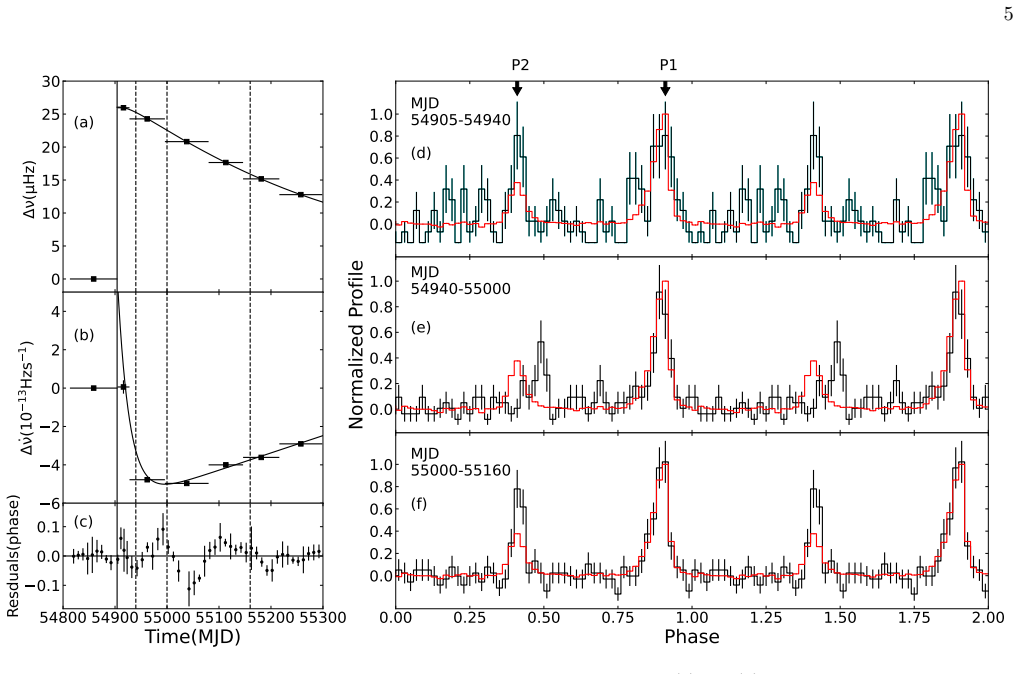
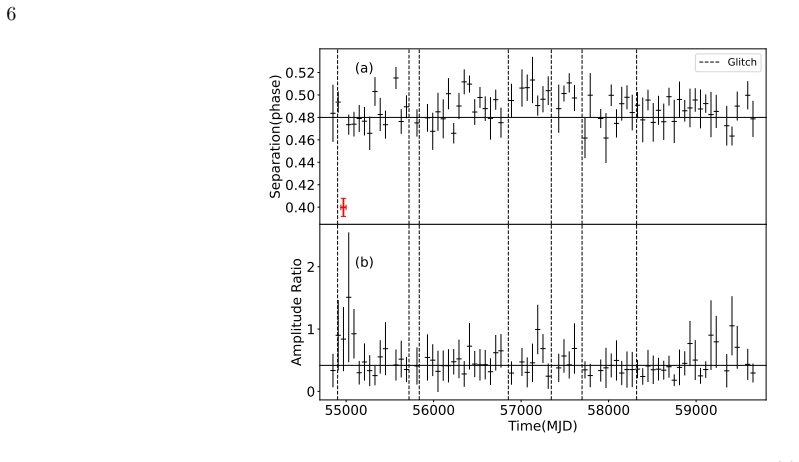
Successive variations occurred in the gamma-ray pulsed radiation of PSR J0205+6449 after the glitch at MJD 54904. The amplitude ratio of the two peaks rose during MJD 54905-54940, recovered, then the peak separation decreased significantly over MJD 54940-55000; the ratio rose again around MJD 55000-55160 with marginal flux change before the emission reverted to normal. This constitutes the first significant detection of pulsed radiation variation associated with a glitch in a gamma-ray pulsar and is attributed to magnetospheric reconfiguration from localized crustal breaking and elastic displacement near the polar cap.
What carries the argument
Magnetospheric reconfiguration triggered by localized crustal breaking and associated elastic displacement near the polar cap, which alters the gamma-ray emission geometry and produces the observed changes in peak amplitude ratio and separation.
If this is right
- Glitches can modify gamma-ray emission in addition to radio emission.
- Crustal events near the polar cap can propagate to affect the high-energy magnetosphere.
- The pulse profile returns to its stable state after a finite recovery period of several months.
- Timing of radiation changes can be used to locate the site of glitch-induced crustal activity.
Where Pith is reading between the lines
- Similar short-term gamma-ray variations may appear in other young pulsars after large glitches if polar-cap crustal motion is common.
- The duration of the observed recovery window could correlate with the energy released in the glitch or the depth of the crustal fracture.
- Simultaneous radio and gamma-ray monitoring after future glitches would test whether the same magnetospheric adjustment affects both wavebands.
- The result raises the possibility that interior neutron-star dynamics leave detectable imprints on high-energy light curves on timescales of weeks to months.
Load-bearing premise
The observed shifts in peak ratio and separation are produced by the glitch rather than by unrelated timing fluctuations that coincided with the glitch epoch.
What would settle it
A search across other gamma-ray pulsars with recorded glitches that finds no corresponding pulse-profile changes aligned with the glitch times, or the detection of identical profile variations in PSR J0205+6449 during intervals with no glitch.
Figures
read the original abstract
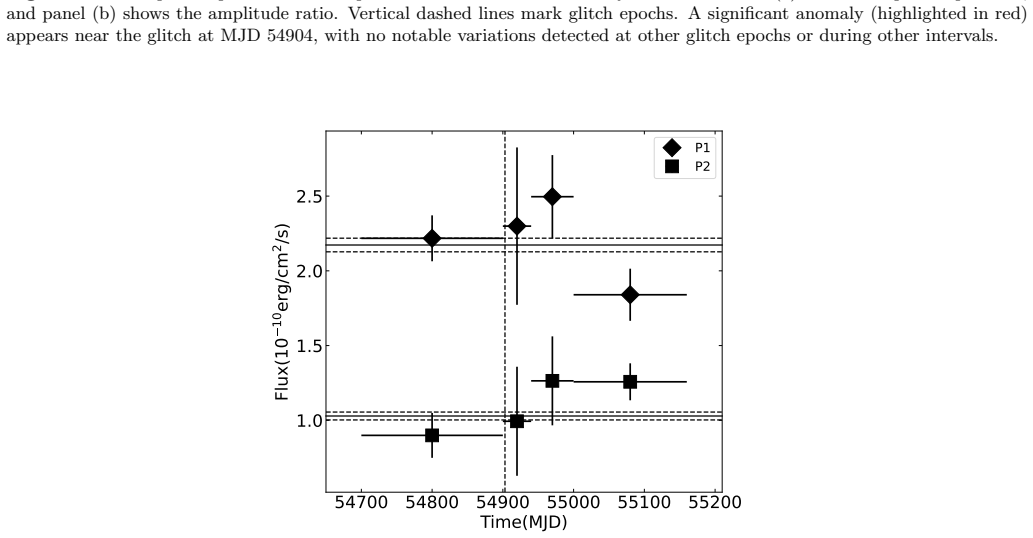
Rotation-powered pulsars exhibit stable emission characteristics most of the time. However, their radiative state can vary with the sudden changes of rotational state such as glitches. To date, pulsed radiation changes associated with glitches have only been detected in the radio band. Since the emission regions of radio and $\gamma$-ray may differ, searching and investigating whether glitches can induce changes in high-energy radiation would further deepen our understanding of how glitches affect the magnetosphere of pulsars. We report successive variations in the $\gamma$-ray pulsed radiation of PSR J0205+6449 following the glitch at MJD 54904 observed by the {\sl Fermi}/LAT. The amplitude ratio of the two peaks showed a hint of an increase during MJD 54905--54940 initially, followed by a recovery to the mean level and a significant ($>5\,\sigma$) decrease in the separation between the two peaks over MJD 54940--55000. The amplitude ratio of the two peaks increased ($\sim3\,\sigma$) again in MJD 55000--55160, accompanied by a marginal flux variation. Finally, the pulsed radiation reverted to its normal state. This is the first significant detection of pulsed radiation variation associated with a glitch in $\gamma$-ray pulsars. We attribute this to magnetospheric reconfiguration triggered by localized crustal breaking and associated elastic displacement near the polar cap following the glitch.
Editorial analysis
A structured set of objections, weighed in public.
Referee Report
Summary. The manuscript reports successive variations in the γ-ray pulsed emission profile of PSR J0205+6449 following the glitch at MJD 54904, as observed by Fermi/LAT. These include a hint of increased peak amplitude ratio (MJD 54905–54940), a >5σ decrease in peak separation (MJD 54940–55000), a ~3σ ratio increase (MJD 55000–55160) with marginal flux change, followed by recovery to the pre-glitch state. The authors claim this is the first significant detection of glitch-associated pulsed γ-ray variations and attribute it to magnetospheric reconfiguration from localized crustal breaking and elastic displacement near the polar cap.
Significance. If the causal link to the glitch is established, the result would extend glitch-induced radiative changes from the radio to the γ-ray band and provide observational constraints on magnetospheric response to crustal events. The multi-epoch recovery pattern could test models of polar-cap displacement, though the current evidence rests on timing alignment without a reported null-hypothesis test.
major comments (1)
- [Abstract] Abstract: The central claim that the reported variations are 'associated with' the glitch at MJD 54904 (and thus the first such γ-ray detection) rests on temporal coincidence alone. No quantitative test is described for the probability that the observed sequence of amplitude-ratio and separation changes (with heterogeneous significances spanning ~150 days) would arise from intrinsic variability under a stationary-emission null hypothesis, nor is a control-epoch comparison or change-point analysis presented. This statistical support is load-bearing for the attribution to magnetospheric reconfiguration.
minor comments (2)
- The abstract states the changes 'reverted to its normal state' but does not specify the exact criterion or epoch used to define recovery; this should be quantified in the results section with reference to the pre-glitch baseline.
- Notation for the two peaks (e.g., 'amplitude ratio of the two peaks') is used without an explicit definition or figure reference in the abstract; ensure consistent labeling in §3 or §4.
Simulated Author's Rebuttal
We thank the referee for their thorough review and constructive feedback on our manuscript. We address the single major comment below and agree that additional statistical analysis will strengthen the paper.
read point-by-point responses
-
Referee: [Abstract] Abstract: The central claim that the reported variations are 'associated with' the glitch at MJD 54904 (and thus the first such γ-ray detection) rests on temporal coincidence alone. No quantitative test is described for the probability that the observed sequence of amplitude-ratio and separation changes (with heterogeneous significances spanning ~150 days) would arise from intrinsic variability under a stationary-emission null hypothesis, nor is a control-epoch comparison or change-point analysis presented. This statistical support is load-bearing for the attribution to magnetospheric reconfiguration.
Authors: We agree that a formal quantitative test under the null hypothesis of stationary emission would provide stronger support for attributing the observed sequence to the glitch. The manuscript reports the individual significances of the changes (e.g., >5σ decrease in peak separation) and notes the recovery to the pre-glitch state, but does not include a Monte Carlo simulation, change-point analysis, or control-epoch comparison for the full multi-epoch pattern. In the revised manuscript we will add a dedicated subsection describing such a test, including Monte Carlo trials of the profile parameters under a stationary-emission model and a comparison with control epochs away from the glitch epoch. This will directly address the concern while preserving the existing timing-based attribution. revision: yes
Circularity Check
No circularity: purely observational report with no derivation chain
full rationale
The paper is an observational report of gamma-ray pulse profile changes (amplitude ratio and peak separation) in PSR J0205+6449 after the MJD 54904 glitch, detected via Fermi/LAT data. No equations, fitted parameters, predictions, or mathematical derivations are present in the abstract or described structure. The central claim rests on timing alignment of observed variations with the glitch epoch and an interpretive attribution to magnetospheric reconfiguration; this does not reduce to any self-definitional, fitted-input, or self-citation mechanism. The work is self-contained as data reporting and does not invoke load-bearing prior results from the same authors that would create circularity.
Axiom & Free-Parameter Ledger
Reference graph
Works this paper leans on
-
[1]
A., Ackermann, M., Ajello, M., et al
Abdo, A. A., Ackermann, M., Ajello, M., et al. 2009, ApJL, 699, L102, doi: 10.1088/0004-637X/699/2/L102
-
[2]
A., Ackermann, M., Ajello, M., et al
Abdo, A. A., Ackermann, M., Ajello, M., et al. 2010, ApJ, 708, 1254, doi: 10.1088/0004-637X/708/2/1254
-
[3]
2020, ApJS, 247, 33, doi: 10.3847/1538-4365/ab6bcb
Abdollahi, S., Acero, F., Ackermann, M., et al. 2020, ApJS, 247, 33, doi: 10.3847/1538-4365/ab6bcb
-
[4]
Ackermann, M., Ajello, M., Atwood, W. B., et al. 2012, ApJ, 750, 3, doi: 10.1088/0004-637X/750/1/3
-
[5]
2013, ApJL, 777, L2, doi: 10.1088/2041-8205/777/1/L2
Allafort, A., Baldini, L., Ballet, J., et al. 2013, ApJL, 777, L2, doi: 10.1088/2041-8205/777/1/L2
-
[6]
Alpar, M. A., Pines, D., Anderson, P. W., & Shaham, J. 1984, ApJ, 276, 325, doi: 10.1086/161616
-
[7]
Anderson, P. W., & Itoh, N. 1975, Nature, 256, 25, doi: 10.1038/256025a0
-
[8]
Espinoza, C. M. 2012, PhRvL, 109, 241103, doi: 10.1103/PhysRevLett.109.241103
-
[9]
J.6971071–1102 doi:10.1088/0004-637X/697/2/1071
Atwood, W. B., Abdo, A. A., Ackermann, M., et al. 2009, ApJ, 697, 1071, doi: 10.1088/0004-637X/697/2/1071
-
[10]
2022, MNRAS, 510, 4049, doi: 10.1093/mnras/stab3336
Basu, A., Shaw, B., Antonopoulou, D., et al. 2022, MNRAS, 510, 4049, doi: 10.1093/mnras/stab3336
-
[11]
F., Kondratiev, V., Ransom, S., et al
Bietenholz, M. F., Kondratiev, V., Ransom, S., et al. 2013, MNRAS, 431, 2590, doi: 10.1093/mnras/stt353
-
[12]
Harding, A. K., & Kazanas, D. 2018, ApJ, 858, 81, doi: 10.3847/1538-4357/aab3e1
-
[13]
Camilo, F., Stairs, I. H., Lorimer, D. R., et al. 2002, ApJL, 571, L41, doi: 10.1086/341178
-
[14]
2018, MNRAS, 475, 2185, doi: 10.1093/mnras/stx3322
Chang, S., Zhang, L., Li, X., & Jiang, Z. 2018, MNRAS, 475, 2185, doi: 10.1093/mnras/stx3322
-
[15]
Cheng, K. S., Ho, C., & Ruderman, M. 1986, ApJ, 300, 500, doi: 10.1086/163829
-
[16]
Cozzolongo, G., Fiori, A., Razzano, M., & Saz Parkinson, P. M. 2025, A&A, 702, A60, doi: 10.1051/0004-6361/202555331
-
[17]
Daugherty, J. K., & Harding, A. K. 1994, ApJ, 429, 325, doi: 10.1086/174321
-
[18]
2003, ApJ, 598, 1201, doi: 10.1086/379052
Dyks, J., & Rudak, B. 2003, ApJ, 598, 1201, doi: 10.1086/379052
-
[19]
2020, Nature Astronomy, 4, 511, doi: 10.1038/s41550-020-1088-1
Feng, H., Li, H., Long, X., et al. 2020, Nature Astronomy, 4, 511, doi: 10.1038/s41550-020-1088-1
-
[20]
Fiori, A., Razzano, M., Harding, A. K., et al. 2024, A&A, 685, A70, doi: 10.1051/0004-6361/202348924
-
[21]
Franco, L. M., Link, B., & Epstein, R. I. 2000, ApJ, 543, 987, doi: 10.1086/317121 9
-
[22]
2025, Science China
Ge, M., Ji, L., Taverna, R., et al. 2025, Science China
2025
-
[23]
Physics, Mechanics, and Astronomy, 68, 119505, doi: 10.1007/s11433-025-2796-y
-
[24]
Ge, M. Y., Yuan, J. P., Lu, F. J., et al. 2020a, ApJL, 900, L7, doi: 10.3847/2041-8213/abaeed
-
[25]
Ge, M. Y., Zhang, S. N., Lu, F. J., et al. 2020b, ApJ, 896, 55, doi: 10.3847/1538-4357/ab8db6
-
[26]
Ge, M.-Y., Yang, Y.-P., Lu, F.-J., et al. 2024, Research in Astronomy and Astrophysics, 24, 015016, doi: 10.1088/1674-4527/ad0f0c G¨ ugercino˘ glu, E., & Alpar, M. A. 2014, ApJL, 788, L11, doi: 10.1088/2041-8205/788/1/L11 G¨ ugercino˘ glu, E., & Alpar, M. A. 2016, MNRAS, 462, 1453, doi: 10.1093/mnras/stw1758 G¨ ugercino˘ glu, E., Ge, M. Y., Yuan, J. P., &...
-
[27]
Hermsen, W., Hessels, J. W. T., Kuiper, L., et al. 2013, Science, 339, 436, doi: 10.1126/science.1230960
-
[28]
Kalapotharakos, C., Harding, A. K., & Kazanas, D. 2014, ApJ, 793, 97, doi: 10.1088/0004-637X/793/2/97
-
[29]
2025, ApJ, 991, 225, doi: 10.3847/1538-4357/adfa95
Kerr, M. 2025, ApJ, 991, 225, doi: 10.3847/1538-4357/adfa95
-
[30]
2013, A&A, 560, A18, doi: 10.1051/0004-6361/201219839
Kothes, R. 2013, A&A, 560, A18, doi: 10.1051/0004-6361/201219839
-
[31]
Kou, F. F., Yuan, J. P., Wang, N., Yan, W. M., & Dang, S. J. 2018, MNRAS, 478, L24, doi: 10.1093/mnrasl/sly068
-
[32]
2018, MNRAS, 475, 1238, doi: 10.1093/mnras/stx3128
Kuiper, L., Hermsen, W., & Dekker, A. 2018, MNRAS, 475, 1238, doi: 10.1093/mnras/stx3128
-
[33]
Kuiper, L., Hermsen, W., Urama, J. O., et al. 2010, A&A, 515, A34, doi: 10.1051/0004-6361/200913851
-
[34]
2012, ApJ, 746, 60, doi: 10.1088/0004-637X/746/1/60
Li, J., Spitkovsky, A., & Tchekhovskoy, A. 2012, ApJ, 746, 60, doi: 10.1088/0004-637X/746/1/60
-
[35]
Li, J., Torres, D. F., Lin, T. T., et al. 2018, ApJ, 858, 84, doi: 10.3847/1538-4357/aabac9
-
[36]
2011, ApJ, 743, 113, doi: 10.1088/0004-637X/743/2/113
Li, X., & Zhang, L. 2011, ApJ, 743, 113, doi: 10.1088/0004-637X/743/2/113
-
[37]
Lin, L. C.-C., Wang, H.-H., Hui, C. Y., et al. 2021, MNRAS, 503, 4908, doi: 10.1093/mnras/stab783
-
[38]
2022, ApJ, 931, 103, doi: 10.3847/1538-4357/ac6bf7
Liu, J., Wang, H.-G., Shen, Z.-Q., et al. 2022, ApJ, 931, 103, doi: 10.3847/1538-4357/ac6bf7
-
[39]
2021, ApJ, 912, 58, doi: 10.3847/1538-4357/abf140
Liu, J., Wang, H.-G., Yan, Z., et al. 2021, ApJ, 912, 58, doi: 10.3847/1538-4357/abf140
-
[40]
2024, MNRAS, 533, 4274, doi: 10.1093/mnras/stae1973
Liu, P., Yuan, J.-P., Ge, M.-Y., et al. 2024, MNRAS, 533, 4274, doi: 10.1093/mnras/stae1973
-
[41]
2026, ApJL, 998, L15, doi: 10.3847/2041-8213/ae3c0f
Liu, X.-Z., Ge, M.-Y., Zheng, X.-P., et al. 2026, ApJL, 998, L15, doi: 10.3847/2041-8213/ae3c0f
-
[42]
Liu, Y., Keith, M. J., Antonopoulou, D., et al. 2024, MNRAS, 532, 859, doi: 10.1093/mnras/stae1499
-
[43]
Livingstone, M. A., Ransom, S. M., Camilo, F., et al. 2009, ApJ, 706, 1163, doi: 10.1088/0004-637X/706/2/1163
-
[44]
2010, Science, 329, 408, doi: 10.1126/science.1186683
Lyne, A., Hobbs, G., Kramer, M., Stairs, I., & Stappers, B. 2010, Science, 329, 408, doi: 10.1126/science.1186683
-
[45]
Lyne, A. G. 1971, MNRAS, 153, 27P, doi: 10.1093/mnras/153.1.27P
-
[46]
Lyne, A. G., Smith, F. G., & Pritchard, R. S. 1992, Nature, 359, 706, doi: 10.1038/359706a0
-
[47]
Marshall, F. E., Guillemot, L., Harding, A. K., Martin, P., & Smith, D. A. 2015, ApJL, 807, L27, doi: 10.1088/2041-8205/807/2/L27
-
[48]
Murray, S. S., Slane, P. O., Seward, F. D., Ransom, S. M., & Gaensler, B. M. 2002, ApJ, 568, 226, doi: 10.1086/338766
-
[49]
Ng, C. W., Takata, J., & Cheng, K. S. 2016, ApJ, 825, 18, doi: 10.3847/0004-637X/825/1/18
-
[50]
M., Hotan, A., Ellingsen, S., & van Straten, W
Palfreyman, J., Dickey, J. M., Hotan, A., Ellingsen, S., & van Straten, W. 2018, Nature, 556, 219, doi: 10.1038/s41586-018-0001-x
-
[51]
Panin, A. G., & Sokolova, E. V. 2025, A&A, 697, A178, doi: 10.1051/0004-6361/202452613
-
[52]
2022, ARA&A, 60, 495, doi: 10.1146/annurev-astro-052920-112338
Philippov, A., & Kramer, M. 2022, ARA&A, 60, 495, doi: 10.1146/annurev-astro-052920-112338
-
[53]
Philippov, A. A., & Spitkovsky, A. 2014, ApJL, 785, L33, doi: 10.1088/2041-8205/785/2/L33
-
[54]
Philippov, A. A., & Spitkovsky, A. 2018, ApJ, 855, 94, doi: 10.3847/1538-4357/aaabbc
-
[55]
A., Spitkovsky, A., & Cerutti, B
Philippov, A. A., Spitkovsky, A., & Cerutti, B. 2015, ApJL, 801, L19, doi: 10.1088/2041-8205/801/1/L19
-
[56]
Qiao, G. J., Lee, K. J., Wang, H. G., Xu, R. X., & Han, J. L. 2004, ApJL, 606, L49, doi: 10.1086/421048
-
[57]
Rajwade, K., Seymour, A., Lorimer, D. R., et al. 2016, MNRAS, 462, 2518, doi: 10.1093/mnras/stw1858
-
[58]
Romani, R. W. 1996, ApJ, 470, 469, doi: 10.1086/177878
-
[59]
Ruderman, M. A., & Sutherland, P. G. 1975, ApJ, 196, 51, doi: 10.1086/153393
-
[60]
Schwope, A., Pires, A. M., Kurpas, J., et al. 2022, A&A, 661, A41, doi: 10.1051/0004-6361/202141105
-
[61]
Shang, L. H., Zhi, Q. J., Dang, S. J., & Wang, Q. S. 2020, Ap&SS, 365, 70, doi: 10.1007/s10509-020-03783-9
-
[62]
Shaw, B., Stappers, B. W., Weltevrede, P., et al. 2022, MNRAS, 513, 5861, doi: 10.1093/mnras/stac1156
-
[63]
Takata, J., Wang, H. H., Lin, L. C. C., et al. 2020, ApJ, 890, 16, doi: 10.3847/1538-4357/ab67b1
-
[64]
Timokhin, A. N. 2010, MNRAS, 408, L41, doi: 10.1111/j.1745-3933.2010.00924.x
-
[65]
2009, ApJ, 695, 1289, doi: 10.1088/0004-637X/695/2/1289 10
Johnston, S. 2009, ApJ, 695, 1289, doi: 10.1088/0004-637X/695/2/1289 10
-
[66]
2017, in International Cosmic Ray Conference, Vol
Wood, M., Caputo, R., Charles, E., et al. 2017, in International Cosmic Ray Conference, Vol. 301, 35th International Cosmic Ray Conference (ICRC2017), 824, doi: 10.22323/1.301.0824
-
[67]
2022, Research in Astronomy and Astrophysics, 22, 045012, doi: 10.1088/1674-4527/ac556d
Yan, L.-L., Ge, M.-Y., Tuo, Y.-L., Wang, L.-j., & Zhou, Q.-y. 2022, Research in Astronomy and Astrophysics, 22, 045012, doi: 10.1088/1674-4527/ac556d
-
[68]
Zhang, S.-N., Santangelo, A., Xu, Y., et al. 2025, Science China Physics, Mechanics, and Astronomy, 68, 119502, doi: 10.1007/s11433-025-2786-6
-
[69]
Zhang, Y. H., Ge, M. Y., Lu, F. J., et al. 2022, ApJ, 932, 11, doi: 10.3847/1538-4357/ac6d53
-
[70]
2022, Universe, 8, 641, doi: 10.3390/universe8120641
Zhou, S., G¨ ugercino˘ glu, E., Yuan, J., Ge, M., & Yu, C. 2022, Universe, 8, 641, doi: 10.3390/universe8120641
-
[71]
Q., G¨ ugercino˘ glu, E., Yuan, J
Zhou, S. Q., G¨ ugercino˘ glu, E., Yuan, J. P., et al. 2023, MNRAS, 519, 74, doi: 10.1093/mnras/stac3355
-
[72]
2025, A&A, 694, A124, doi: 10.1051/0004-6361/202452693
Zubieta, E., Garc´ ıa, F., del Palacio, S., et al. 2025, A&A, 694, A124, doi: 10.1051/0004-6361/202452693
discussion (0)
Sign in with ORCID, Apple, or X to comment. Anyone can read and Pith papers without signing in.