Signs of Sulphur fractionation under high magnetic field strength
Pith reviewed 2026-06-29 21:02 UTC · model grok-4.3
The pith
Sulphur fractionation decreases above 150 G in coronal loops, independent of length.
A machine-rendered reading of the paper's core claim, the machinery that carries it, and where it could break.
Core claim
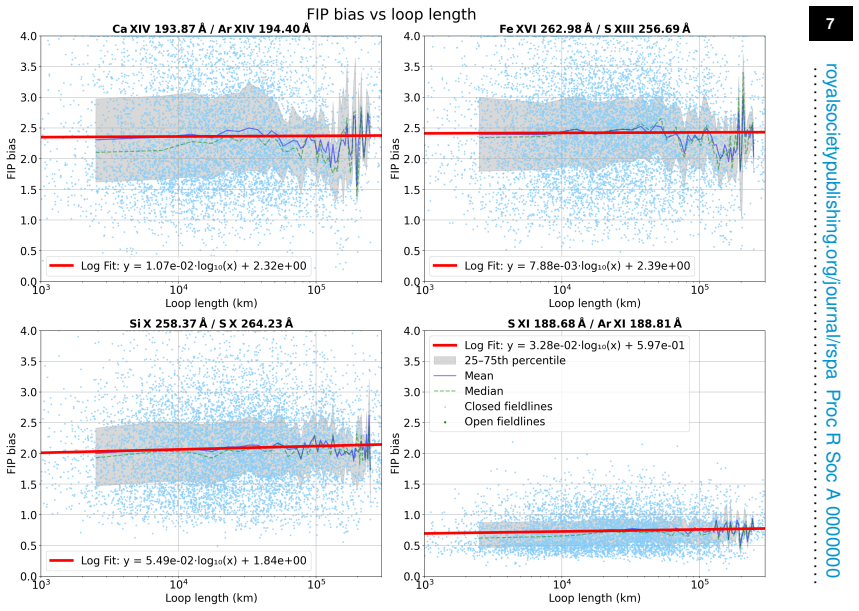
Analysis of Hinode/EIS observations using four diagnostic line pairs (Si X/S X, S XI/Ar XI, Ca XIV/Ar XIV, Fe XVI/S XIII) and regularised DEM inversion shows that abundances of low-FIP elements, including sulphur, decrease above approximately 150 G relative to the high-FIP element Ar, while showing no dependence on loop length. This provides evidence that FIP fractionation is modulated by mean magnetic field strength of coronal loops.
What carries the argument
Regularised differential emission measure inversion from four diagnostic line pairs to derive FIP bias versus PFSS-derived mean magnetic field strength and loop length.
If this is right
- FIP fractionation depends on mean magnetic field strength of coronal loops rather than on loop length.
- Sulphur behaves as a high-FIP element once field strength exceeds approximately 150 G.
- Variable sulphur behaviour observed during flares and magnetic restructuring may trace changes in local field strength.
- The modulation supplies a mechanism that can reconcile remote-sensing and in-situ abundance measurements.
Where Pith is reading between the lines
- Coronal abundance models could be extended to predict elemental ratios directly from photospheric magnetic field maps.
- The 150 G threshold offers a testable target for three-dimensional MHD simulations that include ion-neutral separation.
- Future multi-instrument campaigns during active region evolution could check whether the same field-strength dependence appears in other elements near the FIP boundary.
Load-bearing premise
The diagnostic line pairs and regularised DEM inversion isolate true FIP bias without significant contamination from temperature structure, density, or calibration uncertainties.
What would settle it
Repeating the full analysis on the same or similar EIS rasters with an independent DEM method or different instrument that yields no abundance drop above 150 G would falsify the claim.
Figures

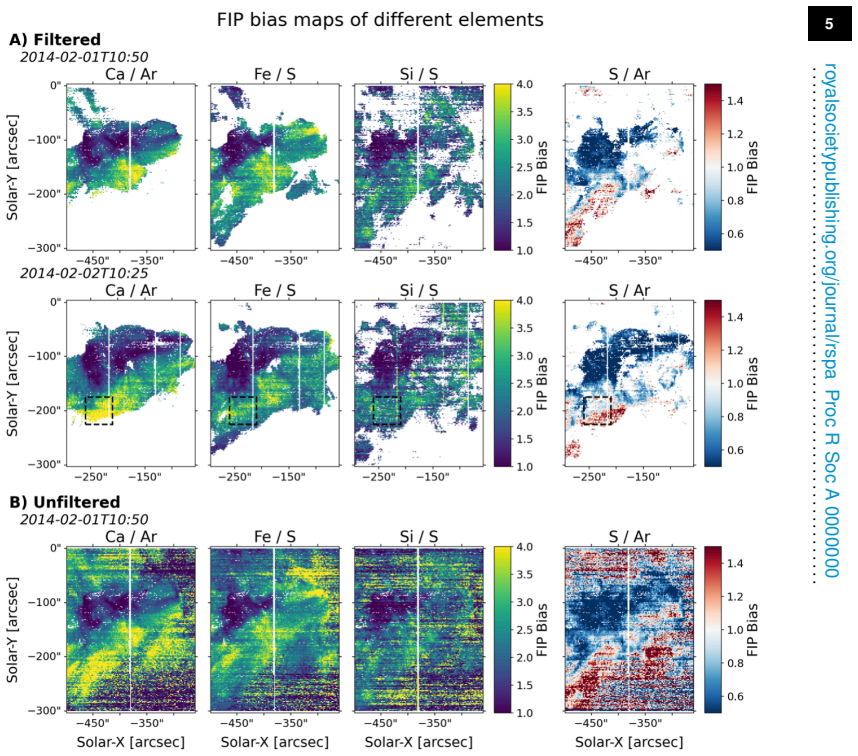

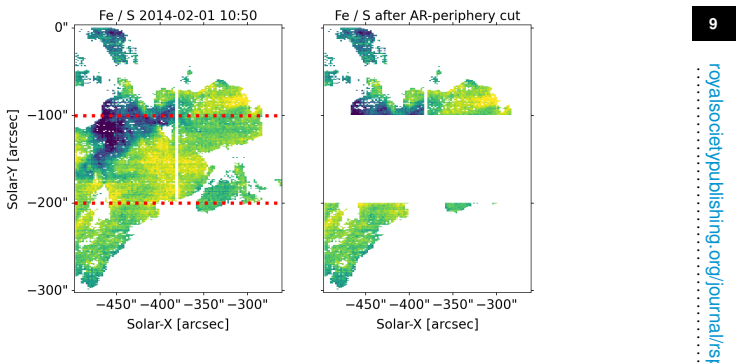


read the original abstract
Sulphur, with a first ionisation potential (FIP) of 10.36 eV, lies at the boundary between low- and high-FIP elements, making it particularly sensitive to fractionation processes in the solar atmosphere. Sulphur exhibits variable behaviour across solar environments, with coronal remote sensing studies often observing it as a high-FIP element while in-situ measurements sometimes detect low-FIP-like enhancement. Sulphur also exhibits variable behaviour during flares and magnetic restructuring. To understand sulphur's variations, we quantify how sulphur's FIP bias depends on potential field source surface (PFSS)-derived loop properties. We analyse nine Hinode/EUV Imaging Spectrometer (EIS) raster observations using four diagnostic line pairs (Si X 258.37 A / S X 264.23 A, S XI 188.68 A / Ar XI 188.81 A, Ca XIV 193.87 A / Ar XIV 194.40 A, and Fe XVI 262.98 A / S XIII 256.69 A), with FIP biases derived using differential emission measures (DEM) calculated via regularised inversion. Our results show that abundances of low-FIP elements, including sulphur, decrease above approximately 150 G relative to the high-FIP element Ar, while showing no dependence on loop length. This provides evidence that FIP fractionation is modulated by mean magnetic field strength of coronal loops.
Editorial analysis
A structured set of objections, weighed in public.
Referee Report
Summary. The manuscript analyzes nine Hinode/EIS raster observations of coronal loops using four diagnostic line pairs (Si X 258.37 Å/S X 264.23 Å, S XI 188.68 Å/Ar XI 188.81 Å, Ca XIV 193.87 Å/Ar XIV 194.40 Å, Fe XVI 262.98 Å/S XIII 256.69 Å) and regularised DEM inversion to derive FIP biases. It reports that low-FIP element abundances (including sulphur) decrease relative to high-FIP Ar above a PFSS-derived mean magnetic field strength of ~150 G, with no dependence on loop length, and interprets this as evidence that FIP fractionation is modulated by mean loop magnetic field strength.
Significance. If the central correlation holds after validation, the result would be significant for solar atmospheric physics: it supplies an observational link between the FIP effect and a measurable physical parameter (mean B), helps explain sulphur's variable fractionation across remote-sensing and in-situ data, and constrains fractionation models. The use of multiple independent line-pair diagnostics and PFSS models is a methodological strength when properly error-checked.
major comments (2)
- [Methods (diagnostics and DEM section)] Methods (diagnostics and DEM section): the abstract and available description supply no error bars on the derived FIP biases, no data-exclusion criteria for the nine rasters, and no validation of the four line-pair diagnostics against alternative DEM methods or density/temperature sensitivity tests; these steps are load-bearing for the claim that the reported trend isolates true FIP bias rather than temperature structure or calibration effects.
- [Results (magnetic-field dependence)] Results (magnetic-field dependence): the 150 G threshold and absence of length dependence rest on PFSS mean field strengths; no cross-check against NLFFF extrapolations, vector-field data, or direct coronal B proxies is described, yet PFSS is known to underestimate B by 30-50 % in active-region loops, which could shift the reported threshold and binning.
minor comments (1)
- [Abstract] Abstract: the number of individual loops per raster and the statistical significance or scatter of the abundance trend versus B should be stated explicitly.
Simulated Author's Rebuttal
We thank the referee for their constructive comments on our manuscript. We address each major comment below and outline the revisions we will make.
read point-by-point responses
-
Referee: [Methods (diagnostics and DEM section)] Methods (diagnostics and DEM section): the abstract and available description supply no error bars on the derived FIP biases, no data-exclusion criteria for the nine rasters, and no validation of the four line-pair diagnostics against alternative DEM methods or density/temperature sensitivity tests; these steps are load-bearing for the claim that the reported trend isolates true FIP bias rather than temperature structure or calibration effects.
Authors: We agree that the current manuscript lacks explicit error bars, data-exclusion criteria, and validation tests. In the revised version we will (i) propagate uncertainties from line intensities and the regularised DEM inversion to report error bars on all FIP-bias values, (ii) state the selection criteria applied to the nine EIS rasters, and (iii) add a dedicated subsection presenting density- and temperature-sensitivity tests together with a comparison against an alternative MCMC DEM method. These additions will confirm that the reported magnetic-field trend is not an artefact of temperature structure or calibration. revision: yes
-
Referee: [Results (magnetic-field dependence)] Results (magnetic-field dependence): the 150 G threshold and absence of length dependence rest on PFSS mean field strengths; no cross-check against NLFFF extrapolations, vector-field data, or direct coronal B proxies is described, yet PFSS is known to underestimate B by 30-50 % in active-region loops, which could shift the reported threshold and binning.
Authors: PFSS models are known to underestimate absolute field strengths, and we will add an explicit discussion of this limitation in the revised manuscript. Nevertheless, PFSS supplies a homogeneous, reproducible estimate of the mean loop field for all nine observations, preserving the relative ordering and the existence of a transition near 150 G. We therefore maintain that the observed correlation with FIP bias remains valid even if the absolute threshold shifts. Direct cross-checks with NLFFF extrapolations or vector-field data are not feasible for the full sample because co-temporal high-quality vector magnetograms are unavailable for several of the rasters; we will state this limitation clearly. revision: partial
Circularity Check
No circularity: observational correlation from independent spectra and models
full rationale
The paper reports an empirical correlation between FIP biases (derived from EIS line ratios via regularised DEM inversion) and PFSS-computed mean loop field strengths across nine rasters. No derivation, equation, or self-citation reduces the reported abundance trends or the 150 G threshold to a fitted parameter or input by construction. The central claim rests on external data products (EIS spectra, PFSS extrapolations) whose validity is independent of the target result. This matches the default expectation of a non-circular observational study.
Axiom & Free-Parameter Ledger
axioms (2)
- domain assumption The chosen spectral line pairs and regularised DEM inversion yield unbiased FIP ratios
- domain assumption PFSS models accurately represent the mean magnetic field strength of the observed coronal loops
Reference graph
Works this paper leans on
-
[1]
Tuned range-separated hybrids in density functional theory,
Asplund M, Grevesse N, Sauval AJ, Scott P . 2009 The Chemical Composition of the Sun.Annu. Rev. Astron. Astrophys. 47, 481–522. (10.1146/annurev .astro.46.060407.145222)
-
[2]
2015 The elemental composition of the Sun
Scott P , Grevesse N, Asplund M, Sauval AJ, Lind K, Takeda Y , Collet R, Trampedach R, Hayek W. 2015 The elemental composition of the Sun. I. The intermediate mass elements Na to Ca. Astron. Astrophys. 573, A25. ( 10.1051/0004-6361/201424109)
-
[3]
1963 The Lower Solar Corona: Interpretation of the Ultraviolet Spectrum
Pottasch SR. 1963 The Lower Solar Corona: Interpretation of the Ultraviolet Spectrum.. Astrophys. J. 137, 945. ( 10.1086/147569)
-
[5]
2015 Full-Sun observations for identifying the source of the slow solar wind
Brooks DH, Ugarte-Urra I, Warren HP . 2015 Full-Sun observations for identifying the source of the slow solar wind. Nature Communications 6, 5947. (10.1038/ncomms6947)
-
[6]
Doschek GA, Warren HP , Feldman U. 2015 ANOMALOUS RELATIVE AR/CA CORONAL ABUNDANCES OBSERVED BY THE HINODE/EUV IMAGING SPECTROMETER NEAR SUNSPOTS. Astrophys. J. Lett.. 808, L7. ( 10.1088/2041-8205/808/1/l7)
-
[7]
2016 THE MYSTERIOUS CASE OF THE SOLAR ARGON ABUNDANCE NEAR SUNSPOTS IN FLARES
Doschek GA, Warren HP . 2016 THE MYSTERIOUS CASE OF THE SOLAR ARGON ABUNDANCE NEAR SUNSPOTS IN FLARES. Astrophys. J. 825, 36. ( 10.3847/0004- 637x/825/1/36)
-
[8]
2018 A Diagnostic of Coronal Elemental Behavior during the Inverse FIP Effect in Solar Flares
Brooks DH. 2018 A Diagnostic of Coronal Elemental Behavior during the Inverse FIP Effect in Solar Flares. Astrophys. J. 863, 140. ( 10.3847/1538-4357/aad415)
-
[9]
2022 Detection of Stellar- like Abundance Anomalies in the Slow Solar Wind
Brooks DH, Baker D, van Driel-Gesztelyi L, Warren HP , Yardley SL. 2022 Detection of Stellar- like Abundance Anomalies in the Slow Solar Wind. Astrophys. J. Lett. 930, L10. (10.3847/2041- 8213/ac6878)
-
[10]
2024 Searching for Evidence of Subchromospheric Magnetic Reconnection on the Sun
Baker D, van Driel-Gesztelyi L, James AW, Démoulin P , To ASH, Murabito M, Long DM, Brooks DH, McKevitt J, Laming JM, Green LM, Yardley SL, Valori G, Mihailescu T, Matthews SA, Kuniyoshi H. 2024 Searching for Evidence of Subchromospheric Magnetic Reconnection on the Sun. Astrophys. J. 970, 39. (10.3847/1538-4357/ad4a6e) 18royalsocietypublishing.org/journa...
-
[11]
Laming JM. 2004 A Unified Picture of the First Ionization Potential and Inverse First Ionization Potential Effects. Astrophys. J. 614, 1063–1072. (10.1086/423780)
-
[12]
2009 Non-Wkb Models of the First Ionization Potential Effect: Implications for Solar Coronal Heating and the Coronal Helium and Neon Abundances
Laming JM. 2009 Non-Wkb Models of the First Ionization Potential Effect: Implications for Solar Coronal Heating and the Coronal Helium and Neon Abundances. Astrophys. J. 695, 954–
2009
-
[13]
(10.1088/0004-637X/695/2/954)
-
[14]
2015 The FIP and Inverse FIP Effects in Solar and Stellar Coronae
Laming JM. 2015 The FIP and Inverse FIP Effects in Solar and Stellar Coronae. Living Reviews in Solar Physics 12, 2. (10.1007/lrsp-2015-2)
-
[15]
Brooks DH, Warren HP . 2011 Establishing a Connection Between Active Region Outflows and the Solar Wind: Abundance Measurements with EIS/Hinode. Astrophys. J. Lett. 727, L13. (10.1088/2041-8205/727/1/L13)
-
[16]
2013 Plasma Composition in a Sigmoidal Anemone Active Region
Baker D, Brooks DH, Démoulin P , van Driel-Gesztelyi L, Green LM, Steed K, Carlyle J. 2013 Plasma Composition in a Sigmoidal Anemone Active Region. Astrophys. J. 778, 69. (10.1088/0004-637X/778/1/69)
-
[17]
Photon Rings around Kerr and Kerr-like B lack Holes
Baker D, Brooks DH, Démoulin P , Yardley SL, Van Driel-Gesztelyi L, Long DM, Green LM. 2015 FIP bias evolution in a decaying active region. Astrophys. J. 802, 104. ( 10.1088/0004- 637X/802/2/104)
-
[18]
2018 Coronal Elemental Abundances in Solar Emerging Flux Regions
Baker D, Brooks DH, van Driel-Gesztelyi L, James AW, Démoulin P , Long DM, Warren HP , Williams DR. 2018 Coronal Elemental Abundances in Solar Emerging Flux Regions. Astrophys. J. 856, 71. (10.3847/1538-4357/aaadb0)
-
[19]
2023 Understanding the Relationship between Solar Coronal Abundances and F10.7 cm Radio Emission
To ASH, James AW, Bastian TS, van Driel-Gesztelyi L, Long DM, Baker D, Brooks DH, Lomuscio S, Stansby D, Valori G. 2023 Understanding the Relationship between Solar Coronal Abundances and F10.7 cm Radio Emission. Astrophys. J. 948, 121. (10.3847/1538-4357/acbc1b)
-
[21]
2024 Spectroscopic Observations of Coronal Rain Formation and Evolution Following an X2 Solar Flare
Brooks DH, Reep JW, Ugarte-Urra I, Unverferth JE, Warren HP . 2024 Spectroscopic Observations of Coronal Rain Formation and Evolution Following an X2 Solar Flare. Astrophys. J. 962, 105. ( 10.3847/1538-4357/ad18be)
-
[22]
To ASH, Brooks DH, Imada S, French RJ, van Driel-Gesztelyi L, Baker D, Long DM, Ashfield, IV W, Hayes LA. 2024 Spatially resolved plasma composition evolution in a solar flare – The effect of reconnection outflow. Astron. Astrophys. 691, A95. (10.1051/0004-6361/202449246)
-
[24]
Spinning Primordial Black Holes and Scalar In- duced Gravitational Waves from Single Field Inflation
Mihailescu T, Brooks DH, Laming JM, Baker D, Green LM, James AW, Long DM, van Driel-Gesztelyi L, Stangalini M. 2023 Intriguing Plasma Composition Pattern in a Solar Active Region: A Result of Nonresonant Alfvén Waves?. Astrophys. J. 959, 72. ( 10.3847/1538- 4357/ad05bf)
-
[25]
Mzerguat S, Janvier M, Buchlin E, Baker D, To ASH, Long DM, Zambrana Prado N. 2026 Sulfur fractionation in coronal plumes as observed by Solar Orbiter/SPICE. arXiv e-prints p. arXiv:2602.23170. (10.48550/arXiv .2602.23170)
work page internal anchor Pith review doi:10.48550/arxiv 2026
-
[26]
2016 Slow Solar Wind: Observations and Modeling
Abbo L, Ofman L, Antiochos SK, Hansteen VH, Harra L, Ko YK, Lapenta G, Li B, Riley P , Strachan L, von Steiger R, Wang YM. 2016 Slow Solar Wind: Observations and Modeling. Space Sci. Rev. 201, 55–108. (10.1007/s11214-016-0264-1)
-
[27]
2017 A Solar cycle correlation of coronal element abundances in Sun-as-a-star observations
Brooks DH, Baker D, van Driel-Gesztelyi L, Warren HP . 2017 A Solar cycle correlation of coronal element abundances in Sun-as-a-star observations. Nature Communications 8, 183. (10.1038/s41467-017-00328-7)
-
[28]
2020 Magnetic Field Geometry and Composition Variation in Slow Solar Winds: The Case of Sulfur
Kuroda N, Laming JM. 2020 Magnetic Field Geometry and Composition Variation in Slow Solar Winds: The Case of Sulfur. Astrophys. J. 895, 36. (10.3847/1538-4357/ab8870)
-
[29]
Reames DV . 2018 The “FIP Effect” and the Origins of Solar Energetic Particles and of the Solar Wind. Sol. Phys. 293, 47. ( 10.1007/s11207-018-1267-8)
-
[30]
2021 The source of the major solar energetic particle events from super active region 11944
Brooks DH, Yardley SL. 2021 The source of the major solar energetic particle events from super active region 11944. Science Advances 7, eabf0068. (10.1126/sciadv .abf0068)
-
[31]
Yardley SL, Brooks DH. 2024 Sigmoid Eruption Associated with the X9.3 Flare from AR 12673 Drives the Gradual Solar Energetic Particle Event on 2017 September 6. Astrophys. J. 976, 152. (10.3847/1538-4357/ad8d5f)
-
[32]
2012 The Helioseismic and Magnetic 19royalsocietypublishing.org/journal/rspa Proc R Soc A 0000000
Scherrer PH, Schou J, Bush RI, Kosovichev AG, Bogart RS, Hoeksema JT, Liu Y , Duvall TL, Zhao J, Title AM, Schrijver CJ, Tarbell TD, Tomczyk S. 2012 The Helioseismic and Magnetic 19royalsocietypublishing.org/journal/rspa Proc R Soc A 0000000. . . . . . . . . . . . . . . . . . . . . . . . . . . . . . . . . . . . . . . . . . . . . . . . . . . . . . . . . . ...
2012
-
[33]
(10.1007/s11207-011-9834-2)
-
[34]
2022 What Determines Active Region Coronal Plasma Composition?
Mihailescu T, Baker D, Green LM, van Driel-Gesztelyi L, Long DM, Brooks DH, To ASH. 2022 What Determines Active Region Coronal Plasma Composition?. Astrophys. J. 933, 245. (10.3847/1538-4357/ac6e40)
-
[35]
Air Force
NOAA Space Weather Prediction Center (SWPC), U.S. Air Force. 2014a Joint USAF/NOAA Solar Region Summary (SRS), Issued 2014 Feb 02 0030 UTC. Daily text report
2014
-
[36]
Air Force
NOAA Space Weather Prediction Center (SWPC), U.S. Air Force. 2014b Joint USAF/NOAA Solar Region Summary (SRS), Issued 2014 Feb 03 0030 UTC. Daily text report
2014
-
[37]
Air Force
NOAA Space Weather Prediction Center (SWPC), U.S. Air Force. 2014c Joint USAF/NOAA Solar Region Summary (SRS), Issued 2014 Feb 04 0030 UTC. Daily text report
2014
-
[38]
Air Force
NOAA Space Weather Prediction Center (SWPC), U.S. Air Force. 2014d Joint USAF/NOAA Solar Region Summary (SRS), Issued 2014 Feb 05 0030 UTC. Daily text report
2014
-
[39]
Air Force
NOAA Space Weather Prediction Center (SWPC), U.S. Air Force. 2014e Joint USAF/NOAA Solar Region Summary (SRS), Issued 2014 Feb 06 0030 UTC. Daily text report
2014
-
[40]
2019 Transient Inverse-FIP Plasma Composition Evolution within a Solar Flare
Baker D, van Driel-Gesztelyi L, Brooks DH, Valori G, James AW, Laming JM, Long DM, Démoulin P , Green LM, Matthews SA, Oláh K, K˝ ovári Z. 2019 Transient Inverse-FIP Plasma Composition Evolution within a Solar Flare. Astrophys. J. 875, 35. (10.3847/1538-4357/ab07c1)
-
[41]
2014 The Absolute Calibration of the EUV Imaging Spectrometer on Hinode
Warren HP , Ugarte-Urra I, Landi E. 2014 The Absolute Calibration of the EUV Imaging Spectrometer on Hinode. Astrophys. J. Suppl. 213, 11. (10.1088/0067-0049/213/1/11)
-
[42]
2012 Differential emission measures from the regularized inversion of Hinode and SDO data
Hannah IG, Kontar EP . 2012 Differential emission measures from the regularized inversion of Hinode and SDO data. Astron. Astrophys. 539, A146. ( 10.1051/0004-6361/201117576)
-
[43]
1997 CHIANTI - an atomic database for emission lines
Dere KP , Landi E, Mason HE, Monsignori Fossi BC, Young PR. 1997 CHIANTI - an atomic database for emission lines. Astron. Astrophys. Suppl. 125, 149–173. (10.1051/aas:1997368)
-
[44]
2021 CHIANTI—An Atomic Database for Emission Lines
Del Zanna G, Dere KP , Young PR, Landi E. 2021 CHIANTI—An Atomic Database for Emission Lines. XVI. V ersion 10, Further Extensions. Astrophys. J. 909, 38. (10.3847/1538-4357/abd8ce)
-
[45]
2015 The elemental composition of the Sun
Scott P , Asplund M, Grevesse N, Bergemann M, Sauval AJ. 2015 The elemental composition of the Sun. II. The iron group elements Sc to Ni. Astron. Astrophys. 573, A26. ( 10.1051/0004- 6361/201424110)
-
[46]
2023 EISPAC - The EIS Python Analysis Code
Weberg M, Warren H, Crump N, Barnes W. 2023 EISPAC - The EIS Python Analysis Code. The Journal of Open Source Software 8, 4914. (10.21105/joss.04914)
-
[47]
2020 pfsspy: A Python package for potential field source surface modelling
Stansby D, Yeates A, Badman S. 2020 pfsspy: A Python package for potential field source surface modelling. The Journal of Open Source Software 5, 2732. (10.21105/joss.02732)
-
[48]
Hayashi K, Hoeksema JT, Liu Y , Bobra MG, Sun XD, Norton AA. 2015 The Helioseismic and Magnetic Imager (HMI) V ector Magnetic Field Pipeline: Magnetohydrodynamics Simulation Module for the Global Solar Corona. Sol. Phys. 290, 1507–1529. (10.1007/s11207-015-0686-z)
-
[49]
Martínez-Sykora J, De Pontieu B, Hansteen VH, Testa P , Wargnier QM, Szydlarski M. 2023 The Impact of Multifluid Effects in the Solar Chromosphere on the Ponderomotive Force under SE and NEQ Ionization Conditions. Astrophys. J. 949, 112. (10.3847/1538-4357/acc465)
-
[50]
2022 Extending the FIP bias sample to magnetically active stars
Seli B, Oláh K, Kriskovics L, K˝ ovári Z, Vida K, Balázs LG, Laming JM, van Driel-Gesztelyi L, Baker D. 2022 Extending the FIP bias sample to magnetically active stars. Challenging the FIP bias paradigm. Astron. Astrophys. 659, A3. (10.1051/0004-6361/202141493)
-
[51]
2010 Element Abundances in X-ray Emitting Plasmas in Stars
Testa P . 2010 Element Abundances in X-ray Emitting Plasmas in Stars. Space Sci. Rev. 157, 37–55. (10.1007/s11214-010-9714-3)
-
[52]
2015 Stellar activity and coronal heating: an overview of recent results
Testa P , Saar SH, Drake JJ. 2015 Stellar activity and coronal heating: an overview of recent results. Philosophical T ransactions of the Royal Society of London Series A 373, 20140259–20140259. (10.1098/rsta.2014.0259)
-
[53]
2018 A Chandra/LETGS Survey of Main- sequence Stars
Wood BE, Laming JM, Warren HP , Poppenhaeger K. 2018 A Chandra/LETGS Survey of Main- sequence Stars. Astrophys. J. 862, 66. ( 10.3847/1538-4357/aaccf6)
-
[54]
2025 Exploring coronal abundances of M dwarfs at moderate activity levels
Chebly JJ, Poppenhäger K, Alvarado-Gómez JD, Wood BE. 2025 Exploring coronal abundances of M dwarfs at moderate activity levels. Astron. Astrophys. 695, A165. (10.1051/0004-6361/202450209)
-
[55]
2007 The First Direct Measurements of Surface Magnetic Fields on V ery Low Mass Stars
Reiners A, Basri G. 2007 The First Direct Measurements of Surface Magnetic Fields on V ery Low Mass Stars. Astrophys. J. 656, 1121–1135. (10.1086/510304)
-
[56]
2017 Strong dipole magnetic fields in fast rotating fully convective stars
Shulyak D, Reiners A, Engeln A, Malo L, Yadav R, Morin J, Kochukhov O. 2017 Strong dipole magnetic fields in fast rotating fully convective stars. Nature Astronomy 1, 0184. (10.1038/s41550-017-0184)
-
[57]
Astropy Collaboration, Price-Whelan AM, Lim PL, Earl N, Starkman N, Bradley L, Shupe DL, Patil AA, Corrales L, Brasseur CE, Nöthe M, Donath A, Tollerud E, Morris BM, Ginsburg 20royalsocietypublishing.org/journal/rspa Proc R Soc A 0000000. . . . . . . . . . . . . . . . . . . . . . . . . . . . . . . . . . . . . . . . . . . . . . . . . . . . . . . . . . . . ...
work page internal anchor Pith review doi:10.3847/1538-4357/ac7c74 2022
-
[58]
2020 SunPy: A Python package for Solar Physics
Mumford S, Freij N, Christe S, Ireland J, Mayer F, Hughitt V , Shih A, Ryan D, Liedtke S, Pérez- Suárez D, Chakraborty P , K V , Inglis A, Pattnaik P , Sip˝ ocz B, Sharma R, Leonard A, Stansby D, Hewett R, Hamilton A, Hayes L, Panda A, Earnshaw M, Choudhary N, Kumar A, Chanda P , Haque M, Kirk M, Mueller M, Konge S, Srivastava R, Jain Y , Bennett S, Barua...
-
[59]
2020 The SunPy Project: Open Source Development and Status of the V ersion 1.0 Core Package
SunPy Community, Barnes WT, Bobra MG, Christe SD, Freij N, Hayes LA, Ireland J, Mumford S, Perez-Suarez D, Ryan DF, Shih A Y , Chanda P , Glogowski K, Hewett R, Hughitt VK, Hill A, Hiware K, Inglis A, Kirk MSF, Konge S, Mason JP , Maloney SA, Murray SA, Panda A, Park J, Pereira TMD, Reardon K, Savage S, Sip˝ ocz BM, Stansby D, Jain Y , Taylor G, Yadav T, ...
-
[60]
Computing in Science and Engineering , keywords =
Hunter JD. 2007 Matplotlib: A 2D Graphics Environment. Computing in Science and Engineering 9, 90–95. (10.1109/MCSE.2007.55)
-
[61]
Harris CR, Millman KJ, van der Walt SJ, Gommers R, Virtanen P , Cournapeau D, Wieser E, Taylor J, Berg S, Smith NJ, Kern R, Picus M, Hoyer S, van Kerkwijk MH, Brett M, Haldane A, del Río JF, Wiebe M, Peterson P , Gérard-Marchant P , Sheppard K, Reddy T, Weckesser W, Abbasi H, Gohlke C, Oliphant TE. 2020 Array programming with NumPy. Nature 585, 357–362. (...
-
[62]
Virtanen P , Gommers R, Oliphant TE, Haberland M, Reddy T, Cournapeau D, Burovski E, Peterson P , Weckesser W, Bright J, van der Walt SJ, Brett M, Wilson J, Millman KJ, Mayorov N, Nelson ARJ, Jones E, Kern R, Larson E, Carey CJ, Polat ˙I, Feng Y , Moore EW, VanderPlas J, Laxalde D, Perktold J, Cimrman R, Henriksen I, Quintero EA, Harris CR, Archibald AM, ...
discussion (0)
Sign in with ORCID, Apple, or X to comment. Anyone can read and Pith papers without signing in.