An Empirical Evaluation of Quantum-Inspired QUBO Methods for Heterogeneous HPC Workflow Mapping and Scheduling
Pith reviewed 2026-06-29 20:56 UTC · model grok-4.3
The pith
QUBO schedulers for heterogeneous HPC workflows lose feasibility beyond 15 tasks while classical solvers stay reliable.
A machine-rendered reading of the paper's core claim, the machinery that carries it, and where it could break.
Core claim
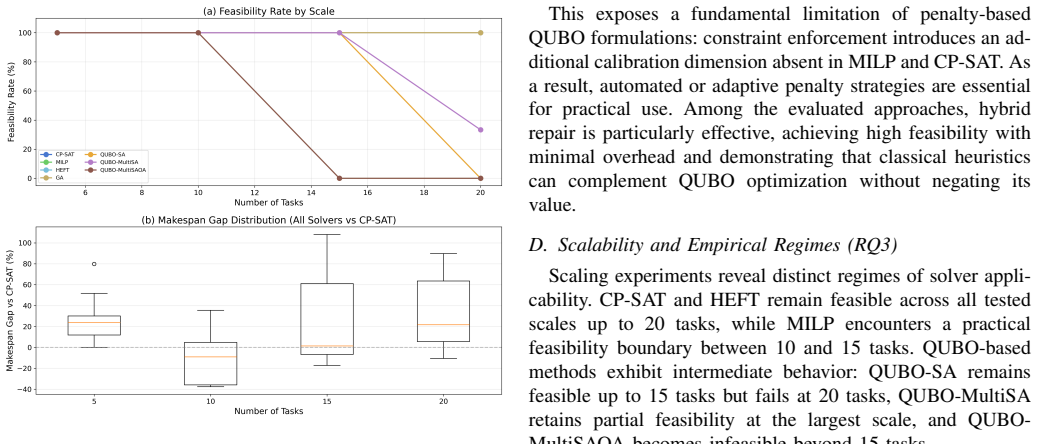
Quantum-inspired QUBO formulations recover the expected optimal makespan on validation instances with 3-4 tasks but exhibit feasibility degradation as constraint interactions intensify and instance sizes grow, with QUBO-SA losing feasibility beyond 15 tasks and the QAOA-inspired variant beyond 10 tasks, while classical solvers remain robust across the full range of 5-20 task synthetic instances under progressive constraint activation and penalty sweeps.
What carries the argument
The unified evaluation pipeline that measures feasibility, makespan, and resource utilization across single-run simulated annealing, multi-attempt annealing, and layered QAOA-inspired QUBO variants under controlled penalty sweeps and progressive constraint activation.
If this is right
- For workflows exceeding 15 tasks, classical exact or heuristic solvers remain the reliable choice under present QUBO solver capabilities.
- Communication costs must be handled with particular care in QUBO penalty design because they trigger the sharpest feasibility thresholds.
- Multi-attempt annealing improves reliability over single-run annealing but does not remove the scaling ceiling.
- Hybrid classical-quantum strategies are required to push QUBO applicability past the observed 10-15 task boundary.
Where Pith is reading between the lines
- The observed feasibility boundaries may shift if real workflows contain denser or different constraint graphs than the synthetic patterns tested.
- Improvements in QUBO solver technology or hardware could move the 15-task threshold outward without changes to the formulation itself.
- The same penalty-sweep methodology could be applied to other mapping problems such as data-center resource allocation or scientific workflow orchestration.
Load-bearing premise
The synthetic scaling instances with 5-20 tasks and their chosen constraint interactions and communication patterns are representative of real heterogeneous HPC workflows.
What would settle it
Running the QUBO-SA formulation on a real heterogeneous HPC workflow containing 16 or more tasks and checking whether any feasible schedule is returned under the moderate-to-strong penalty regimes that succeeded on the synthetic instances.
Figures


read the original abstract
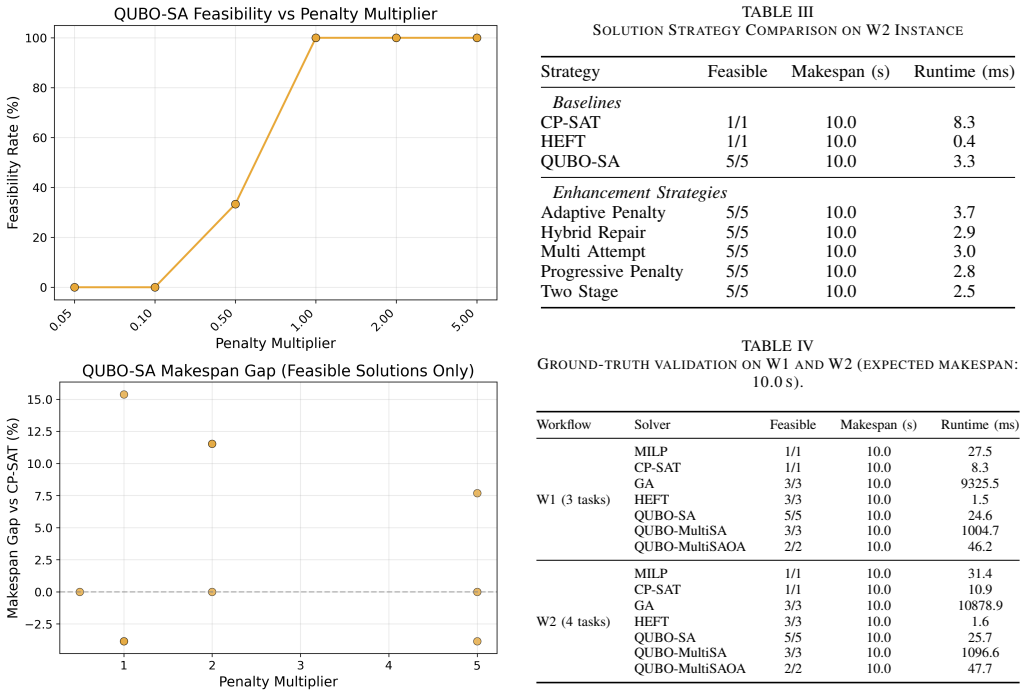
Heterogeneous HPC workflow scheduling under multiple hard constraints poses a challenging combinatorial optimization problem. Classical exact solvers guarantee optimality but face scalability limits, motivating interest in quantum-inspired Quadratic Unconstrained Binary Optimization (QUBO) as an alternative optimization paradigm. This work presents a systematic empirical evaluation of QUBO-based scheduling methods against classical baselines including MILP, CP-SAT, GA, and HEFT. We evaluate three QUBO variants, single-run simulated annealing, multi-attempt annealing, and a layered QAOA-inspired schedule, with hybrid enhancement strategies on validation workflows (3-4 tasks) and synthetic scaling instances (5-20 tasks). All solvers are assessed through a unified pipeline tracking feasibility, makespan, and resource utilization under progressive constraint activation and controlled penalty sweeps. All approaches recover the expected optimal makespan on validation instances, confirming formulation correctness. However, feasibility degradation emerges for specific QUBO variants as constraint interactions intensify, particularly when communication costs are introduced. Penalty analysis reveals a sharp feasibility threshold for QUBO-SA, where insufficient penalties consistently fail and moderate-to-strong penalties restore feasibility. Scaling experiments show that classical solvers remain robust across all tested sizes, while QUBO-SA loses feasibility beyond 15 tasks and the QAOA-inspired variant beyond 10 tasks. The study provides a clear empirical characterization of the reliability boundaries of quantum-inspired QUBO formulations for HPC scheduling and identifies regimes where classical approaches remain preferable under current solver capabilities.
Editorial analysis
A structured set of objections, weighed in public.
Referee Report
Summary. The paper presents an empirical evaluation of three QUBO variants (single-run simulated annealing, multi-attempt annealing, and a layered QAOA-inspired schedule) for heterogeneous HPC workflow mapping and scheduling under hard constraints, comparing them to classical baselines (MILP, CP-SAT, GA, HEFT) on validation instances (3-4 tasks) and synthetic scaling instances (5-20 tasks). It reports that all methods recover expected optimal makespan on validation instances but that QUBO-SA loses feasibility beyond 15 tasks and the QAOA-inspired variant beyond 10 tasks while classical solvers remain robust, thereby characterizing reliability boundaries and regimes favoring classical approaches.
Significance. If the observed feasibility thresholds hold on the tested instances, the work supplies a concrete empirical map of current practical limits for quantum-inspired QUBO formulations in constrained scheduling, which could usefully guide selection between solver families in HPC settings.
major comments (1)
- [Abstract] Abstract: the scaling experiments and the claim to identify 'reliability boundaries' and 'regimes where classical approaches remain preferable' rest exclusively on synthetic instances of 5-20 tasks, yet no details are supplied on instance generation procedure, task-graph structure, constraint densities, communication patterns, or any comparison against real HPC workflow traces. This directly undermines the load-bearing generalization from the reported thresholds (QUBO-SA beyond 15 tasks, QAOA beyond 10) to heterogeneous HPC workflows.
minor comments (2)
- [Abstract] Abstract: no error bars, variance measures, or number of independent runs are reported for the feasibility and makespan results.
- [Abstract] Abstract: exact numerical values of the penalty coefficients used in the sweeps are not stated, hindering reproducibility.
Simulated Author's Rebuttal
We thank the referee for highlighting the need for greater transparency in the abstract and experimental description. We will revise the manuscript accordingly while preserving the core empirical findings on the tested instances.
read point-by-point responses
-
Referee: [Abstract] Abstract: the scaling experiments and the claim to identify 'reliability boundaries' and 'regimes where classical approaches remain preferable' rest exclusively on synthetic instances of 5-20 tasks, yet no details are supplied on instance generation procedure, task-graph structure, constraint densities, communication patterns, or any comparison against real HPC workflow traces. This directly undermines the load-bearing generalization from the reported thresholds (QUBO-SA beyond 15 tasks, QAOA beyond 10) to heterogeneous HPC workflows.
Authors: We agree that the abstract and main text should supply explicit details on the synthetic instance generation to support reproducibility and to avoid over-generalization. In the revised version we will: (1) expand the abstract to state that all scaling results derive from synthetically generated DAGs with 5–20 tasks; (2) add a new subsection describing the generation procedure, including how task-graph topologies, communication volumes, constraint densities, and penalty terms were constructed; and (3) qualify all claims about “reliability boundaries” and “regimes where classical approaches remain preferable” to refer specifically to the controlled synthetic instances examined. The study deliberately employs synthetic benchmarks to isolate scaling behavior under progressive constraint activation—an accepted methodology when the goal is to map feasibility thresholds rather than to benchmark against production traces. We therefore do not claim, and will not claim, direct applicability to arbitrary real HPC workflows. These changes directly address the referee’s concern about load-bearing generalization. revision: yes
Circularity Check
No circularity: pure empirical comparison with no derivation chain
full rationale
The paper is an empirical study that runs multiple solvers (QUBO-SA, QAOA-inspired, MILP, CP-SAT, GA, HEFT) on validation (3-4 task) and synthetic scaling (5-20 task) instances, reporting observed feasibility, makespan, and utilization under varying penalties and constraints. No equations, uniqueness theorems, ansatzes, or predictions are derived; all results are direct measurements against external classical baselines. The abstract and described methodology contain no self-referential definitions, fitted parameters renamed as predictions, or load-bearing self-citations that reduce the central claims to inputs by construction. The work is therefore self-contained against external benchmarks.
Axiom & Free-Parameter Ledger
free parameters (1)
- penalty coefficients
axioms (1)
- domain assumption The QUBO formulation correctly encodes all hard constraints of the heterogeneous HPC scheduling problem.
Reference graph
Works this paper leans on
-
[1]
Performance-effective and low-complexity task scheduling for heterogeneous computing,
H. Topcuoglu, S. Hariri, and M.-Y . Wu, “Performance-effective and low-complexity task scheduling for heterogeneous computing,”IEEE transactions on parallel and distributed systems, vol. 13, no. 3, pp. 260–274, 2002. [Online]. Available: https://doi.org/10.1109/71.993206
-
[2]
Ibm ilog cp optimizer for scheduling: 20+ years of scheduling with constraints at ibm/ilog,
P. Laborie, J. Rogerie, P. Shaw, and P. Vil ´ım, “Ibm ilog cp optimizer for scheduling: 20+ years of scheduling with constraints at ibm/ilog,” Constraints, vol. 23, no. 2, pp. 210–250, 2018. [Online]. Available: https://doi.org/10.1007/s10601-018-9281-x
-
[3]
A tutorial on formulating and using qubo models,
F. Glover, G. Kochenberger, and Y . Du, “A tutorial on formulating and using qubo models,”arXiv preprint arXiv:1811.11538, 2018. [Online]. Available: https://doi.org/10.48550/arXiv.1811.11538
-
[4]
A Quantum Approximate Optimization Algorithm
E. Farhi, J. Goldstone, and S. Gutmann, “A quantum approximate optimization algorithm,”arXiv preprint arXiv:1411.4028, 2014. [Online]. Available: https://doi.org/10.48550/arXiv.1411.4028
work page internal anchor Pith review Pith/arXiv arXiv doi:10.48550/arxiv.1411.4028 2014
-
[5]
Adiabatic quantum computation,
T. Albash and D. A. Lidar, “Adiabatic quantum computation,”Reviews of Modern Physics, vol. 90, no. 1, p. 015002, 2018. [Online]. Available: https://doi.org/10.1103/RevModPhys.90.015002
-
[6]
Drozdowski,Scheduling for parallel processing
M. Drozdowski,Scheduling for parallel processing. Springer, 2009, vol. 18. [Online]. Available: https://doi.org/10.1007/978-1-84882-310-5
-
[7]
J. Yu and R. Buyya, “Scheduling scientific workflow applications with deadline and budget constraints using genetic algorithms,”Scientific Programming, vol. 14, no. 3-4, pp. 217–230, 2006. [Online]. Available: https://doi.org/10.1155/2006/271608
-
[8]
Observation of topological phenomena in a programmable lattice of 1,800 qubits,
A. D. King, J. Carrasquilla, J. Raymond, I. Ozfidan, E. Andriyash, A. Berkley, M. Reis, T. Lanting, R. Harris, F. Altomareet al., “Observation of topological phenomena in a programmable lattice of 1,800 qubits,”Nature, vol. 560, no. 7719, pp. 456–460, 2018. [Online]. Available: https://doi.org/10.1038/s41586-018-0410-x
-
[9]
From the quantum approximate optimization algorithm to a quantum alternating operator ansatz,
S. Hadfield, Z. Wang, B. O’gorman, E. G. Rieffel, D. Venturelli, and R. Biswas, “From the quantum approximate optimization algorithm to a quantum alternating operator ansatz,”Algorithms, vol. 12, no. 2, p. 34, 2019. [Online]. Available: https://doi.org/10.3390/a12020034
-
[10]
Solving boolean satisfiability problems with the quantum approximate optimization algorithm,
S. Boulebnane and A. Montanaro, “Solving boolean satisfiability problems with the quantum approximate optimization algorithm,” PRX Quantum, vol. 5, no. 3, p. 030348, 2024. [Online]. Available: https://doi.org/10.1103/PRXQuantum.5.030348
-
[11]
R. Shaydulin, C. Li, S. Chakrabarti, M. DeCross, D. Herman, N. Kumar, J. Larson, D. Lykov, P. Minssen, Y . Sunet al., “Evidence of scaling advantage for the quantum approximate optimization algorithm on a classically intractable problem,”Science Advances, vol. 10, no. 22, p. eadm6761, 2024. [Online]. Available: https://doi.org/10.1126/sciadv.adm6761
-
[12]
Quantum approximate multi-objective optimization,
A. Kotil, E. Pelofske, S. Riedm ¨uller, D. J. Egger, S. Eidenbenz, T. Koch, and S. Woerner, “Quantum approximate multi-objective optimization,”Nature Computational Science, pp. 1–10, 2025. [Online]. Available: https://doi.org/10.1038/s43588-025-00873-y
-
[13]
B. Mete, “A novel approach for solving constrained optimization problems with the quantum approximate optimization algorithm,” M.Sc. Thesis, Technical University of Munich, Munich, Germany, May 2023. [Online]. Available: https://mediatum.ub.tum.de/doc/1661426/
-
[14]
A. K. Sharma, C. Boehme, P. Gelß, R. Yahyapour, and J. Kunkel, “Workflow-driven modeling for the compute continuum: An optimization approach to automated system and workload scheduling,” in2025 IEEE 49th Annual Computers, Software, and Applications Conference (COMPSAC). IEEE Xplore, 2025, pp. 2170–2177. [Online]. Available: https://doi.org/10.1109/COMPSAC...
discussion (0)
Sign in with ORCID, Apple, or X to comment. Anyone can read and Pith papers without signing in.