A pre-merger-informed spectral-level ringdown inference framework for black-hole spectroscopy
Pith reviewed 2026-06-29 20:50 UTC · model grok-4.3
The pith
The SPRING framework incorporates pre-merger data into agnostic ringdown models to improve spectral inference for black hole remnants.
A machine-rendered reading of the paper's core claim, the machinery that carries it, and where it could break.
Core claim
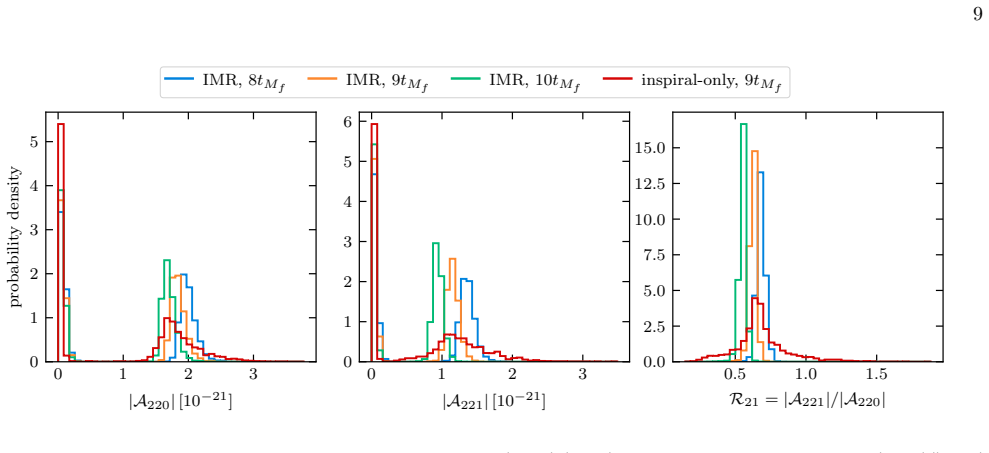
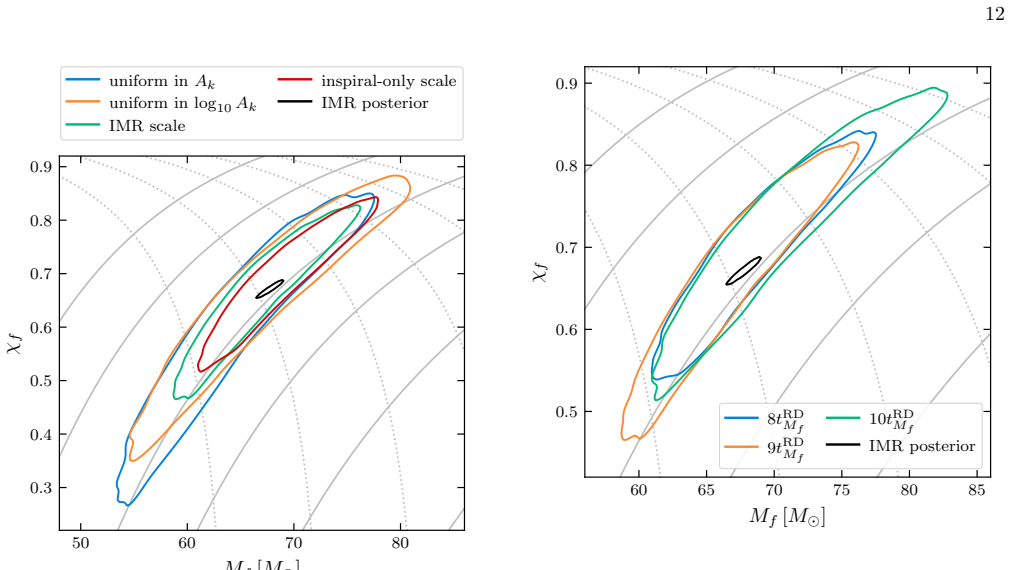
SPRING separates ringdown spectral inference from theory-side interpretation while propagating pre-merger information through amplitude-scale estimation. Applied to GW250114 with an agnostic two-component damped-sinusoid model for Kerr remnant inference, SPRING improves the Bayesian support for the agnostic 2DS signal model with an increase of ΔlnB ∼ 5–10. The resulting remnant posterior remains closely consistent with the inspiral-merger-ringdown estimate despite the extra freedom from the second component.
What carries the argument
The SPRING framework, which estimates quasinormal-mode amplitude scales from pre-merger data to inform agnostic spectral models of the ringdown.
If this is right
- The Bayesian evidence for multi-mode ringdown models increases when pre-merger information is included.
- Remnant parameter estimates from the ringdown stay consistent with full-signal estimates even with additional model freedom.
- This provides a spectral-level method for black-hole spectroscopy that does not rely on theory-specific frequency relations.
Where Pith is reading between the lines
- Applying SPRING to additional events could reveal whether pre-merger information systematically affects mode identification in ringdown.
- Future extensions might allow simultaneous inference of multiple events to build stronger constraints on remnant properties.
Load-bearing premise
Pre-merger data can estimate quasinormal mode amplitude scales without causing systematic bias in the frequency inference for models that remain agnostic to specific theoretical relations between the modes.
What would settle it
Demonstrating that including pre-merger amplitude estimates leads to remnant posteriors that disagree with those from inspiral-merger-ringdown analyses or produces no gain in Bayesian evidence for the signal model.
Figures





read the original abstract
Black-hole spectroscopy aims to infer properties of the remnant spacetime from the quasinormal-mode (QNM) spectrum of the gravitational-wave ringdown signal. In most implementations, however, this inference is performed with waveform models that already incorporate Kerr or other theory-specific QNM spectral relations, thereby entangling spectral measurement with remnant or beyond-Kerr parameter inference. At the same time, conventional ringdown analyses commonly excise the pre-merger data, which in principle contain information about the excitation amplitudes and phases of the QNMs. We introduce \texttt{SPRING} (\textit{Spectral-level Pre-merger-informed RINGdown inference}), a framework designed to separate ringdown spectral inference from theory-side interpretation while propagating pre-merger information through amplitude-scale estimation. As a demonstration, we apply \texttt{SPRING} to GW250114 using an agnostic two-component damped-sinusoid (2DS) model for Kerr remnant inference. \texttt{SPRING} improves the Bayesian support for the agnostic 2DS signal model relative to analyses that do not use pre-merger information, with an increase of \(\Delta\ln B\sim 5\)--\(10\). The resulting remnant posterior remains closely consistent with the inspiral-merger-ringdown estimate, despite the extra freedom introduced by the second DS component. This work bridges pre-merger information and ringdown inference, establishing a fully spectral-level route for future black-hole spectroscopy.
Editorial analysis
A structured set of objections, weighed in public.
Referee Report
Summary. The manuscript introduces the SPRING framework, which propagates information from the pre-merger segment of a gravitational-wave signal into ringdown analysis by estimating QNM amplitude scales separately from frequency inference. Using an agnostic two-damped-sinusoid (2DS) model on GW250114, it reports an increase in Bayesian evidence of ΔlnB∼5–10 relative to analyses without pre-merger information, while the remnant posterior remains consistent with the full IMR estimate despite the added freedom of the second component.
Significance. If the separation of amplitude-scale estimation from frequency inference proves robust, the approach would enable more agnostic spectral measurements in black-hole spectroscopy, reducing entanglement between data-driven QNM extraction and theory-specific relations such as Kerr QNM spectra. The reported posterior consistency with IMR results provides an internal cross-check, and the framework's focus on real-event application (GW250114) strengthens its relevance for future LIGO/Virgo/KAGRA analyses.
major comments (3)
- [Abstract, §3] Abstract and §3 (amplitude-scale estimation): the precise propagation method from pre-merger data to amplitude-scale priors is not specified with equations or pseudocode, leaving open whether the procedure can introduce systematic shifts into the frequency posterior when the model remains agnostic to Kerr relations; this is load-bearing for the central claim of unbiased spectral inference.
- [§4] §4 (results on GW250114): no injection-recovery tests or synthetic-signal validations are presented to quantify potential bias in the recovered frequencies or the ΔlnB values when pre-merger information is included; without such tests the reported consistency of the remnant posterior cannot be confirmed to hold under controlled conditions.
- [Table 1] Table 1 or equivalent evidence table: the ΔlnB∼5–10 improvement is stated without explicit comparison values, prior choices, or evidence-calculation details (e.g., nested-sampling settings) for the pre-merger-informed versus standard 2DS runs, making it impossible to assess whether the gain is driven by the amplitude-scale information or by other modeling choices.
minor comments (2)
- [§2] Notation for the two damped-sinusoid components (e.g., subscripts on A, ω, τ) should be defined explicitly in the first equation block of §2 to avoid ambiguity when comparing to standard QNM conventions.
- [Figure 3] Figure 3 (posterior corner plot): axis labels and units for the remnant mass and spin should be stated in the caption, and the IMR reference contour should be overlaid for direct visual comparison.
Simulated Author's Rebuttal
We thank the referee for their constructive comments and positive assessment of the SPRING framework's potential. We address each major comment below and will revise the manuscript to incorporate additional details and validations as outlined.
read point-by-point responses
-
Referee: [Abstract, §3] Abstract and §3 (amplitude-scale estimation): the precise propagation method from pre-merger data to amplitude-scale priors is not specified with equations or pseudocode, leaving open whether the procedure can introduce systematic shifts into the frequency posterior when the model remains agnostic to Kerr relations; this is load-bearing for the central claim of unbiased spectral inference.
Authors: We agree that the description in §3 would benefit from greater formality. In the revised manuscript we will add explicit equations for the amplitude-scale prior construction from pre-merger data together with pseudocode for the full propagation step. These additions will make clear that amplitude-scale estimation is performed independently of frequency inference and does not couple to the agnostic frequency posterior, thereby preserving the unbiased character of the spectral measurement. revision: yes
-
Referee: [§4] §4 (results on GW250114): no injection-recovery tests or synthetic-signal validations are presented to quantify potential bias in the recovered frequencies or the ΔlnB values when pre-merger information is included; without such tests the reported consistency of the remnant posterior cannot be confirmed to hold under controlled conditions.
Authors: We acknowledge that controlled injection studies provide an important internal validation. Although the present work is framed as a real-event demonstration, we will add an appendix containing a set of synthetic-signal injection-recovery tests that quantify any bias in recovered frequencies and in the reported ΔlnB values when pre-merger information is included. These tests will confirm that the remnant-posterior consistency observed for GW250114 holds under controlled conditions. revision: yes
-
Referee: [Table 1] Table 1 or equivalent evidence table: the ΔlnB∼5–10 improvement is stated without explicit comparison values, prior choices, or evidence-calculation details (e.g., nested-sampling settings) for the pre-merger-informed versus standard 2DS runs, making it impossible to assess whether the gain is driven by the amplitude-scale information or by other modeling choices.
Authors: We will expand the evidence table (or introduce a supplementary table) to report the precise ΔlnB values, the full set of prior choices, and the nested-sampling settings used for both the pre-merger-informed and standard 2DS analyses. This will allow readers to verify that the reported improvement originates from the amplitude-scale information propagated by SPRING. revision: yes
Circularity Check
No significant circularity in derivation chain
full rationale
The SPRING framework separates pre-merger amplitude-scale estimation from agnostic ringdown frequency inference using independent data segments. No equations or steps reduce by construction to fitted inputs, self-definitions, or self-citation chains; the reported ΔlnB improvement and posterior consistency with IMR serve as external cross-checks rather than tautological outputs. The derivation remains self-contained against the described benchmarks.
Axiom & Free-Parameter Ledger
free parameters (1)
- amplitude scales
axioms (1)
- domain assumption Ringdown signals can be represented as sums of damped sinusoids whose frequencies are to be measured independently of Kerr or other theory-specific relations.
Reference graph
Works this paper leans on
-
[1]
S. A. Teukolsky, ApJ185, 635 (1973)
1973
-
[2]
Chandrasekhar and S
S. Chandrasekhar and S. Detweiler, Proceedings of the Royal Society of London. A. Mathematical and Physical Sciences344, 441 (1975). 18
1975
-
[3]
E. W. Leaver, Proceedings of the Royal Society of Lon- don. A. Mathematical and Physical Sciences402, 285 (1985)
1985
-
[4]
K. D. Kokkotas and B. G. Schmidt, Living Rev. Relativ. 2, 2 (1999)
1999
-
[5]
Quasinormal modes of black holes and black branes
E. Berti, V. Cardoso, and A. O. Starinets, Class. Quan- tum Grav.26, 163001 (2009), arXiv:0905.2975 [gr-qc]
work page internal anchor Pith review Pith/arXiv arXiv 2009
-
[6]
Black Hole Spectroscopy: Testing General Relativity through Gravitational Wave Observations
O. Dreyer, B. Kelly, B. Krishnan, L. S. Finn, D. Garrison, and R. Lopez-Aleman, Class. Quantum Grav.21, 787 (2004), arXiv:gr-qc/0309007
work page internal anchor Pith review Pith/arXiv arXiv 2004
-
[7]
Multi-mode black hole spectroscopy
V. Baibhav and E. Berti, Phys. Rev. D99, 024005 (2019), arXiv:1809.03500 [gr-qc]
work page internal anchor Pith review Pith/arXiv arXiv 2019
-
[8]
Black hole spectroscopy: from theory to experiment
E. Bertiet al., Black hole spectroscopy: From theory to experiment (2025), arXiv:2505.23895 [gr-qc]
work page internal anchor Pith review Pith/arXiv arXiv 2025
-
[9]
Berti, M
E. Berti, M. H.-Y. Cheung, and S. Yi, Physics Today78, 32 (2025)
2025
-
[10]
Carullo, Gen Relativ Gravit57, 76 (2025)
G. Carullo, Gen Relativ Gravit57, 76 (2025)
2025
-
[11]
Giesler, M
M. Giesler, M. Isi, M. A. Scheel, and S. A. Teukolsky, Phys. Rev. X9, 041060 (2019)
2019
-
[12]
R. Cotesta, G. Carullo, E. Berti, and V. Cardoso, Phys. Rev. Lett.129, 111102 (2022), arXiv:2201.00822 [gr-qc]
-
[13]
C. D. Capano, M. Cabero, J. Westerweck, J. Abedi, S. Kastha, A. H. Nitz, Y.-F. Wang, A. B. Nielsen, and B. Krishnan, Phys. Rev. Lett.131, 221402 (2023)
2023
- [14]
- [15]
- [16]
-
[17]
M. Giesler, S. Ma, K. Mitman, N. Oshita, S. A. Teukol- sky, M. Boyle, N. Deppe, L. E. Kidder, J. Moxon, K. C. Nelli, H. P. Pfeiffer, M. A. Scheel, W. Throwe, and N. L. Vu, Phys. Rev. D111, 084041 (2025), arXiv:2411.11269 [gr-qc]
- [18]
-
[19]
Tests of General Relativity with GWTC-3
R. Abbottet al.(LIGO Scientific, Virgo, KAGRA), Tests of General Relativity with GWTC-3 (2021), arXiv:2112.06861 [gr-qc]
work page internal anchor Pith review Pith/arXiv arXiv 2021
-
[20]
R. Abbottet al.(LIGO Scientific, Virgo), Phys. Rev. D 103, 122002 (2021), arXiv:2010.14529 [gr-qc]
work page internal anchor Pith review Pith/arXiv arXiv 2021
- [21]
-
[22]
V. Gennari, G. Carullo, and W. D. Pozzo, Eur. Phys. J. C84, 233 (2024), arXiv:2312.12515 [gr-qc]
- [23]
-
[24]
LIGO Scientific Collaboration, Virgo Collaboration, and KAGRA Collaboration, Black Hole Spectroscopy and Tests of General Relativity with GW250114 (2025), arXiv:2509.08099 [gr-qc]
work page internal anchor Pith review Pith/arXiv arXiv 2025
-
[25]
A. G. Abacet al.(LIGO Scientific, Virgo, KAGRA), Phys. Rev. Lett.135, 111403 (2025), arXiv:2509.08054 [gr-qc]
work page internal anchor Pith review Pith/arXiv arXiv 2025
-
[26]
B. P. Abbottet al.(LIGO Scientific, Virgo), Phys. Rev. Lett.116, 221101 (2016), arXiv:1602.03841 [gr-qc]
work page internal anchor Pith review Pith/arXiv arXiv 2016
-
[27]
Observational Black Hole Spectroscopy: A time-domain multimode analysis of GW150914
G. Carullo, W. D. Pozzo, and J. Veitch, Phys. Rev. D 99, 123029 (2019), arXiv:1902.07527 [gr-qc]
work page internal anchor Pith review Pith/arXiv arXiv 2019
-
[28]
S. Guo and Y.-G. Miao, A theory-agnostic hierarchical Bayesian framework for black-hole spectroscopy: A case study on GW250114 in Einstein-dilaton-Gauss-Bonnet gravity (2025), arXiv:2512.03713 [gr-qc]
-
[29]
Kamaretsos, M
I. Kamaretsos, M. Hannam, S. Husa, and B. S. Sathyaprakash, Phys. Rev. D85, 024018 (2012)
2012
-
[30]
Kamaretsos, M
I. Kamaretsos, M. Hannam, and B. S. Sathyaprakash, Phys. Rev. Lett.109, 141102 (2012)
2012
- [31]
- [32]
-
[33]
Effective one-body approach to general relativistic two-body dynamics
A. Buonanno and T. Damour, Phys. Rev. D59, 084006 (1999), arXiv:gr-qc/9811091
work page internal anchor Pith review Pith/arXiv arXiv 1999
-
[34]
Transition from inspiral to plunge in binary black hole coalescences
A. Buonanno and T. Damour, Phys. Rev. D62, 064015 (2000), arXiv:gr-qc/0001013
work page internal anchor Pith review Pith/arXiv arXiv 2000
- [35]
-
[36]
Transition from inspiral to plunge in precessing binaries of spinning black holes
A. Buonanno, Y. Chen, and T. Damour, Phys. Rev. D 74, 104005 (2006), arXiv:gr-qc/0508067
work page internal anchor Pith review Pith/arXiv arXiv 2006
-
[37]
Sources of Gravitational Waves: Theory and Observations
A. Buonanno and B. S. Sathyaprakash, Sources of Gravitational Waves: Theory and Observations (2015), arXiv:1410.7832 [gr-qc]
work page internal anchor Pith review Pith/arXiv arXiv 2015
-
[38]
A. Ramos-Buades, A. Buonanno, H. Estell´ es, M. Khalil, D. P. Mihaylov, S. Ossokine, L. Pompili, and M. Shiferaw, Phys. Rev. D108, 124037 (2023), arXiv:2303.18046 [gr-qc]
-
[39]
L. Pompiliet al., Phys. Rev. D108, 124035 (2023), arXiv:2303.18039 [gr-qc]
-
[40]
Pompili, E
L. Pompili, E. Maggio, H. O. Silva, and A. Buonanno, Phys. Rev. D111, 124040 (2025)
2025
-
[41]
B. P. Abbottet al.(LIGO Scientific, Virgo), Phys. Rev. Lett.116, 241102 (2016)
2016
-
[42]
B. P. Abbottet al.(LIGO Scientific, Virgo), Phys. Rev. Lett.116, 061102 (2016), arXiv:1602.03837 [gr-qc]
work page internal anchor Pith review Pith/arXiv arXiv 2016
- [43]
- [44]
-
[45]
X. Li, L. Sun, R. K. L. Lo, E. Payne, and Y. Chen, Phys- ical Review D105, 10.1103/physrevd.105.024016 (2022)
-
[46]
K. Mitmanet al., Probing the ringdown perturba- tion in binary black hole coalescences with an im- proved quasi-normal mode extraction algorithm (2025), arXiv:2503.09678 [gr-qc]
-
[47]
L. Gao, G. B. Cook, L. E. Kidder, H. P. Pfeiffer, M. A. Scheel, N. Deppe, W. Throwe, N. L. Vu, K. C. Nelli, J. Moxon, and M. Boyle, Physical Review D112, 10.1103/3jj6-jc8q (2025)
-
[48]
Buonanno, G
A. Buonanno, G. B. Cook, and F. Pretorius, Phys. Rev. D75, 124018 (2007)
2007
-
[49]
Modeling Ringdown: Beyond the Fundamental Quasi-Normal Modes
L. London, J. Healy, and D. Shoemaker, Phys. Rev. D 90, 124032 (2014), arXiv:1404.3197 [gr-qc]
work page internal anchor Pith review Pith/arXiv arXiv 2014
-
[50]
C. Pacilio, S. Bhagwat, F. Nobili, and D. Gerosa, Phys. Rev. D110, 103037 (2024), arXiv:2408.05276 [gr-qc]
- [51]
-
[52]
Prix,Bayesian QNM search on black hole ring- down modes (applied to GW150914), Tech
R. Prix,Bayesian QNM search on black hole ring- down modes (applied to GW150914), Tech. Rep. LIGO- T1500618-v4 (LIGO Scientific Collaboration, 2016) lIGO Technical Report
2016
- [53]
- [54]
- [55]
-
[56]
Veitch, W
J. Veitch, W. D. Pozzo, Cody, M. Pitkin, and Ed1d1a8d, Johnveitch/cpnest: Minor optimisation, Zenodo (2017)
2017
- [57]
-
[58]
M. van de Meent, A. Buonanno, D. P. Mihaylov, S. Os- sokine, L. Pompili, N. Warburton, A. Pound, B. Wardell, L. Durkan, and J. Miller, Enhancing the seobnrv5 effective-one-body waveform model with second-order gravitational self-force fluxes (2023), arXiv:2303.18026 [gr-qc]
-
[59]
S. J. Miller, M. Isi, K. Chatziioannou, V. Varma, and I. Mandel, Physical Review D109, 10.1103/phys- revd.109.024024 (2024)
-
[60]
S. J. Miller, M. Isi, K. Chatziioannou, V. Varma, and S. Hourihane, Physical Review D112, 10.1103/xq5g- zm7z (2025)
-
[61]
S. J. Miller, S. Hourihane, M. Isi, R. Udall, and K. Chatziioannou,tdinf: time domain parameter esti- mation for gravitational-wave signals (2025)
2025
-
[62]
S. Ma, L. Sun, and Y. Chen, Phys. Rev. D107, 084010 (2023)
2023
-
[63]
Testing the no-hair theorem with black hole ringdowns using TIGER
J. Meidam, M. Agathos, C. V. D. Broeck, J. Veitch, and B. S. Sathyaprakash, Phys. Rev. D90, 064009 (2014), arXiv:1406.3201 [gr-qc]
work page internal anchor Pith review Pith/arXiv arXiv 2014
-
[64]
Empirical tests of the black hole no-hair conjecture using gravitational-wave observations
G. Carullo, L. van der Schaaf, L. London, P. T. H. Pang, K. W. Tsang, O. A. Hannuksela, J. Meidam, M. Agathos, A. Samajdar, A. Ghosh, T. G. F. Li, W. D. Pozzo, and C. V. D. Broeck, Phys. Rev. D98, 104020 (2018), arXiv:1805.04760 [gr-qc]
work page internal anchor Pith review Pith/arXiv arXiv 2018
-
[65]
M. Isi, M. Giesler, W. M. Farr, M. A. Scheel, and S. A. Teukolsky, Phys. Rev. Lett.123, 111102 (2019), arXiv:1905.00869 [gr-qc]
work page internal anchor Pith review Pith/arXiv arXiv 2019
-
[66]
S. Bhagwat, X. J. Forteza, P. Pani, and V. Ferrari, Phys. Rev. D101, 044033 (2020), arXiv:1910.08708 [gr-qc]
- [67]
-
[68]
B. P. Abbottet al.(LIGO Scientific, Virgo), Phys. Rev. Lett.116, 221101 (2016)
2016
-
[69]
S. Mezzasoma and N. Yunes, Phys. Rev. D106, 024026 (2022), arXiv:2203.15934 [gr-qc]
-
[70]
K. Chandra and J. C. Bustillo, Black-hole ringdown anal- ysis with inspiral-merger informed templates and limita- tions of classical spectroscopy (2025), arXiv:2509.17315 [gr-qc]
-
[71]
Science with the Einstein Telescope: a comparison of different designs
M. Branchesiet al., J. Cosmol. Astropart. Phys.2023 (07), 068, arXiv:2303.15923 [gr-qc]
work page internal anchor Pith review Pith/arXiv arXiv 2023
-
[72]
A Horizon Study for Cosmic Explorer: Science, Observatories, and Community
M. Evanset al., A Horizon Study for Cosmic Ex- plorer: Science, Observatories, and Community (2021), arXiv:2109.09882 [astro-ph]
work page internal anchor Pith review Pith/arXiv arXiv 2021
-
[73]
TianQin: a space-borne gravitational wave detector
J. Luoet al., Class. Quantum Grav.33, 035010 (2016), arXiv:1512.02076 [astro-ph]
work page internal anchor Pith review Pith/arXiv arXiv 2016
-
[74]
Laser Interferometer Space Antenna
P. Amaro-Seoaneet al., Laser Interferometer Space An- tenna (2017), arXiv:1702.00786 [astro-ph]
work page internal anchor Pith review Pith/arXiv arXiv 2017
-
[75]
W.-H. Ruan, Z.-K. Guo, R.-G. Cai, and Y.-Z. Zhang, Int. J. Mod. Phys. A35, 2050075 (2020), arXiv:1807.09495 [gr-qc]
-
[76]
The Astropy Collaboration, A&A558, A33 (2013), arXiv:1307.6212 [astro-ph]
work page internal anchor Pith review Pith/arXiv arXiv 2013
-
[77]
The Astropy Collaboration, AJ156, 123 (2018), arXiv:1801.02634 [astro-ph]
work page internal anchor Pith review Pith/arXiv arXiv 2018
-
[78]
The Astropy Collaboration, ApJ935, 167 (2022), arXiv:2206.14220 [astro-ph]
work page internal anchor Pith review Pith/arXiv arXiv 2022
-
[79]
Foreman-Mackey, The Journal of Open Source Soft- ware1, 24 (2016)
D. Foreman-Mackey, The Journal of Open Source Soft- ware1, 24 (2016)
2016
-
[80]
D. M. Macleod, J. S. Areeda, S. B. Coughlin, T. J. Massinger, and A. L. Urban, SoftwareX13, 100657 (2021)
2021
discussion (0)
Sign in with ORCID, Apple, or X to comment. Anyone can read and Pith papers without signing in.