WeeCare: Towards Handheld Bladder Fullness Sensing with a Conformable Pad
Pith reviewed 2026-06-29 20:51 UTC · model grok-4.3
The pith
A handheld conformable pad with fabric electrodes performs on-demand bladder fullness sensing via electrical impedance tomography despite repeated repositioning.
A machine-rendered reading of the paper's core claim, the machinery that carries it, and where it could break.
Core claim
WeeCare demonstrates that a handheld conformable pad equipped with fabric electrodes can support electrical impedance tomography for bladder fullness sensing, with the design and validation showing robustness to electrode placement variations through in-silico electrode characterization, in-vitro phantom measurements across salinities and volumes, and in-vivo human data on fullness, voiding, and filling dynamics.
What carries the argument
The handheld conformable pad with fabric electrodes that applies electrical impedance tomography to map bladder conductivity changes.
If this is right
- Users could shift from fixed-interval catheterization to checks triggered only by sensed fullness.
- Monitoring of voiding and refilling dynamics becomes possible without continuous attachment.
- Phantom and simulation results indicate the electrode layout tolerates typical noise levels in EIT reconstructions.
- The fabric electrode approach supports repeated use on skin without rigid hardware.
Where Pith is reading between the lines
- The same pad geometry might be tested for other abdominal conductivity targets beyond the bladder.
- Integration with a simple readout device could allow home-based rather than clinic-only measurements.
- Extending the in-vivo protocol to more subjects would clarify how well the single human trial generalizes.
Load-bearing premise
That variations in electrode position and contact quality from repeated removal and reattachment can still be overcome enough for reliable detection of bladder fullness levels.
What would settle it
Human trials in which electrical impedance tomography readings from the pad fail to distinguish between empty, partially full, and full bladder states across multiple independent placements on the same subjects.
Figures


read the original abstract
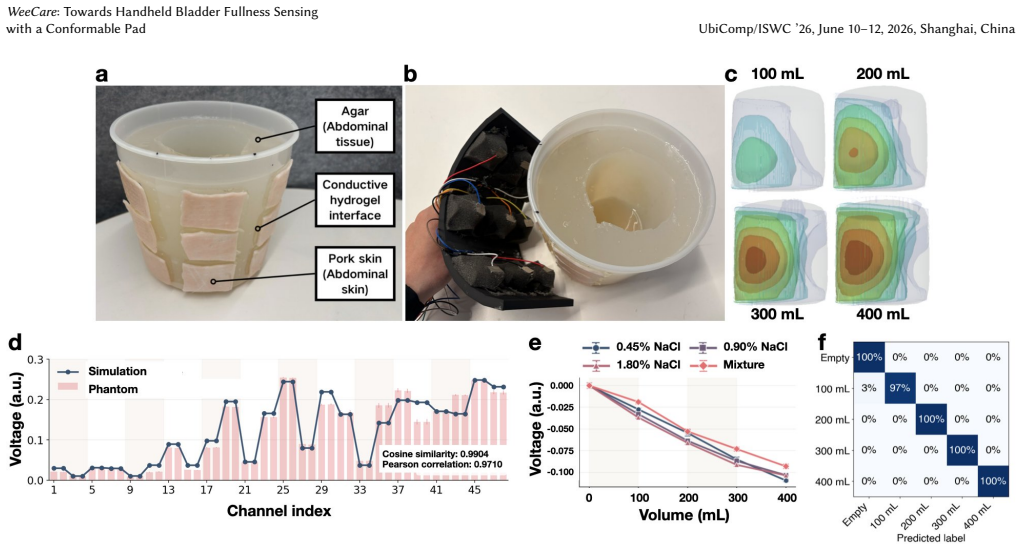
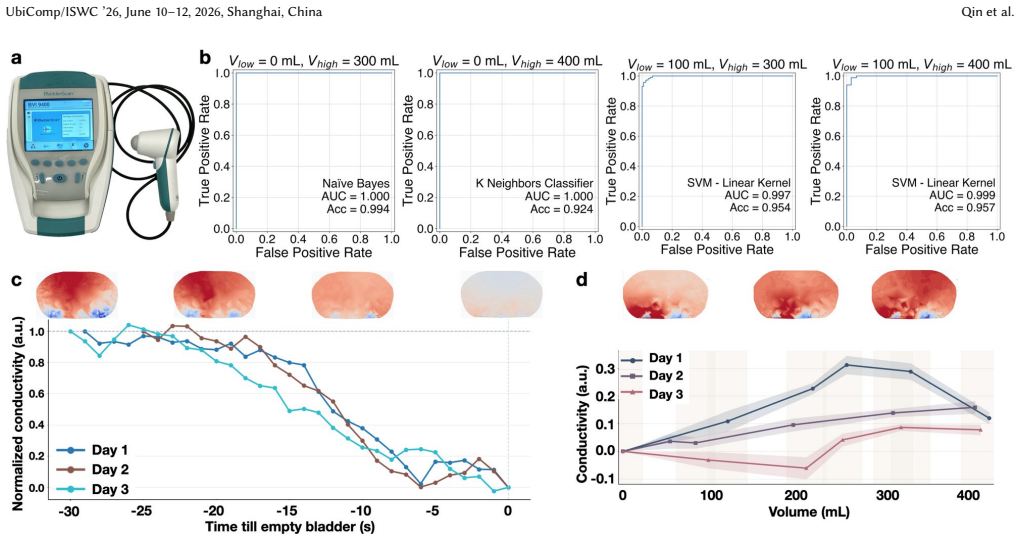
Patients with bladder dysfunction often lose the sensation of bladder fullness and cannot void naturally, forcing reliance on fixed-schedule catheterization that is uncomfortable and risks complications. We present WeeCare, a handheld conformable pad with fabric electrodes for on-demand bladder fullness sensing using electrical impedance tomography (EIT). The central challenge is that repeated removal and reattachment can introduce variation in electrode position and contact quality. We assess WeeCare along three axes: in-silico simulations characterizing electrode layout and noise robustness, in-vitro phantom experiments across urine salinities and filling levels, and an in-vivo human measurement for bladder fullness sensing, voiding, and filling dynamics.
Editorial analysis
A structured set of objections, weighed in public.
Referee Report
Summary. The manuscript presents WeeCare, a handheld conformable fabric-electrode pad for on-demand bladder fullness sensing via electrical impedance tomography (EIT). The central claim is that the device can overcome variations from repeated removal/reattachment through three evaluation axes: in-silico simulations of electrode layout and noise robustness, in-vitro phantom experiments across urine salinities and filling levels, and a single in-vivo human measurement session capturing bladder fullness, voiding, and filling dynamics.
Significance. If the robustness to electrode repositioning and contact variation is quantitatively demonstrated, the work could enable practical, non-invasive, on-demand sensing for patients with bladder dysfunction, reducing risks of fixed-schedule catheterization. The multi-modal evaluation (simulation, phantom, human) is a positive structural choice; machine-checked elements or reproducible code are not mentioned.
major comments (2)
- [§3, §4] §4 (In-vivo experiments) and §3 (Phantom experiments): the reported reconstructions do not include a quantitative tolerance analysis (e.g., maximum allowable electrode displacement in mm or contact impedance drift in ohms) such that the bladder conductivity contrast between empty and full states remains distinguishable above the reconstruction error; without this margin the handheld on-demand claim is not yet load-bearing.
- [§2.2] §2.2 (EIT reconstruction pipeline): the noise-robustness simulations characterize additive noise but do not propagate the specific positional jitter and contact-quality variations expected from repeated pad removal/reattachment; the resulting conductivity maps are therefore not shown to remain stable within the signal difference observed in the phantom and human data.
minor comments (2)
- [Figures 4-6] Figure captions for the phantom and in-vivo EIT images should explicitly state the color scale units (conductivity in S/m) and the exact electrode placement coordinates used in each trial.
- [Abstract] The abstract states three evaluation axes but supplies no numerical performance metrics (e.g., classification accuracy, RMSE); these should be added for immediate readability.
Simulated Author's Rebuttal
We thank the referee for the constructive feedback. We agree that quantitative tolerance margins for electrode displacement and contact variations are needed to fully support the on-demand handheld claim, and we will revise the manuscript accordingly.
read point-by-point responses
-
Referee: [§3, §4] §4 (In-vivo experiments) and §3 (Phantom experiments): the reported reconstructions do not include a quantitative tolerance analysis (e.g., maximum allowable electrode displacement in mm or contact impedance drift in ohms) such that the bladder conductivity contrast between empty and full states remains distinguishable above the reconstruction error; without this margin the handheld on-demand claim is not yet load-bearing.
Authors: We agree that the manuscript would be strengthened by an explicit quantitative tolerance analysis. In the revision we will add Monte Carlo simulations of electrode displacements (0–15 mm) and contact impedance drifts (0–50 Ω) applied to the in-silico and phantom geometries, reporting the maximum values at which the empty-to-full conductivity contrast remains above reconstruction error. These margins will be cross-validated against the observed signal differences in the existing phantom and single in-vivo datasets. revision: yes
-
Referee: [§2.2] §2.2 (EIT reconstruction pipeline): the noise-robustness simulations characterize additive noise but do not propagate the specific positional jitter and contact-quality variations expected from repeated pad removal/reattachment; the resulting conductivity maps are therefore not shown to remain stable within the signal difference observed in the phantom and human data.
Authors: The §2.2 simulations were limited to additive Gaussian noise to benchmark the reconstruction pipeline. We acknowledge they do not yet incorporate positional jitter or contact-quality variations. In revision we will extend the simulation framework to include realistic reattachment jitter (drawn from 5–10 mm Gaussian displacements and 10–30 Ω contact impedance perturbations) and will demonstrate that the resulting conductivity maps remain stable within the empty–full signal differences measured in the phantom and in-vivo experiments. revision: yes
Circularity Check
No circularity: experimental evaluation chain is self-contained
full rationale
The paper describes a hardware prototype and its empirical validation through in-silico simulations of electrode layouts and noise, in-vitro phantom tests across salinities and fill levels, and a single in-vivo human session. No equations, fitted parameters, derivations, or self-citations appear as load-bearing steps in the provided abstract or evaluation description. The central claim rests on measured stability of EIT reconstructions rather than any reduction of outputs to inputs by construction.
Axiom & Free-Parameter Ledger
axioms (1)
- domain assumption Electrical impedance tomography can detect bladder volume changes via conductivity contrast between urine and surrounding tissues despite electrode contact variations.
Reference graph
Works this paper leans on
-
[1]
2020.PyCaret: An open source, low-code machine learning library in Python
Moez Ali. 2020.PyCaret: An open source, low-code machine learning library in Python. https://www.pycaret.org PyCaret version 1.0.0
2020
-
[2]
Lynn Stothers Andrew J. Macnab. 2008. Near-infrared spectroscopy: validation of bladder-outlet obstruction assessment using non-invasive parameters.Canadian Journal of Urology15, 5 (2008), 4241–4248. http://www.techscience.com/CJU/ v15n5/62252
2008
-
[3]
Benoit Brazey, Yassine Haddab, and Nabil Zemiti. 2022. Robust imaging using electrical impedance tomography: review of current tools.Proceedings. Mathe- matical, Physical, and Engineering Sciences478 (2022). https://api.semanticscholar. org/CorpusID:246445033
2022
-
[4]
Long Long Cao, Feng Wen Wang, Jingwei Xue, Fulei Liu, and Ming Liang Jin
-
[5]
Integrated Ultrasound Device for Precision Bladder Volume Monitoring via Acoustic Focusing and Machine Learning.Advanced Science13, 17 (2026), e20926. arXiv:https://advanced.onlinelibrary.wiley.com/doi/pdf/10.1002/advs.202520926 doi:10.1002/advs.202520926
-
[6]
CO-Z. 2026. CO-Z 1.1 Gallon Water Distiller. https://www.amazon.com/dp/ B0D87F64BX Accessed 2026-05-23
2026
- [7]
-
[8]
Kanika Dheman, Stefan Walser, Philipp Mayer, Manuel Eggimann, Marko Ko- zomara, Denise Franke, Thomas Hermanns, Hugo Sax, Simone Schürle, and Michele Magno. 2024. Noninvasive Urinary Bladder Volume Estimation With Artifact-Suppressed Bioimpedance Measurements.IEEE Sensors Journal24, 2 (2024), 1633–1643. doi:10.1109/JSEN.2023.3324819
-
[9]
Peter T Dorsher and Peter M McIntosh. 2012. Neurogenic bladder.Advances in urology2012, 1 (2012), 816274
2012
-
[10]
Lin Duan and Ming-Liang Jin. 2025. A biocompatible integrated bladder elec- tronics for wireless capacity monitoring assessment.Soft Science5, 1 (2025). doi:10.20517/ss.2024.46
-
[11]
Eoghan Dunne, Adam Santorelli, Brian Mc Ginley, Geraldine Leader, Martin O’Halloran, and Emily Porter. 2018. Image-based classification of bladder state using electrical impedance tomography.Physiological Measurement39 (12 2018). doi:10.1088/1361-6579/aae6ed
-
[12]
Pascal Fechner, Fabian König, Wolfgang Kratsch, Jannik Lockl, and Maximilian Röglinger. 2023. Near-infrared spectroscopy for bladder monitoring: a machine learning approach.ACM Transactions on Management Information Systems14, 2 (2023), 1–23
2023
-
[13]
Daniel D Fong, Xiaofan Yu, Jiageng Mao, Mahya Saffarpour, Prashant Gupta, Rami Abueshsheikh, Alejandro Velazquez Alcantar, Eric A Kurzrock, and Soheil Ghiasi. 2018. Restoring the sense of bladder fullness for spinal cord injury patients. Smart Health9 (2018), 12–22
2018
-
[14]
Generic Bio-Tech. 2026. Gel Pads for Abs Stimulator. https://www.amazon.com/ dp/B0FLJHG4C8 Accessed 2026-05-23
2026
-
[15]
Holder (Ed.)
David S. Holder (Ed.). 2005.Electrical Impedance Tomography: Methods, History and Applications. CRC Press
2005
-
[16]
Yasuhiko Igawa, Jean-Jacques Wyndaele, and Osamu Nishizawa. 2008. Catheteri- zation: possible complications and their prevention and treatment.International journal of urology15, 6 (2008), 481–485
2008
-
[17]
Kiwibunn. 2021. Female Torso Anatomy Study Sketch. https: //sketchfab.com/3d-models/female-torso-anatomy-study-sketch- 5f186790eb5d436cad3b73b6117464d8. Accessed: 2026-05-18
2021
-
[18]
F Krewer, F Morgan, E Jones, M Glavin, and M O’Halloran. 2014. Development of a wearable microwave bladder monitor for the management and treatment of urinary incontinence. InRadar Sensor Technology XVIII, Vol. 9077. SPIE, 295–303
2014
-
[19]
Niels Kristian Kristiansen, Hans Nygaard, and Jens Christian Djurhuus
-
[20]
arXiv:https://doi.org/10.1080/00365590510031165 doi:10.1080/00365590510031165 PMID: 16118108
Clinical evaluation of a novel ultrasound-based bladder volume mon- itor.Scandinavian Journal of Urology and Nephrology39, 4 (2005), 321–328. arXiv:https://doi.org/10.1080/00365590510031165 doi:10.1080/00365590510031165 PMID: 16118108
-
[21]
Eliza Lamin and Diane K Newman. 2016. Clean intermittent catheterization revisited.International urology and nephrology48, 6 (2016), 931–939
2016
-
[22]
Kyungsu Lee, Moon Hwan Lee, Dongho Kang, Sewoong Kim, Jin Ho Chang, Seung-June Oh, and Jae Youn Hwang. 2024. Intelligent bladder volume mon- itoring for Wearable Ultrasound devices: enhancing Accuracy through Deep Learning-based coarse-to-fine shape estimation.IEEE Transactions on Ultrasonics, Ferroelectrics, and Frequency Control71, 7 (2024), 775–785
2024
-
[23]
Steffen Leonhardt, Axel Cordes, Harry Plewa, Robert Pikkemaat, Irina Sol- janik, Klaus Moehring, Hans J Gerner, and Rüdiger Rupp. 2011. Electric impedance tomography for monitoring volume and size of the urinary blad- der.Biomedizinische Technik. Biomedical engineering56, 6 (December 2011), 301—307. doi:10.1515/bmt.2011.022
-
[24]
Dorothea Leonhäuser, Carlos Castelar, Thomas Schlebusch, Martin Rohm, Rüdi- ger Rupp, Steffen Leonhardt, Marian Walter, and Joachim O. Grosse. 2018. Eval- uation of electrical impedance tomography for determination of urinary blad- der volume: comparison with standard ultrasound methods in healthy volun- teers.BioMedical Engineering OnLine17 (2018). https...
2018
-
[25]
Rihui Li, Jinwu Gao, Yaning Li, Junpeng Wu, Zhanqi Zhao, and Yang Liu. 2016. Preliminary study of assessing bladder urinary volume using electrical impedance tomography.Journal of Medical and Biological Engineering36, 1 (2016), 71–79
2016
-
[26]
Xuyang Li, Elena Pancera, Lukasz Niestoruk, Wilhelm Stork, and Thomas Zwick
-
[27]
InThe 7th European Radar Conference
Performance of an ultra wideband radar for detection of water accumulation in the human bladder. InThe 7th European Radar Conference. IEEE, 212–215
-
[28]
Benyuan Liu, Bin Yang, Canhua Xu, Junying Xia, Meng Dai, Zhenyu Ji, Fusheng You, Xiuzhen Dong, Xuetao Shi, and Feng Fu. 2018. pyEIT: A python based framework for Electrical Impedance Tomography.SoftwareX7 (2018), 304–308
2018
-
[29]
H Madersbacher. 1990. The various types of neurogenic bladder dysfunction: an update of current therapeutic concepts.Spinal Cord28, 4 (1990), 217–229
1990
-
[30]
Behnam Molavi, Babak Shadgan, Andrew J Macnab, and Guy A Dumont. 2013. Noninvasive optical monitoring of bladder filling to capacity using a wireless near infrared spectroscopy device.IEEE transactions on biomedical circuits and systems8, 3 (2013), 325–333
2013
-
[31]
Anna S. Nagle, Adam P. Klausner, Jary Varghese, Rachel J. Bernardo, Andrew F. Colhoun, Robert W. Barbee, Laura R. Carucci, and John E. Speich. 2017. Quan- tification of bladder wall biomechanics during urodynamics: A methodologic investigation using ultrasound.Journal of Biomechanics61 (2017), 232–241. doi:10.1016/j.jbiomech.2017.07.028
-
[32]
Shuhei S Noyori, Gojiro Nakagami, and Hiromi Sanada. 2022. Non-invasive urine volume estimation in the bladder by electrical impedance-based methods: A review.Medical Engineering & Physics101, 1 (2022), 103748
2022
-
[33]
Shuhei S Noyori, Gojiro Nakagami, and Hiromi Sanada. 2022. Non-invasive urine volume estimation in the bladder by electrical impedance-based methods: A re- view.Medical Engineering & Physics101 (2022), 103748. doi:10.1016/j.medengphy. 2021.103748
-
[34]
M O’Halloran, F Morgan, M Glavin, E Jones, RC Conceio, and D Byrne. 2013. Bladder-state monitoring using ultra wideband radar. In2013 7th European Con- ference on Antennas and Propagation (EuCAP). IEEE, 624–627
2013
-
[35]
Parker Laboratories Inc. [n. d.]. Aquasonic Ultrasound Gel Blue 1 Liter Bot- tle. https://www.amazon.com/dp/B07CX17646?ref_=ppx_hzsearch_conn_dt_b_ fed_asin_title_5. Accessed: 2026-05-05
2026
-
[36]
Nolan Perry. 2026. EIT for Bladder Monitoring: Principles, Methods, and Clinical Validation in Urodynamic Research. Biomedical Engineering Science. https://www.biomedengsci.com/posts/eit-for-bladder-monitoring- principles-methods-and-clinical-validation-in-urodynamic-research Accessed: 2026-05-25
2026
-
[37]
Aiyada Phisaiphan, Phanpasorn Laor-Iam, Chamaiporn Sukjamsri, Anurak Dowloy, and Taweechai Ouypornkochagorn. 2025. Bladder monitoring with time- frequency-difference electrical impedance tomography technique.Measurement 250 (2025), 117162. doi:10.1016/j.measurement.2025.117162
-
[38]
Cong Pu, Ben Fu, Lehang Guo, Huixiong Xu, and Chang Peng. 2024. A Stretchable and Wearable Ultrasonic Transducer Array for Bladder Volume Monitoring Application.IEEE Sensors Journal24, 10 (2024), 15875–15883. doi:10.1109/JSEN.2024.3382244
-
[39]
A E Rees, L C Ward, B H Cornish, and B J Thomas. 1999. Sensitivity of multiple frequency bioelectrical impedance analysis to changes in ion status.Physiological Measurement20, 4 (nov 1999), 349. doi:10.1088/0967-3334/20/4/302 UbiComp/ISWC ’26, June 10–12, 2026, Shanghai, China Qin et al
-
[40]
Gregory Samson and Diana D Cardenas. 2007. Neurogenic bladder in spinal cord injury.Physical medicine and rehabilitation clinics of North America18, 2 (2007), 255–274
2007
-
[41]
Thomas Schlebusch, Steffen Nienke, S Leonhardt, and M Walter. 2014. Blad- der volume estimation from electrical impedance tomography.Physiological measurement35, 9 (2014), 1813–1823
2014
-
[42]
Seung-chul Shin, Junhyung Moon, Saewon Kye, Kyoungwoo Lee, Yong Seung Lee, and Hong-Goo Kang. 2017. Continuous bladder volume monitoring system for wearable applications. In2017 39th Annual International Conference of the IEEE Engineering in Medicine and Biology Society (EMBC). 4435–4438. doi:10.1109/ EMBC.2017.8037840
-
[43]
Alp Timucin Toymus, Umut Can Yener, Emine Bardakci, Özgür Deniz Temel, Ersin Koseoglu, Dincay Akcoren, Burak Eminoglu, Mohsin Ali, Rasim Kilic, Tufan Tarcan, et al. 2024. An integrated and flexible ultrasonic device for continuous bladder volume monitoring.Nature Communications15, 1 (2024), 7216
2024
-
[44]
Verathon. 2018. BladderScan Prime Plus. https://www.verathon.com/assets/0900- 4510-xx-60.pdf. Product brochure. Accessed: 2026-05-05
2018
-
[45]
Verathon Medical. 2008. BladderScan BVI 9400 Product Brochure. https://www. verathon.com/sites/default/files/2021-08/0900-4412-xx-60.pdf. Accessed: 2026- 05-05
2008
-
[46]
Carla Verpoorten and Gunnar M Buyse. 2008. The neurogenic bladder: medical treatment.Pediatric nephrology23, 5 (2008), 717–725
2008
-
[47]
Women’s Health and Education Center. 2009. Urodynamic Assessment: Tech- niques. https://polylang.womenshealthsection.com/urog/urog003 Accessed: 2026-05-21
2009
-
[48]
WVOVW. 2026. 2"X12"X12" Sound Proofing Egg Crate Foam Pad. https://www. amazon.com/dp/B0FP4K2CJB/ Accessed 2026-05-23
2026
-
[49]
WVOVW. 2026. Faraday Fabric Tape 1inch x 50 Feet Double Conductive High 1 Inch x 50. https://www.amazon.com/dp/B097HPSLTH Accessed 2026-05-23
2026
-
[50]
JJ Wyndaele. 2002. Complications of intermittent catheterization: their prevention and treatment.Spinal cord40, 10 (2002), 536–541
2002
-
[51]
Yuantide Bio-Tech. 2026. Yuantide Bio Lab-Grade 100% Agar Agar Powder,150g / 5oz. https://www.amazon.com/dp/B0CN41D2D4 Accessed 2026-05-23
2026
-
[52]
Ruoyu Zhang, Ruijie Fang, Chongzhou Fang, Houman Homayoun, and Gozde Goncu Berk. 2023. Privee: A wearable for real-time bladder monitoring system. InAdjunct Proceedings of the 2023 ACM International Joint Conference on Pervasive and Ubiquitous Computing & the 2023 ACM International Symposium on Wearable Computing. 291–295
2023
-
[53]
Snowden, Joshua Verdejo, Emily Chen, Paul Zhang, Hamid Ghaednia, Joseph H
Junyi Zhu, Jackson C. Snowden, Joshua Verdejo, Emily Chen, Paul Zhang, Hamid Ghaednia, Joseph H. Schwab, and Stefanie Mueller. 2021. EIT-kit: An Electrical Impedance Tomography Toolkit for Health and Motion Sensing. InProceedings of the 34th Annual ACM Symposium on User Interface Software and Technology (UIST ’21). ACM, New York, NY, USA, 400–413. doi:10....
discussion (0)
Sign in with ORCID, Apple, or X to comment. Anyone can read and Pith papers without signing in.