Ces\`aro convergence of the high-order WKB method and its applications to black-hole overtones and long-lived modes
Pith reviewed 2026-06-29 20:40 UTC · model grok-4.3
The pith
High-order WKB method with diagonal Padé approximants accurately computes black-hole overtones and long-lived modes but can converge to incorrect values for non-moderate metrics.
A machine-rendered reading of the paper's core claim, the machinery that carries it, and where it could break.
Core claim
Pushing the WKB method to high orders and improving it with diagonal Padé approximants renders it efficient for overtones with n>l and long-lived modes of massive fields; however, for non-moderate black-hole metrics the sequence can exhibit apparent convergence to inaccurate values, while the Cesàro means converge monotonically once a sufficient order is reached.
What carries the argument
High-order WKB expansion via the Bender-Wu algorithm, combined with diagonal Padé approximants and Cesàro means for convergence monitoring.
If this is right
- The method extends to previously difficult regimes like overtones and massive field modes.
- Apparent numerical stabilization alone does not guarantee correctness for all metrics.
- Cesàro means provide a reliable internal check for convergence at high orders.
- The implementation is limited only by memory and computational time.
Where Pith is reading between the lines
- Applying this to additional metrics could identify the boundary between moderate and non-moderate classes more clearly.
- Integration with other approximation techniques might improve accuracy for challenging cases.
- Similar high-order approaches could be tested in related wave equations in curved spacetimes.
Load-bearing premise
The automatic implementation of the Bender-Wu algorithm produces accurate coefficients up to the orders considered without additional truncation or numerical errors.
What would settle it
Independent high-precision numerical computation of quasinormal frequencies for a non-moderate metric with large higher near-horizon coefficients, compared against the high-order WKB result.
Figures

read the original abstract
We develop a fully automatic Mathematica implementation of the black-hole WKB method at very high orders based on the Bender-Wu algorithm, which in principle is limited only by memory and computational time, and show that when pushed to sufficiently high order and improved by diagonal Pad\'e approximants the method becomes efficient for two regimes which are usually regarded as difficult for the standard low-order WKB treatment: the first several overtones with n>l and the very long-lived quasinormal modes of massive fields. At the same time, we show that this efficiency has a nontrivial limitation: for black-hole metrics belonging to the non-moderate class, especially when higher coefficients of the near-horizon parametrization become large, the WKB sequence may exhibit an apparent convergence to values which are nevertheless far from the accurate quasinormal frequencies. Thus, numerical stabilization of the WKB output alone is not always a sufficient criterion of correctness. However, we observe that although the WKB method with diagonal or near-diagonal Pad\'e approximants does not exhibit monotonic convergence order by order, the corresponding Ces\`aro means become monotonically convergent once a sufficiently high WKB order is reached. This behavior may serve as an internal WKB criterion for the convergence of the method.
Editorial analysis
A structured set of objections, weighed in public.
Referee Report
Summary. The paper develops a fully automatic Mathematica implementation of the black-hole WKB method at very high orders based on the Bender-Wu algorithm. It claims that pushing to high orders, combined with diagonal Padé approximants and Cesàro means, makes the method efficient for the first several overtones with n>l and very long-lived quasinormal modes of massive fields. It simultaneously identifies a nontrivial limitation: for non-moderate metrics (especially when higher near-horizon coefficients are large), the WKB sequence may exhibit apparent convergence to values far from accurate frequencies, so that numerical stabilization alone is not a sufficient correctness criterion. Cesàro means are proposed as an internal convergence criterion once a sufficiently high order is reached.
Significance. If the numerical results and coefficient accuracy hold, the work is significant for extending WKB applicability to two regimes usually difficult for low-order treatments and for providing a practical internal convergence test via Cesàro means. The automatic high-order implementation (limited only by memory/time) and the explicit warning about apparent convergence in non-moderate metrics are useful contributions to the field. The observation that diagonal/near-diagonal Padé approximants yield monotonically convergent Cesàro means is a concrete, falsifiable finding.
major comments (2)
- [Abstract and Bender-Wu implementation section] Abstract and the section describing the Bender-Wu implementation: the central efficiency claims for overtones (n>l) and long-lived massive-field modes rest on the accuracy of the automatically generated high-order coefficients. No explicit cross-validation of even moderate-order coefficients against known analytic WKB expansions (e.g., Schwarzschild or Reissner-Nordström) is described; any systematic truncation or recursion error would produce internally consistent but incorrect Cesàro convergence, undermining the claim that stabilization serves as a reliable internal criterion.
- [Section discussing non-moderate metrics and the limitation] Section on the limitation for non-moderate metrics: the statement that the WKB sequence 'may exhibit an apparent convergence to values which are nevertheless far from the accurate quasinormal frequencies' is load-bearing for the paper's cautionary conclusion, yet the provided text does not include a specific quantitative example with an independent method (continued fractions, time-domain evolution, or Leaver's method) showing the discrepancy magnitude.
minor comments (2)
- [Introduction or metric classification subsection] The definition of the 'moderate' versus 'non-moderate' class of metrics should be stated explicitly with the relevant near-horizon expansion coefficients, rather than left implicit.
- [Figures and tables] Figure captions and table headings should include the precise WKB order, Padé type, and Cesàro averaging window used for each entry to allow direct reproduction.
Simulated Author's Rebuttal
We thank the referee for the thorough and constructive report. The comments highlight important points regarding validation and illustration of the method's limitations. We address each major comment below and will incorporate revisions to strengthen the manuscript.
read point-by-point responses
-
Referee: [Abstract and Bender-Wu implementation section] Abstract and the section describing the Bender-Wu implementation: the central efficiency claims for overtones (n>l) and long-lived massive-field modes rest on the accuracy of the automatically generated high-order coefficients. No explicit cross-validation of even moderate-order coefficients against known analytic WKB expansions (e.g., Schwarzschild or Reissner-Nordström) is described; any systematic truncation or recursion error would produce internally consistent but incorrect Cesàro convergence, undermining the claim that stabilization serves as a reliable internal criterion.
Authors: We agree that explicit cross-validation of the generated coefficients is necessary to support the claims. In the revised manuscript we will add a new subsection in the Bender-Wu implementation section that compares our automatically computed coefficients (up to order 10–12) with the known analytic WKB expansions for Schwarzschild and Reissner-Nordström black holes. This comparison will be presented both in tabular form and via direct numerical agreement of the resulting quasinormal frequencies, thereby confirming the absence of systematic implementation errors before higher-order results are discussed. revision: yes
-
Referee: [Section discussing non-moderate metrics and the limitation] Section on the limitation for non-moderate metrics: the statement that the WKB sequence 'may exhibit an apparent convergence to values which are nevertheless far from the accurate quasinormal frequencies' is load-bearing for the paper's cautionary conclusion, yet the provided text does not include a specific quantitative example with an independent method (continued fractions, time-domain evolution, or Leaver's method) showing the discrepancy magnitude.
Authors: We concur that a concrete quantitative example would make the limitation more compelling. In the revised version we will include a specific non-moderate metric (a near-extremal Reissner-Nordström black hole with a chosen massive scalar field) for which the high-order WKB-Cesàro sequence stabilizes to a value that differs from the accurate frequency obtained via the continued-fraction method. The discrepancy will be quantified (both in absolute and relative terms) and the corresponding Padé approximants and Cesàro means will be shown explicitly to illustrate the point. revision: yes
Circularity Check
No significant circularity detected
full rationale
The paper presents a numerical implementation of the established Bender-Wu algorithm for high-order WKB calculations of black-hole quasinormal modes, augmented by Padé approximants and Cesàro means. Claims regarding efficiency for overtones and long-lived modes, plus limitations for non-moderate metrics, rest on direct computational outputs and observed stabilization behavior rather than any self-referential definitions, fitted parameters renamed as predictions, or load-bearing self-citations that reduce the result to its own inputs. The derivation chain is self-contained, with the method's performance assessed through explicit numerical examples against known regimes, yielding an honest non-finding of circularity.
Axiom & Free-Parameter Ledger
axioms (1)
- domain assumption The WKB approximation and Bender-Wu algorithm remain valid when extended to arbitrarily high orders for the black-hole metrics considered.
Forward citations
Cited by 2 Pith papers
-
Hawking Emission from Black Holes Evaporating toward Wormholes and the Accuracy of the WKB Approximation
Numerical greybody factors for photons and massless Dirac fields in Simpson-Visser and Casadio-Fabbri-Mazzacurati geometries reveal that WKB overestimates luminosities by orders of magnitude near wormhole endpoints, i...
-
Hawking Radiation from the Dymnikova Regular Black Hole
Numerical greybody factors for the Dymnikova black hole show temperature-driven luminosity suppression near the extremal remnant, with increasing fermion dominance in the residual massless flux.
Reference graph
Works this paper leans on
-
[1]
This is the undeformed reference point obtained by setting all deformation pa- rameters to zero, ǫ = a0 = b0 = a1 = b1 = 0
Schwarzschild black holes. This is the undeformed reference point obtained by setting all deformation pa- rameters to zero, ǫ = a0 = b0 = a1 = b1 = 0. (6)
-
[2]
These are parametrized black holes for which the metric functions vary relatively slowly in the near-horizon zone
Moderately deformed black holes. These are parametrized black holes for which the metric functions vary relatively slowly in the near-horizon zone. In such cases the deformation of the effective potential is smooth and the quasinormal spectrum changes perturbatively: the fundamental mode and the first overtones change ap- proximately at the same rate and th...
-
[3]
nonmoderate
Nonmoderately deformed black holes. These ge- ometries are close to Schwarzschild in the weak-field re- gion and may satisfy the same size-to-mass relation and post-Newtonian constraints, so that one keeps ǫ, a0, and b0 zero or close to zero, a1, and b1 very small, but one or more higher near-horizon coefficients (usually a2, b2 and/or higher) in the continu...
-
[4]
directly into the ansatz. Using the compact coordinate intro- duced earlier, we write Ψ = H(x) ∞∑ n=0 dnxn, x = 1 − r0 r , (9) where the prefactor is chosen so that H ∝ e− iωr ∗ near x = 0 (r = r0) and H ∝ e+iχr ∗ as x → 1 (r → ∞ ). The remaining series is regular at the horizon and, for the correct quasinormal frequencies, defines the minimal solution in ...
-
[5]
( 7) yields a linear recur- rence relation for the Frobenius coefficients
into Eq. ( 7) yields a linear recur- rence relation for the Frobenius coefficients. In generic parametrized metrics this relation need not be three-term 4 from the beginning; rather, one typically obtains p∑ j=0 cj,n dn− j = 0, n ≥ p − 1, (10) with p > 2, because the rational structure of the met- ric functions generates several neighboring couplings be- tw...
-
[6]
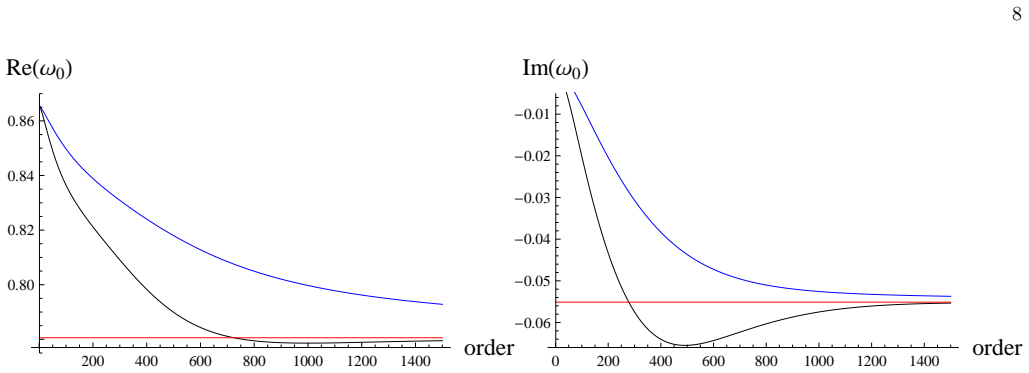
as a formal truncated series in an auxiliary bookkeeping parameter λ, PN (λ) = V0 − iK √ − 2V ′′ 0 λ − i √ − 2V ′′ 0 N∑ j=2 λ jΛ j, ω 2 ≈ PN (1). (16) The direct value PN (1) is often useful, but for higher overtones or slowly damped massive modes it may oscil- late with order and therefore provide an unreliable pic- ture of convergence. For this reason w...
-
[7]
For µ > ∼ 0
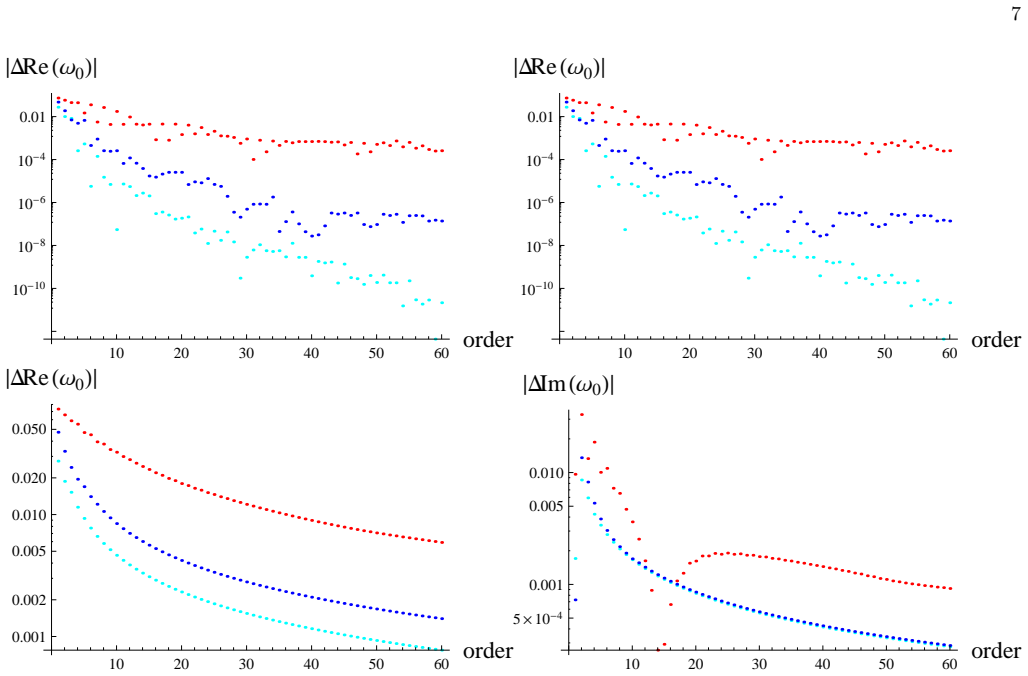
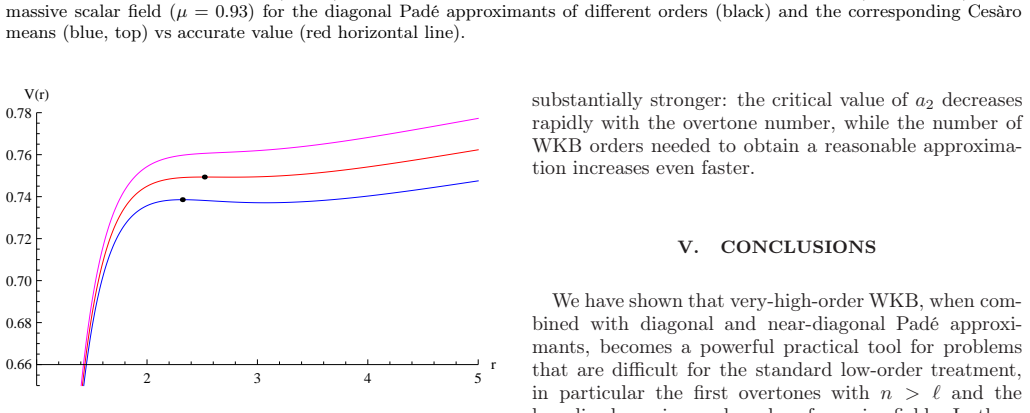
0553404140i, reproducing correctly three decimal places. For µ > ∼ 0. 94 the effective potential is monotonous and does not have any local maxima. IV. QUASINORMAL MODES AND PRACTICAL CONVERGENCE OF THE WKB RESUL TS AT DIFFERENT ORDERS The automatic Mathematica code used in this sec- tion has three levels. First, it generates numerically the derivatives wit...
-
[8]
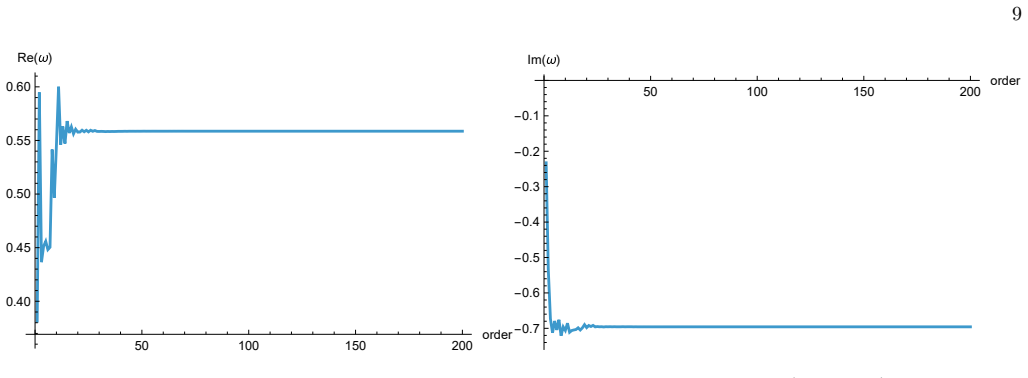
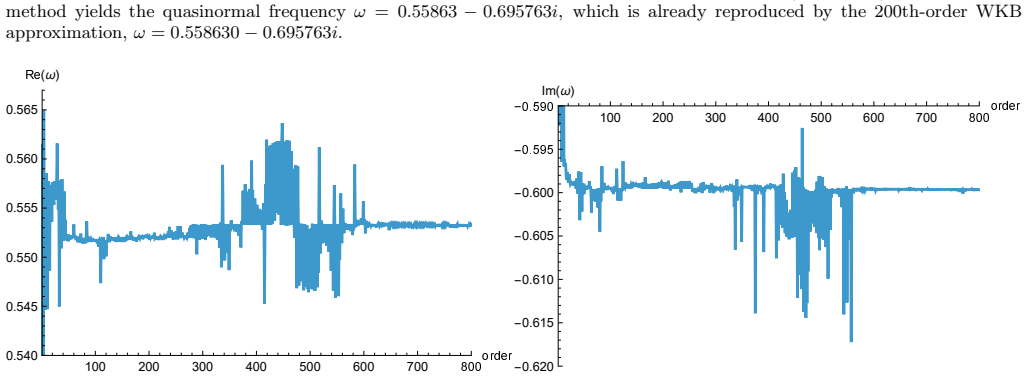
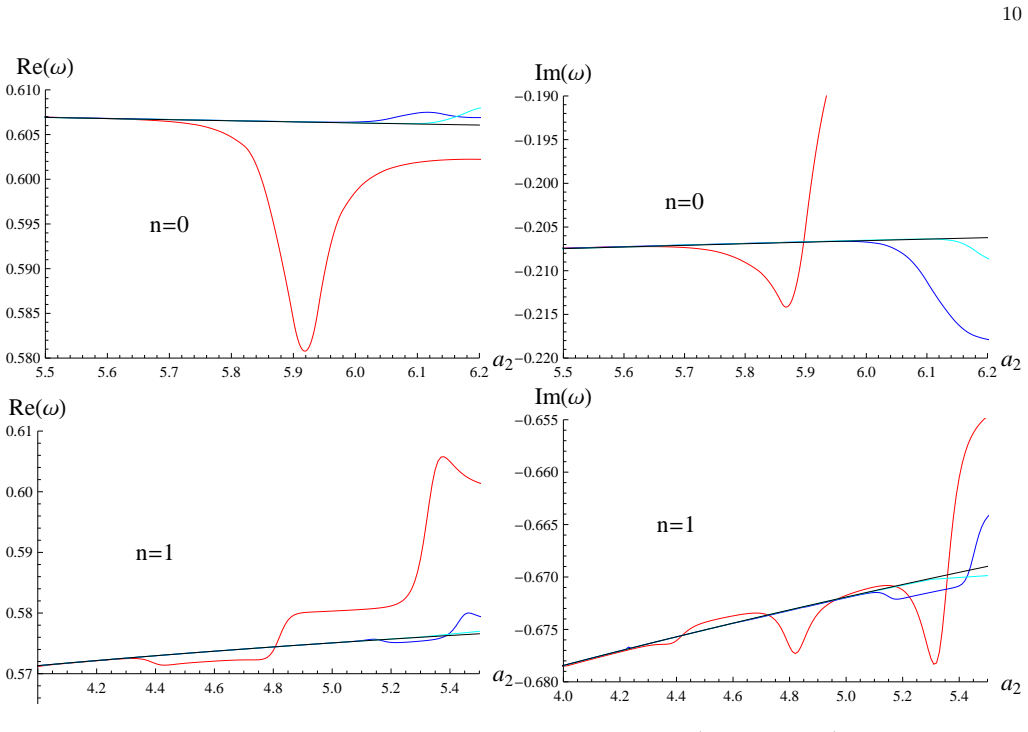
We have referred to this behavior as apparent convergence. Thus numerical stabilization alone is not always a sufficient criterion of correctness, and whenever possible it should be checked against an independent method such as the Frobenius approach. The massive-field case is particularly interesting. Al- though the standard WKB derivation is based on a two...
-
[9]
K. D. Kokkotas and B. G. Schmidt, Living Rev. Rel. 2, 2 (1999) , arXiv:gr-qc/9909058
work page internal anchor Pith review Pith/arXiv arXiv 1999
-
[10]
R. A. Konoplya and A. Zhi- denko, Rev. Mod. Phys. 83, 793 (2011) , arXiv:1102.4014 [gr-qc]
work page internal anchor Pith review Pith/arXiv arXiv 2011
-
[11]
B. P. Abbott et al. (LIGO Scientific, Virgo), Phys. Rev. Lett. 116, 061102 (2016) , arXiv:1602.03837 [gr-qc]
work page internal anchor Pith review Pith/arXiv arXiv 2016
-
[12]
B. P. Abbott et al. (LIGO Scientific, Virgo), Phys. Rev. Lett. 119, 161101 (2017) , arXiv:1710.05832 [gr-qc]
work page internal anchor Pith review Pith/arXiv arXiv 2017
-
[13]
R. Abbott et al. (LIGO Scientific, Virgo), Astrophys. J. Lett. 896, L44 (2020) , arXiv:2006.12611 [astro-ph.HE]
work page internal anchor Pith review Pith/arXiv arXiv 2020
-
[14]
First M87 Event Horizon Telescope Results. I. The Shadow of the Supermassive Black Hole
K. Akiyama et al. (Event Horizon Tele- scope), Astrophys. J. Lett. 875, L1 (2019) , arXiv:1906.11238 [astro-ph.GA]
work page internal anchor Pith review Pith/arXiv arXiv 2019
-
[15]
S. V. Bolokhov and M. Skvortsova, Grav. Cosmol. 31, 423 (2025)
2025
-
[16]
B. F. Schutz and C. M. Will, 11 Astrophys. J. Lett. 291, L33 (1985)
1985
-
[17]
Iyer and C
S. Iyer and C. M. Will, Phys. Rev. D 35, 3621 (1987)
1987
-
[18]
R. A. Konoplya, Phys. Rev. D 68, 024018 (2003) , arXiv:gr-qc/0303052
work page internal anchor Pith review Pith/arXiv arXiv 2003
- [19]
-
[20]
S. V. Bolokhov, Phys. Rev. D 109, 064017 (2024)
2024
- [21]
- [22]
- [23]
-
[24]
Bolokhov, Eur
S. Bolokhov, Eur. Phys. J. C 85, 1166 (2025)
2025
- [25]
-
[26]
M. Skvortsova, Grav. Cosmol. 30, 279 (2024) , arXiv:2405.15807 [gr-qc]
-
[27]
M. Skvortsova, Fortsch. Phys. 72, 2400132 (2024) , arXiv:2405.06390 [gr-qc]
- [28]
- [29]
- [30]
- [31]
- [32]
-
[33]
A. Dubinsky, Int. J. Theor. Phys. 65, 45 (2026) , arXiv:2511.00778 [gr-qc]
-
[34]
A. Dubinsky, Annals Phys. 485, 170299 (2026) , arXiv:2509.11017 [gr-qc]
-
[35]
A. Dubinsky, Int. J. Grav. Theor. Phys. 1, 2 (2025) , arXiv:2507.00256 [gr-qc]
-
[36]
A. Dubinsky and A. Zin- hailo, Eur. Phys. J. C 84, 847 (2024) , arXiv:2404.01834 [gr-qc]
-
[37]
Quasinormal modes of black holes. The improved semianalytic approach
J. Matyjasek and M. Opala, Phys. Rev. D 96, 024011 (2017) , arXiv:1704.00361 [gr-qc]
work page internal anchor Pith review Pith/arXiv arXiv 2017
-
[38]
J. Matyjasek and M. Telecka, Phys. Rev. D 100, 124006 (2019) , arXiv:1908.09389 [gr-qc]
-
[39]
Y. Hatsuda, Phys. Rev. D 101, 024008 (2020) , arXiv:1906.07232 [gr-qc]
-
[40]
O. B. Zaslavsky, Phys. Rev. D 43, 605 (1991)
1991
-
[41]
A. Ohashi and M.-a. Sakagami, Class. Quant. Grav. 21, 3973 (2004) , arXiv:gr-qc/0407009
work page internal anchor Pith review Pith/arXiv arXiv 2004
-
[42]
R. A. Konoplya and A. Zhidenko, Phys. Lett. B 609, 377 (2005) , arXiv:gr-qc/0411059
work page internal anchor Pith review Pith/arXiv arXiv 2005
-
[43]
R. A. Konoplya and A. Zhidenko, Phys. Rev. D 73, 124040 (2006) , arXiv:gr-qc/0605013
work page internal anchor Pith review Pith/arXiv arXiv 2006
-
[44]
D. V. Gal’tsov and A. A. Matiukhin, Class. Quant. Grav. 9, 2039 (1992)
2039
- [45]
- [46]
-
[47]
New parametrization for spherically symmetric black holes in metric theories of gravity
L. Rezzolla and A. Zhidenko, Phys. Rev. D 90, 084009 (2014) , arXiv:1407.3086 [gr-qc]
work page internal anchor Pith review Pith/arXiv arXiv 2014
- [48]
-
[49]
K. D. Kokkotas, R. A. Konoplya, and A. Zhidenko, Phys. Rev. D 96, 064004 (2017) , arXiv:1706.07460 [gr-qc]
work page internal anchor Pith review Pith/arXiv arXiv 2017
-
[50]
K. Kokkotas, R. A. Konoplya, and A. Zhidenko, Phys. Rev. D 96, 064007 (2017) , arXiv:1705.09875 [gr-qc]
- [51]
- [52]
-
[53]
A new method for shadow calculations: application to parameterised axisymmetric black holes
Z. Younsi, A. Zhidenko, L. Rezzolla, R. Kono- plya, and Y. Mizuno, Phys. Rev. D 94, 084025 (2016) , arXiv:1607.05767 [gr-qc]
work page internal anchor Pith review Pith/arXiv arXiv 2016
- [54]
- [55]
- [56]
- [57]
-
[58]
E. W. Leaver, Proc. Roy. Soc. Lond. A 402, 285 (1985)
1985
-
[59]
S. Bolokhov, K. Bronnikov, and R. Kono- plya, Fortsch. Phys. 73, 2400187 (2025) , arXiv:2306.11083 [gr-qc]
-
[60]
A. Rostworowski, Acta Phys. Polon. B 38, 81 (2007), arXiv:gr-qc/0606110
work page internal anchor Pith review Pith/arXiv arXiv 2007
-
[61]
Nollert, Phys
H.-P. Nollert, Phys. Rev. D 47, 5253 (1993)
1993
-
[62]
Massive scalar field quasi-normal modes of higher dimensional black holes
A. Zhidenko, Phys. Rev. D 74, 064017 (2006) , arXiv:gr-qc/0607133
work page internal anchor Pith review Pith/arXiv arXiv 2006
-
[63]
R. A. Konoplya, A. Zhidenko, and A. F. Zin- hailo, Class. Quant. Grav. 36, 155002 (2019) , arXiv:1904.10333 [gr-qc]
work page internal anchor Pith review Pith/arXiv arXiv 2019
-
[64]
Bonatsos, C
D. Bonatsos, C. Daskaloyannis, and K. D. Kokkotas, Phys. Rev. A 45, 6153 (1992)
1992
-
[65]
C. M. Bender and T. T. Wu, Phys. Rev. D 7, 1620 (1973)
1973
-
[66]
Aspects of Perturbation theory in Quantum Mechanics: The BenderWu Mathematica package
T. Sulejmanpasic and M. Ünsal, Comput. Phys. Commun. 228, 273 (2018) , arXiv:1608.08256 [hep-th]
work page internal anchor Pith review Pith/arXiv arXiv 2018
-
[67]
G. H. Hardy, Divergent Series (Oxford University Press, Oxford, 1949)
1949
discussion (0)
Sign in with ORCID, Apple, or X to comment. Anyone can read and Pith papers without signing in.