The Symmetric Location Problem: a Song of Efficiency and Robustness
Pith reviewed 2026-06-29 20:30 UTC · model grok-4.3
The pith
Semiparametric statistics reconciles efficiency and robustness in the symmetric location problem.
A machine-rendered reading of the paper's core claim, the machinery that carries it, and where it could break.
Core claim
The semiparametric framework allows estimation or hypothesis testing on a finite-dimensional parameter in the presence of an infinite-dimensional nuisance parameter such as the noise density, and this framework reconciles statistical efficiency with robustness understood as distribution-freeness.
What carries the argument
The semiparametric model for the symmetric location problem, which treats the noise density as a nuisance function while targeting the location parameter.
Load-bearing premise
The symmetric location problem represents the broader class of semiparametric tasks in signal processing and the developed methods extend to those tasks without losing the efficiency-robustness property.
What would settle it
A numerical experiment in which the semiparametric estimator either falls short of the efficiency bound when the noise density is known or shows performance degradation when the true distribution changes would falsify the central reconciliation claim.
Figures

read the original abstract
The aim of this Lecture Note is to introduce the Signal Processing (SP) community to a powerful yet still under-utilised tool: the semiparametric statistics. In short, the semiparametric framework allows us to estimate or perform hypothesis testing on a finite-dimensional parameter in the presence of an infinite-dimensional nuisance parameter (i.e. a function), such as the density of the noise. Clearly, this framework is general enough to include almost every SP application. Remarkably, as the title suggests drawing on George R. R. Martin's famous book series, the greatest advantage of semiparametric statistics over parametric and non-parametric ones lies in the fact that it is able to reconcile two seemingly dichotomous concepts: statistical efficiency and robustness. Here, robustness is understood in the sense of distribution-freeness, that is the estimation performance must be robust with respect to the lack of knowledge of the functional form of the generating data distribution. To explain exactly what this means, in this Lecture Note we will focus our attention on the famous and fundamental symmetric location problem. The symmetric location problem is a fundamental problem that can be found (in various forms) in countless areas of SP: source localization, time synchronization, array signal processing, and distributed sensor networks, just to name a few. Furthermore, it is important to note that the methodology we will develop for this specific problem can be extended to much more general semiparametric estimation problems, such as the estimation of the location vector and covariance matrix in elliptical data.
Editorial analysis
A structured set of objections, weighed in public.
Referee Report
Summary. The manuscript is a lecture note introducing semiparametric statistics to the signal processing community. It centers on the symmetric location problem to illustrate estimation or hypothesis testing of a finite-dimensional parameter (location) in the presence of an infinite-dimensional nuisance (noise density), claiming this reconciles statistical efficiency with robustness (distribution-freeness). The note asserts that the methodology extends to broader SP tasks including source localization, array processing, and elliptical covariance estimation.
Significance. The reconciliation of efficiency and robustness under symmetry is a standard, definitional property of the semiparametric framework rather than a novel result. The note's primary contribution is expository: making these established concepts accessible to SP researchers. No machine-checked proofs, reproducible code, or new empirical validations are presented. If the exposition is accurate, it may usefully bridge semiparametric methods to applications such as distributed sensor networks.
major comments (1)
- [Abstract] Abstract: the assertion that 'the methodology we will develop for this specific problem can be extended to much more general semiparametric estimation problems, such as the estimation of the location vector and covariance matrix in elliptical data' is load-bearing for the claim of broad applicability to SP tasks, yet no specific theorem, reference, or outline of the extension is indicated; this risks overstating transferability without material loss of the efficiency-robustness property.
minor comments (2)
- The abstract contains several long sentences that could be split to improve readability for the target SP audience.
- The title's reference to 'A Song of Efficiency and Robustness' (drawing on George R. R. Martin) should be clarified in a footnote if the manuscript is intended for readers unfamiliar with the allusion.
Simulated Author's Rebuttal
We thank the referee for their constructive review and for recognizing the potential utility of this lecture note in introducing semiparametric methods to the signal processing community. We address the major comment below.
read point-by-point responses
-
Referee: [Abstract] Abstract: the assertion that 'the methodology we will develop for this specific problem can be extended to much more general semiparametric estimation problems, such as the estimation of the location vector and covariance matrix in elliptical data' is load-bearing for the claim of broad applicability to SP tasks, yet no specific theorem, reference, or outline of the extension is indicated; this risks overstating transferability without material loss of the efficiency-robustness property.
Authors: We agree that the abstract statement on extendability would benefit from additional grounding to prevent any risk of overstating the transferability. The note positions the symmetric location problem as a foundational, canonical case whose semiparametric treatment (efficiency under symmetry plus distribution-freeness) is intended to illustrate the general framework; the claim of broader applicability follows from the standard generality of semiparametric models rather than from a new theorem proved here. To address the concern directly, we will revise the abstract and add a short paragraph (with one or two key references to the elliptical semiparametric literature) outlining how the same efficiency-robustness trade-off extends to location and scatter estimation under elliptical symmetry. This change will be limited in scope and preserve the expository character of the lecture note. revision: yes
Circularity Check
No significant circularity; expository lecture note on established concepts
full rationale
The manuscript is a lecture note whose purpose is to introduce established semiparametric concepts (finite-dimensional parameter estimation in the presence of an infinite-dimensional nuisance) to the SP community via the symmetric location model. No derivation chain, fitted parameters, predictions, or uniqueness theorems are presented; the reconciliation of efficiency and robustness under symmetry is described as a definitional property of the semiparametric framework and is not advanced as a novel theorem or empirical result. The text contains no equations or steps that reduce by construction to the paper's own inputs.
Axiom & Free-Parameter Ledger
axioms (1)
- domain assumption Noise distribution is symmetric around the unknown location parameter.
Reference graph
Works this paper leans on
-
[1]
Robust semiparametric efficient estimators in complex elliptically symmetric distributions,
S. Fortunati, A. Renaux, and F. Pascal, “Robust semiparametric efficient estimators in complex elliptically symmetric distributions,”IEEE Transactions on Signal Processing, vol. 68, pp. 5003–5015, 2020
2020
-
[2]
S. Fortunati, J.-P. Delmas, and E. Ollila, “Nuisance parameters and elliptically symmetric distributions: a geometric approach to parametric and semiparametric efficiency,” https://arxiv.org/abs/2506.23213, 2026
work page internal anchor Pith review Pith/arXiv arXiv 2026
-
[3]
Le Cam and G
L. Le Cam and G. L. Yang,Asymptotics in Statistics: Some Basic Concepts (second edition). Springer series in statistics, 2000
2000
-
[4]
A. W. van der Vaart,Asymptotic Statistics, ser. Cambridge Series in Statistical and Probabilistic Mathematics. Cambridge University Press, 1998
1998
-
[5]
Bickel, C
P. Bickel, C. Klaassen, Y . Ritov, and J. Wellner,Efficient and Adaptive Estimation for Semiparametric Models. Johns Hopkins University Press, 1993
1993
-
[6]
A fresh look at the semiparametric Cram ´er-Rao bound,
S. Fortunati, F. Gini, M. Greco, A. M. Zoubir, and M. Rangaswamy, “A fresh look at the semiparametric Cram ´er-Rao bound,” in2018 26th European Signal Processing Conference (EUSIPCO), Sep. 2018, pp. 261–265
2018
-
[7]
Semi-parametric efficiency, distribution-freeness and invariance,
M. Hallin and B. J. M. Werker, “Semi-parametric efficiency, distribution-freeness and invariance,”Bernoulli, vol. 9, no. 1, pp. 137–165, 2003
2003
-
[8]
E. L. Lehmann and J. P. Romano,Testing Statistical Hypotheses, 3rd ed., 2008
2008
-
[9]
On statistics independent of a complete sufficient statistic,
D. Basu, “On statistics independent of a complete sufficient statistic,”Sankhy ¯a: The Indian Journal of Statistics (1933- 1960), vol. 15, no. 4, pp. 377–380, 1955
1933
-
[10]
The family of ancillary statistics,
——, “The family of ancillary statistics,”Sankhy ¯a: The Indian Journal of Statistics (1933-1960), vol. 21, no. 3/4, pp. 247–256, 1959. May 26, 2026 DRAFT IEEE SIGNAL PROCESSING MAGAZINE, VOL. XX, NO. XX, JUNE 2024 18
1933
-
[11]
Background on real and complex elliptically symmetric distributions,
J.-P. Delmas, “Background on real and complex elliptically symmetric distributions,” inElliptically Symmetric Distributions in Signal Processing and Machine Learning, J.-P. Delmas, M. N. El Korso, S. Fortunati, and F. Pascal, Eds. Cham: Springer Nature Switzerland, 2024, pp. 1–34. [Online]. Available: https://hal.science/hal-04217510v5
2024
-
[12]
Application of the Radon-Nikodym theorem to the theory of sufficient statistics,
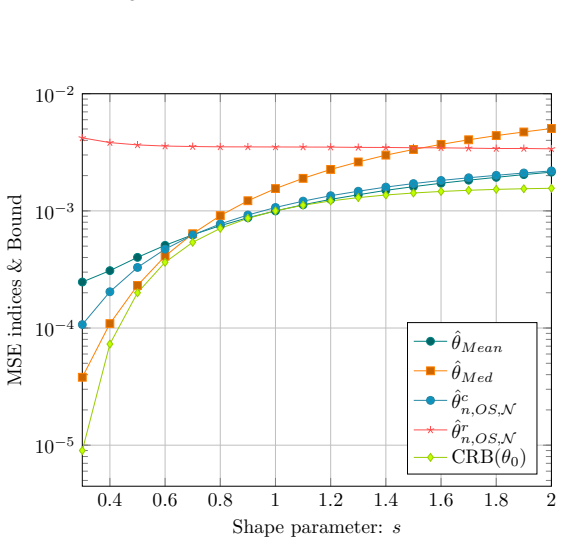
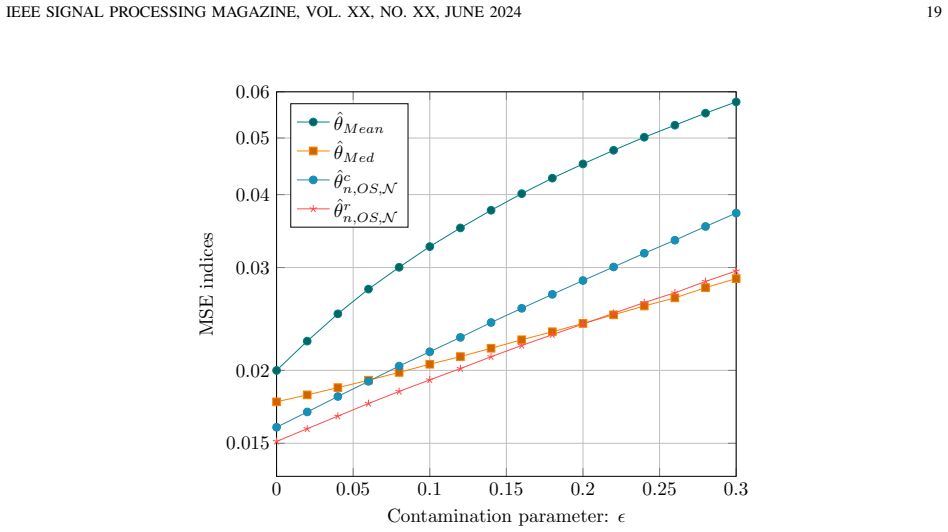
P. R. Halmos and L. J. Savage, “Application of the Radon-Nikodym theorem to the theory of sufficient statistics,”The Annals of Mathematical Statistics, vol. 20, no. 2, pp. 225–241, 1949. 2 4 6 8 10 0.01 0.02 0.04 0.06 0.08 0.1 Degrees of freedom: ν MSE indices & Bound ˆθM ean ˆθM ed ˆθc n,OS,N ˆθr n,OS,N CRB(θ0) Fig. 1: Case 1:t-distributed observations. ...
1949
discussion (0)
Sign in with ORCID, Apple, or X to comment. Anyone can read and Pith papers without signing in.