Fuzzy PyTorch: Rapid Numerical Variability Evaluation for Deep Learning Models
Pith reviewed 2026-06-29 22:56 UTC · model grok-4.3
The pith
Fuzzy PyTorch adds stochastic arithmetic to PyTorch so numerical variability in deep learning models can be measured quickly without changing model behavior.
A machine-rendered reading of the paper's core claim, the machinery that carries it, and where it could break.
Core claim
The paper establishes that integrating stochastic arithmetic into PyTorch through probabilistic rounding and instruction set management produces a practical tool for variability evaluation: it preserves original model performance, delivers large runtime savings over prior methods, and handles networks ranging from one parameter to 341 million parameters.
What carries the argument
Probabilistic rounding with instruction set management, which supplies stochastic and up-down rounding modes inside the PyTorch execution path to simulate floating-point variability during model runs.
If this is right
- Model developers can insert variability checks into existing PyTorch code with minimal changes.
- Large-scale networks become feasible to audit for floating-point sensitivity.
- Runtime cost of variability testing drops enough to support repeated checks during development.
- Both stochastic and up-down rounding modes become available for the same model without separate toolchains.
Where Pith is reading between the lines
- The same interface could be extended to other deep-learning frameworks to create a common way of reporting numerical robustness.
- If the measured variability correlates with real deployment errors, it could guide selective use of higher precision in sensitive layers.
- Routine variability scans might reveal which operations in a network are most responsible for output differences across hardware.
Load-bearing premise
The added rounding modes reproduce the same numerical effects that occur in ordinary floating-point hardware without introducing extra changes to the model's outputs or training dynamics.
What would settle it
A side-by-side test in which the variability statistics reported by the library differ from the spread of results obtained by running the identical model repeatedly on different floating-point hardware or in higher-precision arithmetic.
Figures




read the original abstract
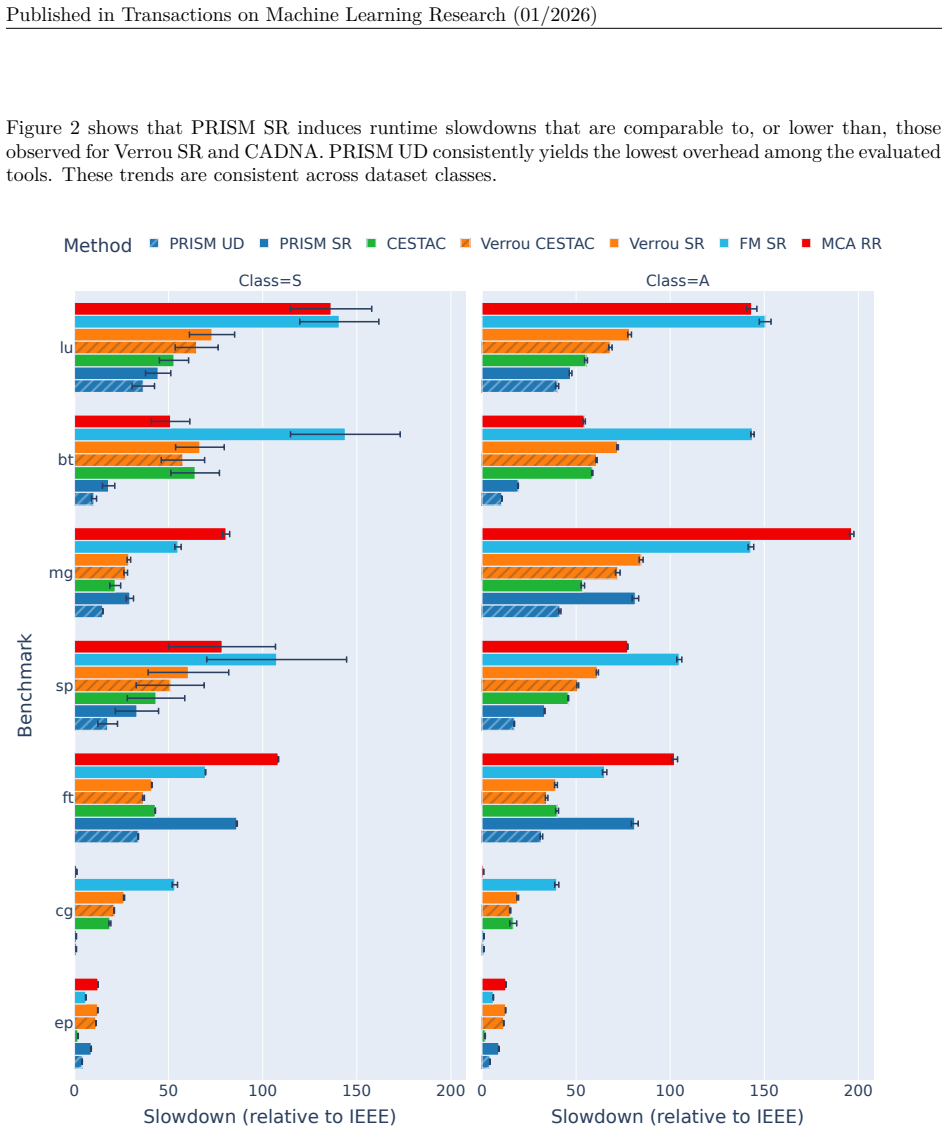
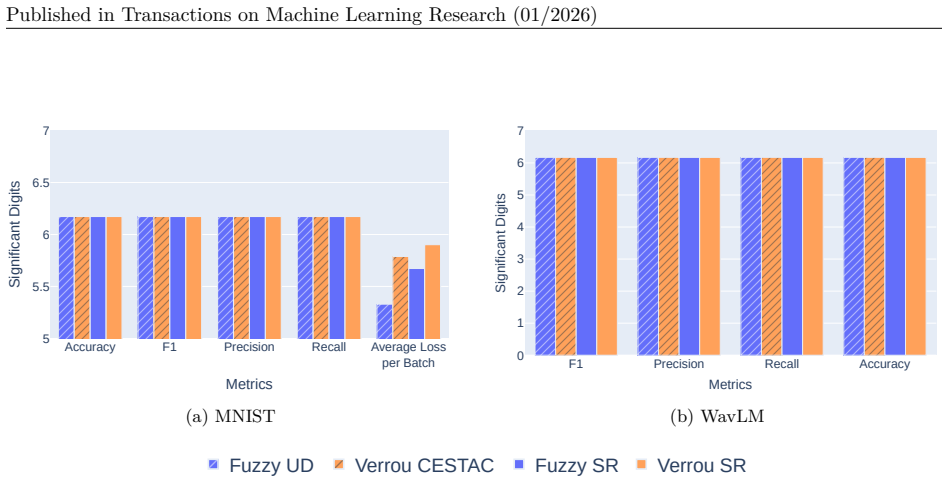
We introduce Fuzzy PyTorch, a framework for rapid evaluation of numerical variability in deep learning (DL) models. As DL is increasingly applied to diverse tasks, understanding variability from floating-point arithmetic is essential to ensure robust and reliable performance. Tools assessing such variability must be scalable, efficient, and integrate seamlessly with existing frameworks while minimizing code modifications. Fuzzy PyTorch enables this by integrating stochastic arithmetic into PyTorch through Probabilistic Rounding with Instruction Set Management, a novel library interfacing with Verificarlo, a numerical analysis compiler. The library offers stochastic rounding mode and a novel mode; up-down rounding. Comparative evaluations show Fuzzy PyTorch maintains model performance and achieves runtime reductions of 5x to 60x versus Verrou, a state-of-the-art tool. We further demonstrate scalability by running models from 1 to 341 million parameters, confirming applicability across small and large DL architectures. Overall, Fuzzy PyTorch provides an efficient, scalable, and practical solution for assessing numerical variability in deep learning, enabling researchers and practitioners to quantify and manage floating-point uncertainty without compromising performance or computational efficiency.
Editorial analysis
A structured set of objections, weighed in public.
Referee Report
Summary. The manuscript introduces Fuzzy PyTorch, a PyTorch framework for evaluating numerical variability in deep learning models. It integrates stochastic arithmetic via a new Probabilistic Rounding with Instruction Set Management library built on Verificarlo, offering stochastic rounding and a novel up-down rounding mode. The central claims are that the tool maintains model performance while delivering 5x–60x runtime reductions versus Verrou and scales to models with 1–341 million parameters.
Significance. If the runtime and accuracy claims hold under rigorous experimental validation, the work would supply a practical, scalable instrument for quantifying floating-point uncertainty in DL pipelines. This addresses a recognized need for efficient variability analysis tools that integrate with existing frameworks without extensive code changes.
major comments (2)
- [Abstract] Abstract: the claims that Fuzzy PyTorch 'maintains model performance' and achieves 'runtime reductions of 5x to 60x versus Verrou' are presented without any reference to the models tested, datasets, number of trials, error bars, or controls for post-hoc analysis choices. These omissions are load-bearing for the central empirical contribution.
- [Abstract] Abstract and evaluation description: the novel 'up-down rounding' mode and the Probabilistic Rounding with Instruction Set Management library are introduced without a precise definition, pseudocode, or verification that they reproduce standard floating-point variability semantics rather than introducing unintended behavioral shifts.
minor comments (1)
- [Abstract] The abstract mentions 'Comparative evaluations' and 'scalability by running models from 1 to 341 million parameters' but supplies no table, figure, or section reference for these results.
Simulated Author's Rebuttal
We thank the referee for their constructive feedback on the abstract and the presentation of the new library and rounding mode. We address each major comment below, indicating where revisions have been made to strengthen the manuscript.
read point-by-point responses
-
Referee: [Abstract] Abstract: the claims that Fuzzy PyTorch 'maintains model performance' and achieves 'runtime reductions of 5x to 60x versus Verrou' are presented without any reference to the models tested, datasets, number of trials, error bars, or controls for post-hoc analysis choices. These omissions are load-bearing for the central empirical contribution.
Authors: We agree that the abstract should supply sufficient context for the central empirical claims. In the revised manuscript we have updated the abstract to reference the range of models evaluated (1 million to 341 million parameters), the datasets employed, the number of independent trials, and the reporting of error bars and controls; full experimental details and post-hoc analysis procedures remain in the dedicated evaluation section. revision: yes
-
Referee: [Abstract] Abstract and evaluation description: the novel 'up-down rounding' mode and the Probabilistic Rounding with Instruction Set Management library are introduced without a precise definition, pseudocode, or verification that they reproduce standard floating-point variability semantics rather than introducing unintended behavioral shifts.
Authors: We acknowledge that the abstract itself does not contain these elements. The full manuscript already includes a methods section with a precise definition of the Probabilistic Rounding with Instruction Set Management library, pseudocode for the up-down rounding mode, and verification experiments confirming that both modes reproduce standard floating-point variability semantics (via direct comparison with Verrou). To address the referee's concern we have added a concise definition and a forward reference to the verification results in the revised abstract. revision: partial
Circularity Check
No significant circularity
full rationale
The paper introduces Fuzzy PyTorch, a software framework integrating stochastic arithmetic into PyTorch via Probabilistic Rounding and Verificarlo for evaluating floating-point variability in DL models. All claims are empirical: runtime speedups (5x-60x vs Verrou) and scalability (1 to 341M parameters) measured against external baselines. No equations, derivations, fitted parameters presented as predictions, or self-citation chains appear in the provided text. The central results rest on comparative measurements whose validity is independent of internal definitions or prior author work.
Axiom & Free-Parameter Ledger
axioms (1)
- domain assumption Stochastic rounding modes can be used to model floating-point arithmetic variability in neural network computations
invented entities (2)
-
Probabilistic Rounding with Instruction Set Management library
no independent evidence
-
up-down rounding mode
no independent evidence
Reference graph
Works this paper leans on
-
[1]
El-Mehdi El Arar, Silviu-Ioan Filip, Theo Mary, and Elisa Riccietti. Mixed precision accumulation for neural network inference guided by componentwise forward error analysis.arXiv preprint arXiv:2503.15568,
-
[2]
Rounding modes.https://awsdocs-neuron.readthedocs-hosted.com/en/latest/ general/arch/neuron-features/rounding-modes.html, n.d
AWS Neuron Team. Rounding modes.https://awsdocs-neuron.readthedocs-hosted.com/en/latest/ general/arch/neuron-features/rounding-modes.html, n.d. Accessed: 2025-06-25. Théo Beuzeville, Alfredo Buttari, Serge Gratton, and Theo Mary. Deterministic and probabilistic backward error analysis of neural networks in floating-point arithmetic
2025
-
[3]
Automatic exploration of reduced floating-point representations in iterative methods
Yohan Chatelain, Eric Petit, Pablo de Oliveira Castro, Ghislain Lartigue, and David Defour. Automatic exploration of reduced floating-point representations in iterative methods. InEuro-Par 2019: Parallel Processing: 25th International Conference on Parallel and Distributed Computing, Göttingen, Germany, August 26–30, 2019, Proceedings 25, pp. 481–494. Springer,
2019
-
[4]
Accessed: 2024-12-21
URLhttps://github.com/onnx/onnx. Accessed: 2024-12-21. Intel Corporation. oneDNN: Deep Learning Open Source Performance Library,
2024
-
[5]
com/oneapi-src/oneDNN
URLhttps://github. com/oneapi-src/oneDNN. Accessed: 2024-12-21. Pablo de Oliveira Castro.High Performance Computing code optimizations: Tuning performance and accu- racy. PhD thesis, Université Paris-Saclay,
2024
-
[6]
Accessed: 2024-12-17
URLhttps://github.com/Deep-MI/FastSurfer. Accessed: 2024-12-17. DavidDefour, FrançoisFévotte, StefGraillat, FabienneJézéquel, WilfriedKirschenmann, Jean-LucLamotte, Bruno Lathuilière, Yves Lhuillier, Eric Petit, Julien Signoles, et al. InterFLOP, Interoperable Tools for Computing, Debugging, Validation and Optimization of Floating-Point Programs. InISC-HP...
2024
-
[7]
Reproducibility of tumor segmentation outcomes with a deep learning model
13 Published in Transactions on Machine Learning Research (01/2026) Morgane Des Ligneris, Axel Bonnet, Yohan Chatelain, Tristan Glatard, Michaël Sdika, Gaël Vila, Valentine Wargnier-Dauchelle, Sorina Pop, and Carole Frindel. Reproducibility of tumor segmentation outcomes with a deep learning model. In2023 IEEE 20th International Symposium on Biomedical Im...
2026
-
[8]
Brecht Desplanques, Jenthe Thienpondt, and Kris Demuynck. Ecapa-tdnn: Emphasized channel attention, propagation and aggregation in tdnn based speaker verification.arXiv preprint arXiv:2005.07143,
work page Pith review arXiv 2005
-
[9]
VERROU: a CESTAC evaluation without recompilation.SCAN 2016, pp
François Févotte and Bruno Lathuiliere. VERROU: a CESTAC evaluation without recompilation.SCAN 2016, pp. 47,
2016
-
[10]
Conserva- tive & Aggressive NaNs Accelerate U-Nets for Neuroimaging.arXiv preprint arXiv:2601.17180,
Inés Gonzalez-Pepe, Vinuyan Sivakolunthu, Jacob Fortin, Yohan Chatelain, and Tristan Glatard. Conserva- tive & Aggressive NaNs Accelerate U-Nets for Neuroimaging.arXiv preprint arXiv:2601.17180,
-
[11]
Highway, 2024a
Google. Highway, 2024a. URLhttps://github.com/google/highway. Accessed: 2024-12-17. Google. Protocol buffers, 2024b. URLhttps://github.com/protocolbuffers/protobuf. Accessed: 2024- 12-21. Google. Highway: Performance-portable, length-agnostic simd with runtime dispatch.https://github. com/google/highway,
2024
-
[12]
IEEE Standard for Floating-Point Arithmetic.https://ieeexplore.ieee.org/ document/4610935, aug
IEEE Computer Society. IEEE Standard for Floating-Point Arithmetic.https://ieeexplore.ieee.org/ document/4610935, aug
-
[13]
Fabienne Jézéquel and Jean-Marie Chesneaux
IEEE Std 754-2008. Fabienne Jézéquel and Jean-Marie Chesneaux. CADNA: a library for estimating round-off error propagation. Computer Physics Communications, 178(12):933–955,
2008
-
[14]
Eliska Kloberdanz, Kyle G Kloberdanz, and Wei Le. DeepStability: A Study of Unstable Numerical Methods and Their Solutions in Deep Learning.arXiv preprint arXiv:2202.03493,
-
[15]
CGO 2004., pp. 75–86. IEEE,
2004
-
[16]
TinyIREE: An ML execution environment for embedded systems from compilation to deployment.IEEE micro, 42(5):9–16,
14 Published in Transactions on Machine Learning Research (01/2026) Hsin-I Cindy Liu, Marius Brehler, Mahesh Ravishankar, Nicolas Vasilache, Ben Vanik, and Stella Laurenzo. TinyIREE: An ML execution environment for embedded systems from compilation to deployment.IEEE micro, 42(5):9–16,
2026
-
[17]
Ac- cessed: 2024-12-17
URLhttps://github.com/verificarlo/significantdigits. Ac- cessed: 2024-12-17. Marc Vicuna, Martin Khannouz, Gregory Kiar, Yohan Chatelain, and Tristan Glatard. Reducing numerical precision preserves classification accuracy in mondrian forests. In2021 IEEE International Conference on Big Data (Big Data), pp. 2785–2790. IEEE,
2024
-
[18]
These methods rely on non-deterministic rounding
15 Published in Transactions on Machine Learning Research (01/2026) A Numerical Variability Estimation Measuring numerical variability in DL models can involve a family of techniques that introduce randomness into floating-point computations. These methods rely on non-deterministic rounding. Unlike standard IEEE-754 rounding modes, this approach rounds to...
2026
-
[19]
(SR) technique rounds the result of each floating-point with a probability that depends on the distance between the exact value and the two closest representable floating- point numbers. The probability is computed as: ◦sr(x) = { ⌊x⌋with probabilitypsr ⌈x⌉with probability1−psr (4) wherep sr(x)is defined as: psr(x) = 1−x−⌊x⌋ ⌈x⌉−⌊x⌋ SR implementations incl...
1998
-
[20]
The model was trained on the mPower speech dataset (Bot et al., 2016)
and a linear layer classifier followed by a max operation to obtain binary classification to determine whether a subject has Parkinson’s disease or is a healthy control 17 Published in Transactions on Machine Learning Research (01/2026) subject. The model was trained on the mPower speech dataset (Bot et al., 2016). We will refer to this pipeline as WavLM ...
2026
-
[21]
is a CNN model that performs whole-brain segmentation, cortical surface reconstruction, fast spherical mapping, and cortical thickness analysis from anatomical MRI. The FastSurfer CNN is inspired by the QuickNAT model (Roy et al., 2019), which is composed of three 2D fully convolutional neural networks—each associated with a different 2D slice orientation...
2019
-
[22]
This segmentation step is entirely performed by the CNN, without surface reconstruction, and uses the pre-trained FastSurfer model (v2.1.0) available on GitHub (Deep-MI, 2024)
We focus exclu- sively on the task of whole-brain segmentation, defined as voxel-wise anatomical labeling of brain regions. This segmentation step is entirely performed by the CNN, without surface reconstruction, and uses the pre-trained FastSurfer model (v2.1.0) available on GitHub (Deep-MI, 2024). FastSurfer has demonstrated high accuracy, strong genera...
2024
discussion (0)
Sign in with ORCID, Apple, or X to comment. Anyone can read and Pith papers without signing in.