Topology of pulsating active matter: Defect asymmetry controls emergent motility
Pith reviewed 2026-06-29 19:16 UTC · model grok-4.3
The pith
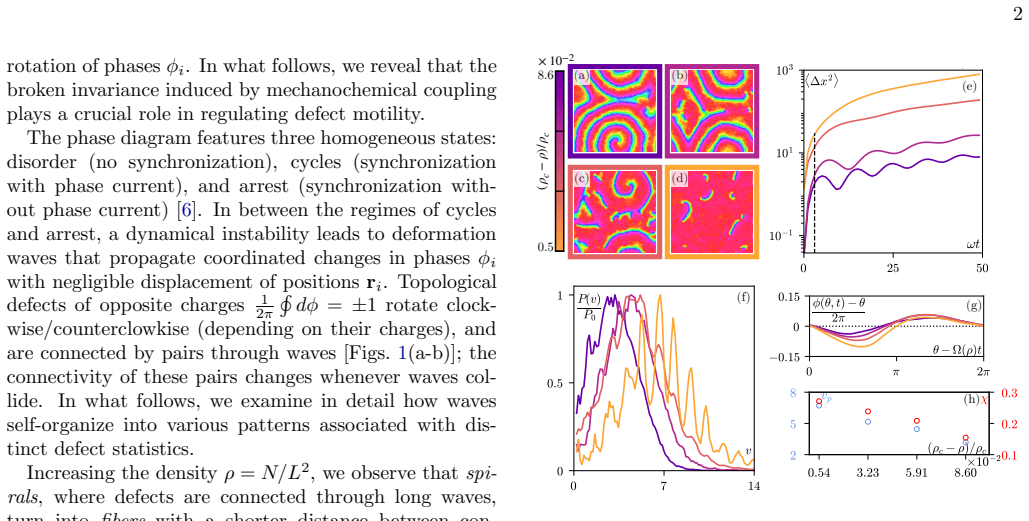
Motility of topological defects in pulsating active matter arises from a ratchet effect in which mechanochemical coupling breaks spatial and time-reversal symmetries, allowing fluctuations to drive drift of asymmetric rotating defects.
A machine-rendered reading of the paper's core claim, the machinery that carries it, and where it could break.
Core claim
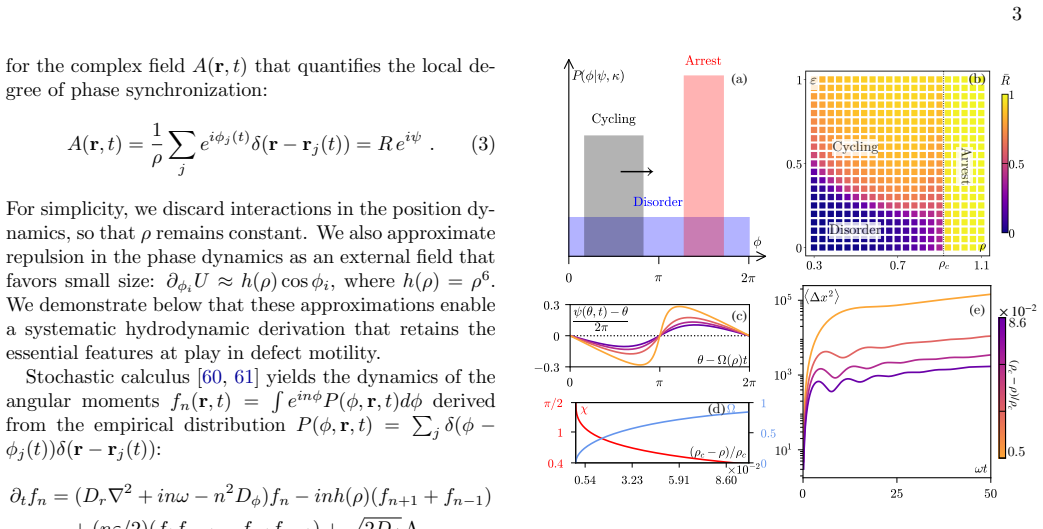
Topological defects in pulsating active matter are motile because the mechanochemical coupling between local oscillations and repulsive interactions breaks both spatial and time-reversal symmetries; asymmetric rotating defects therefore drift under fluctuations. This ratchet mechanism controls a crossover between spiral waves that connect slow defects and fiber-like waves that connect fast defects, in analogy with the onset of heart rhythm disorder. The entire process is rationalized by a fluctuating hydrodynamics that describes spontaneous nucleation and directed motion of motile defects inside an ordered background.
What carries the argument
The ratchet effect generated by mechanochemical coupling between local oscillations and repulsive interactions, which breaks spatial and time-reversal symmetries and produces fluctuation-driven drift of asymmetric rotating defects.
If this is right
- Motile defects spontaneously nucleate and move within an ordered background.
- The crossover between spiral waves and fiber-like waves is regulated by defect speed and asymmetry.
- Fluctuating hydrodynamics describes both the nucleation and the directed motion of the defects.
- The same symmetry-breaking mechanism is proposed to operate in cardiac tissues during the onset of rhythm disorder.
Where Pith is reading between the lines
- The ratchet mechanism may operate in any oscillating active system where local phase and repulsive forces are coupled, even if the microscopic details differ from the present model.
- Engineering the strength or symmetry of the coupling could provide a route to control defect speed and direction without adding self-propulsion.
- The fluctuating-hydrodynamics description could be adapted to quantify defect statistics in other symmetry-broken active systems that lack explicit motility.
Load-bearing premise
The model assumes that mechanochemical coupling between local oscillations and repulsive interactions is present and sufficient to break both spatial and time-reversal symmetries in the way needed for the ratchet effect to operate.
What would settle it
Direct observation that asymmetric rotating defects remain immobile under fluctuations when the mechanochemical coupling is removed or made symmetric would falsify the claim that this coupling produces the ratchet-driven motility.
Figures

read the original abstract
In pulsating active matter, topological defects are motile despite the absence of any macroscopic flows and microscopic self-propulsion. We reveal that this motility arises from a ratchet effect: the mechanochemical coupling between local oscillations and repulsive interactions breaks both spatial and time-reversal symmetries, thus leading asymmetric rotating defects to drift under fluctuations. This mechanism regulates a crossover between spiral waves connecting slow defects and fiber-like waves connecting fast defects, in analogy with the onset of heart rhythm disorder in cardiac tissues. We rationalize this crossover in terms of a fluctuating hydrodynamics that captures how motile defects spontaneously nucleate and move within an ordered background.
Editorial analysis
A structured set of objections, weighed in public.
Referee Report
Summary. The paper claims that in pulsating active matter, topological defects exhibit motility without macroscopic flows or microscopic self-propulsion. This motility arises from a ratchet effect in which mechanochemical coupling between local oscillations and repulsive interactions breaks both spatial and time-reversal symmetries, causing asymmetric rotating defects to drift under fluctuations. The mechanism controls a crossover between spiral waves (connecting slow defects) and fiber-like waves (connecting fast defects), analogous to the onset of heart rhythm disorder. The crossover is rationalized via a fluctuating hydrodynamics description that accounts for spontaneous nucleation and motion of motile defects within an ordered background.
Significance. If the central claim holds, the work identifies a symmetry-breaking ratchet mechanism that generates emergent defect motility in active matter purely from local oscillations and interactions. This provides a theoretical link between topology, mechanochemical coupling, and fluctuation-driven transport, with potential relevance to biological pattern formation such as cardiac tissues. The fluctuating hydrodynamics framework is a constructive element that rationalizes the observed crossover and could guide future modeling of defect dynamics in oscillatory active systems.
minor comments (3)
- [§3] §3 (Model section): the definition of the mechanochemical coupling term should explicitly state its functional form and parameter values used in simulations to allow direct reproduction of the symmetry-breaking argument.
- [Figure 4] Figure 4 caption: the distinction between 'slow' and 'fast' defects in the crossover regime is described qualitatively; adding a quantitative measure (e.g., average defect speed vs. oscillation frequency) would strengthen the comparison to the hydrodynamics prediction.
- [§5] §5 (Hydrodynamics): the stochastic term in the fluctuating hydrodynamics equation is introduced without a derivation of its correlator; a brief appendix deriving the noise strength from the underlying microscopic fluctuations would improve clarity.
Simulated Author's Rebuttal
We thank the referee for their careful reading, positive assessment of the significance of our work, and recommendation for minor revision. The referee's summary accurately reflects the central claims of the manuscript.
Circularity Check
No significant circularity detected
full rationale
The central claim rests on introducing mechanochemical coupling between oscillations and repulsions as a physically motivated model ingredient that breaks symmetries to produce a ratchet effect. The fluctuating hydrodynamics is then built to describe the resulting defect nucleation and drift. No derivation step reduces by construction to its own inputs, no parameter is fitted on a subset and then relabeled a prediction, and no load-bearing uniqueness theorem or ansatz is imported via self-citation. The model assumptions are stated explicitly and the derivation proceeds from them without self-referential closure.
Axiom & Free-Parameter Ledger
Reference graph
Works this paper leans on
-
[1]
Topology of pulsating active matter: Defect asymmetry controls emergent motility
has a cut-off ata ij = 1. The dependence ofUon positionsr i and phasesϕ i yields displacement (−∇ iU) and deformation (−∂ ϕi U) forces when particles overlap. This mechanochemical coupling is typically absent when modelling contractile tissues as excitable media [31, 34– 37], and implies thatUis not invariant under an arbitrary (a) (c) (d) 0 π 2π 𝜙 (b) 0 ...
work page internal anchor Pith review Pith/arXiv arXiv 2026
-
[2]
Tjhung and L
E. Tjhung and L. Berthier, Discontinuous fluidization transition in time-correlated assemblies of actively de- forming particles, Phys. Rev. E96, 050601(R) (2017)
2017
-
[3]
Koyano, H
Y. Koyano, H. Kitahata, and A. S. Mikhailov, Diffusion in crowded colloids of particles cyclically changing their shapes, Europhys. Lett.128, 40003 (2020)
2020
-
[4]
Togashi, Modeling of nanomachine/micromachine crowds: Interplay between the internal state and sur- roundings, J
Y. Togashi, Modeling of nanomachine/micromachine crowds: Interplay between the internal state and sur- roundings, J. Phys. Chem. B123, 1481 (2019)
2019
-
[5]
D. R. Parisi, L. E. Wiebke, J. N. Mandl, and J. Textor, Flow rate resonance of actively deforming particles, Sci. Rep.13, 9455 (2023)
2023
-
[6]
Li, Q.-L
Z.-Q. Li, Q.-L. Lei, and Y. qiang Ma, Fluidization and anomalous density fluctuations in 2d voronoi celepithe- lial tissues with pulsating activity, Proc. Natl. Acad. Sci. USA122, e2421518122 (2025)
2025
-
[7]
Zhang and E
Y. Zhang and E. Fodor, Pulsating active matter, Phys. Rev. Lett.131, 238302 (2023)
2023
-
[8]
W. h. Liu, W. j. Zhu, and B. q. Ai, Collective motion of pulsating active particles in confined structures, New J. Phys.26, 023017 (2024)
2024
-
[9]
W. D. Pi˜ neros and E. Fodor, Biased ensembles of pulsat- ing active matter, Phys. Rev. Lett.134, 038301 (2025)
2025
-
[10]
T. Banerjee, T. Desaleux, J. Ranft, and ’Etienne Fodor, Hydrodynamics of pulsating active liquids (2025), arXiv:2407.19955 [cond-mat.soft]
-
[11]
T. Banerjee, T. Desaleux, J. Ranft, and ’Etienne Fodor, Contraction waves in pulsating active liquids: From pace- maker to aster dynamics (2025), arXiv:2509.19024 [cond- mat.stat-mech]
-
[12]
G¨ oth and J
N. G¨ oth and J. Dzubiella, Collective chemo-mechanical oscillations and cluster waves in communicating colloids, Commun. Phys.8, 65 (2025)
2025
-
[13]
Zhu, X.-k
W.-j. Zhu, X.-k. Jiang, J.-j. Li, and B.-q. Ai, Directed transport and collective dynamics of pulsing particles in topological lattices, Phys. Rev. E111, 044123 (2025)
2025
-
[14]
Li and W.-j
X.-l. Li and W.-j. Zhu, Spontaneous demixing of a bi- nary cell mixture induced by self-pulsation disparity in confluent tissues, Phys. Rev. E112, 064407 (2025)
2025
-
[15]
M. L. Manning, Essay: Collections of deformable parti- cles present exciting challenges for soft matter and bio- logical physics, Phys. Rev. Lett.130, 130002 (2023)
2023
-
[16]
K. K. Chiou, J. W. Rocks, C. Y. Chen, S. Cho, K. E. Merkus, A. Rajaratnam, P. Robison, M. Tewari, K. Vo- gel, S. F. Majkut, B. L. Prosser, D. E. Discher, and A. J. Liu, Mechanical signaling coordinates the embry- onic heartbeat, Proc. Natl. Acad. Sci. USA113, 8939 (2016)
2016
-
[17]
Ishihara, P
S. Ishihara, P. Marcq, and K. Sugimura, From cells to tissue: A continuum model of epithelial mechanics, Phys. Rev. E96, 022418 (2017)
2017
-
[18]
Oyama, T
N. Oyama, T. Kawasaki, H. Mizuno, and A. Ikeda, Glassy dynamics of a model of bacterial cytoplasm with metabolic activities, Phys. Rev. Res.1, 032038(R) (2019)
2019
-
[19]
M. F. Staddon, E. M. Munro, and S. Banerjee, Pul- satile contractions and pattern formation in excitable ac- tomyosin cortex, PLoS Comput. Biol.18, 1 (2022)
2022
-
[20]
Boocock, T
D. Boocock, T. Hirashima, and E. Hannezo, Interplay be- tween mechanochemical patterning and glassy dynamics in cellular monolayers, PRX Life1, 013001 (2023)
2023
-
[21]
P´ erez-Verdugo, S
F. P´ erez-Verdugo, S. Banks, and S. Banerjee, Excitable dynamics driven by mechanical feedback in biological tis- sues, Commun. Phys.7, 167 (2024)
2024
- [22]
-
[23]
L. Koehler, E. Sandaltzopoulou, F. J¨ ulicher, and J. Brugu´ es, Flow-wave coupling synchronizes oscilla- tions in growing active matter (2026), arXiv:2601.05907 [physics.bio-ph]
-
[24]
Karma, Physics of cardiac arrhythmogenesis, Annu
A. Karma, Physics of cardiac arrhythmogenesis, Annu. Rev. Condens. Matter Phys.4, 313 (2013)
2013
-
[25]
Molavi Tabrizi, A
A. Molavi Tabrizi, A. Mesgarnejad, M. Bazzi, S. Luther, J. Christoph, and A. Karma, Spatiotemporal organiza- tion of electromechanical phase singularities during high- frequency cardiac arrhythmias, Phys. Rev. X12, 021052 (2022)
2022
-
[26]
Rappel, The physics of heart rhythm disorders, Phys
W.-J. Rappel, The physics of heart rhythm disorders, Phys. Rep.978, 1 (2022), the physics of heart rhythm disorders
2022
-
[27]
T. Y. Kim, S.-J. Woo, S. min Hwang, J. H. Hong, and K. J. Lee, Cardiac beat-to-beat alternations driven by unusual spiral waves, Proc. Natl. Acad. Sci. USA104, 11639 (2007)
2007
-
[28]
Bray, Theory of phase-ordering kinetics, Adv
A. Bray, Theory of phase-ordering kinetics, Adv. Phys. 43, 357 (1994)
1994
-
[29]
Shankar, A
S. Shankar, A. Souslov, M. J. Bowick, M. C. Marchetti, 6 and V. Vitelli, Topological active matter, Nat. Rev. Phys. 4, 380 (2022)
2022
-
[30]
Tubiana, G
L. Tubiana, G. P. Alexander, A. Barbensi, D. Buck, J. H. Cartwright, M. Chwastyk, M. Cieplak, I. Coluzza, S. ˇCopar, D. J. Craik, M. Di Stefano, R. Everaers, P. F. Fa´ ısca, F. Ferrari, A. Giacometti, D. Goundaroulis, E. Haglund, Y.-M. Hou, N. Ilieva, S. E. Jackson, A. Japaridze, N. Kaplan, A. R. Klotz, H. Li, C. N. Likos, E. Locatelli, T. L´ opez-Le´ on,...
2024
-
[31]
Agudo-Canalejo and E
J. Agudo-Canalejo and E. Tang, Topological phases in discrete stochastic systems, Rep. Prog. Phys.88, 102601 (2025)
2025
-
[32]
Barkley, Spiral meandering, inChemical Waves and Patterns(Springer Netherlands, 1995) pp
D. Barkley, Spiral meandering, inChemical Waves and Patterns(Springer Netherlands, 1995) pp. 163–189
1995
-
[33]
Garc´ ıa-Ojalvo and L
J. Garc´ ıa-Ojalvo and L. Schimansky-Geier, Noise- induced spiral dynamics in excitable media, Europhys. Lett.47, 298 (1999)
1999
-
[34]
I. V. Biktasheva and V. N. Biktashev, Wave-particle du- alism of spiral waves dynamics, Phys. Rev. E67, 026221 (2003)
2003
-
[35]
Cameron and J
T. Cameron and J. Davidsen, Induced spiral motion in cardiac tissue due to alternans, Phys. Rev. E86, 061908 (2012)
2012
-
[36]
S. F. Pravdin, M. A. Patrakeev, and A. V. Panfilov, Me- ander pattern of spiral wave and the spatial distribution of its cycle length, Phys. Rev. E107, 014215 (2023)
2023
-
[37]
B. J. Roth, Meandering of spiral waves in anisotropic car- diac tissue, Physica D: Nonlinear Phenomena150, 127 (2001)
2001
-
[38]
Grill, V
S. Grill, V. S. Zykov, and S. C. M¨ uller, Feedback- controlled dynamics of meandering spiral waves, Phys. Rev. Lett.75, 3368 (1995)
1995
-
[39]
A. S. Mikhailov and K. Showalter, Control of waves, pat- terns and turbulence in chemical systems, Phys. Rep. 425, 79 (2006)
2006
-
[40]
Giomi, M
L. Giomi, M. J. Bowick, X. Ma, and M. C. Marchetti, Defect annihilation and proliferation in active nematics, Phys. Rev. Lett.110, 228101 (2013)
2013
-
[41]
F. C. Keber, E. Loiseau, T. Sanchez, S. J. DeCamp, L. Giomi, M. J. Bowick, M. C. Marchetti, Z. Dogic, and A. R. Bausch, Topology and dynamics of active nematic vesicles, Science345, 1135 (2014)
2014
-
[42]
Giomi, Geometry and topology of turbulence in active nematics, Phys
L. Giomi, Geometry and topology of turbulence in active nematics, Phys. Rev. X5, 031003 (2015)
2015
-
[43]
Shankar, S
S. Shankar, S. Ramaswamy, M. C. Marchetti, and M. J. Bowick, Defect unbinding in active nematics, Phys. Rev. Lett.121, 108002 (2018)
2018
-
[44]
Angheluta, Z
L. Angheluta, Z. Chen, M. C. Marchetti, and M. J. Bow- ick, The role of fluid flow in the dynamics of active ne- matic defects, New J. Phys.23, 033009 (2021)
2021
-
[45]
Vafa, Defect dynamics in active polar fluids vs
F. Vafa, Defect dynamics in active polar fluids vs. active nematics, Soft Matter18, 8087 (2022)
2022
-
[46]
G. M. La Montagna, S. Burekovi´ c, A. Maitra, and C. Nardini, Shape dictates the motion of topological defects in active nematics, Phys. Rev. E113, L053401 (2026)
2026
-
[47]
B. N. Radhakrishnan, F. Serafin, T. L. Schmidt, and E. Fodor, Irreversibility in scalar active turbulence: the role of topological defects, New J. Phys.28, 034601 (2026)
2026
-
[48]
Angheluta, A
L. Angheluta, A. L˚ ang, E. L˚ ang, and S. O. Bøe, Full- integer topological defects in polar active matter: From collective migration to tissue patterning, Annu. Rev. Condens. Matter Phys.17, 305 (2026)
2026
-
[49]
S.-Z. Lin, F. J¨ ulicher, J. Prost, and J.-F. Rupprecht, Spontaneous flows in active smectics with dislocations, Eur. Phys. J. Spec. Top.235, 157 (2026)
2026
-
[50]
E. S. Bililign, F. Balboa Usabiaga, Y. A. Ganan, A. Pon- cet, V. Soni, S. Magkiriadou, M. J. Shelley, D. Bartolo, and W. T. M. Irvine, Motile dislocations knead odd crys- tals into whorls, Nat. Phys.18, 212 (2022)
2022
-
[51]
Rouzaire and D
Y. Rouzaire and D. Levis, Defect superdiffusion and un- binding in a 2d xy model of self-driven rotors, Phys. Rev. Lett.127, 088004 (2021)
2021
-
[52]
Rouzaire, D
Y. Rouzaire, D. J. G. Pearce, I. Pagonabarraga, and D. Levis, Nonreciprocal interactions reshape topological defect annihilation, Phys. Rev. Lett.134, 167101 (2025)
2025
-
[53]
See Supplemental Material at [URL will be inserted by publisher] for details on analytical derivations and nu- merical simulations, which includes Ref. [98]
-
[54]
Curie, Sur la sym´ etrie dans les ph´ enom` enes physiques, sym´ etrie d’un champ ´ electrique et d’un champ magn´ etique, J
P. Curie, Sur la sym´ etrie dans les ph´ enom` enes physiques, sym´ etrie d’un champ ´ electrique et d’un champ magn´ etique, J. Phys. Theor. Appl.3, 393 (1894)
-
[55]
Reimann, Brownian motors: noisy transport far from equilibrium, Phys
P. Reimann, Brownian motors: noisy transport far from equilibrium, Phys. Rep.361, 57 (2002)
2002
-
[56]
C. O. Reichhardt and C. Reichhardt, Ratchet effects in active matter systems, Annu. Rev. Condens. Matter Phys.8, 51 (2017)
2017
-
[57]
Borsley, D
S. Borsley, D. A. Leigh, and B. M. W. Roberts, Molec- ular ratchets and kinetic asymmetry: Giving chemistry direction, Angew. Chem. Int. Ed.63, e202400495 (2024)
2024
-
[58]
I. S. Aranson and L. Kramer, The world of the com- plex ginzburg-landau equation, Rev. Mod. Phys.74, 99 (2002)
2002
-
[59]
J. A. Acebr´ on, L. L. Bonilla, C. J. P´ erez Vicente, F. Ri- tort, and R. Spigler, The kuramoto model: A simple paradigm for synchronization phenomena, Rev. Mod. Phys.77, 137 (2005)
2005
-
[60]
Rouzaire, P
Y. Rouzaire, P. Rahmani, I. Pagonabarraga, F. Peruani, and D. Levis, Activity leads to topological phase transi- tion in 2d populations of heterogeneous oscillators, Phys. Rev. Lett.134, 188301 (2025)
2025
-
[61]
D. S. Dean, Langevin equation for the density of a system of interacting langevin processes, J. Phys. A : Math. Gen. 29, L613–L617 (1996)
1996
-
[62]
Fodor and M
E. Fodor and M. C. Marchetti, The statistical physics of active matter: From self-catalytic colloids to living cells, Physica A504, 106 (2018)
2018
-
[63]
M. E. Cates and J. Tailleur, Motility-induced phase sepa- ration, Annu. Rev. Condens. Matter Phys.6, 219 (2015)
2015
-
[64]
Chat´ e, Dry aligning dilute active matter, Annu
H. Chat´ e, Dry aligning dilute active matter, Annu. Rev. Condens. Matter Phys.11, 189 (2020)
2020
-
[65]
A. J. Archer, Dynamical density functional theory for molecular and colloidal fluids: A microscopic approach to fluid mechanics, J Chem. Phys.130, 014509 (2009)
2009
-
[66]
Manacorda and A
A. Manacorda and A. Puglisi, Lattice model to derive the fluctuating hydrodynamics of active particles with inertia, Phys. Rev. Lett.119, 208003 (2017)
2017
-
[67]
Manacorda and E
A. Manacorda and E. Fodor, Diffusive oscillators capture 7 the pulsating states of deformable particles, Phys. Rev. E111, L053401 (2025)
2025
-
[68]
Zhang, A
Y. Zhang, A. Manacorda, and E. Fodor, Species inter- conversion of deformable particles yields transient phase separation, New J. Phys27, 043023 (2025)
2025
-
[69]
Antonsen, T
J. Antonsen, T. M., R. T. Faghih, M. Girvan, E. Ott, and J. Platig, External periodic driving of large systems of globally coupled phase oscillators, Chaos18, 037112 (2008)
2008
-
[70]
L. M. Childs and S. H. Strogatz, Stability diagram for the forced kuramoto model, Chaos18, 043128 (2008)
2008
-
[71]
Cestnik and A
R. Cestnik and A. Pikovsky, Hierarchy of exact low- dimensional reductions for populations of coupled oscil- lators, Phys. Rev. Lett.128, 054101 (2022)
2022
-
[72]
Buend´ ıa, Mesoscopic theory for coupled stochastic os- cillators, Phys
V. Buend´ ıa, Mesoscopic theory for coupled stochastic os- cillators, Phys. Rev. Lett.134, 197201 (2025)
2025
-
[73]
R. Majumder, J. Barr´ e, and S. Gupta, Finite-size fluctu- ations for stochastic coupled oscillators: A general theory (2025), arXiv:2510.02448 [cond-mat.stat-mech]
-
[74]
Chatzittofi, R
M. Chatzittofi, R. Golestanian, and J. Agudo-Canalejo, Collective synchronization of dissipatively-coupled noise- activated processes, New J. Phys.25, 093014 (2023)
2023
-
[75]
Martin, D
D. Martin, D. Seara, Y. Avni, M. Fruchart, and V. Vitelli, Transition to collective motion in nonrecip- rocal active matter: Coarse graining agent-based models into fluctuating hydrodynamics, Phys. Rev. X15, 041015 (2025)
2025
-
[76]
K. Blom, U. Thiele, and A. c. v. Godec, Local order con- trols the onset of oscillations in the nonreciprocal ising model, Phys. Rev. E111, 024207 (2025)
2025
-
[77]
Fodor, C
E. Fodor, C. Nardini, M. E. Cates, J. Tailleur, P. Visco, and F. van Wijland, How far from equilibrium is active matter?, Phys. Rev. Lett.117, 038103 (2016)
2016
-
[78]
Nardini, E
C. Nardini, E. Fodor, E. Tjhung, F. van Wijland, J. Tailleur, and M. E. Cates, Entropy production in field theories without time-reversal symmetry: Quantify- ing the non-equilibrium character of active matter, Phys. Rev. X7, 021007 (2017)
2017
-
[79]
Fodor, R
E. Fodor, R. L. Jack, and M. E. Cates, Irreversibility and biased ensembles in active matter: Insights from stochas- tic thermodynamics, Annu. Rev. Condens. Matter Phys. 13, 215 (2022)
2022
-
[80]
Liebchen and D
B. Liebchen and D. Levis, Collective behavior of chiral active matter: Pattern formation and enhanced flocking, Phys. Rev. Lett.119, 058002 (2017)
2017
discussion (0)
Sign in with ORCID, Apple, or X to comment. Anyone can read and Pith papers without signing in.