Neuronal Stochastic Attention Circuit (NSAC) for Probabilistic Representation Learning
Pith reviewed 2026-06-29 22:31 UTC · model grok-4.3
The pith
NSAC reformulates continuous-time attention as an Ornstein-Uhlenbeck SDE modulated by C. elegans-derived gates to induce Gaussian logits and logistic-normal attention weights.
A machine-rendered reading of the paper's core claim, the machinery that carries it, and where it could break.
Core claim
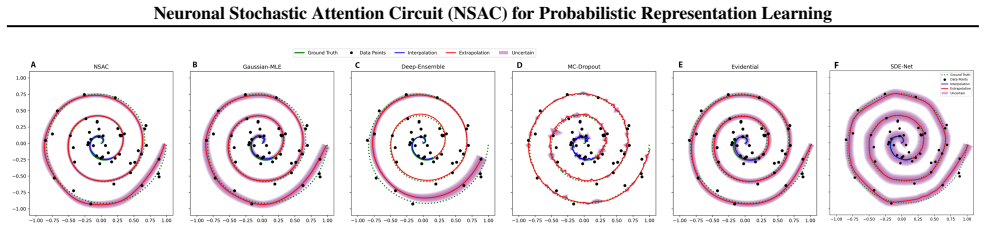
NSAC reformulates attention logit computation as the solution of an Ornstein-Uhlenbeck stochastic differential equation modulated by input-dependent, nonlinear interlinked gates derived from repurposed C. elegans Neuronal Circuit Policies (NCPs) wiring mechanism. It induces a Gaussian distribution over logits that propagates principled stochasticity through a logistic-normal distribution over attention weights to yield probabilistic output. A two-term objective function combining Gaussian negative log-likelihood with an epistemic-separation regularizer enforces higher predictive variance under distributional shifts and enables joint quantification of aleatoric and epistemic uncertainty.
What carries the argument
Ornstein-Uhlenbeck SDE modulated by input-dependent nonlinear interlinked gates from repurposed C. elegans NCPs, which generates the Gaussian distribution over logits and the logistic-normal distribution over attention weights.
If this is right
- State stability bounds, closed-form guarantees, and frozen-coefficient error approximations hold for the continuous-time attention dynamics.
- The two-term objective jointly quantifies aleatoric and epistemic uncertainty while increasing predictive variance on out-of-distribution inputs.
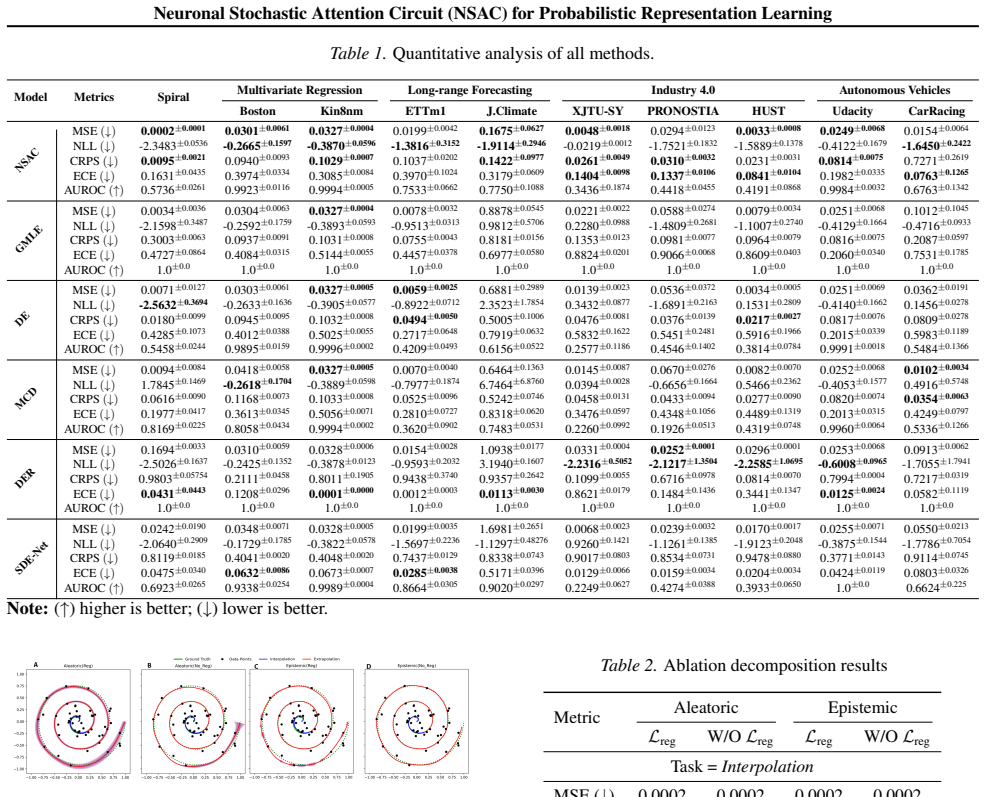
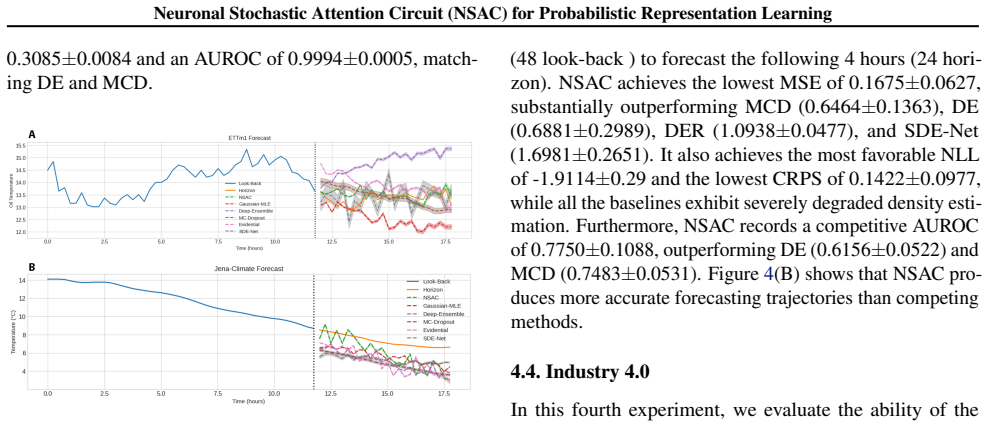
- The architecture remains competitive in accuracy on irregular continuous-time function approximation, multivariate regression, long-range forecasting, Industry 4.0 tasks, and autonomous-vehicle lane keeping.
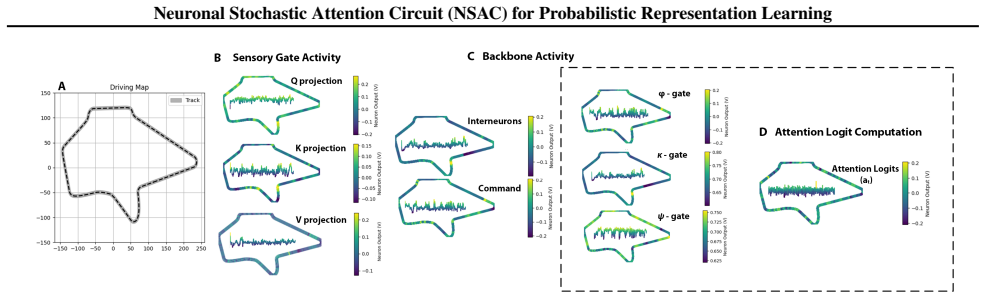
- Interpretability is available at the level of individual neuronal cells.
Where Pith is reading between the lines
- Cell-level interpretability may allow inspection of how uncertainty is generated inside attention for safety-critical continuous-time systems.
- If the NCP gates reliably produce the target distributions, analogous biological wiring motifs could be repurposed for other stochastic differential equations used in machine learning.
- The continuous-time formulation may transfer to robotics or sensor networks where sampling times are irregular.
- Joint uncertainty estimates could be used to trigger human intervention or model retraining when epistemic uncertainty rises.
Load-bearing premise
The repurposed C. elegans Neuronal Circuit Policies wiring mechanism supplies valid input-dependent, nonlinear interlinked gates that correctly modulate the Ornstein-Uhlenbeck SDE to produce the claimed Gaussian and logistic-normal distributions in continuous-time attention.
What would settle it
Direct sampling of the attention weights under the NCP-modulated Ornstein-Uhlenbeck dynamics that shows the empirical distribution deviates from logistic-normal, or a controlled distributional-shift experiment in which predictive variance does not increase after the epistemic-separation regularizer is applied.
Figures



read the original abstract
Reliable uncertainty quantification in continuous-time (CT) representation learning remains nascent, particularly within CT attention literature. We introduce the Neuronal Stochastic Attention Circuit (NSAC), a novel biologically-inspired CT attention architecture that reformulates attention logit computation as the solution of an Ornstein-Uhlenbeck stochastic differential equation modulated by input-dependent, nonlinear interlinked gates derived from repurposed C. elegans Neuronal Circuit Policies (NCPs) wiring mechanism. It induces a Gaussian distribution over logits that propagates principled stochasticity through a logistic-normal distribution over attention weights to yield probabilistic output. A two-term objective function combining Gaussian negative log-likelihood with an epistemic-separation regularizer enforces higher predictive variance under distributional shifts and enables joint quantification of aleatoric and epistemic uncertainty. Theoretically, we provide: (i) state stability bounds; (ii) closed-form guarantees; and (iii) frozen-coefficient error approximation. Empirically, we implement NSAC in a diverse set of learning tasks including: (i) irregular CT function approximation; (ii) multivariate regression; (iii) long-range forecasting; (iv) Industry 4.0; and (v) lane-keeping of autonomous vehicles. We observe that NSAC remains competitive against several baselines in terms of accuracy and produces informative uncertainty estimates while being interpretable at the neuronal cell level.
Editorial analysis
A structured set of objections, weighed in public.
Referee Report
Summary. The manuscript introduces the Neuronal Stochastic Attention Circuit (NSAC), a continuous-time attention architecture that reformulates attention logit computation as the solution of an Ornstein-Uhlenbeck SDE modulated by input-dependent nonlinear interlinked gates derived from repurposed C. elegans Neuronal Circuit Policies (NCPs) wiring. It claims this induces a Gaussian distribution over logits that propagates to a logistic-normal distribution over attention weights for probabilistic outputs. A two-term objective combines Gaussian negative log-likelihood with an epistemic-separation regularizer to enable joint aleatoric and epistemic uncertainty quantification with higher predictive variance under shifts. Theoretical contributions listed include state stability bounds, closed-form guarantees, and frozen-coefficient error approximation. Empirical results are reported across irregular CT function approximation, multivariate regression, long-range forecasting, Industry 4.0 tasks, and autonomous vehicle lane-keeping, with claims of competitiveness against baselines and interpretable neuronal-level uncertainty estimates.
Significance. If the distributional induction via the modulated SDE and the listed theoretical guarantees hold with supporting derivations, NSAC would provide a novel biologically-inspired mechanism for continuous-time probabilistic attention and uncertainty quantification, potentially advancing representation learning in irregular time-series and dynamic systems with built-in interpretability.
major comments (3)
- [Abstract] Abstract: the central claim that NCP-derived gates modulate the Ornstein-Uhlenbeck SDE to induce a Gaussian distribution over logits (and thus logistic-normal attention weights) is asserted without any derivation, stationary-distribution calculation, or explicit verification that the specific gate form preserves the Gaussian property under the continuous-time dynamics. This step is load-bearing for the two-term objective, aleatoric/epistemic separation, and all downstream uncertainty claims.
- [Abstract] Abstract (theoretical contributions): the listed results—(i) state stability bounds, (ii) closed-form guarantees, and (iii) frozen-coefficient error approximation—are stated as provided but no equations, proofs, or section references appear that would allow verification of correctness or scope.
- [Abstract] Abstract (empirical section): claims of competitiveness on five tasks and informative uncertainty estimates are made, yet no experimental details, result tables, hyperparameter settings, or baseline comparisons are supplied, preventing assessment of whether post-hoc choices affect the outcomes.
minor comments (1)
- [Abstract] The term 'frozen-coefficient error approximation' is used without prior definition or context in the abstract.
Simulated Author's Rebuttal
We thank the referee for the constructive comments on our manuscript. We address each major comment below with clarifications from the full paper and indicate proposed revisions to the abstract for improved verifiability.
read point-by-point responses
-
Referee: [Abstract] Abstract: the central claim that NCP-derived gates modulate the Ornstein-Uhlenbeck SDE to induce a Gaussian distribution over logits (and thus logistic-normal attention weights) is asserted without any derivation, stationary-distribution calculation, or explicit verification that the specific gate form preserves the Gaussian property under the continuous-time dynamics. This step is load-bearing for the two-term objective, aleatoric/epistemic separation, and all downstream uncertainty claims.
Authors: We agree the abstract is concise and omits the derivation. The stationary distribution calculation, Fokker-Planck analysis, and verification that the NCP gate form preserves Gaussianity under the modulated OU dynamics are provided in Section 3.2 (with explicit moment derivations and the resulting logistic-normal attention weights). We will revise the abstract to reference Section 3.2 and include a one-sentence summary of the stationary Gaussian property. revision: yes
-
Referee: [Abstract] Abstract (theoretical contributions): the listed results—(i) state stability bounds, (ii) closed-form guarantees, and (iii) frozen-coefficient error approximation—are stated as provided but no equations, proofs, or section references appear that would allow verification of correctness or scope.
Authors: The three theoretical results are developed with proofs and equations in the manuscript: stability bounds in Appendix A, closed-form SDE solution guarantees in Section 3.3, and frozen-coefficient error bounds in Section 4. We will revise the abstract to add parenthetical section references for each item. revision: yes
-
Referee: [Abstract] Abstract (empirical section): claims of competitiveness on five tasks and informative uncertainty estimates are made, yet no experimental details, result tables, hyperparameter settings, or baseline comparisons are supplied, preventing assessment of whether post-hoc choices affect the outcomes.
Authors: Full experimental details (hyperparameters, baselines such as standard attention and CT-RNN variants, result tables, and uncertainty metrics) appear in Section 5 and the supplementary material. The abstract summarizes due to length limits. We will add a brief reference to Section 5 and the evaluation protocol in the revised abstract. revision: partial
Circularity Check
No significant circularity detected in NSAC derivation chain
full rationale
The paper defines NSAC via an OU SDE modulated by repurposed NCP gates, states that this induces a Gaussian over logits propagating to logistic-normal attention weights, and supplies a two-term objective (Gaussian NLL plus epistemic-separation regularizer) together with explicit theoretical results: state stability bounds, closed-form guarantees, and frozen-coefficient error approximation. No equations or self-citations are exhibited that reduce any claimed output (distributional form, uncertainty separation, or performance) to a fitted parameter or prior result by construction. The architecture and objective are presented as independently derived from the SDE and gate mechanism, with external empirical validation across five task families; the derivation chain therefore remains self-contained.
Axiom & Free-Parameter Ledger
free parameters (2)
- Ornstein-Uhlenbeck drift and diffusion coefficients
- NCP-derived gate parameters
axioms (2)
- standard math Existence and uniqueness of solutions to the Ornstein-Uhlenbeck SDE under the stated modulation
- domain assumption The logistic-normal distribution over attention weights follows directly from a Gaussian over logits
invented entities (1)
-
NSAC circuit with NCP-modulated SDE
no independent evidence
Reference graph
Works this paper leans on
-
[1]
Generating Long Sequences with Sparse Transformers
Rewon Child, Scott Gray, Alec Radford, and Ilya Sutskever. Generating long sequences with sparse transformers. arXiv preprint arXiv:1904.10509,
work page internal anchor Pith review Pith/arXiv arXiv 1904
-
[2]
Lingkai Kong, Jimeng Sun, and Chao Zhang. Sde-net: Equipping deep neural networks with uncertainty esti- mates.arXiv preprint arXiv:2008.10546,
-
[3]
Mathias Lechner, Ramin M Hasani, and Radu Grosu. Neu- ronal circuit policies.arXiv preprint arXiv:1803.08554,
work page internal anchor Pith review Pith/arXiv arXiv
-
[4]
Developing Distance-Aware Physics-Constrained Probabilistic Frameworks for Industrial Prognostics
Waleed Razzaq and Yun-Bo Zhao. Carle: a hybrid deep- shallow learning framework for robust and explainable rul estimation of rolling element bearings.Soft Computing, 29(23):6269–6292, 2025a. 10 Neuronal Stochastic Attention Circuit (NSAC) for Probabilistic Representation Learning Waleed Razzaq and Yun-Bo Zhao. Developing distance- aware uncertainty quanti...
work page internal anchor Pith review Pith/arXiv arXiv
-
[5]
Accessed: 2025- 10-05
URL https://github.com/naokishibuya/ car-behavioral-cloning. Accessed: 2025- 10-05. Nguyen Duc Thuan and Hoang Si Hong. Hust bearing: a practical dataset for ball bearing fault diagnosis.BMC research notes, 16(1):138,
2025
-
[6]
Continuous-time atten- tion: Pde-guided mechanisms for long-sequence trans- formers
Yukun Zhang and Xueqing Zhou. Continuous-time atten- tion: Pde-guided mechanisms for long-sequence trans- formers. InProceedings of the 2025 Conference on Em- pirical Methods in Natural Language Processing, pages 21654–21674,
2025
-
[7]
Derivations & Proofs A.1
Appendix A. Derivations & Proofs A.1. Derivation of Closed-form Solution We derive the closed-form solution of NSAC. Throughout this derivation, the input-dependent gate parameters κ(u), ϕ(u), and ψ(u) are treated as piecewise constant within each discrete update interval (locally frozen coefficients (John, 1952)). Under this assumption, the system reduce...
1952
discussion (0)
Sign in with ORCID, Apple, or X to comment. Anyone can read and Pith papers without signing in.