ModMax black hole surrounded by perfect-fluid dark matter in Lorentz-violating Kalb-Ramond gravity
Pith reviewed 2026-06-30 17:21 UTC · model grok-4.3
The pith
A static spherically symmetric black hole metric exists that merges ModMax nonlinear electrodynamics, Lorentz-violating Kalb-Ramond gravity, and perfect-fluid dark matter, producing altered horizons and thermodynamic quantities.
A machine-rendered reading of the paper's core claim, the machinery that carries it, and where it could break.
Core claim
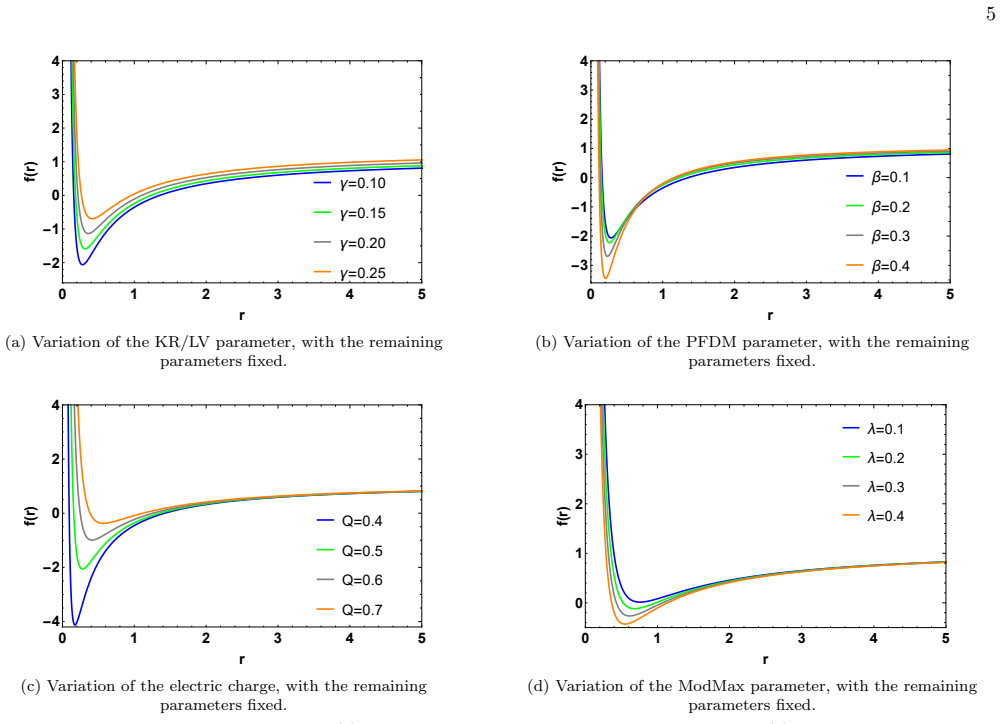
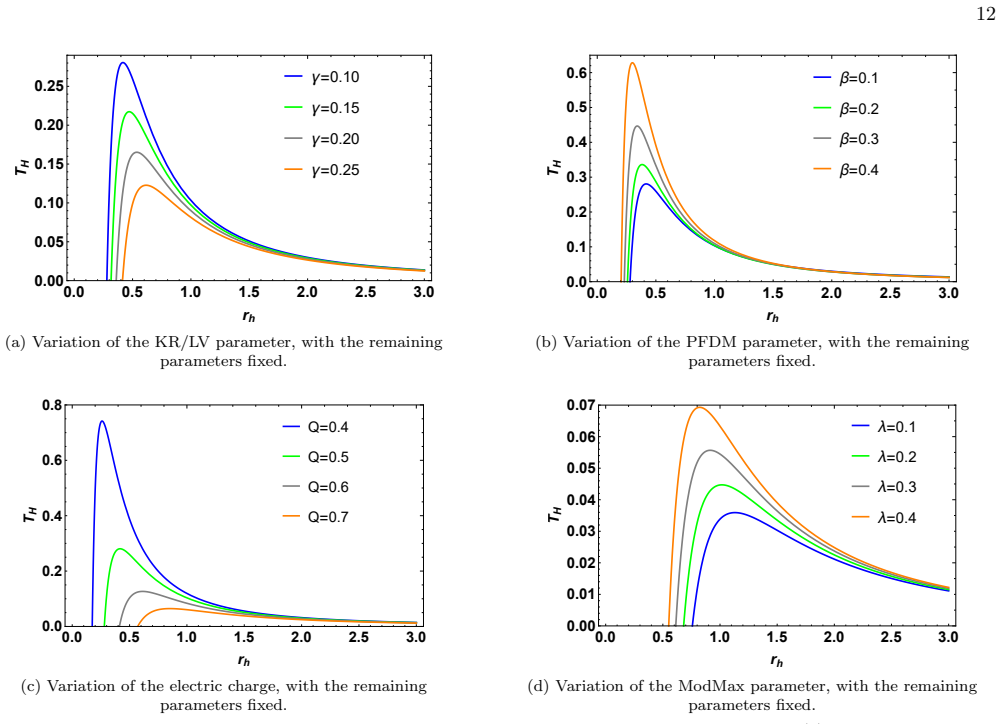
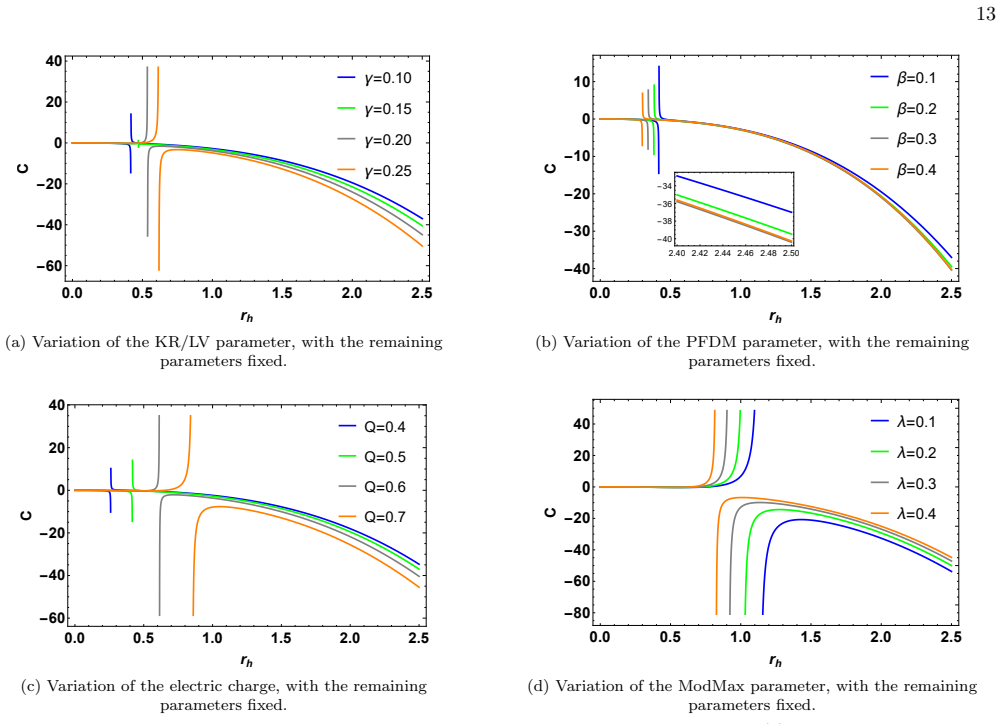
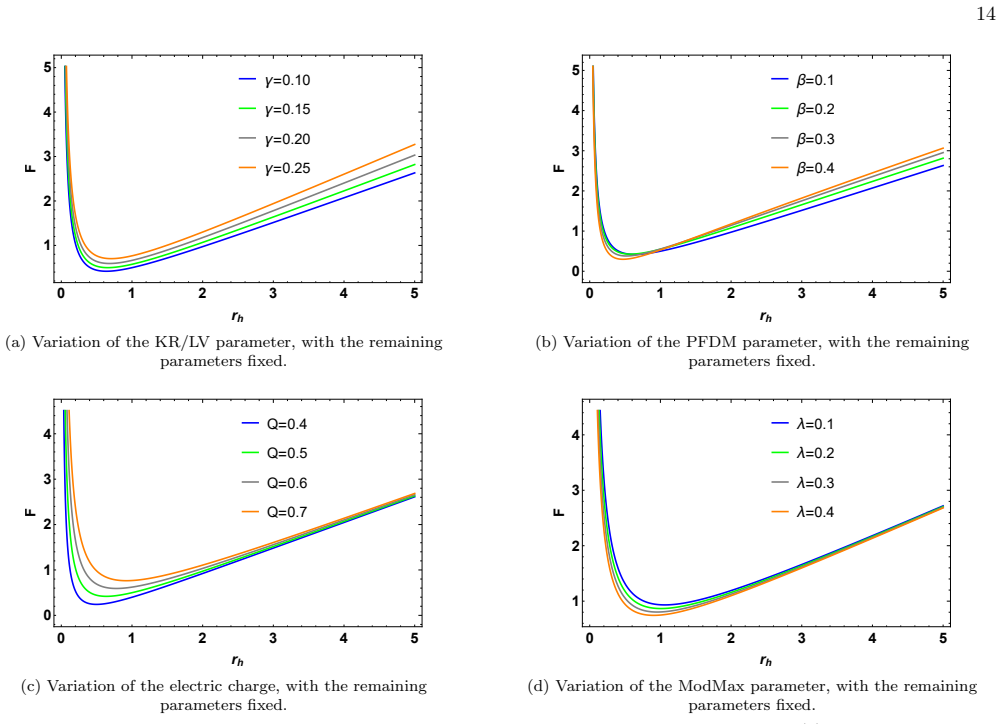
We obtain the corresponding static and spherically symmetric black hole geometry and analyze how the charge, ModMax parameter, Kalb-Ramond coupling, and dark matter parameter affect the horizon structure and thermodynamic behavior. In particular, we study the Hawking temperature, entropy, heat capacity, and Helmholtz free energy, showing that the combined effects of nonlinear electrodynamics and Lorentz violation may shift the extremal configuration, modify the thermal stability regions, and generate nontrivial phase behavior. The perfect fluid dark matter contribution introduces an additional logarithmic correction to the geometry, becoming especially relevant at intermediate radial scales.
What carries the argument
The static spherically symmetric metric obtained by solving the field equations with ModMax electrodynamics, Kalb-Ramond Lorentz violation, and perfect-fluid dark matter contributions.
Load-bearing premise
A static and spherically symmetric solution exists for the combined system of ModMax electrodynamics, Kalb-Ramond gravity with Lorentz violation, and perfect fluid dark matter.
What would settle it
An explicit verification that the derived metric does not satisfy the Einstein equations for nonzero values of the ModMax, Kalb-Ramond, and dark matter parameters, or thermodynamic observations of a black hole showing no shift in stability regions when dark matter is present.
Figures



read the original abstract
We investigate a ModMax black hole surrounded by perfect-fluid dark matter within the framework of Lorentz-violating Kalb-Ramond gravity. The model combines three physically distinct contributions: nonlinear electrodynamic corrections from the ModMax sector, Lorentz-symmetry-breaking effects induced by the background Kalb-Ramond field, and environmental modifications associated with the surrounding dark matter fluid. We obtain the corresponding static and spherically symmetric black hole geometry and analyze how the charge, ModMax parameter, Kalb-Ramond coupling, and dark matter parameter affect the horizon structure and thermodynamic behavior. In particular, we study the Hawking temperature, entropy, heat capacity, and Helmholtz free energy, showing that the combined effects of nonlinear electrodynamics and Lorentz violation may shift the extremal configuration, modify the thermal stability regions, and generate nontrivial phase behavior. The perfect fluid dark matter contribution introduces an additional logarithmic correction to the geometry, becoming especially relevant at intermediate radial scales. Our results indicate that ModMax electrodynamics can effectively screen the electric sector, while the Kalb-Ramond parameter amplifies the geometric deformation and changes the thermodynamic response of the system. These features suggest that black holes in Lorentz-violating backgrounds surrounded by dark matter provide a useful arena for probing deviations from standard charged black-hole thermodynamics.
Editorial analysis
A structured set of objections, weighed in public.
Referee Report
Summary. The paper investigates a ModMax black hole surrounded by perfect-fluid dark matter in Lorentz-violating Kalb-Ramond gravity. It claims to obtain the corresponding static spherically symmetric black hole geometry incorporating nonlinear electrodynamic corrections, Lorentz-symmetry-breaking effects from the Kalb-Ramond field, and dark matter modifications, then analyzes the effects of the charge, ModMax parameter, Kalb-Ramond coupling, and dark matter parameter on horizon structure and thermodynamic quantities (Hawking temperature, entropy, heat capacity, Helmholtz free energy), concluding that these can shift extremal configurations, modify thermal stability regions, generate nontrivial phase behavior, and that dark matter introduces a logarithmic correction to the geometry.
Significance. If the metric is a valid solution to the combined field equations, the work could illustrate how multiple extensions (ModMax NED, KR Lorentz violation, and perfect-fluid DM) interact to alter black hole thermodynamics beyond standard charged solutions. The explicit inclusion of a logarithmic DM term and parameter screening effects offers a concrete arena for probing deviations, though the absence of limit checks or comparisons to known cases reduces immediate impact.
major comments (1)
- [Geometry section (following abstract claim of obtaining the solution)] The central claim that a static spherically symmetric geometry exists for the combined ModMax + KR + perfect-fluid DM system is asserted in the abstract and introduction but not supported by an explicit metric function f(r), the full action, or variation steps confirming that the three stress-energy contributions are simultaneously satisfied. This is load-bearing because the subsequent analysis of horizons, temperature, heat capacity, and phase behavior all presuppose this metric; without the derivation, the thermodynamic results cannot be verified as following from the model.
minor comments (2)
- The abstract refers to 'nontrivial phase behavior' without specifying whether this involves swallowtail structures in free energy, critical points in heat capacity, or other diagnostics; the main text should include explicit calculations or figures for at least one parameter set.
- Notation for the free parameters (ModMax parameter, Kalb-Ramond coupling, dark matter parameter) should be introduced with clear definitions and ranges early in the text to avoid ambiguity in later thermodynamic expressions.
Simulated Author's Rebuttal
We thank the referee for their careful reading of the manuscript and for highlighting the need for explicit verification of the metric derivation. We address the single major comment below and will revise the manuscript accordingly.
read point-by-point responses
-
Referee: The central claim that a static spherically symmetric geometry exists for the combined ModMax + KR + perfect-fluid DM system is asserted in the abstract and introduction but not supported by an explicit metric function f(r), the full action, or variation steps confirming that the three stress-energy contributions are simultaneously satisfied. This is load-bearing because the subsequent analysis of horizons, temperature, heat capacity, and phase behavior all presuppose this metric; without the derivation, the thermodynamic results cannot be verified as following from the model.
Authors: We agree that the original manuscript did not provide sufficient detail on the derivation. In the revised version we will include: (i) the complete action combining the ModMax nonlinear electrodynamics, the Lorentz-violating Kalb-Ramond term, and the perfect-fluid dark-matter stress-energy; (ii) the explicit static spherically symmetric metric function f(r) that incorporates the logarithmic dark-matter correction; and (iii) the step-by-step variation of the action showing that the three stress-energy tensors are simultaneously satisfied by this f(r). These additions will allow direct verification that the subsequent thermodynamic quantities follow from the field equations. revision: yes
Circularity Check
No significant circularity detected
full rationale
The paper states that the static spherically symmetric geometry is obtained from the combined field equations of ModMax NED, Lorentz-violating KR gravity, and perfect-fluid DM, after which Hawking temperature, entropy, heat capacity, and free energy are computed directly from the resulting metric function. No load-bearing step reduces by construction to a fitted parameter, self-definition, or self-citation chain; the thermodynamic analysis follows from the derived line element without renaming or circular re-use of inputs. The derivation chain is therefore self-contained against the Einstein equations and external to any fitted data.
Axiom & Free-Parameter Ledger
free parameters (4)
- ModMax parameter
- Kalb-Ramond coupling
- dark matter parameter
- electric charge
axioms (2)
- domain assumption Static and spherically symmetric metric ansatz
- domain assumption Perfect fluid equation of state for surrounding dark matter
invented entities (2)
-
ModMax nonlinear electromagnetic field
no independent evidence
-
Background Kalb-Ramond field
no independent evidence
Reference graph
Works this paper leans on
-
[1]
This form is useful because it shows how the external parameters compete whenMis kept fixed
Equivalently, one may write the mass parameter as M=M(r h). This form is useful because it shows how the external parameters compete whenMis kept fixed. Increasingαamplifies all terms weighted by (1−α) −1 or (1−α) −2. In the parameter range used in the plots, the outer horizon moves inward asαincreases. The same in- ward shift is found whenQorβis increase...
2025
-
[2]
Schwarzschild, Sitzungsberichte der K”oniglich Preussischen Akademie der Wissenschaften , 189 (1916)
K. Schwarzschild, Sitzungsberichte der K”oniglich Preussischen Akademie der Wissenschaften , 189 (1916)
1916
-
[3]
Reissner, Annalen der Physik355, 106 (1916)
H. Reissner, Annalen der Physik355, 106 (1916)
1916
-
[4]
Nordstr”om, Koninklijke Nederlandse Akademie van Wetenschappen Proceedings20, 1238 (1918)
G. Nordstr”om, Koninklijke Nederlandse Akademie van Wetenschappen Proceedings20, 1238 (1918)
1918
-
[5]
Carter, Physical Review174, 1559 (1968)
B. Carter, Physical Review174, 1559 (1968)
1968
-
[6]
J. M. Bardeen, B. Carter, and S. W. Hawking, Commu- nications in Mathematical Physics31, 161 (1973)
1973
-
[7]
J. D. Bekenstein, Physical Review D7, 2333 (1973)
1973
-
[8]
S. W. Hawking, Communications in Mathematical Physics43, 199 (1975)
1975
-
[9]
G. W. Gibbons and S. W. Hawking, Physical Review D 15, 2752 (1977)
1977
-
[10]
S. W. Hawking and G. F. R. Ellis,The Large Scale Struc- ture of Space-Time(Cambridge University Press, 1973)
1973
-
[11]
R. M. Wald, Physical Review D48, R3427 (1993), arXiv:gr-qc/9307038
work page internal anchor Pith review Pith/arXiv arXiv 1993
-
[12]
Some Properties of Noether Charge and a Proposal for Dynamical Black Hole Entropy
V. Iyer and R. M. Wald, Physical Review D50, 846 (1994), arXiv:gr-qc/9403028
work page internal anchor Pith review Pith/arXiv arXiv 1994
-
[13]
LIGO Scientific Collaboration and Virgo Collabora- tion, Physical Review Letters116, 061102 (2016), arXiv:1602.03837 [gr-qc]
work page internal anchor Pith review Pith/arXiv arXiv 2016
-
[14]
Event Horizon Telescope Collaboration, Astrophysical Journal Letters875, L1 (2019), arXiv:1906.11238 [astro- ph.GA]
work page internal anchor Pith review Pith/arXiv arXiv 2019
-
[15]
Event Horizon Telescope Collaboration, Astrophysical Journal Letters875, L6 (2019), arXiv:1906.11243 [astro- ph.GA]
work page internal anchor Pith review Pith/arXiv arXiv 2019
-
[16]
Event Horizon Telescope Collaboration, Astrophysical Journal Letters930, L12 (2022)
2022
-
[17]
Regge and J
T. Regge and J. A. Wheeler, Physical Review108, 1063 (1957)
1957
-
[18]
F. J. Zerilli, Physical Review Letters24, 737 (1970)
1970
-
[19]
S. A. Teukolsky, Astrophysical Journal185, 635 (1973)
1973
-
[20]
K. D. Kokkotas and B. G. Schmidt, Living Reviews in Relativity2, 2 (1999), arXiv:gr-qc/9909058
work page internal anchor Pith review Pith/arXiv arXiv 1999
-
[21]
Quasinormal modes of black holes and black branes
E. Berti, V. Cardoso, and A. O. Starinets, Classical and Quantum Gravity26, 163001 (2009), arXiv:0905.2975 [gr-qc]
work page internal anchor Pith review Pith/arXiv arXiv 2009
-
[22]
R. A. Konoplya and A. Zhidenko, Reviews of Modern Physics83, 793 (2011), arXiv:1102.4014 [gr-qc]
work page internal anchor Pith review Pith/arXiv arXiv 2011
-
[23]
D. N. Page, Physical Review D13, 198 (1976)
1976
-
[24]
N. G. Sanchez, Physical Review D18, 1030 (1978)
1978
-
[25]
J. M. Maldacena and A. Strominger, Physical Review D 55, 861 (1997), arXiv:hep-th/9609026
work page internal anchor Pith review Pith/arXiv arXiv 1997
-
[26]
I. R. Klebanov, Nuclear Physics B496, 231 (1997), arXiv:hep-th/9702076. 21
work page internal anchor Pith review Pith/arXiv arXiv 1997
-
[27]
S. R. Das, G. W. Gibbons, and S. D. Mathur, Physical Review Letters78, 417 (1997), arXiv:hep-th/9609052
work page internal anchor Pith review Pith/arXiv arXiv 1997
-
[28]
Some general bounds for 1-D scattering
M. Visser, Physical Review A59, 427 (1999), arXiv:quant-ph/9901030
work page internal anchor Pith review Pith/arXiv arXiv 1999
-
[29]
Regge-Wheeler equation, linear stability, and greybody factors for dirty black holes
P. Boonserm, T. Ngampitipan, and M. Visser, Physical Review D88, 041502 (2013), arXiv:1305.1416 [gr-qc]
work page internal anchor Pith review Pith/arXiv arXiv 2013
-
[30]
J. L. Synge, Monthly Notices of the Royal Astronomical Society131, 463 (1966)
1966
-
[31]
J. M. Bardeen, inBlack Holes, edited by C. DeWitt and B. S. DeWitt (Gordon and Breach, New York, 1973) pp. 215–239
1973
-
[32]
P. V. P. Cunha and C. A. R. Herdeiro, General Relativity and Gravitation50, 42 (2018), arXiv:1801.00860 [gr-qc]
work page internal anchor Pith review Pith/arXiv arXiv 2018
-
[33]
V. Perlick and O. Y. Tsupko, Physics Reports947, 1 (2022), arXiv:2105.07101 [gr-qc]
-
[34]
V. A. Kostelecky and S. Samuel, Physical Review D39, 683 (1989)
1989
-
[35]
V. A. Kostelecky, Physical Review D69, 105009 (2004), arXiv:hep-th/0312310
work page internal anchor Pith review Pith/arXiv arXiv 2004
-
[36]
Q. G. Bailey and V. A. Kostelecky, Physical Review D 74, 045001 (2006), arXiv:gr-qc/0603030
work page internal anchor Pith review Pith/arXiv arXiv 2006
-
[37]
Spontaneous Lorentz Violation, Nambu-Goldstone Modes, and Gravity
R. Bluhm and V. A. Kostelecky, Physical Review D71, 065008 (2005), arXiv:hep-th/0412320
work page internal anchor Pith review Pith/arXiv arXiv 2005
-
[38]
Kalb and P
M. Kalb and P. Ramond, Physical Review D9, 2273 (1974)
1974
-
[39]
Lorentz violation with an antisymmetric tensor
B. Altschul, Q. G. Bailey, and V. A. Kostelecky, Physical Review D81, 065028 (2010), arXiv:0912.4852 [gr-qc]
work page internal anchor Pith review Pith/arXiv arXiv 2010
-
[40]
S. Aashish and S. Panda, Physical Review D100, 065010 (2019), arXiv:1903.11364 [gr-qc]
- [41]
-
[42]
K. Yang, Y.-Z. Chen, Z.-Q. Duan, and J.-Y. Zhao, Phys- ical Review D108, 124004 (2023), arXiv:2308.06613 [gr- qc]
-
[43]
Z.-Q. Duan, J.-Y. Zhao, and K. Yang, European Phys- ical Journal C 10.1140/epjc/s10052-024-13188-5 (2024), arXiv:2310.13555 [gr-qc]
- [44]
- [45]
-
[46]
Charged Black Holes in KR-gravity Surrounded by Perfect Fluid Dark Matter
F. Ahmed, M. Fathi, and E. O. Silva, arXiv (2026), arXiv:2604.11357 [gr-qc]
work page internal anchor Pith review Pith/arXiv arXiv 2026
-
[47]
Born and L
M. Born and L. Infeld, Proceedings of the Royal Society of London A144, 425 (1934)
1934
-
[48]
G. W. Gibbons and D. A. Rasheed, Nuclear Physics B 454, 185 (1995), arXiv:hep-th/9506035
work page internal anchor Pith review Pith/arXiv arXiv 1995
- [49]
- [50]
-
[51]
J. Barrientos, A. Cisterna, D. Kubiznak, and J. Oliva, Physics Letters B834, 137447 (2022), arXiv:2205.15777 [gr-qc]
- [52]
-
[53]
M. Campos, C. A. R. Herdeiro, A. M. Pombo, and E. Radu, Physical Review D 10.1103/fzf2-qfc5 (2025), arXiv:2506.17489 [gr-qc]
-
[54]
M. I. Shaukatet al., European Physical Journal C85, 10.1140/epjc/s10052-025-13932-5 (2025)
-
[55]
V. V. Kiselev, Classical and Quantum Gravity20, 1187 (2003), arXiv:gr-qc/0210040
work page internal anchor Pith review Pith/arXiv arXiv 2003
-
[56]
Z. Xu, X. Hou, J. Wang, and Y. Liao, Advances in High Energy Physics2019, 2434390 (2019), arXiv:1610.05454 [gr-qc]
work page internal anchor Pith review Pith/arXiv arXiv 2019
-
[57]
X. Hou, Z. Xu, and J. Wang, Journal of Cosmology and Astroparticle Physics12, 040, arXiv:1810.06381 [gr-qc]
work page internal anchor Pith review Pith/arXiv arXiv
- [58]
discussion (0)
Sign in with ORCID, Apple, or X to comment. Anyone can read and Pith papers without signing in.