From Hubble to HWO: Bridging the Frontier of White Dwarf Exoplanet Science
Pith reviewed 2026-06-30 14:27 UTC · model grok-4.3
The pith
Preserving HST's UV spectroscopy through 2035 is required to measure exoplanet compositions from polluted white dwarfs and prepare for JWST and HWO.
A machine-rendered reading of the paper's core claim, the machinery that carries it, and where it could break.
Core claim
High-resolution UV spectra from HST remain the only near-term means to detect the full set of volatile and rock-forming elements in polluted white dwarfs, and continued observations through at least 2035 are required to deliver statistically significant composition measurements, supply critical groundwork for HWO, and create a powerful synergy with JWST data on the same systems.
What carries the argument
High-resolution (R>15,000) UV spectroscopy of photospheric metal lines in polluted white dwarfs, which reveals the elemental abundances of accreted exoplanetary material.
If this is right
- A statistically significant sample of exoplanetary bulk compositions becomes measurable using only current facilities.
- JWST mid-infrared observations of the same white dwarfs can be interpreted with complete elemental inventories rather than partial ones.
- HWO ultraviolet instrument requirements and target selection can be informed by real performance data from HST on the same science case.
- Habitability studies gain access to volatile-element abundances that are otherwise inaccessible.
Where Pith is reading between the lines
- If HST UV time is deprioritized, the field would face a multi-year gap in composition data that cannot be filled by ground-based or other space facilities.
- The same UV data sets could also constrain the timing and efficiency of planetesimal delivery in white dwarf systems, an implication not developed in the paper.
- Extending the argument to other white dwarf science, such as atmospheric studies of the white dwarfs themselves, would strengthen the case for instrument preservation but is left implicit.
Load-bearing premise
No other facility will be able to deliver the required high-resolution UV spectra of polluted white dwarfs before the mid-2030s.
What would settle it
Detection and publication of a statistically useful sample of polluted white dwarf UV spectra at R>15,000 from any instrument other than HST COS or STIS before 2035.
Figures
read the original abstract
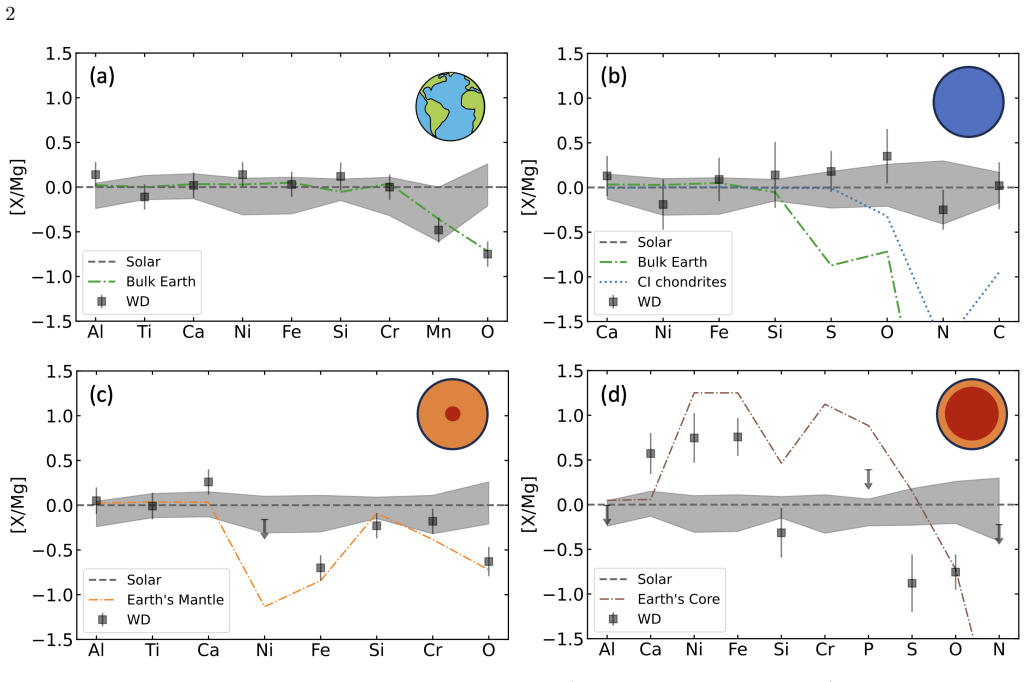
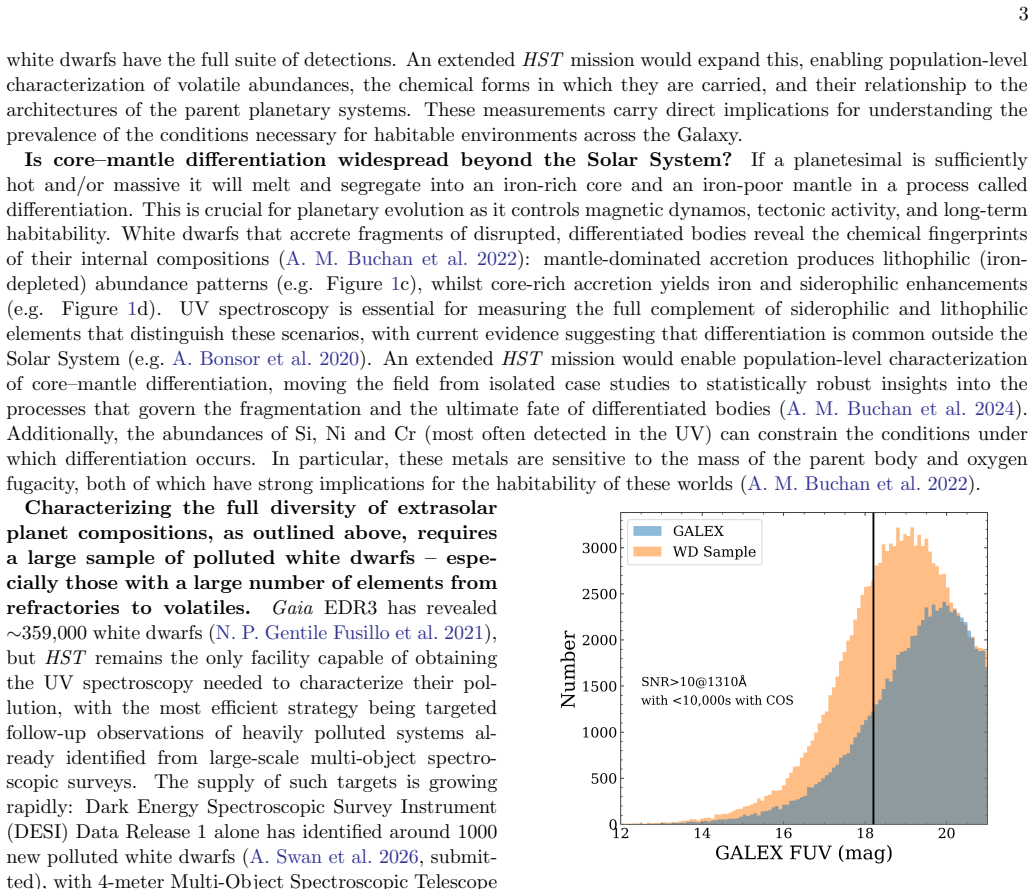
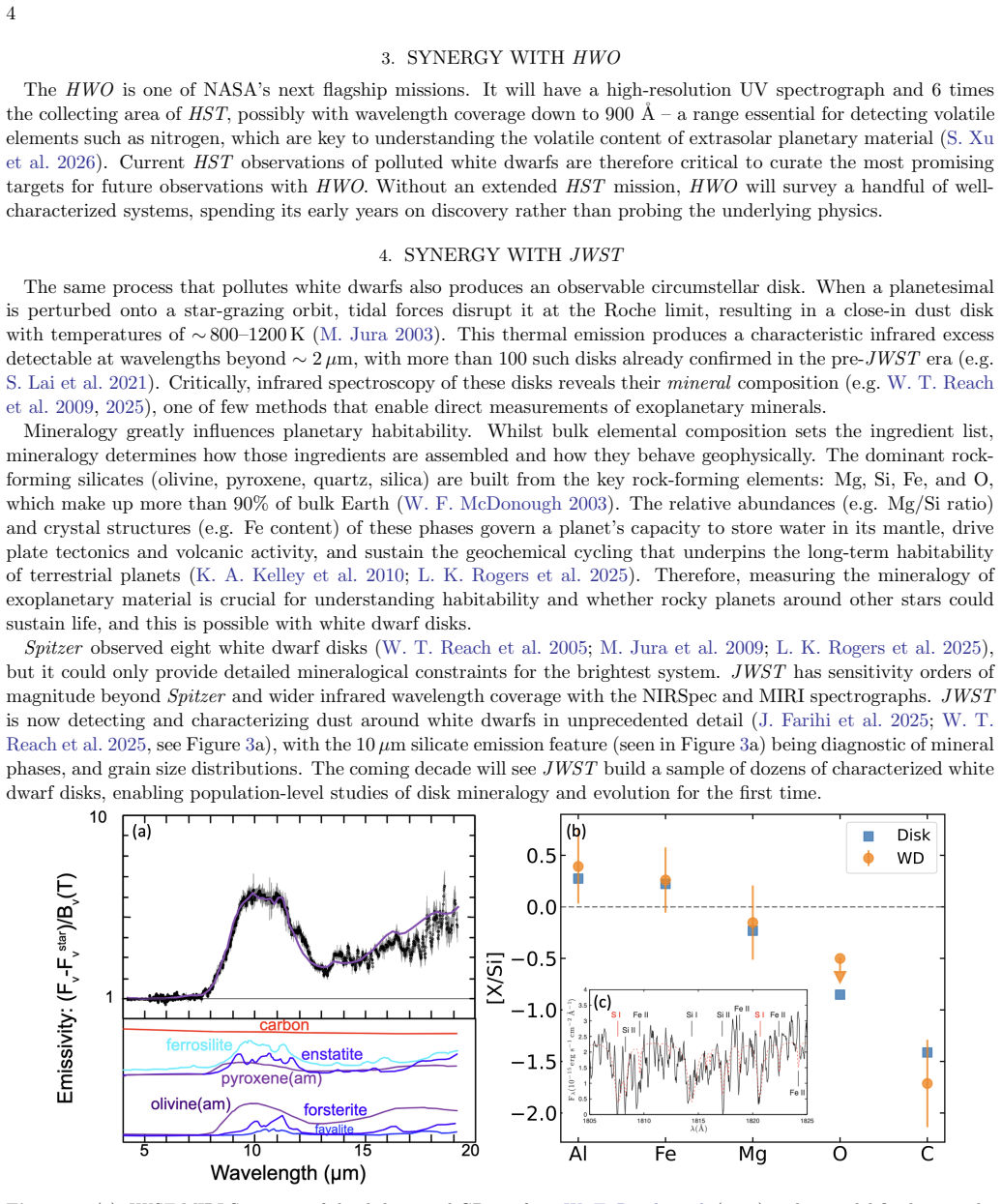
White dwarf stars, the endpoint of stellar evolution for 97% of stars in our Milky Way, offer a unique and powerful window into the bulk elemental composition of rocky exoplanetary bodies. Up to 50% of single white dwarfs are observed with photospheric metal lines from accreted exoplanetary bodies (called 'polluted' white dwarfs), and spectroscopic observations reveal the bulk composition of this material. High-resolution (R>15,000) UV spectra are essential for detecting many elements present in the material, such as the volatile elements imperative for habitability studies (C, N, O, P, S) and key rock-forming elements required to constrain interior structure (e.g. Fe, Si, Mg, Al, Ni). HST, through its COS and STIS spectrographs, remains the only facility capable of performing this science in the near future. Looking to the next decade, the scientific case for continued HST UV observations of polluted white dwarfs is compelling on three fronts (i) as a standalone to enable the bulk composition of exoplanetary material to be measured in a statistically significant sample, (ii) as essential groundwork for the Habitable Worlds Observatory (HWO), and (iii) in a powerful synergy with JWST, to enable characterization of the bulk mineralogy and bulk elemental composition of exoplanetary material. This white paper argues that continued UV spectroscopic capabilities with HST is a high-return investment for white dwarf and exoplanet science, and preserving and prioritizing HST's UV capabilities through at least 2035 is crucial to maximize the scientific return from HST, JWST, and HWO.
Editorial analysis
A structured set of objections, weighed in public.
Referee Report
Summary. The manuscript is a white paper advocating for continued prioritization of high-resolution (R>15,000) UV spectroscopy with HST/COS and STIS on polluted white dwarfs through at least 2035. It claims that up to 50% of single white dwarfs show photospheric metals from accreted exoplanetary bodies, that UV spectra are required to access volatiles (C, N, O, P, S) and rock-forming elements (Fe, Si, Mg, Al, Ni), and that HST is the only near-term facility capable of this work. The case is made on three fronts: enabling statistically significant standalone samples, providing essential groundwork for HWO, and enabling synergy with JWST for bulk mineralogy and composition.
Significance. If the uniqueness claim is substantiated, the paper would supply a focused advocacy document useful for facility planning and multi-mission coordination in exoplanet and white-dwarf science. It correctly highlights the diagnostic power of UV lines for habitability-related volatiles and interior-structure constraints, drawing on established literature percentages and capabilities. No new quantitative derivations, error budgets, or sample statistics are introduced.
major comments (2)
- [Abstract] Abstract: The statement that 'HST, through its COS and STIS spectrographs, remains the only facility capable of performing this science in the near future' is load-bearing for all three advocacy fronts yet is asserted without any comparison of wavelength coverage, resolving power, or sensitivity against other current or approved instruments (ground-based or space-based) through 2035. A dedicated assessment is required to support the timeline and prioritization recommendation.
- [Abstract] Abstract (three fronts paragraph): The standalone-sample, HWO-groundwork, and JWST-synergy arguments each presuppose HST exclusivity; without an explicit facility-comparison section or table, the degree to which each front depends specifically on HST (versus partial coverage elsewhere) cannot be evaluated.
minor comments (2)
- The abstract would be strengthened by including one or two concrete quantitative examples (e.g., number of elements detected per target or typical S/N achieved) drawn from the cited HST literature.
- Consider adding a short table listing the key elements, their diagnostic UV transitions, and the minimum resolution/sensitivity needed; this would make the technical requirements more transparent.
Simulated Author's Rebuttal
We thank the referee for the detailed review and constructive criticism. The comments correctly identify that the uniqueness claim for HST is central to the paper's three advocacy arguments yet is presented without explicit supporting comparisons. We will revise the manuscript by adding a dedicated facility-comparison section and table to substantiate the claims.
read point-by-point responses
-
Referee: [Abstract] Abstract: The statement that 'HST, through its COS and STIS spectrographs, remains the only facility capable of performing this science in the near future' is load-bearing for all three advocacy fronts yet is asserted without any comparison of wavelength coverage, resolving power, or sensitivity against other current or approved instruments (ground-based or space-based) through 2035. A dedicated assessment is required to support the timeline and prioritization recommendation.
Authors: We agree that the assertion requires explicit substantiation. In the revised manuscript we will insert a new section (approximately Section 2) that systematically compares HST/COS and STIS capabilities (R > 15 000, wavelength coverage 1150–3200 Å, sensitivity for faint white-dwarf targets) against all relevant ground-based (e.g., VLT/UVES, Keck/HIRES, noting atmospheric cutoff below ~3000 Å and limited access to key volatile lines) and space-based facilities (current or approved) expected to be operational through 2035. The section will quantify why no other platform provides equivalent high-resolution UV access to C, N, O, P, S, Fe, Si, Mg, Al, and Ni lines in the near term, thereby supporting the 2035 timeline. revision: yes
-
Referee: [Abstract] Abstract (three fronts paragraph): The standalone-sample, HWO-groundwork, and JWST-synergy arguments each presuppose HST exclusivity; without an explicit facility-comparison section or table, the degree to which each front depends specifically on HST (versus partial coverage elsewhere) cannot be evaluated.
Authors: We concur that the three fronts rest on the exclusivity claim and that the current text does not allow the reader to assess partial alternatives. The new comparison section will explicitly map each front to the comparison results: (i) standalone statistical samples require the full volatile and rock-forming element set accessible only at HST resolution and sensitivity; (ii) HWO groundwork depends on the same UV lines for calibration and target selection; (iii) JWST synergy for mineralogy likewise needs the UV elemental abundances that ground-based or lower-resolution facilities cannot supply. A summary table will tabulate which elements and science cases are lost without HST. revision: yes
Circularity Check
No circularity detected in derivation chain
full rationale
The paper asserts that HST/COS/STIS remains the only near-term facility for the required high-resolution UV spectroscopy but presents this as a direct factual premise rather than deriving it from any equations, fitted inputs, self-citations, or prior author work. No self-definitional loops, predictions that reduce to fits, uniqueness theorems imported from self-citations, or ansatzes smuggled via citations appear in the text. The central advocacy claim for HST prioritization through 2035 rests on stated capabilities and synergies without reducing by construction to its own inputs, rendering the argument self-contained.
Axiom & Free-Parameter Ledger
Reference graph
Works this paper leans on
-
[1]
Bhattacharjee, S., Vanderbosch, Z. P., Hollands, M. A., et al. 2025, arXiv e-prints, arXiv:2502.05502, doi: 10.48550/arXiv.2502.05502
-
[2]
Bonsor, A., Carter, P. J., Hollands, M., et al. 2020, MNRAS, 492, 2683, doi: 10.1093/mnras/stz3603
-
[3]
Buchan, A. M., Bonsor, A., Rogers, L. K., et al. 2024, MNRAS, 532, 2705, doi: 10.1093/mnras/stae1608
-
[4]
M., Bonsor, A., Shorttle, O., et al
Buchan, A. M., Bonsor, A., Shorttle, O., et al. 2022, MNRAS, 510, 3512, doi: 10.1093/mnras/stab3624
-
[5]
2019, The Messenger, 175, 30, doi: 10.18727/0722-6691/5122 Cˆ ot´ e, P., Woods, T
Chiappini, C., Minchev, I., Starkenburg, E., et al. 2019, The Messenger, 175, 30, doi: 10.18727/0722-6691/5122 Cˆ ot´ e, P., Woods, T. E., Hutchings, J. B., et al. 2025, Journal of Astronomical Telescopes, Instruments, and Systems, 11, 042202, doi: 10.1117/1.JATIS.11.4.042202
-
[6]
Doyle, A. E., Klein, B. L., Dufour, P., et al. 2023, ApJ, 950, 93, doi: 10.3847/1538-4357/acbd44 Dr¸ a˙ zkowska, J. 2026, A&A, 709, A36, doi: 10.1051/0004-6361/202659169
-
[7]
Farihi, J., Brinkworth, C. S., G¨ ansicke, B. T., et al. 2011, ApJL, 728, L8, doi: 10.1088/2041-8205/728/1/L8
-
[8]
Farihi, J., Su, K. Y. L., Melis, C., et al. 2025, arXiv e-prints, arXiv:2501.18338, doi: 10.48550/arXiv.2501.18338
-
[9]
Farihi, J., Noor, H. T., Melis, C., et al. 2026, MNRAS, doi: 10.1093/mnras/stag176 G¨ ansicke, B. T., Koester, D., Farihi, J., et al. 2012, MNRAS, 424, 333, doi: 10.1111/j.1365-2966.2012.21201.x Gentile Fusillo, N. P., Tremblay, P.-E., Cukanovaite, E., et al. 2021, MNRAS, 508, 3877, doi: 10.1093/mnras/stab2672
-
[10]
Hinkel, N. R., Timmes, F. X., Young, P. A., Pagano, M. D., & Turnbull, M. C. 2014, AJ, 148, 54, doi: 10.1088/0004-6256/148/3/54
-
[11]
Jin, S., Trager, S. C., Dalton, G. B., et al. 2024, MNRAS, 530, 2688, doi: 10.1093/mnras/stad557
-
[12]
2003, ApJL, 584, L91, doi: 10.1086/374036
Jura, M. 2003, ApJL, 584, L91, doi: 10.1086/374036
-
[13]
2015, ApJ, 799, 109, doi: 10.1088/0004-637X/799/1/109
Jura, M., Dufour, P., Xu, S., et al. 2015, ApJ, 799, 109, doi: 10.1088/0004-637X/799/1/109
-
[14]
2009, AJ, 137, 3191, doi: 10.1088/0004-6256/137/2/3191
Jura, M., Farihi, J., & Zuckerman, B. 2009, AJ, 137, 3191, doi: 10.1088/0004-6256/137/2/3191
-
[15]
A., Plank, T., Newman, S., et al
Kelley, K. A., Plank, T., Newman, S., et al. 2010, Journal of Petrology, 51, 1711, doi: 10.1093/petrology/egq036
-
[16]
Koester, D., G¨ ansicke, B. T., & Farihi, J. 2014, A&A, 566, A34, doi: 10.1051/0004-6361/201423691
-
[17]
Kulkarni, S. R., Harrison, F. A., Grefenstette, B. W., et al. 2021, arXiv e-prints, arXiv:2111.15608, doi: 10.48550/arXiv.2111.15608
-
[18]
2021, ApJ, 920, 156, doi: 10.3847/1538-4357/ac1354
Lai, S., Dennihy, E., Xu, S., et al. 2021, ApJ, 920, 156, doi: 10.3847/1538-4357/ac1354
-
[19]
Lodders, K., Bergemann, M., & Palme, H. 2025, SSRv, 221, 23, doi: 10.1007/s11214-025-01146-w
-
[20]
Lodders, K., Palme, H., & Gail, H. P. 2009, Landolt Börnstein, 4B, 712, doi: 10.1007/978-3-540-88055-4 34
-
[21]
McDonough, W. F. 2003, Treatise on Geochemistry, 2, 568, doi: 10.1016/B0-08-043751-6/02015-6
-
[22]
Noor, H. T., Farihi, J., Kenyon, S. J., et al. 2025, MNRAS, 543, 1602, doi: 10.1093/mnras/staf1380
-
[23]
2026, ApJ, 997, 358, doi: 10.3847/1538-4357/ae2c7d Ould Rouis, L
Okuya, A., Okuzumi, S., Takigawa, A., & Enomoto, H. 2026, ApJ, 997, 358, doi: 10.3847/1538-4357/ae2c7d Ould Rouis, L. B., Hermes, J. J., G¨ ansicke, B. T., et al. 2024, ApJ, 976, 156, doi: 10.3847/1538-4357/ad86bb
-
[24]
Reach, W. T., Kuchner, M. J., von Hippel, T., et al. 2005, ApJL, 635, L161, doi: 10.1086/499561
-
[25]
T., Lisse, C., von Hippel, T., & Mullally, F
Reach, W. T., Lisse, C., von Hippel, T., & Mullally, F. 2009, ApJ, 693, 697, doi: 10.1088/0004-637X/693/1/697
-
[26]
Reach, W. T., Kilic, M., Lisse, C. M., et al. 2025, ApJ, 994, 195, doi: 10.3847/1538-4357/ae11a9
-
[27]
Rogers, L. K., Bonsor, A., Xu, S., et al. 2024a, MNRAS, 527, 6038, doi: 10.1093/mnras/stad3557
-
[28]
Rogers, L. K., Bonsor, A., Xu, S., et al. 2024b, MNRAS, 532, 3866, doi: 10.1093/mnras/stae1520
-
[29]
K., Bonsor, A., Le Bourdais, ´E., et al
Rogers, L. K., Bonsor, A., Le Bourdais, ´E., et al. 2025, MNRAS, 542, 293, doi: 10.1093/mnras/staf1221
-
[30]
Sahu, S., G¨ ansicke, B. T., Williams, J. T., et al. 2025, MNRAS, 543, 223, doi: 10.1093/mnras/staf1424 SDSS Collaboration, Adamane Pallathadka, G.,
-
[31]
2025, arXiv e-prints, arXiv:2507.07093, doi: 10.48550/arXiv.2507.07093
Aghakhanloo, M., et al. 2025, arXiv e-prints, arXiv:2507.07093, doi: 10.48550/arXiv.2507.07093
-
[32]
Swan, A., Gaensicke, B., Izquierdo, P., & et al. 2026,
2026
-
[33]
Trierweiler, I. L., Doyle, A. E., & Young, E. D. 2023, The Planetary Science Journal, 4, 136, doi: 10.3847/PSJ/acdef3
-
[34]
L., Melis, C., Le Bourdais, ´E., et al
Trierweiler, I. L., Melis, C., Le Bourdais, ´E., et al. 2025, ApJ, 993, 53, doi: 10.3847/1538-4357/ae003d
-
[35]
Vanderburg, A., Johnson, J. A., Rappaport, S., et al. 2015, Nature, 526, 546, doi: 10.1038/nature15527
-
[36]
E., Kilic, M., Bergeron, P., & Leiphart, N
Wall, R. E., Kilic, M., Bergeron, P., & Leiphart, N. D. 2023, MNRAS, 523, 4067, doi: 10.1093/mnras/stad1699
-
[37]
Williams, J. T., G¨ ansicke, B. T., Sahu, S., et al. 2025, MNRAS, 541, 1377, doi: 10.1093/mnras/staf1034
-
[38]
Wilson, D. J., G¨ ansicke, B. T., Koester, D., et al. 2014, MNRAS, 445, 1878, doi: 10.1093/mnras/stu1876
-
[39]
L., & Dufour, P
Xu, S., Barstow, M., Buchan, A., Bourdais, E. L., & Dufour, P. 2026, in Astronomical Society of the Pacific Conference
2026
-
[40]
542, Astronomical Society of the Pacific Conference Series, ed
Series, Vol. 542, Astronomical Society of the Pacific Conference Series, ed. J. C. Lee, J. Noviello, S. LaMassa, & M. Postman, 61, doi: 10.26624/GRGT3979
-
[41]
2013, ApJ, 766, 132, doi: 10.1088/0004-637X/766/2/132 7
Xu, S., Jura, M., Klein, B., Koester, D., & Zuckerman, B. 2013, ApJ, 766, 132, doi: 10.1088/0004-637X/766/2/132 7
-
[42]
Xu, S., Rogers, L. K., & Blouin, S. 2024, arXiv e-prints, arXiv:2404.15425, doi: 10.48550/arXiv.2404.15425
-
[43]
2017, ApJL, 836, L7, doi: 10.3847/2041-8213/836/1/L7
Xu, S., Zuckerman, B., Dufour, P., et al. 2017, ApJL, 836, L7, doi: 10.3847/2041-8213/836/1/L7
-
[44]
Xu, S., Su, K. Y. L., Rogers, L. K., et al. 2018, ApJ, 866, 108, doi: 10.3847/1538-4357/aadcfe
-
[45]
Zuckerman, B., Koester, D., Reid, I. N., & H¨ unsch, M. 2003, ApJ, 596, 477, doi: 10.1086/377492 All Authors and Affiliations Lead Authors: Laura K. Rogers ,1,∗ Siyi Xu (许偲艺) ,1 Co-authors: Martin Barstow ,2 Simon Blouin ,3 Amy Bonsor ,4 Andrew M. Buchan ,5 Sarah L. Casewell ,2 Tim Cunningham ,6 John Debes ,7 Patrick Dufour ,8, 9, 10 Boris G¨ansicke ,5 Jo...
discussion (0)
Sign in with ORCID, Apple, or X to comment. Anyone can read and Pith papers without signing in.