Constraining Scattering Medium Geometry with Cyclic Spectroscopy
Pith reviewed 2026-06-29 20:14 UTC · model grok-4.3
The pith
Cyclic spectroscopy measures C1 at 1.18 for pulsar B1937+21, indicating a thick scattering screen spanning just over 10 percent of the Earth-pulsar distance.
A machine-rendered reading of the paper's core claim, the machinery that carries it, and where it could break.
Core claim
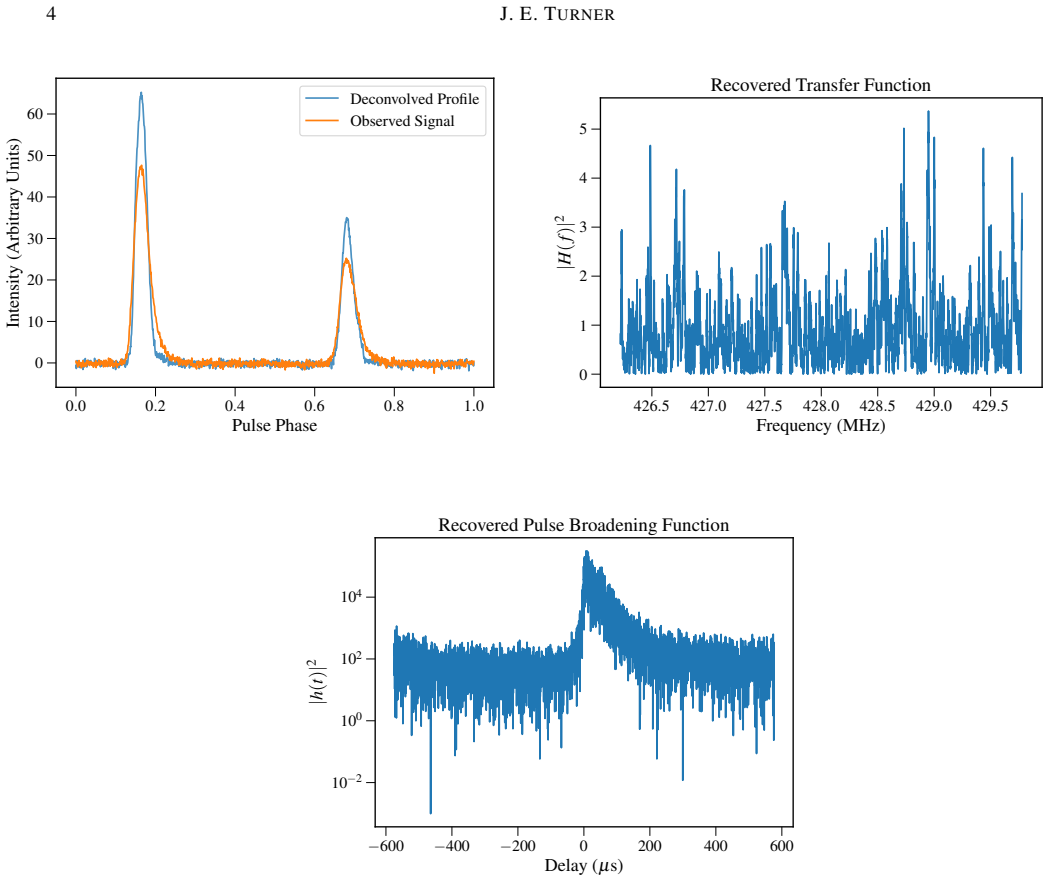
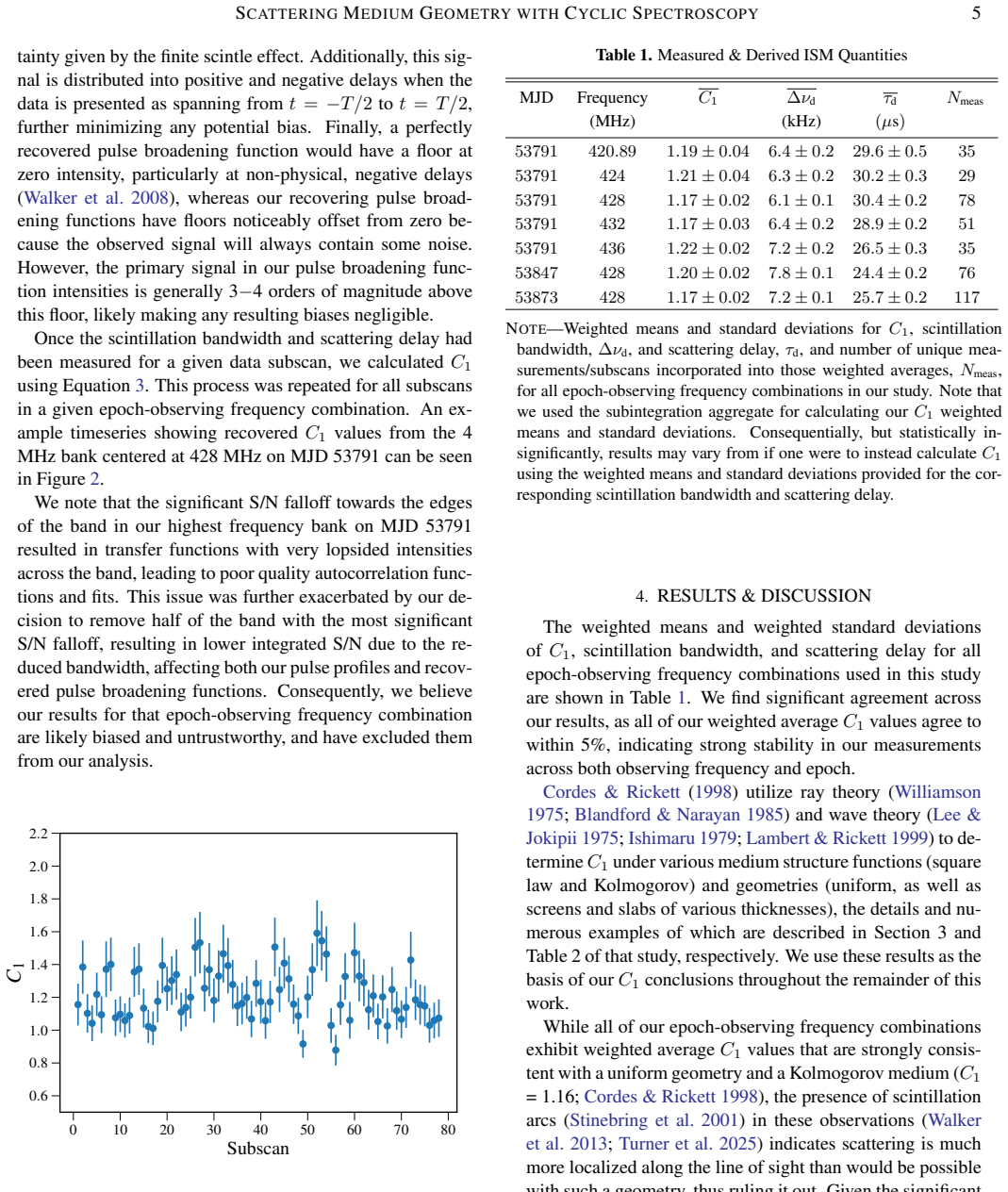
We use cyclic spectroscopy to directly measure the scintillation parameter C1 for the millisecond pulsar B1937+21. This marks the first time this constant has been measured for any pulsar without assuming a pulse broadening function shape prior to deconvolution from the intrinsic pulse profile. At 428 MHz, we find an aggregate weighted mean and standard deviation of C1=1.18±0.01, which, along with the presence of scintillation arcs, indicates a thick screen geometry spanning just over 10% of the Earth-pulsar distance. The resulting precision allows us to rule out various thin screen geometries, as well as thick screen geometries comprising more than 30% of the Earth-pulsar distance, with gre
What carries the argument
Cyclic spectroscopy that isolates C1 independently of assumed pulse-broadening shapes, then maps the measured C1 value onto the fractional thickness of a scattering screen in standard thin- and thick-screen scintillation models.
If this is right
- Thin-screen geometries are ruled out at greater than 5 sigma.
- Thick-screen geometries thicker than 30 percent of the line of sight are ruled out at greater than 5 sigma.
- Diffraction scales are determined to be roughly 11,000 km between 418 and 438 MHz.
- An inner turbulence scale on the order of 1,000 km is implied by the diffraction scales.
- The method can be applied to other lines of sight to map structures responsible for most pulsar scattering.
Where Pith is reading between the lines
- Repeating the measurement at multiple frequencies on the same pulsar would test whether the inferred screen thickness remains constant or changes with wavelength.
- Extending the technique to a larger sample of pulsars would produce a statistical map of scattering-screen locations across the galactic disk.
- If the inner-scale estimate holds, it constrains the smallest eddy sizes that contribute to diffractive scintillation in the interstellar medium.
Load-bearing premise
The conversion of the measured C1 value into a screen thickness of just over 10 percent assumes that standard thin- and thick-screen scintillation models apply without unmodeled effects and that cyclic spectroscopy has removed all residual dependence on the intrinsic pulse profile.
What would settle it
A future measurement of C1 near 0.5 or near 2.0, or the absence of scintillation arcs in the dynamic spectrum, would contradict the claimed thick-screen geometry at the reported significance.
Figures
read the original abstract
We use cyclic spectroscopy to directly measure the scintillation parameter $C_1$ for the millisecond pulsar B1937+21. This marks the first time this constant has been measured for any pulsar without assuming a pulse broadening function shape prior to deconvolution from the intrinsic pulse profile, removing significant potential biases in scattering delay estimation and letting us consider a wider range of line of sight geometries. At 428 MHz, we find an aggregate weighted mean and standard deviation of $C_1=1.18\pm0.01$, which, along with the presence of scintillation arcs, indicates a thick screen geometry spanning just over 10% of the Earth-pulsar distance. The resulting precision in our weighted average allows us to rule out various thin screen geometries, as well as thick screen geometries comprising more than 30% of the Earth-pulsar distance, with greater than $5\sigma$ certainty at this observing frequency. We also use our measured $C_1$ values to determine diffraction scales, which we find to be roughly 11$\times10^3$ km between 418$-$438 MHz, suggesting an inner scale on the order of $10^3$ km. Future implementations of our method to other lines of sight through the galaxy may substantially improve efforts to understand structures that contribute to the majority of pulsar emission scattering in the interstellar medium. As flagship instruments like the Green Bank Telescope begin offering the use of cyclic spectroscopy backends, and other instruments begin exploration and commissioning of similar systems, demonstrations like these will be crucial for the widespread adoption of cyclic spectroscopy.
Editorial analysis
A structured set of objections, weighed in public.
Referee Report
Summary. The manuscript reports the first measurement of the scintillation parameter C1 for millisecond pulsar B1937+21 using cyclic spectroscopy at 428 MHz, without assuming a pulse-broadening function shape prior to deconvolution. The authors obtain an aggregate weighted mean C1 = 1.18 ± 0.01, which they interpret (together with the presence of scintillation arcs) as indicating a thick scattering screen spanning just over 10% of the Earth-pulsar distance; this precision is claimed to exclude thin-screen geometries and thick-screen geometries exceeding 30% of the line of sight at >5σ. They additionally derive diffraction scales of ~11×10^3 km (418–438 MHz) implying an inner scale ~10^3 km and discuss future applications to other lines of sight.
Significance. If the central mapping from C1 to screen thickness fraction holds and the measurement is demonstrably free of residual profile bias, the result supplies a high-precision geometric constraint on the interstellar scattering medium for this line of sight. The avoidance of assumed broadening shapes via cyclic spectroscopy is a methodological advance that could be applied more broadly once backends become available on facilities such as the Green Bank Telescope.
major comments (3)
- [abstract and data-reduction description] The abstract states that cyclic spectroscopy removes dependence on the intrinsic pulse profile shape, yet the manuscript provides no explicit test or residual-profile simulation demonstrating that the recovered C1 remains insensitive to plausible residual structure or frequency-dependent scattering at 428 MHz. This validation is load-bearing for the quoted uncertainty of ±0.01 and the >5σ geometry exclusions.
- [geometry-interpretation paragraph] The inference that C1 = 1.18 corresponds to a screen thickness of just over 10% (and rules out >30%) rests on the standard thin/thick-screen scintillation model relating C1 to fractional screen distance; the manuscript does not reproduce or cite the specific equation used for this conversion, nor does it quantify possible systematic offsets from anisotropy, multiple screens, or inner-scale effects at 428 MHz.
- [results and statistical analysis] The error budget underlying the weighted mean and standard deviation of C1 is not detailed (e.g., how individual epoch or frequency measurements are combined, what contributes to the quoted ±0.01, or how scintillation-arc information is folded into the statistical claim). This information is required to assess whether the >5σ exclusions are robust.
minor comments (2)
- [abstract] The abstract refers to “the presence of scintillation arcs” as supporting evidence; the main text should clarify whether these arcs provide an independent calibration of screen thickness or serve only as qualitative corroboration.
- [results] Consider adding a table listing the individual C1 measurements (with uncertainties) across the 418–438 MHz band so that the weighted-mean calculation can be reproduced.
Simulated Author's Rebuttal
We thank the referee for their constructive and detailed comments. These have identified areas where additional clarity and validation will strengthen the manuscript. We address each major comment below, indicating the revisions we will make.
read point-by-point responses
-
Referee: [abstract and data-reduction description] The abstract states that cyclic spectroscopy removes dependence on the intrinsic pulse profile shape, yet the manuscript provides no explicit test or residual-profile simulation demonstrating that the recovered C1 remains insensitive to plausible residual structure or frequency-dependent scattering at 428 MHz. This validation is load-bearing for the quoted uncertainty of ±0.01 and the >5σ geometry exclusions.
Authors: The cyclic spectroscopy approach is constructed to operate directly on the cyclic spectrum, thereby decoupling the scattering kernel from the intrinsic pulse profile without requiring an assumed broadening function; this property follows from the mathematical formulation in the method's foundational references. Nevertheless, to provide explicit confirmation that the recovered C1 is robust against plausible residual profile structure or mild frequency-dependent effects at 428 MHz, we will add a dedicated validation subsection containing Monte Carlo simulations of injected residuals. This addition will directly support the quoted uncertainty and the significance of the geometry constraints. revision: yes
-
Referee: [geometry-interpretation paragraph] The inference that C1 = 1.18 corresponds to a screen thickness of just over 10% (and rules out >30%) rests on the standard thin/thick-screen scintillation model relating C1 to fractional screen distance; the manuscript does not reproduce or cite the specific equation used for this conversion, nor does it quantify possible systematic offsets from anisotropy, multiple screens, or inner-scale effects at 428 MHz.
Authors: The mapping from C1 to fractional screen distance follows the standard thin- and thick-screen scintillation relations (e.g., the expressions relating C1 to the screen location parameter s in the literature on interstellar scintillation). We will insert the explicit equation, together with the appropriate citations, into the geometry-interpretation section. We will also add a short paragraph discussing possible systematic contributions from anisotropy, multiple screens, and inner-scale effects at 428 MHz, noting that existing constraints on these quantities for this line of sight suggest they are sub-dominant relative to the reported 5σ exclusions, while acknowledging the limits of the current data in fully quantifying each term. revision: yes
-
Referee: [results and statistical analysis] The error budget underlying the weighted mean and standard deviation of C1 is not detailed (e.g., how individual epoch or frequency measurements are combined, what contributes to the quoted ±0.01, or how scintillation-arc information is folded into the statistical claim). This information is required to assess whether the >5σ exclusions are robust.
Authors: The aggregate weighted mean and its uncertainty are obtained by inverse-variance weighting of the per-epoch, per-frequency C1 values, with the quoted ±0.01 corresponding to the standard error on that weighted mean; scintillation-arc morphology is used only as qualitative corroboration and is not folded into the numerical error budget. To make this fully transparent, we will expand the results section with an explicit error-budget table or subsection that lists the individual measurements, their uncertainties, the weighting scheme, and the separate treatment of the arc information. This will allow readers to evaluate the robustness of the >5σ statements directly. revision: yes
Circularity Check
No significant circularity; C1 measured independently via cyclic spectroscopy and geometry inferred from standard external models
full rationale
The paper's central derivation measures C1 directly from cyclic spectroscopy data without assuming a pulse broadening function shape prior to deconvolution, as described in the abstract. This measured value (C1=1.18±0.01) is then combined with the presence of scintillation arcs to indicate a thick screen geometry of just over 10% of the Earth-pulsar distance, using relations from standard thin/thick screen scintillation models. No step reduces by construction to a self-definition, fitted input renamed as prediction, or load-bearing self-citation chain; the mapping is presented as following from established literature relations rather than being internally defined in terms of the same fitted parameter. The result is self-contained against external benchmarks for the measurement technique and does not exhibit any of the enumerated circularity patterns.
Axiom & Free-Parameter Ledger
axioms (2)
- domain assumption Cyclic spectroscopy can extract the scintillation parameter C1 without prior assumption on the shape of the pulse broadening function.
- domain assumption The presence of scintillation arcs together with the measured C1 value maps uniquely onto a thick screen occupying ~10% of the line of sight.
Reference graph
Works this paper leans on
-
[1]
, " * write output.state after.block = add.period write newline
ENTRY address archivePrefix author booktitle chapter doi edition editor eprint howpublished institution journal key month number organization pages publisher school series title misctitle type volume year version url label extra.label sort.label short.list INTEGERS output.state before.all mid.sentence after.sentence after.block FUNCTION init.state.consts ...
-
[2]
write newline
" write newline "" before.all 'output.state := FUNCTION format.url url empty "" new.block "" url * "" * if FUNCTION format.eprint eprint empty "" archivePrefix empty "" archivePrefix "arXiv" = new.block " " eprint * " " * new.block " " eprint * " " * if if if FUNCTION format.doi doi empty "" " " doi * " " * if FUNCTION format.pid doi empty eprint empty ur...
-
[3]
, " * write output.state after.block = add.period write newline
ENTRY address archivePrefix author booktitle chapter doi edition editor eprint howpublished institution journal key month number organization pages publisher school series title misctitle type volume year version url label extra.label sort.label short.list INTEGERS output.state before.all mid.sentence after.sentence after.block FUNCTION init.state.consts ...
-
[4]
write newline
" write newline "" before.all 'output.state := FUNCTION format.url url empty "" new.block "" url * "" * if FUNCTION format.eprint eprint empty "" archivePrefix empty "" archivePrefix "arXiv" = new.block " " eprint * " " * new.block " " eprint * " " * if if if FUNCTION format.doi doi empty "" " " doi * " " * if FUNCTION format.pid doi empty eprint empty ur...
-
[5]
: bet _ m ʾ:ڋ Yފ\,Pk 0U q (CN ,V>Q 8 &tNo=΅l(鍁w=Ċd :`aJ M ) ^
thebibliography [1] 20pt to REFERENCES 6pt =0pt 10pt plus 3pt =0pt =0pt =1pt plus 1pt =0pt =0pt -12pt =13pt plus 1pt =20pt =13pt plus 1pt \@M =10000 =-1.0em =0pt =0pt 0pt =0pt =1.0em @enumiv\@empty 10000 10000 `\.\@m \@noitemerr \@latex@warning Empty `thebibliography' environment \@ifnextchar \@reference \@latexerr Missing key on reference command Each re...
-
[6]
write newline
" write newline "" before.all 'output.state := FUNCTION new.block output.state before.all = 'skip after.block 'output.state := if FUNCTION field.or.null duplicate empty pop "" 'skip if FUNCTION format.annotation annotation empty "" " quotation " annotation * " quotation " * if FUNCTION fin.entry note output write newline format.annotation write INTEGERS n...
-
[7]
, " * write output.state after.block = add.period write newline
ENTRY address archivePrefix author booktitle chapter doi edition editor eprint howpublished institution journal key month note number organization pages publisher school series title type volume year label extra.label sort.label short.list INTEGERS output.state before.all mid.sentence after.sentence after.block FUNCTION init.state.consts #0 'before.all :=...
-
[8]
write newline
" write newline "" before.all 'output.state := FUNCTION format.doi doi empty "" "doi:" doi * if FUNCTION format.eprint eprint empty "" archivePrefix empty "" archivePrefix ":" * if eprint field.or.null * if FUNCTION format.pid eprint empty format.doi format.eprint if FUNCTION n.dashify 't := "" t empty not t #1 #1 substring "-" = t #1 #2 substring "--" = ...
-
[9]
write newline
" write newline "" before.all 'output.state := FUNCTION format.archive archivePrefix empty "" archivePrefix ":" * if FUNCTION format.primaryClass primaryClass empty "" " [" primaryClass * "]" * if FUNCTION format.eprint eprint empty pages empty not booktitle empty not or or "" archive empty " http://arxiv.org/abs/" eprint * " " * " " * format.archive * ep...
-
[10]
Agazie, G., Alam, M. F., Anumarlapudi, A., et al. 2023, ApJL, 951, L9, 10.3847/2041-8213/acda9a
-
[11]
Bhat , N. D. R., Cordes , J. M., & Chatterjee , S. 2003, , 584, 782, 10.1086/345775
-
[12]
1985, , 213, 591, 10.1093/mnras/213.3.591
Blandford , R., & Narayan , R. 1985, , 213, 591, 10.1093/mnras/213.3.591
-
[13]
Cordes, J. M. 1986, ApJ, 311, 183, 10.1086/164764
-
[14]
Cordes , J. M., & Lazio , T. J. 1991, , 376, 123, 10.1086/170261
-
[15]
Cordes, J. M., & Rickett, B. J. 1998, ApJ, 507, 846, 10.1086/306358
-
[16]
Demorest, P. B. 2011, MNRAS, 416, 2821, 10.1111/j.1365-2966.2011.19230.x
-
[17]
EPTA Collaboration et al.A&A, 678:A50, Oct
Ding, H., Deller, A. T., Stappers, B. W., et al. 2023, MNRAS, 519, 4982, 10.1093/mnras/stac3725
-
[18]
Dolch, T., Stinebring, D. R., Jones, G., et al. 2021, ApJ, 913, 98, 10.3847/1538-4357/abf48b
-
[19]
Geiger, A., Cordes, J. M., Lam, M. T., et al. 2025, ApJ, 986, 191, 10.3847/1538-4357/add0b6
-
[20]
Hunter, J. D. 2007, CSE, 9, 90, 10.1109/MCSE.2007.55
-
[21]
1979, Radio Science, 14, 269, 10.1029/RS014i002p00269
Ishimaru , A. 1979, Radio Science, 14, 269, 10.1029/RS014i002p00269
-
[22]
C., & Rickett, B
Lambert, H. C., & Rickett, B. J. 1999, ApJ, 517, 299. http://stacks.iop.org/0004-637X/517/i=1/a=299
1999
-
[23]
Lee , L. C., & Jokipii , J. R. 1975, , 196, 695, 10.1086/153458
-
[24]
A., Jones, G., et al
Levin, L., McLaughlin, M. A., Jones, G., et al. 2016, ApJ, 818, 166. http://stacks.iop.org/0004-637X/818/i=2/a=166
2016
-
[25]
Liu , Y., Verbiest , J. P. W., Main , R. A., et al. 2022, , 664, A116, 10.1051/0004-6361/202142552
-
[26]
v., Pen, U.-L., Mahajan, N., & Vanderlinde, K
Main, R., Kerkwijk, M. v., Pen, U.-L., Mahajan, N., & Vanderlinde, K. 2017, ApJL, 840, L15, 10.3847/2041-8213/aa6f03
-
[27]
Mall, G., Main, R. A., Antoniadis, J., et al. 2022, MNRAS, 511, 1104, 10.1093/mnras/stac096
-
[28]
Marthi, V. R., & Maan, Y. 2025, ApJL, 989, L34, 10.3847/2041-8213/ade9b7
-
[29]
McKee, J. W., Zhu, H., Stinebring, D. R., & Cordes, J. M. 2022, ApJ, 927, 99, 10.3847/1538-4357/ac460b
-
[30]
Ocker, S. K., Cordes, J. M., Chatterjee, S., et al. 2023, MNRAS, 527, 7568, 10.1093/mnras/stad3683
-
[31]
Reardon , D. J., Main , R., Ocker , S. K., et al. 2025, Nature Astronomy, 9, 1053, 10.1038/s41550-025-02534-6
-
[32]
Stinebring , D. R., McLaughlin , M. A., Cordes , J. M., et al. 2001, , 549, L97, 10.1086/319133
-
[33]
Stock, A. M., & van Kerkwijk, M. H. 2025, ApJ, 980, 80, 10.3847/1538-4357/ada1d8
-
[34]
Turner, J. E. 2026, ApJ, 1001, 231, 10.3847/1538-4357/ae578c
-
[35]
Turner, J. E., Dolch, T., Demorest, P. B., et al. 2025, ApJ, 989, 228, 10.3847/1538-4357/adec73
-
[36]
Turner , J. E., McLaughlin , M. A., Cordes , J. M., et al. 2021, , 917, 10, 10.3847/1538-4357/abfafe
-
[37]
Turner, J. E., Dolch, T., Cordes, J. M., et al. 2024, ApJ, 972, 16, 10.3847/1538-4357/ad5af9
-
[38]
C., & Varoquaux , G
van der Walt , S., Colbert , S. C., & Varoquaux , G. 2011, CSE, 13, 22
2011
-
[39]
2011, , 28, 1, 10.1071/AS10021
van Straten , W., & Bailes , M. 2011, , 28, 1, 10.1071/AS10021
-
[40]
Walker, M. A., Demorest, P. B., & van Straten, W. 2013, ApJ, 779, 99, 10.1088/0004-637X/779/2/99
-
[41]
2008, MNRAS, 387, 1669, doi: 10.1111/j.1365-2966.2008.13360.x
Walker, M. A., Koopmans, L. V. E., Stinebring, D. R., & Van Straten, W. 2008, MNRAS, 388, 1214, 10.1111/j.1365-2966.2008.13452.x
-
[42]
Williamson, I. P. 1975, Proceedings of the Royal Society of London. A. Mathematical and Physical Sciences, 342, 131, 10.1098/rspa.1975.0016
-
[43]
Young, O., & Lam, M. T. 2024, ApJ, 962, 131, 10.3847/1538-4357/ad1ce7
discussion (0)
Sign in with ORCID, Apple, or X to comment. Anyone can read and Pith papers without signing in.