Prox-NAG-GS: A Semi-Implicit Proximal Method for Composite Optimization
Pith reviewed 2026-06-29 20:18 UTC · model grok-4.3
The pith
Prox-NAG-GS controls sequence mismatch via an augmented Lyapunov function to obtain linear convergence for strongly convex composite problems when the proximal parameter meets or exceeds the smoothness constant.
A machine-rendered reading of the paper's core claim, the machinery that carries it, and where it could break.
Core claim
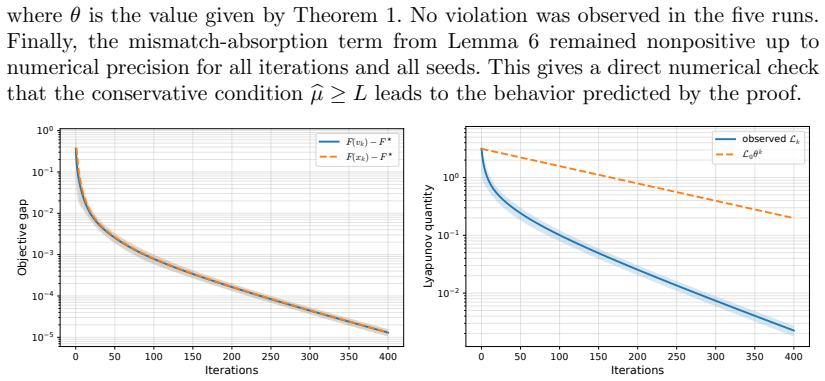
Under the sufficient condition that the proximal quadratic parameter is at least as large as the smoothness constant of f, the augmented Lyapunov function controls the mismatch between the x-sequence and v-sequence, giving a linear convergence result in the strongly convex composite case and an O(1/k) rate for the best iterate and the averaged iterate in the convex case.
What carries the argument
The augmented Lyapunov function involving both the x-sequence and v-sequence, which bounds the mismatch created when the gradient of f is evaluated at x_{k+1} while the proximal update produces v_{k+1}.
If this is right
- Linear convergence holds for strongly convex composite problems under the stated parameter condition.
- O(1/k) rates are obtained for both the best iterate and the averaged iterate when the objective is convex.
- The scheme applies directly to objectives where the nonsmooth term is proximable, including Elastic Net and Group Lasso.
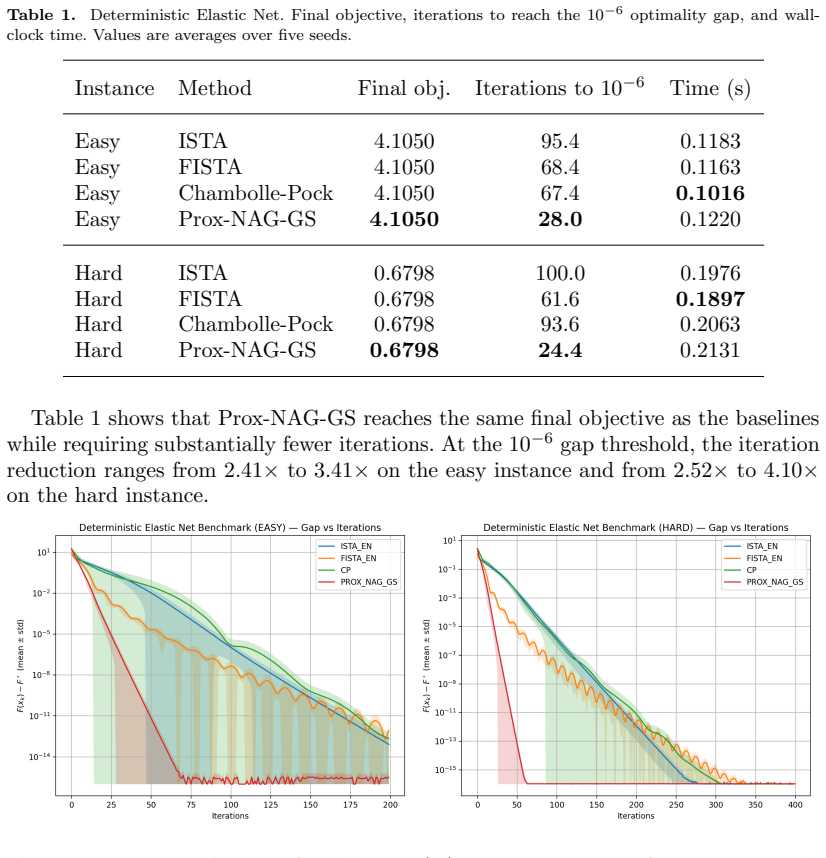
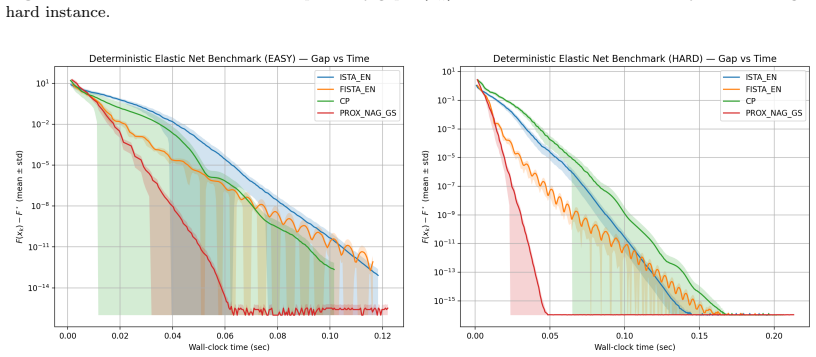
- In deterministic tests the method reaches target solutions with substantially fewer iterations than standard baselines.
Where Pith is reading between the lines
- The same Lyapunov construction could be tested on other semi-implicit inertial discretizations that produce coupled sequences.
- Selecting the proximal parameter exactly equal to the smoothness constant may reduce unnecessary conservatism while preserving the guarantees.
- The deterministic analysis supplies a template that variance-reduced stochastic variants could build upon.
Load-bearing premise
The proximal quadratic parameter must be at least as large as the smoothness constant of f.
What would settle it
A concrete counterexample in which the proximal quadratic parameter is set below the smoothness constant of f and the claimed linear or O(1/k) rates fail to hold.
Figures





read the original abstract
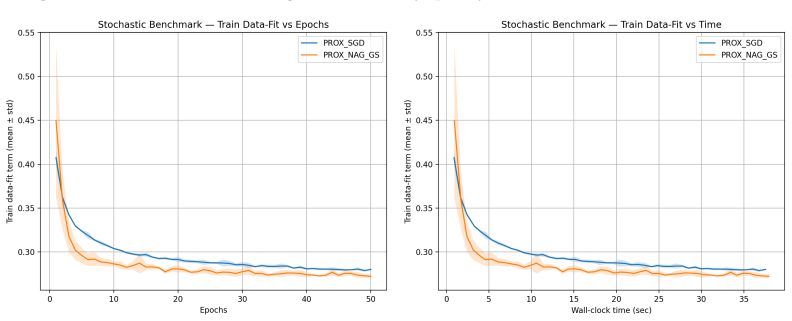
Composite optimization problems, where a smooth loss is combined with a nonsmooth regularizer, are common in machine learning and inverse problems. In this work, we study a proximal extension of NAG-GS, a semi-implicit accelerated method obtained from a Gauss-Seidel discretization of an inertial dynamics. The proposed method, called Prox-NAG-GS, keeps the coupled structure of NAG-GS for the smooth part and replaces the second update by a proximal step. It therefore applies to objectives of the form $F=f+r$, where $f$ is smooth and $r$ is convex and proximable. We derive deterministic convergence guarantees for this method. The analysis has to account for a specific feature of the scheme. Prox-NAG-GS keeps two coupled sequences: an $x$-sequence, on which the gradient of the smooth term is evaluated, and a $v$-sequence, produced by the proximal update. The gradient is evaluated at $x_{k+1}$, whereas the proximal step returns $v_{k+1}$, which creates a mismatch absent from the standard proximal-gradient analysis. Under the sufficient condition that the proximal quadratic parameter is at least as large as the smoothness constant of $f$, we control this mismatch through an augmented Lyapunov function involving both sequences. This gives a linear convergence result in the strongly convex composite case. In the convex case, the same Lyapunov structure yields an $O(1/k)$ rate for the best iterate and for the averaged iterate. We test the method on deterministic Elastic Net and Group Lasso problems, and on stochastic sparse softmax-regression benchmarks. In the deterministic tests, Prox-NAG-GS reaches the same solutions as the baselines with substantially fewer iterations; for Group Lasso this also gives the best wall-clock time. In the stochastic tests, Prox-NAG-GS compares favorably with Prox-SGD in terms of data-fit reduction and gives similar test accuracies.
Editorial analysis
A structured set of objections, weighed in public.
Referee Report
Summary. The paper proposes Prox-NAG-GS, a proximal extension of the semi-implicit NAG-GS method for composite problems min f(x) + r(x) with f smooth and r convex proximable. The scheme maintains coupled x- and v-sequences, with the gradient of f evaluated at x_{k+1} and the proximal step producing v_{k+1}. Under the explicit sufficient condition that the proximal quadratic parameter is at least the smoothness constant L of f, an augmented Lyapunov function controls the resulting mismatch and yields linear convergence in the strongly convex case together with O(1/k) rates on both the best iterate and the averaged iterate in the convex case. Deterministic convergence guarantees are stated; numerical tests on Elastic Net, Group Lasso, and stochastic sparse softmax regression are reported.
Significance. If the stated rates hold, the work supplies a new accelerated proximal scheme whose analysis directly addresses the x/v-sequence mismatch via an augmented Lyapunov construction. The explicit sufficient condition on the proximal parameter is a clarity strength. The deterministic rates and the reported iteration reductions on deterministic ML problems constitute the main technical and practical contributions.
minor comments (3)
- [§3] §3 (analysis): the construction of the augmented Lyapunov function is described only at a high level in the abstract; the main text should explicitly display the two-sequence Lyapunov and the algebraic steps that absorb the mismatch term under the stated parameter condition.
- [Numerical section] Table 1 and Figure 2: the iteration counts and wall-clock times for Group Lasso would benefit from an additional column reporting the proximal parameter value used relative to the estimated L, to make the sufficient-condition compliance transparent.
- [Theorem on convex case] The O(1/k) claim for the averaged iterate in the convex case should be accompanied by the precise averaging weights (uniform or weighted) and the corresponding theorem number.
Simulated Author's Rebuttal
We thank the referee for the positive summary of our work on Prox-NAG-GS and for recommending minor revision. No specific major comments were provided in the report, so we have no point-by-point responses to offer. We remain available to address any additional feedback from the editor.
Circularity Check
No significant circularity identified
full rationale
The paper derives convergence rates for Prox-NAG-GS via an augmented Lyapunov function that explicitly incorporates the x/v-sequence mismatch under the stated sufficient condition (proximal quadratic parameter >= smoothness constant of f). This is a standard first-principles analysis technique in optimization; the rates are not obtained by fitting parameters to data subsets, renaming known results, or reducing via self-citation chains to unverified premises. The condition is presented as necessary for the proof rather than smuggled in, and the derivation remains self-contained against external benchmarks without load-bearing self-references or definitional equivalence.
Axiom & Free-Parameter Ledger
axioms (2)
- domain assumption f is L-smooth and r is convex and proximable
- domain assumption The proximal quadratic parameter is at least the smoothness constant of f
Reference graph
Works this paper leans on
-
[1]
Akiba, S
T. Akiba, S. Sano, T. Yanase, T. Ohta, and M. Koyama,Optuna: A Next-generation Hyperparameter Optimization Framework, inProceedings of the 25th ACM SIGKDD In- ternational Conference on Knowledge Discovery & Data Mining. 2019, pp. 2623–2631
2019
-
[2]
Alvarez and H
F. Alvarez and H. Attouch,An inertial proximal method for maximal monotone operators via discretization of a nonlinear oscillator with damping, Set-Valued Analysis 9 (2001), pp. 3–11. 28
2001
-
[3]
Attouch, Z
H. Attouch, Z. Chbani, and H. Riahi,Fast proximal methods via time scaling of damped inertial dynamics, SIAM Journal on Optimization 29 (2019), pp. 2227–2256
2019
-
[4]
Bauschke and P.L
H.H. Bauschke and P.L. Combettes,Convex Analysis and Monotone Operator Theory in Hilbert Spaces, 2nd ed., Springer, 2017
2017
-
[5]
Beck and M
A. Beck and M. Teboulle,A fast iterative shrinkage-thresholding algorithm for linear inverse problems, SIAM Journal on Imaging Sciences 2 (2009), pp. 183–202
2009
-
[6]
Bottou, F.E
L. Bottou, F.E. Curtis, and J. Nocedal,Optimization methods for large-scale machine learning, SIAM Review 60 (2018), pp. 223–311
2018
-
[7]
Chambolle and T
A. Chambolle and T. Pock,A first-order primal-dual algorithm for convex problems with applications to imaging, Journal of Mathematical Imaging and Vision 40 (2011), pp. 120– 145
2011
-
[8]
Combettes and J.C
P.L. Combettes and J.C. Pesquet,Proximal splitting methods in signal processing, in Fixed-Point Algorithms for Inverse Problems in Science and Engineering, Springer, 2011, pp. 185–212
2011
-
[9]
Combettes and V.R
P.L. Combettes and V.R. Wajs,Signal recovery by proximal forward-backward splitting, Multiscale Modeling & Simulation 4 (2005), pp. 1168–1200
2005
-
[10]
L. Condat,A primal-dual splitting method for convex optimization involving lipschitzian, proximable and linear composite terms, Journal of Optimization Theory and Applications 158 (2013), pp. 460–479
2013
-
[11]
Daubechies, M
I. Daubechies, M. Defrise, and C. De Mol,An iterative thresholding algorithm for lin- ear inverse problems with a sparsity constraint, Communications on Pure and Applied Mathematics 57 (2004), pp. 1413–1457
2004
-
[12]
Defazio, F
A. Defazio, F. Bach, and S. Lacoste-Julien,SAGA: A fast incremental gradient method with support for non-strongly convex composite objectives, inAdvances in Neural Infor- mation Processing Systems, Vol. 27. 2014, pp. 1646–1654
2014
-
[13]
Duchi and Y
J. Duchi and Y. Singer,Efficient online and batch learning using forward backward split- ting, Journal of Machine Learning Research 10 (2009), pp. 2899–2934
2009
-
[14]
Ghadimi and G
S. Ghadimi and G. Lan,Stochastic first- and zeroth-order methods for nonconvex stochas- tic programming, SIAM Journal on Optimization 23 (2013), pp. 2341–2368
2013
-
[15]
Ghadimi, G
S. Ghadimi, G. Lan, and H. Zhang,Mini-batch stochastic approximation methods for nonconvex stochastic composite optimization, Mathematical Programming 155 (2016), pp. 267–305
2016
-
[16]
Johnson and T
R. Johnson and T. Zhang,Accelerating stochastic gradient descent using predictive vari- ance reduction, inAdvances in Neural Information Processing Systems, Vol. 26. 2013, pp. 315–323
2013
-
[17]
Lan,An optimal method for stochastic composite optimization, Mathematical Pro- gramming 133 (2012), pp
G. Lan,An optimal method for stochastic composite optimization, Mathematical Pro- gramming 133 (2012), pp. 365–397
2012
- [18]
-
[19]
Moudafi and M
A. Moudafi and M. Oliny,Convergence of a splitting inertial proximal method for mono- tone operators, Journal of Computational and Applied Mathematics 155 (2003), pp. 447– 454
2003
-
[20]
Nesterov,A method for solving the convex programming problem with convergence rate O(1/k2), inSoviet Mathematics Doklady, Vol
Y. Nesterov,A method for solving the convex programming problem with convergence rate O(1/k2), inSoviet Mathematics Doklady, Vol. 27. 1983, pp. 372–376
1983
-
[21]
Nesterov,Gradient methods for minimizing composite functions, Mathematical Pro- gramming 140 (2013), pp
Y. Nesterov,Gradient methods for minimizing composite functions, Mathematical Pro- gramming 140 (2013), pp. 125–161
2013
-
[22]
Nesterov,Lectures on Convex Optimization, Springer, 2018
Y. Nesterov,Lectures on Convex Optimization, Springer, 2018
2018
-
[23]
P. Ochs, Y. Chen, T. Brox, and T. Pock,iPiano: Inertial proximal algorithm for nonconvex optimization, SIAM Journal on Imaging Sciences 7 (2014), pp. 1388–1419
2014
-
[24]
Parikh and S
N. Parikh and S. Boyd,Proximal algorithms, Foundations and Trends in Optimization 1 (2014), pp. 127–239
2014
-
[25]
Polyak,Some methods of speeding up the convergence of iteration methods, USSR Computational Mathematics and Mathematical Physics 4 (1964), pp
B.T. Polyak,Some methods of speeding up the convergence of iteration methods, USSR Computational Mathematics and Mathematical Physics 4 (1964), pp. 1–17. 29
1964
-
[26]
Schmidt, N
M. Schmidt, N. Le Roux, and F. Bach,Minimizing finite sums with the stochastic average gradient, Mathematical Programming 162 (2017), pp. 83–112
2017
-
[27]
W. Su, S. Boyd, and E.J. Cand` es,A differential equation for modeling Nesterov’s accel- erated gradient method: Theory and insights, Journal of Machine Learning Research 17 (2016), pp. 1–43
2016
-
[28]
Tseng,On accelerated proximal gradient methods for convex-concave optimization, Manuscript (2008)
P. Tseng,On accelerated proximal gradient methods for convex-concave optimization, Manuscript (2008). May 2008
2008
-
[29]
Vu,A splitting algorithm for dual monotone inclusions involving cocoercive operators, Advances in Computational Mathematics 38 (2013), pp
B.C. Vu,A splitting algorithm for dual monotone inclusions involving cocoercive operators, Advances in Computational Mathematics 38 (2013), pp. 667–681
2013
-
[30]
Wilson, B
A.C. Wilson, B. Recht, and M.I. Jordan,A lyapunov analysis of accelerated methods in optimization, Journal of Machine Learning Research 22 (2021), pp. 1–34
2021
-
[31]
Xiao,Dual averaging methods for regularized stochastic learning and online optimiza- tion, Journal of Machine Learning Research 11 (2010), pp
L. Xiao,Dual averaging methods for regularized stochastic learning and online optimiza- tion, Journal of Machine Learning Research 11 (2010), pp. 2543–2596
2010
-
[32]
Xiao and T
L. Xiao and T. Zhang,A proximal stochastic gradient method with progressive variance reduction, SIAM Journal on Optimization 24 (2014), pp. 2057–2075. 30
2014
discussion (0)
Sign in with ORCID, Apple, or X to comment. Anyone can read and Pith papers without signing in.