Collaborative Navigation and Exploration with β-Sparse Gaussian Processes
Pith reviewed 2026-06-29 21:06 UTC · model grok-4.3
The pith
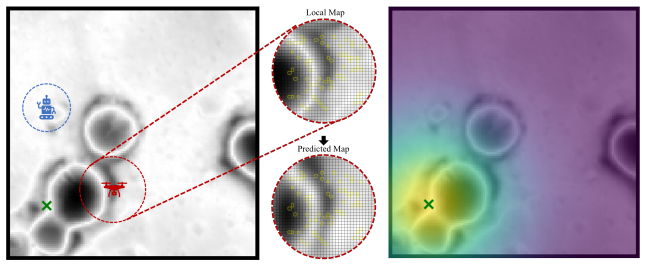
β-Sparse Gaussian Processes let a sensor robot jointly pick which map points to transmit and where to move next while predicting unknown areas under bandwidth limits.
A machine-rendered reading of the paper's core claim, the machinery that carries it, and where it could break.
Core claim
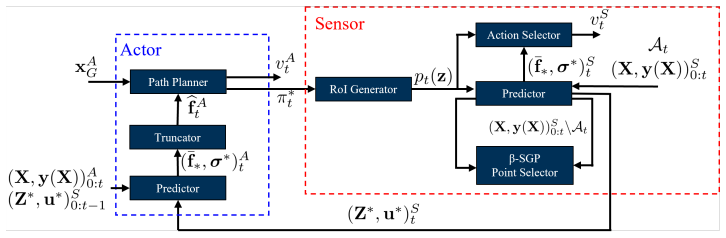
The paper claims that β-Sparse Gaussian Processes supply a variational sparse approximation that selects inducing points in a task-aware manner subject to cardinality constraints; this selection is performed jointly with navigation actions so that the sensor transmits only the most useful map points, chooses its own trajectory to support the lead robot, and produces predictions for unexplored regions, yielding lower path costs and far smaller communication volumes than baselines that transmit everything or nothing.
What carries the argument
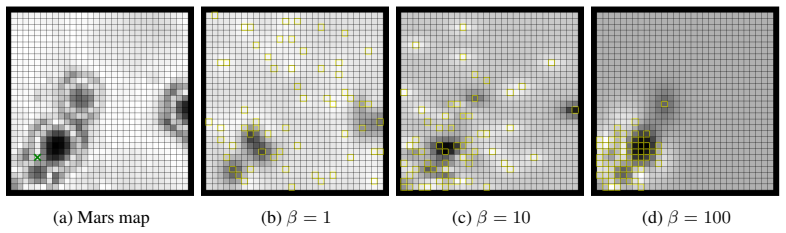
β-Sparse Gaussian Processes, a variational sparse GP model that performs task-aware inducing-point selection under explicit cardinality constraints and supports online joint optimization with navigation actions.
If this is right
- The sensor transmits only a small, task-chosen subset of map points yet still supplies enough information for the lead robot to reach its target more efficiently.
- Navigation actions are chosen to balance immediate task progress with the value of new observations that improve future predictions.
- Unexplored regions receive probabilistic predictions without any extra data transmission beyond the selected inducing points.
- The same sparse model supports repeated online re-optimization as the robots move and new observations arrive.
Where Pith is reading between the lines
- The same selection mechanism could be applied to other bandwidth-limited multi-robot tasks such as cooperative mapping or search.
- Extending the cardinality constraint to time-varying budgets would let the framework adapt when link quality changes during a mission.
- Replacing the current maps with real sensor noise models would test whether the reported savings survive when observations are imperfect.
Load-bearing premise
The variational approximation stays accurate enough for useful inducing-point selection when the same model is optimized together with the robot's movement decisions under a hard limit on how many points can be sent.
What would settle it
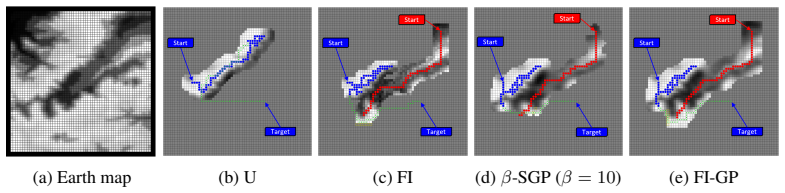
A controlled run on the same Mars or Earth maps in which the joint selection produces path lengths no shorter than the no-communication baseline or transmitted volumes no smaller than raw-data transmission would falsify the claimed practical gains.
Figures
read the original abstract
Collaborative navigation of heterogeneous robots in unknown environments poses significant challenges due to sensing, communication, and computational limitations. In this work, a lead robot navigates toward a target while a mobile sensor robot (e.g., a drone) assists by transmitting information about its locally observed map under bandwidth constraints. We propose a framework that enables the sensor to jointly select its transmitted map points and navigation actions online, while also predicting unexplored regions of the environment. To this end, we present $\beta$-Sparse Gaussian Processes, a robust variational sparse Gaussian Process model for task-aware inducing point selection under cardinality constraints. Furthermore, we develop an action-selection strategy that balances task relevance with exploration. Simulations on Mars and Earth maps show that the framework can reduce path cost by 18% relative to no communication and decrease transmitted information by 76% compared to raw-data transmission baselines.
Editorial analysis
A structured set of objections, weighed in public.
Referee Report
Summary. The paper introduces β-Sparse Gaussian Processes, a variational sparse GP model for task-aware inducing point selection under cardinality constraints. In a collaborative navigation setting, a lead robot navigates to a target while a sensor robot (e.g., drone) jointly selects which locally observed map points to transmit under bandwidth limits and chooses its own navigation actions, while also predicting unexplored regions. Simulations on Mars and Earth maps report an 18% reduction in path cost relative to no-communication baselines and a 76% decrease in transmitted information relative to raw-data transmission.
Significance. If the variational approximation and joint optimization are shown to be sound, the framework would provide a concrete method for bandwidth-efficient multi-robot mapping and exploration that couples sparse GP inference directly with decision making. The simulation gains are quantitatively stated and the problem setting (heterogeneous robots, communication constraints, online operation) is practically relevant; however, the absence of derivation details, error bounds, or ablation on the variational component limits the immediate impact.
major comments (3)
- [Abstract] Abstract: the performance numbers (18% path-cost reduction, 76% transmitted-information reduction) are reported without any reference to simulation parameters, map resolution, number of trials, variance, or data-split protocol, preventing assessment of whether the gains are robust or sensitive to hyper-parameter choices in the β-Sparse GP.
- [Abstract / Methods] The central modeling claim rests on the β-Sparse Gaussian Process providing a 'robust variational sparse approximation' that supports cardinality-constrained, task-aware inducing-point selection; however, no derivation of the variational objective, no bound on the approximation error, and no validation against standard sparse GP baselines (e.g., SVGP, FITC) are supplied, leaving the load-bearing technical contribution unverified.
- [Abstract] The joint online optimization of transmitted points and navigation actions is asserted to balance task relevance with exploration, yet the manuscript supplies neither the explicit objective function nor the algorithm used to solve the cardinality-constrained problem, making it impossible to confirm that the reported gains follow from the proposed method rather than from simulation-specific tuning.
minor comments (2)
- [Abstract] Notation for the β parameter and its role in the sparse approximation should be defined explicitly at first use.
- [Abstract] The abstract refers to 'Mars and Earth maps' without citing the source datasets or their characteristics (resolution, size, obstacle density).
Simulated Author's Rebuttal
We thank the referee for the constructive feedback on the abstract and the need for greater technical transparency. We address each major comment below and commit to revisions that strengthen the presentation without altering the core contributions.
read point-by-point responses
-
Referee: [Abstract] Abstract: the performance numbers (18% path-cost reduction, 76% transmitted-information reduction) are reported without any reference to simulation parameters, map resolution, number of trials, variance, or data-split protocol, preventing assessment of whether the gains are robust or sensitive to hyper-parameter choices in the β-Sparse GP.
Authors: We agree that the abstract would benefit from additional context on the reported metrics. The experimental section already details the simulation setup (50 independent trials on 100×100 grids at 1 m resolution for both Mars and Earth maps, with standard deviations and data-split protocol described in Section 5). In the revision we will update the abstract to briefly reference these parameters and the number of trials, while retaining the quantitative claims. revision: partial
-
Referee: [Abstract / Methods] The central modeling claim rests on the β-Sparse Gaussian Process providing a 'robust variational sparse approximation' that supports cardinality-constrained, task-aware inducing-point selection; however, no derivation of the variational objective, no bound on the approximation error, and no validation against standard sparse GP baselines (e.g., SVGP, FITC) are supplied, leaving the load-bearing technical contribution unverified.
Authors: The manuscript currently presents the β-Sparse GP formulation at a high level. To address the concern we will add an explicit derivation of the variational objective (including the cardinality-constrained ELBO), a statement of the approximation error bound, and direct comparisons against SVGP and FITC (both in terms of predictive performance and inducing-point selection) to the methods and experiments sections. revision: yes
-
Referee: [Abstract] The joint online optimization of transmitted points and navigation actions is asserted to balance task relevance with exploration, yet the manuscript supplies neither the explicit objective function nor the algorithm used to solve the cardinality-constrained problem, making it impossible to confirm that the reported gains follow from the proposed method rather than from simulation-specific tuning.
Authors: We will revise the manuscript to state the joint objective function explicitly (task-relevance term plus exploration bonus subject to cardinality constraint) and include the high-level algorithm (greedy inducing-point selection coupled with receding-horizon planning) in the main text, with a forward reference from the abstract. This will make the source of the reported gains transparent. revision: yes
Circularity Check
No significant circularity detected
full rationale
The paper introduces β-Sparse Gaussian Processes as a new variational sparse GP model for task-aware inducing point selection and pairs it with an action-selection strategy. No load-bearing derivation step is shown to reduce by construction to its own inputs, fitted parameters renamed as predictions, or self-citation chains. Simulation results on Mars/Earth maps are presented as empirical validation rather than tautological outputs. The framework is self-contained against external benchmarks with no quoted equations or citations that collapse the central claims.
Axiom & Free-Parameter Ledger
invented entities (1)
-
β-Sparse Gaussian Process
no independent evidence
Reference graph
Works this paper leans on
-
[1]
C. E. Rasmussen and C. K. I. Williams.Gaussian Processes for Machine Learning, volume 1. MIT Press, Cambridge, MA, 2006
2006
- [2]
-
[3]
M. G. Jadidi, J. V . Miro, and G. Dissanayake. Gaussian processes autonomous mapping and exploration for range-sensing mobile robots.Autonomous Robots, 42(2):273–290, 2018
2018
-
[4]
C. K. I. Williams and M. Seeger. Using the nystr ¨om method to speed up kernel machines. In Annual Conference on Neural Information Processing Systems (NeurIPS), 2001
2001
-
[5]
M. Titsias. Variational learning of inducing variables in sparse gaussian processes. InIn- ternational Conference on Artificial Intelligence and Statistics (AISTATS), volume 5, pages 567–574, Clearwater, FL, USA, Apr 16–18 2009
2009
-
[6]
Hensman, N
J. Hensman, N. Fusi, and N. D. Lawrence. Gaussian processes for big data. InProceedings of the 29th Conference on Uncertainty in Artificial Intelligence (UAI), pages 282–290, 2013
2013
-
[7]
Y . Wei, R. Sheth, and R. Khardon. Direct loss minimization for sparse gaussian processes. InInternational Conference on Artificial Intelligence and Statistics (AISTATS), volume 130, pages 2566–2574, Apr 13–15 2021
2021
-
[8]
Wenger, K
J. Wenger, K. Wu, P. Hennig, J. R. Gardner, G. Pleiss, and J. P. Cunningham. Computation- aware gaussian processes: Model selection and linear-time inference. InAnnual Conference on Neural Information Processing Systems (NeurIPS), 2024
2024
-
[9]
Hensman, A
J. Hensman, A. G. de G. Matthews, M. Filippone, and Z. Ghahramani. Mcmc for variationally sparse gaussian processes. InAdvances in Neural Information Processing Systems (NeurIPS), pages 1648–1656, Montreal, Canada, Dec 7–12 2015
2015
-
[10]
Higgins, L
I. Higgins, L. Matthey, A. Pal, C. Burgess, X. Glorot, M. Botvinick, S. Mohamed, and A. Ler- chner.β-V AE: Learning basic visual concepts with a constrained variational framework. In International Conference on Learning Representations (ICLR), Toulon, France, Apr 24–26 2017
2017
-
[11]
Rossi, M
S. Rossi, M. Heinonen, E. Bonilla, Z. Shen, and M. Filippone. Sparse gaussian processes revis- ited: Bayesian approaches to inducing-variable approximations. InInternational Conference on Artificial Intelligence and Statistics (AISTATS), volume 130, pages 1837–1845, Apr 13–15 2021
2021
-
[12]
A. K. Uhrenholt, V . Charvet, and B. S. Jensen. Probabilistic selection of inducing points in sparse gaussian processes. InConference on Uncertainty in Artificial Intelligence (UAI), volume 161, pages 1035–1044, 27–30 Jul 2021
2021
- [13]
-
[14]
Tishby, F
N. Tishby, F. C. Pereira, and W. Bialek. The information bottleneck method. InAnnual Allerton Conference on Communication, Control, and Computing, pages 368–377, Monticello, IL, USA, 1999
1999
-
[15]
Srinivas, A
N. Srinivas, A. Krause, S. M. Kakade, and M. Seeger. Information-theoretic regret bounds for gaussian process optimization in the bandit setting.IEEE Transactions on Information Theory, 58(5):3250–3265, May 2012
2012
-
[16]
Bogunovic, J
I. Bogunovic, J. Scarlett, and V . Cevher. Time-varying gaussian process bandit optimization. In International Conference on Artificial Intelligence and Statistics (AISTATS), volume 51, pages 314–323, Cadiz, Spain, May 9–11 2016. 9
2016
-
[17]
Digital Terrain Models (DTMs), Map: DTEEC 041277 2115 040776 2115 A01, Accessed Sep
HiRISE. Digital Terrain Models (DTMs), Map: DTEEC 041277 2115 040776 2115 A01, Accessed Sep. 1, 2024. https://www.uahirise.org
2024
-
[18]
Sasaki, K
T. Sasaki, K. Otsu, R. Thakker, S. Haesaert, and A. Agha-Mohammadi. Where to map? itera- tive rover-copter path planning for mars exploration.IEEE Robotics and Automation Letters, 5(2):2123–2130, 2020
2020
-
[19]
Psomiadis, D
E. Psomiadis, D. Maity, and P. Tsiotras. Multi-agent task-driven exploration via intelligent map compression and sharing. InDistributed Autonomous Robotic Systems (DARS), pages 1–14, New York, NY , USA, Oct 28–30 2024
2024
-
[20]
Psomiadis, A
E. Psomiadis, A. R. Pedram, D. Maity, and P. Tsiotras. Communication-aware iterative map compression for online path-planning. InIEEE International Conference on Robotics and Automation (ICRA), Atlanta, GA, USA, May 19–23 2025
2025
- [21]
-
[22]
H. Suthar and D. Maity. Where to fly, what to send: Communication-aware aerial support for ground robots, 2025, arXiv:2512.06207
-
[23]
D. T. Larsson and D. Maity. Communication-aware hierarchical map compression of time- varying environments for mobile robots.IEEE Robotics and Automation Letters, 10(12): 12501–12508, Oct. 2025
2025
-
[24]
Damigos, N
G. Damigos, N. Stathoulopoulos, A. Koval, T. Lindgren, and G. Nikolakopoulos. Communication-aware control of large data transmissions via centralized cognition and 5G networks for multi-robot map merging.Journal of Intelligent & Robotic Systems, 110(22), 2024
2024
-
[25]
K.-C. Ma, L. Liu, H. K. Heidarsson, and G. S. Sukhatme. Data-driven learning and planning for environmental sampling.Journal of Field Robotics, 35(5):643–661, 2018
2018
-
[26]
Jakkala and S
K. Jakkala and S. Akella. Multi-robot informative path planning from regression with sparse gaussian processes. InIEEE International Conference on Robotics and Automation (ICRA), pages 12382–12388, Yokohama, Japan, May 13–17 2024
2024
-
[27]
C. St. Laurent and R. V . Cowlagi. Near-optimal task-driven sensor network configuration. Automatica, 152:110966, 2023
2023
-
[28]
A. Elfes. Sonar-based real-world mapping and navigation.IEEE Transactions on Robotics and Automation, 3(3):249–265, 1987
1987
-
[29]
H. P. Moravec. Sensor fusion in certainty grids for mobile robots.AI Magazine, 9(2):61–74, 1988
1988
-
[30]
R. J. Williams. Simple statistical gradient-following algorithms for connectionist reinforce- ment learning.Machine Learning, 8(3–4):229–256, 1992
1992
-
[31]
Glasserman.Monte Carlo Methods in Financial Engineering, volume 53
P. Glasserman.Monte Carlo Methods in Financial Engineering, volume 53. Springer Science & Business Media, 2013
2013
-
[32]
Asgharivaskasi and N
A. Asgharivaskasi and N. Atanasov. Semantic octree mapping and shannon mutual information computation for robot exploration.IEEE Transactions on Robotics, 39(3):1910–1928, 2023
1910
-
[33]
Maddox, S
W. Maddox, S. D. Stanton, and A. G. Wilson. Conditioning sparse variational gaussian pro- cesses for online decision-making. InAdvances in Neural Information Processing Systems (NeurIPS), 2021. 10
2021
-
[34]
E. W. Dijkstra. A note on two problems in connexion with graphs.Numerische Mathematik, 1 (1):269–271, Dec. 1959
1959
-
[35]
D. P. Kingma and J. Ba. Adam: A method for stochastic optimization. InInternational Conference on Learning Representations (ICLR), San Diego, CA, USA, May 07 - 09 2015
2015
-
[36]
Paszke, S
A. Paszke, S. Gross, F. Massa, A. Lerer, J. Bradbury, G. Chanan, T. Killeen, Z. Lin, N. Gimelshein, L. Antiga, et al. Pytorch: An imperative style, high-performance deep learning library.Advances in Neural Information Processing Systems (NeurIPS), 32, 2019. 11 Appendix The appendix is organized as follows: •Appendix Aprovides background information on Gau...
2019
discussion (0)
Sign in with ORCID, Apple, or X to comment. Anyone can read and Pith papers without signing in.